The Custom House, King’s Lynn: The Building That Announced a Port
Few buildings in King’s Lynn declare the town’s old confidence more clearly than the Custom House. It stands beside the Purfleet with a sort of composed authority, facing river traffic and quayside business as if it still expects merchants to arrive with papers in hand and ships waiting outside. It is one of the town’s best-known landmarks, but its familiar name hides an important truth. The Custom House was not built as a customs office at all.
It began life in 1683 as a merchants’ exchange, commissioned by Sir John Turner and designed by Henry Bell. Only later did it become the official Customs House. That earlier purpose matters because it explains almost everything about the building: its position, its layout, its symbolism, and its air of public self-importance. This was a building created first for trade. It was meant to give shape and dignity to the business life of a prosperous port.

Photo © James Rye 2021
Built for business
By the late seventeenth century King’s Lynn remained a substantial port, with goods moving through the Wash and inland along the Ouse system. Grain was increasingly important. Wine, coal, timber, and other goods also passed through the harbour. Trade needed somewhere visible, respectable, and central: a place where merchants could meet, settle matters, and conduct business under conditions that matched the town’s standing.
Sir John Turner provided that building. The Corporation granted the site on Purfleet Quay at a nominal rent, and the new exchange opened in 1685. The first floor was soon let to the Collector of Customs. In 1703 the building formally became the Customs House, and in 1717 it passed into Crown ownership.
That sequence is worth holding onto. The building we now call the Custom House began as a merchants’ exchange, and its design still reflects that first role. The ground floor originally stood open as an arcade [a row of arches forming a covered open space], allowing movement and sheltered gathering below, while more formal business took place upstairs. This was a working commercial building, not a piece of abstract elegance.
Henry Bell’s statement piece
The Custom House is usually regarded as Henry Bell’s masterpiece, and it is not hard to see why. Bell was a Lynn man with the right blend of experience for such a commission: educated, commercially aware, well travelled, and active in civic life. He understood both the ambitions of his town and the language of classical architecture.
Historic England describes the building as Bell’s masterpiece and the first correctly classical building in King’s Lynn. That is a large claim, but a fair one. The design shows a firm grasp of proportion, symmetry, and classical detail without becoming stiff or overblown. It has often been compared with London’s Royal Exchange and with Dutch civic architecture. Those parallels should not be pushed too far, but they help place the building in a wider world. King’s Lynn was a provincial port, not a backwater, and Bell designed accordingly.
What makes the building so effective is that it does not rely on size. It is not massive. It is simply very well judged. It looks assured because Bell knew exactly how much ornament, order, and ceremony the site could carry.
The exterior: disciplined, symbolic, and clever
The building is almost square in plan [its basic ground layout], built of ashlar [carefully cut and smoothly finished blocks of stone] from Ketton stone, with a tiled roof around a lead-covered flat centre. The north and south fronts have five bays [regular vertical divisions marked by windows or openings], while the east and west sides have four. That compact, balanced form gives the whole building a settled and deliberate look.
The ground floor is marked by Roman Doric pilasters [flat, rectangular columns attached to the wall, in a plain classical style] and a plain Doric entablature [the horizontal band resting above columns or pilasters]. Above them, the first-floor windows are framed by Ionic pilasters [attached flat columns in a more decorative classical style] with garlanded capitals [ornamental tops]. Bell was using the classical orders carefully here. The plainer Doric below gives firmness. The richer Ionic above adds lift and grace.

Photo © James Rye 2021
The windows on the first floor are mullioned and transomed [divided by vertical and horizontal bars] casements with leaded lights. These details may sound technical, but they matter because they help date the building and sharpen its surface. The Custom House is not grand through bulk. It is grand through control.
Then there are the carved keystones [the central locking stones at the top of arches] in the blocked arcade. These include masks of Bacchus and Ceres, figures associated with wine and grain. That was not decorative whimsy. It was commercial symbolism. The building was announcing the sort of town this was and the sort of goods that made it prosper.
The north front is the show front. Its centre projects slightly, drawing the eye to a richly handled entrance. Above the entablature [the horizontal architectural band above columns or pilasters] sits a cartouche [an ornamental carved panel] carrying John Turner’s coat of arms. Above that again is a statue of Charles II set in a niche [a recessed space for a statue], flanked by Corinthian pilasters [attached flat columns with elaborate leafy capitals]. The message is hard to miss. Trade, status, loyalty, and public ambition are all on display at once.
Above the roof rises the most recognisable feature of all: the lantern. This timber structure, built on a Greek-cross plan [with four arms of equal length], combines arches, pediments [formal triangular or curved tops above openings], angle pilasters, and an upper stage capped by an ogee roof [a roof or curve with a double bend]. It is the part of the building people remember, and rightly so. It gives the Custom House its skyline and much of its character.
Not frozen in time
The building did not survive unchanged. The open arcades of the ground floor were later filled in, probably in the eighteenth century. The upper timber structure was also damaged in the great gale of 1741. After that, the lantern was altered and lowered, a balustrade [a low railing of small uprights] was removed, and the lantern received its later ogee cap.
That matters because the Custom House was never just a showpiece. It was used, adapted, repaired, and kept going. Like most important old buildings, it is partly a design and partly a record of wear, weather, and practical adjustment. Its survival is impressive not because it escaped change, but because it retained so much character through it.
Inside: the working life of the port
The exterior gets most of the attention, but the interior still carries the marks of the building’s long working life. The ground floor was originally open, with major beams supported on entactic Doric columns [classical columns with a slight swelling in the shaft to correct the visual effect of straightness] set on octagonal bases. Two of the western columns survive. One ground-floor room, later called the King’s Warehouse, still has a broad panelled door with heavy hinges and lock case, a reminder that this was a building for handling goods as well as managing paperwork.
The staircase is largely eighteenth century, with a moulded string [the sloping structural side of the staircase], turned balusters [the upright supports beneath the handrail], and a substantial oak handrail. It is good work, but the most evocative room is the Long Room upstairs.
This was the heart of the building in its customs phase. Here ships’ masters reported their vessels and merchants entered goods. The name echoed the Long Room in the London Customs House, which tells you something about the tone the place aimed to strike. Panelling, cupboards, fireplaces, and traces of partitions survive, preserving something of the atmosphere of a building tied directly to maritime administration. Nearby rooms, including the Surveyor’s Room, also retain fittings linked to that life.
Sir John Turner in stone
The building makes less sense if Sir John Turner is pushed into the background. Turner was a leading Lynn merchant, strongly associated with the wine trade, and one of the most prominent men in the town. He served as MP for King’s Lynn and as mayor three times. He also lived next door at 1 King Street.
That matters because the Custom House was not simply a philanthropic gesture. Turner was building for the commercial life of the town, certainly, but he was also placing himself at its centre. A merchants’ exchange on this site, beside his own house, was both useful and symbolic. It linked his name with order, prosperity, and civic authority.
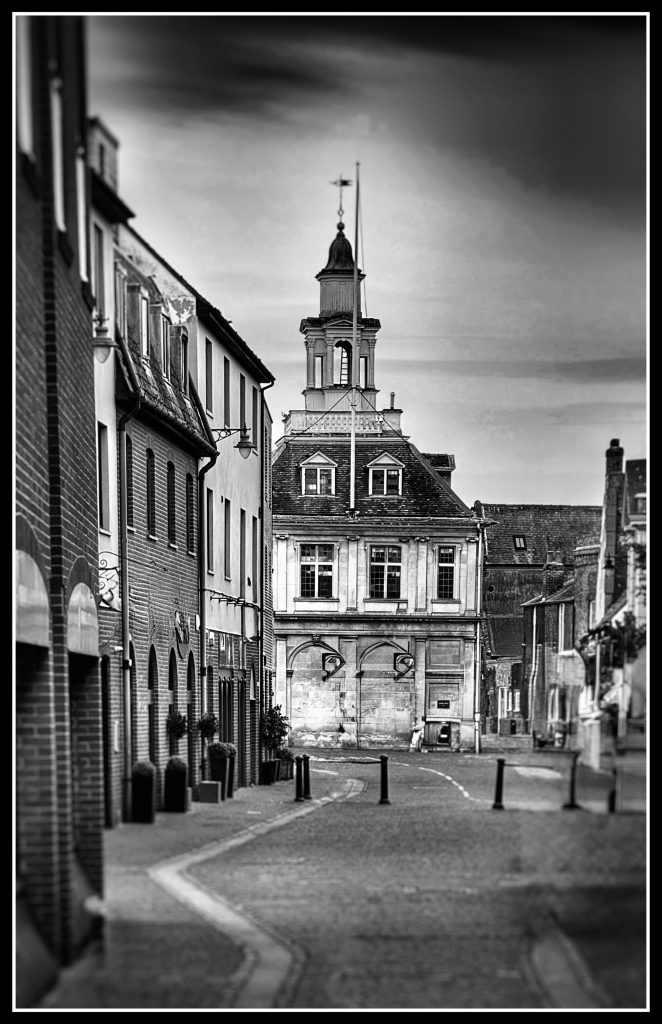
Photo © James Rye 2026
The heraldic cartouche and royal statue on the front make the point perfectly well. This was not modest architecture. It was architecture with a message. Turner wanted a building that served trade, but he also wanted one that advertised rank, loyalty, and influence. In that sense the Custom House is partly a portrait of the man who paid for it.
Why it still matters
The importance of the Custom House lies partly in its beauty, but also in its honesty. It tells the truth about King’s Lynn’s past. This was a town shaped by commerce. It wanted to look prosperous, orderly, and outward-facing. Bell gave that ambition a classical form. Turner paid for it. The riverfront setting completed the effect.
That is why the original identity of the building matters so much. It was born from mercantile life and only later absorbed into state administration. The arcades, the symbolic carving, the Long Room, the site on the Purfleet, and the presence of Turner all point in the same direction. This was a building made for a port that knew its value.
And it still works. Stand on the quay and look at it properly. The stone fronts, the controlled classical detail, the lantern above the roofline: it still announces what it was built to announce. Here, in full public view, was a place where trade, authority, and local ambition met.
© James Rye 2026
See also: The Custom House that Originally Wasn’t
Book a Guided Walk with a Trained and Qualified King’s Lynn Guide
References
- Colvin, Howard. A Biographical Dictionary of British Architects, 1600–1840. 4th ed. New Haven and London: Yale University Press, 2008.
- Historic England. “1, King Street, King’s Lynn.” National Heritage List for England, List Entry 1291147. Accessed April 13, 2026. https://historicengland.org.uk/listing/the-list/list-entry/1291147
- Historic England. “Customs House including North Bank of Purfleet Quay, King’s Lynn.” National Heritage List for England, List Entry 1195414. Accessed April 13, 2026. https://historicengland.org.uk/listing/the-list/list-entry/1195414
- National Trust Collections. “Sir John Turner (1632–1712).” Object no. 1396512. Accessed April 13, 2026. https://www.nationaltrustcollections.org.uk/object/1396512
- Norfolk Heritage Explorer. “Custom-House.” Norfolk County Council. Accessed April 13, 2026. https://www.heritage.norfolk.gov.uk/record-details?MNF5479-Custom-House%2F=
- Pevsner, Nikolaus, and Bill Wilson. The Buildings of England: Norfolk 2, North-West and South. New Haven and London: Yale University Press, 2002.
- Royal Historical Society. “I. Remembrances, 1671–1714.” Camden Fifth Series. Accessed April 13, 2026. https://www.cambridge.org/core/journals/royal-historical-society-camden-fifth-series/article/i-remembrances-16711714/38CA24A001AA6BDAC8DB8B74D918555A
- West Norfolk Borough Council. List of Mayors of King’s Lynn 1248–2023. PDF. Accessed April 13, 2026. https://www.west-norfolk.gov.uk/download/downloads/id/5646/list_of_mayors_of_kings_lynn_1248-2023.pdf