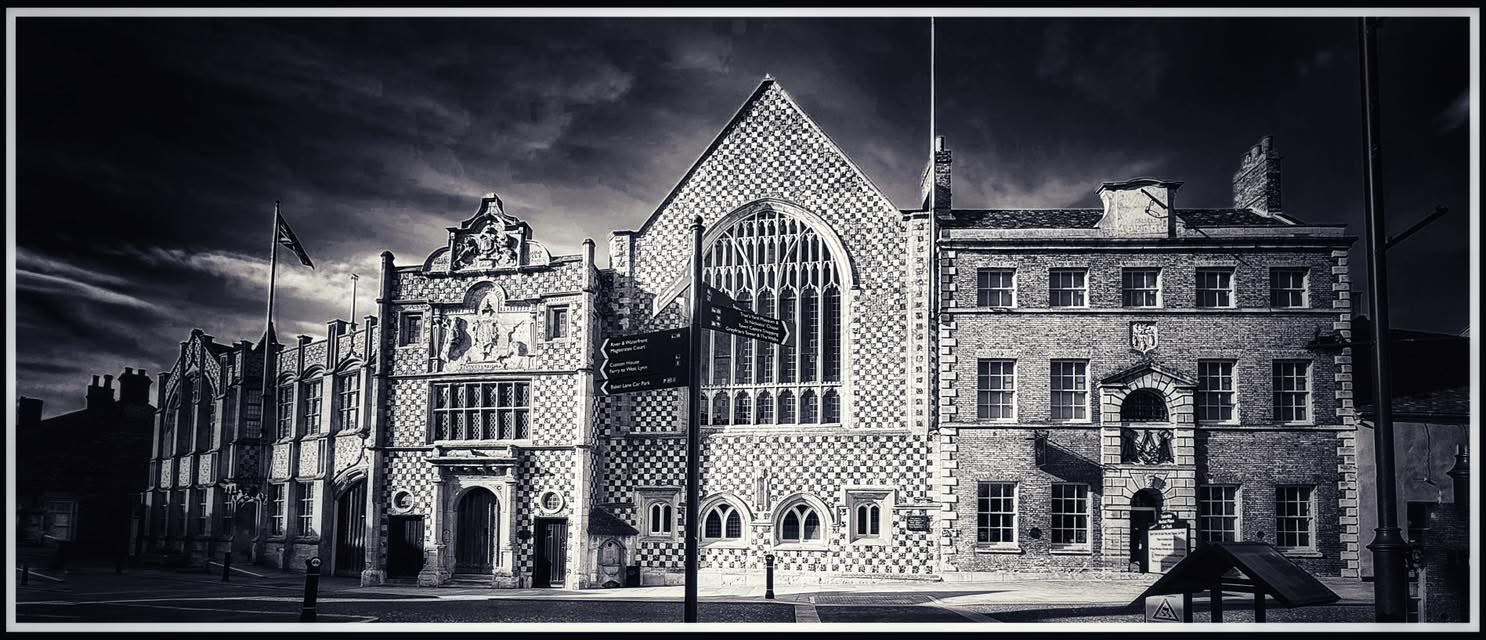
The King’s Lynn FEPOW Memorial Beside the Georgian Pulpit
Step into King’s Lynn Minster and, once your eyes settle on the long nave, the first impression is usually of age and accumulation: pale stone, clustered columns, and a sense that the building has absorbed many different moments of the town’s past. Among its memorials, one of the most affecting is not a grand tomb or stained glass, but a modest cross set along the north side of the nave beside the Georgian pulpit, easy to miss unless you slow down.
This is the Far East Prisoners of War Association memorial cross, presented by the King’s Lynn branch of the FEPOW organisation to mark the twentieth anniversary of liberation from Japanese captivity. The Imperial War Museums’ War Memorials Register describes it as a gilded bronze pulpit crucifix: a “Warrior Christ” figure on a slim metal cross, with four horizontal nails set at the base. Its inscription is blunt and inclusive, commemorating “those who died whilst in Japanese hands 1941–1945” and also those who “died subsequently as a result of their sufferings during captivity”.
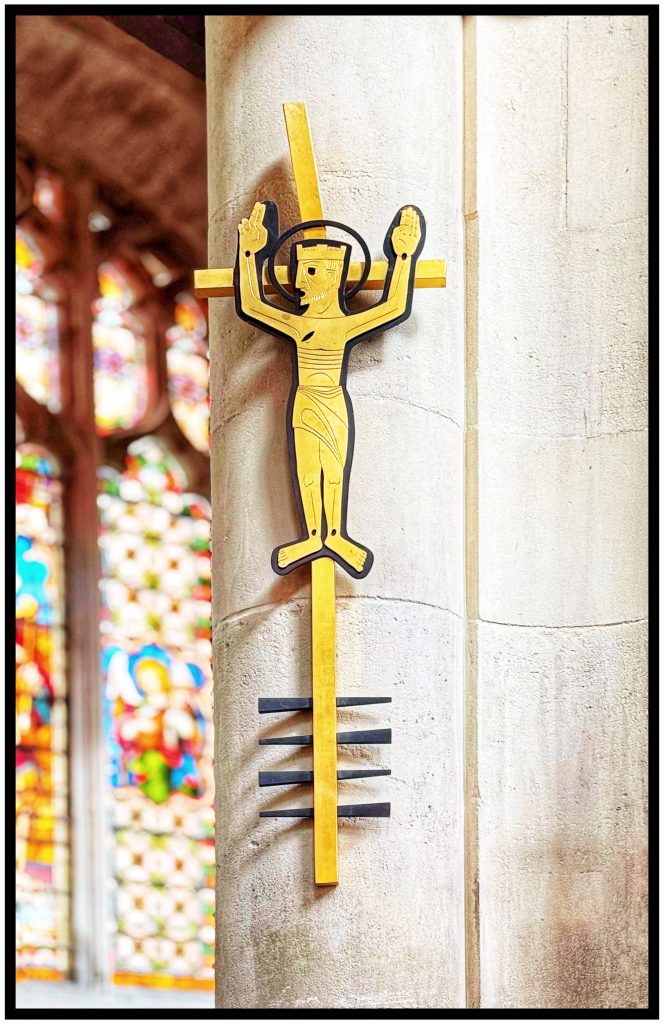
Photo © James Rye 2026
The same register entry anchors the memorial to a particular act of public remembrance. The cross was dedicated on 14 August 1965, with the Bishop of Birmingham present. Mid-August, close to the season of VJ Day, was a time when former prisoners and bereaved families often felt memory press in. In 1965, too, survivor associations were still strongly organised, and many men were living with the delayed physical and psychological consequences of captivity.
Why a FEPOW Memorial Belongs in the Minster
To see why the King’s Lynn FEPOW branch chose the Minster, it helps to think of the church as a civic interior as well as a place of worship. Listed Grade I as the Church of St Margaret, it has long been a public setting for communal identity, including memorial culture. Historic England’s description reminds us how often the building has been reworked, including the substantial internal rebuilding of 1745–46 by Matthew Brettingham after the storm damage of 1741. The Minster is, in that sense, accustomed to receiving new layers of meaning without losing the older ones.
The cross itself reflects the FEPOW association’s purpose. It does not list names; it frames the loss collectively, and it acknowledges a truth many families knew early on: for a great number of men, suffering did not stop in 1945. Chronic illness, disability, and trauma shaped the decades that followed, and the inscription’s reference to those who died later because of captivity insists that remembrance should include the long aftermath.
The “Warrior Christ” and What the Memorial is Trying to Say
The IWM entry preserves an intriguing interpretation, apparently drawn from an information sheet linked to the memorial. It describes the figure as a “Warrior Christ” and connects the design to early medieval, Celtic traditions, noting comparable crosses in maritime communities in Scandinavia and Iceland. Whether or not every element of that reading persuades, the intention is plain. This is not a sentimental image. It is meant to express endurance and moral victory without pretending the suffering was redeemed by a tidy conclusion. The phrase “Eastern simplicity of form”, used in the same material, is also revealing, suggesting a deliberate attempt, in the mid-1960s, to acknowledge how far away the Far East theatre was, while bringing its memory into a familiar English church interior.
Beside the Pulpit: Two Very Different Histories
The memorial’s position beside the Georgian pulpit is more than convenience. Historic England notes a “mid C18 pulpit” among the Minster’s significant furnishings. Other accounts place the pulpit and tester in 1745, describing it as the surviving top section of the former “three-decker”, set on a later base and steps. Either way, it belongs to an age when Protestant worship placed preaching and the spoken word at the centre of the nave. There is, too, a quiet symbolism in the pairing. Far East prisoners returned to a country that did not always want detailed stories, and many carried what had happened in private. Here, their memorial sits beside a structure designed to make speech carry. The effect is understated, but hard to ignore once noticed.
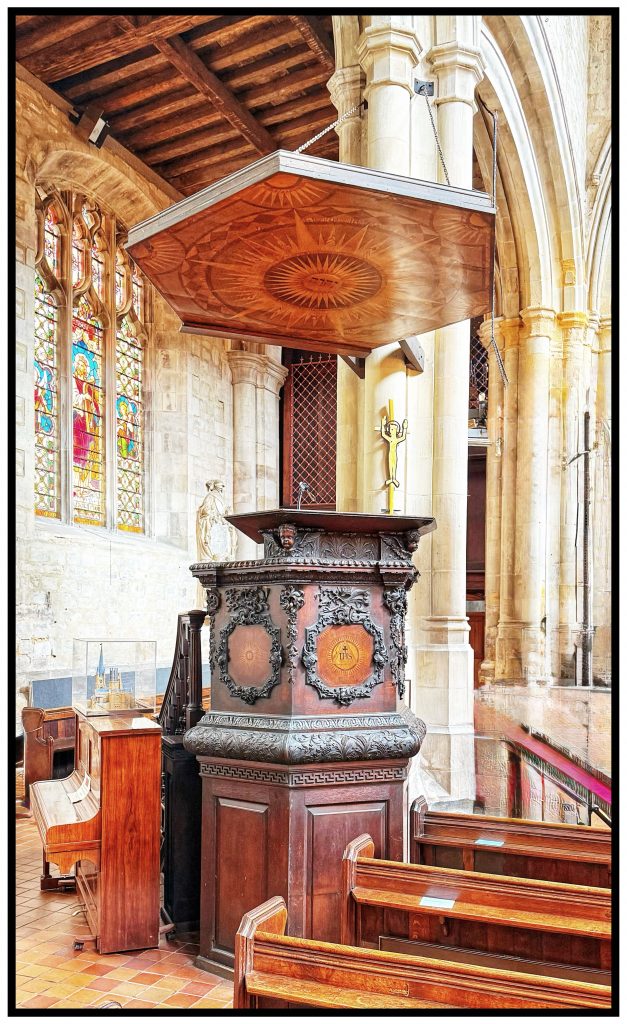
Photo © James Rye 2026
The FEPOW Experience in Brief, Without Softening It
British and Commonwealth servicemen captured by Japanese forces faced conditions defined by forced labour, malnutrition, disease, and brutality. The Imperial War Museums note the prevalence of tropical disease and severe malnutrition, and estimate that as many as a quarter of Far East prisoners of war died in captivity. The National Army Museum similarly stresses the lethal combination of brutality, climate, and inadequate food and medicine, naming illnesses such as cholera, dysentery, and malaria. One site that has become emblematic is the Burma–Thailand railway. A 2003 House of Commons debate, discussing a Far East prisoners memorial, described its construction as costing the lives of around 13,000 prisoners of war and 80,000 forced Asian labourers through sickness, starvation, and brutality. That scale of loss helps explain why FEPOW branches worked to place permanent memorials in public, familiar settings, where remembrance could not be pushed to the margins.
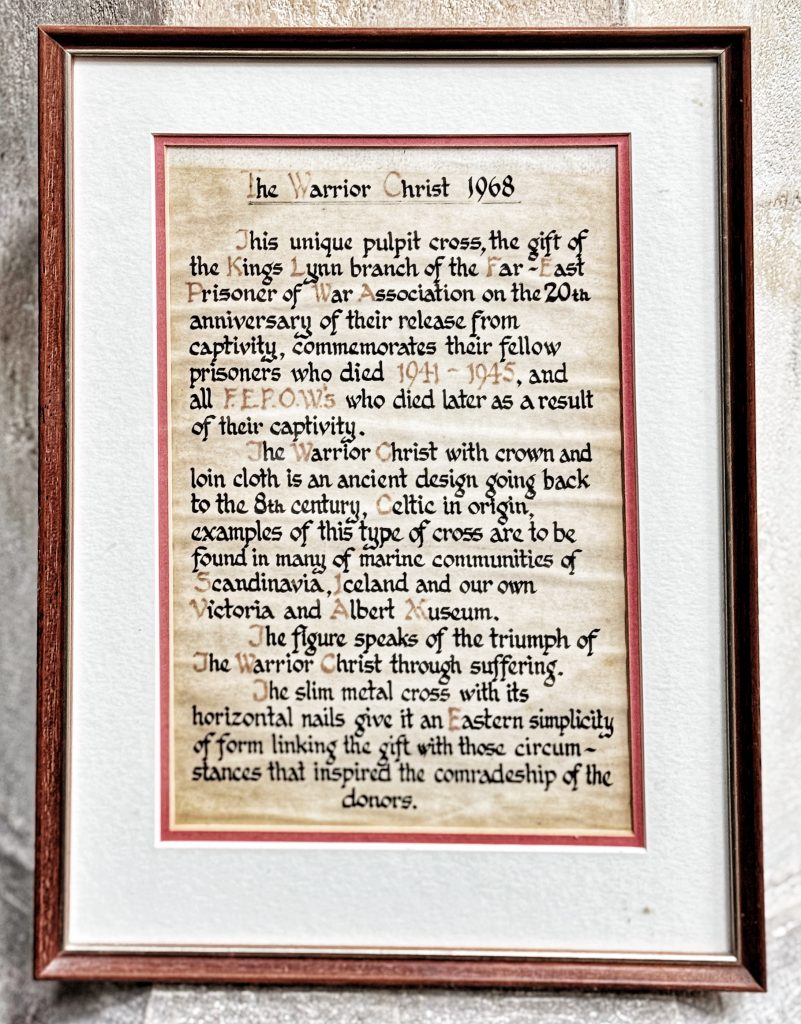
Photo © James Rye 2026
An Understated Memorial Among “Historic Treasures”
King’s Lynn Minster is full of art, craft, and commemoration, and a small cross can easily slip from view. Yet that modesty is part of its force. The FEPOW story was not always kept at the forefront of British wartime memory, and the memorial’s scale reflects something of how many men bore their captivity: present and consequential, but not loudly displayed. If you visit, stand where you can take in pulpit and cross together, and read the inscription slowly. It refuses to confine remembrance to those who died in the camps, insisting instead on the long shadow captivity cast over later lives. In a building that stores the town’s history in plain sight, the FEPOW cross is one of its most quietly eloquent witnesses.
© James Rye 2026
Book a Guided Tour with a Trained and Qualified King’s Lynn Guide
References
- Historic England, National Heritage List for England, List Entry 1211336: “Church of St Margaret, Saturday Market Place, King’s Lynn” (Grade I listing; history; interior notes including “mid C18 pulpit” and rebuilding context). https://historicengland.org.uk/listing/the-list/list-entry/1211336
- Imperial War Museums, War Memorials Register, “FEPOW Far East Prisoner of War Association,” memorial record. https://www.iwm.org.uk/memorials/item/memorial/53408
- Imperial War Museums, “What Life Was Like For POWs In East Asia During The Second World War”. https://www.iwm.org.uk/history/what-life-was-like-for-pows-in-east-asia-during-the-second-world-war
- Imperial War Museums, “How POW Inventions Advanced Medicine During the Second World War” (article noting brutality, forced labour, disease, malnutrition, and mortality rates among Far East POWs). https://www.iwm.org.uk/history/how-pow-inventions-advanced-medicine-during-the-second-world-war
- National Army Museum, “The Far East campaign” (overview including treatment of prisoners and causes of death in captivity). https://www.nam.ac.uk/explore/far-east-campaign
- UK Parliament, House of Commons Hansard, “Far East Prisoners Of War (Memorial),” 28 October 2003 (discussion of Burma–Thailand railway casualties and conditions). https://hansard.parliament.uk/commons/2003-10-28/debates/cb806ea2-5778-4f99-99ec-8dd1c6ebdc9e/FarEastPrisonersOfWar%28Memorial%29