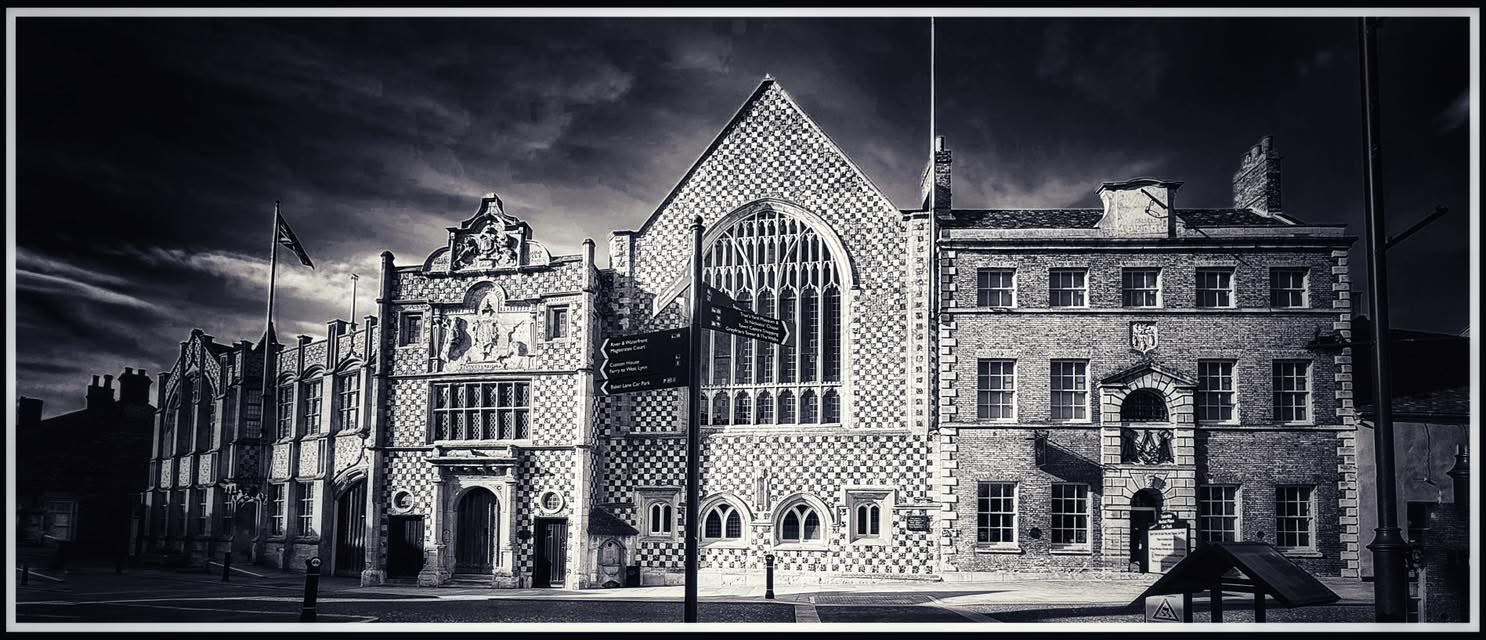
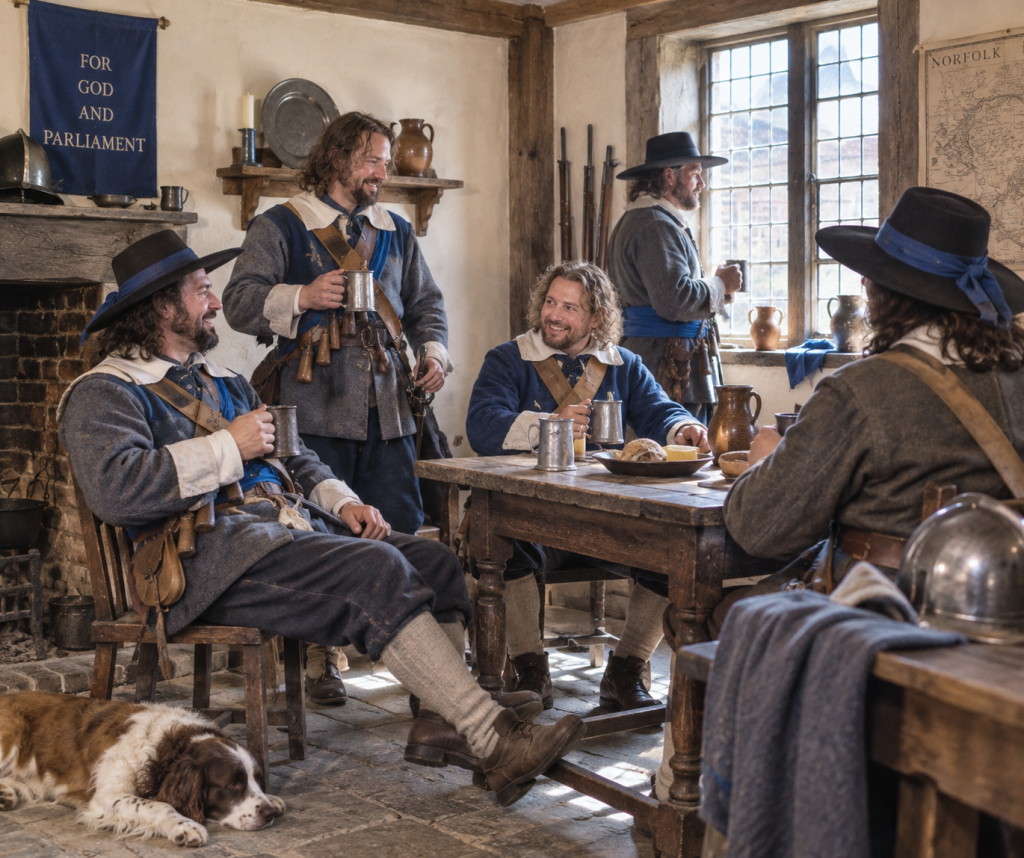
When King’s Lynn surrendered to Parliament on 16 September 1643, the immediate price of defeat was £3,200. The Corporation had to find the money to prevent Manchester’s victorious soldiers from plundering the town. Most of the army soon moved on, but Lynn’s military occupation did not end with its surrender. Parliament had discovered how dangerous it could be to lose control of one of the principal ports on the east coast, and troops remained behind under Colonel Valentine Walton.
Over the following decade their presence affected the town’s finances, politics, defences, trade, and private households. By 1647 unpaid soldiers were mutinying and quarrelling with townspeople over the cost of their accommodation. Yet the garrison survived into the Commonwealth, and it was not until around 1653 that Walton’s long association with the town came to an end and responsibility for Lynn’s security returned increasingly to its civic authorities.
Parliament takes possession
There were sound military reasons for keeping troops in Lynn. The port gave access to the Wash and North Sea, while its waterways provided routes into the Eastern Association. Arms, ammunition, men, and supplies could arrive by ship and move inland. Lynn became an important part of Parliament’s military supply system, supporting operations far beyond Norfolk. Supplies for the siege of York in 1644 passed through the town, and Lynn was still being used to support Cromwell’s Scottish campaign in 1650.
Parliament was concerned about more than an enemy approaching from outside. Lynn had declared for Charles I only months earlier, and surrender had not suddenly removed Royalist sympathies. In June 1644 the Committee of Both Kingdoms instructed Walton to keep the town obedient and to “disarm and secure all those whose fidelity you suspect”. The garrison therefore had two purposes. It defended an important port, but it also provided armed support for Parliament’s authority within a town whose political reliability had recently proved uncertain.
This did not make Lynn simply an occupied Royalist town. Many inhabitants had supported Parliament, the Corporation continued to govern, and normal commercial life carried on as far as wartime conditions allowed. Nevertheless, the divisions exposed in 1643 did not disappear. As late as 1646, inhabitants describing themselves as “well affected” were still demanding action against local Royalists. Someone who had supported the King during the siege might regard the soldiers as a daily reminder of defeat, while a committed Parliamentarian could see the same men as necessary protectors. Before long, however, both might have found a reason to complain about them.
Richard Clampe builds a fortress
The most visible consequence of Parliament’s determination to hold Lynn was the extraordinary reconstruction of its defences. The man responsible was not a professional soldier imported from London or the Continent, but a local physician and mathematician, Richard Clampe, born around 1617. Parliament had authorised improvements to Lynn’s fortifications before the siege, but the Royalist takeover interrupted the work. Once Parliament recovered the town, Clampe was commissioned to design a much more ambitious defensive system.
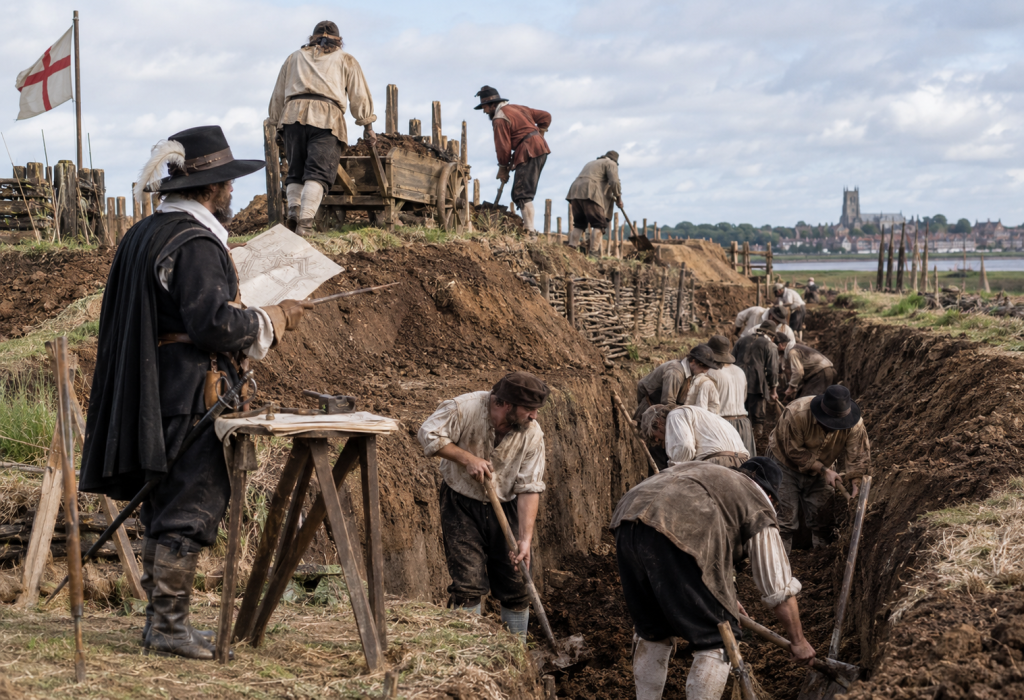
Medieval Lynn had never been completely surrounded by a stone wall. The Great Ouse protected the western side, while waterways, banks, palisades, gates, and short stretches of masonry defended the approaches from the land. Clampe transformed this inherited arrangement using the latest principles of Continental fortification. He designed a bastioned earthwork enclosure around the northern, eastern, and southern approaches, with projecting bastions allowing defenders to fire along the faces of neighbouring works. Ditches, ramparts, lower defensive banks, and protected routes created several layers through which an attacker would have to fight before reaching the town itself. Earthworks also had an advantage against seventeenth-century artillery: unlike brittle masonry, thick banks of compacted soil could absorb cannon shot remarkably well.
The scale was enormous. Clampe’s system extended for about 4.36 kilometres and in places occupied a defensive belt more than fifty metres wide. To the south were additional works protecting the Nar approaches and South Gate, including the small fort later known as World’s End. Recent archaeological excavation of the north-eastern defences discovered a moat about twenty metres across, almost three times the average width found in a study of Civil War defensive ditches elsewhere. Archaeologists also found that the position of the ramparts and lower fausse-braye corresponded remarkably closely with Clampe’s surviving drawings. His elaborate plans were not proposals that remained on paper. They were translated into earth on a formidable scale.
The result has been described as the strongest fortress in East Anglia and perhaps one of the most sophisticated Civil War defensive systems constructed anywhere in the British Isles. Clampe’s reputation subsequently spread beyond Lynn. He worked on the fortifications at Earith and later became involved with the Parliamentarian siegeworks at Newark. His work at Lynn was therefore an early stage in the career of a significant, if now little-known, Civil War military engineer.
For Lynn’s inhabitants, however, Clampe’s achievement was not an abstract exercise in military engineering. They lived inside it. Huge quantities of soil had to be excavated and moved, timber obtained, ditches dug, ramparts raised, and existing approaches altered. The familiar Groundplat of Kings Lyn, associated with Wenceslaus Hollar, is now thought to show the town around 1645, after Clampe’s reconstruction, rather than during the siege of 1643. If that interpretation is correct, it gives us a remarkable picture of the Lynn in which the garrison and townspeople actually lived: the old port enclosed within an immense new landscape of bastions, ditches, and earthworks.
Who would pay for the garrison?
Clampe could make Lynn difficult to capture, but he could not solve the problem that increasingly troubled the Corporation. Parliament could order soldiers to remain in the town much more easily than it could provide the regular income needed to support them.
The first signs appeared within months of the surrender. In February 1644 the Corporation sent Alderman Thomas Toll and Jonas Scott to petition the Earl of Manchester about several grievances, including payment for the “firing and candle for the Court of Guard”. It is a wonderfully mundane glimpse of life inside Clampe’s fortress. Somewhere in Lynn, soldiers were spending winter nights on guard. They needed a fire for warmth and candles for light, and already there was an argument about who should pay.
The expense extended far beyond the guardroom. Soldiers needed wages, food, clothing, accommodation, weapons, fuel, and ammunition. Fortifications had to be maintained, while horses, carts, boats, and labour were needed to move military supplies. Lynn’s garrison also contributed troops to campaigns elsewhere. Five hundred foot were ordered from the town for operations against Newark late in 1645. The soldiers stationed in Lynn were part of a much larger military organisation rather than simply a body of men guarding the gates.
Parliament attempted to spread these costs through regional assessments and other revenues, but the system repeatedly failed to produce enough money at the right time. In May 1645 the Committee of Both Kingdoms was sufficiently concerned about Lynn to ask Parliament to establish better arrangements for paying its garrison. Another petition followed in August, after which £2,000 had to be borrowed towards paying the troops at Lynn and Newport Pagnell. The same pattern recurred. Lynn complained, Parliament or the Eastern Association considered the problem, some money was authorised, and the soldiers continued needing supplies while everyone waited for payment.
This was happening when Lynn itself was struggling financially. In 1645 the Corporation sought relief from taxation, arguing that plague and declining trade had weakened the town. Parliament accepted the case and reduced Lynn’s monthly assessment from £157 6s 4d to £78 6s 8d. The garrison was therefore not being maintained by a prosperous port comfortably absorbing the cost of war. Parliament itself acknowledged that the town’s ability to pay had been badly damaged.
The war ends, but the soldiers do not leave
By the summer of 1646 the military justification for maintaining a substantial garrison appeared much weaker. Newark surrendered in May, Charles I was in the hands of the Scots, and the First Civil War was effectively over. Lynn had remained securely under Parliamentarian control for nearly three years, so in July the Corporation petitioned Parliament asking for the garrison to be disbanded. The request failed. In February 1647 the mayor and Corporation tried again, but the soldiers remained.
Behind this disagreement was an awkward problem. Parliament owed enormous sums in military wages. By March 1647 its armies were owed about £2.5 million in arrears. Soldiers naturally feared that if they were disbanded before receiving what was due to them, they might never see the money. Lynn wanted the soldiers removed partly because maintaining them had become such a burden, while Parliament found it difficult to remove them because it lacked the money needed to settle their accounts.
The contradiction finally produced a crisis in the summer of 1647. Sir Thomas Hoogan, then governor of the Lynn garrison, travelled to London seeking money for his troops and obtained authority to collect it from Parliament’s tax collector at Norwich. When he reached Norwich, he discovered that the money had already been spent elsewhere. News reached Lynn, and on 5 July Hoogan reported to William Lenthall, Speaker of the House of Commons, that his soldiers had “ranne into a mutiny”. Hoogan and the mayor somehow found enough money to calm them temporarily, but the underlying problem remained.
The following day Mayor Thomas Toll wrote his own appeal to Lenthall. “The miserie of our Towne is growne unto such a hight,” he complained, “and our souldiers for want of pay are growne mutinous.” The Corporation demanded a clear choice. Parliament should either provide regular money for the garrison or disband it. Lynn even offered to take responsibility for its own defence “for King and Parliament”. Parliament had stationed troops there partly because it did not trust the town after 1643. Four years later the Corporation was effectively saying that it no longer needed to be guarded against itself.
When the cost reached Lynn’s houses
The emergency payment of July did little more than postpone the confrontation. In September 1647 the Parliamentarian newsbook Perfect Occurrences reported “great dangers of mutiny and fear of bloodshed at Lynn”. Townspeople were quarrelling with soldiers because the troops had no money “to pay quarters”, and Lynn’s seamen were reported to be siding with the inhabitants.
Here the financial problems of Parliament become very human. Lynn had no extensive purpose-built barracks in which a permanent garrison could be isolated from civilian life. Soldiers therefore depended upon accommodation within the town. Inns certainly played a part, while other forms of quartering brought military needs directly into the civilian community. A soldier required somewhere to sleep as well as food, drink, heating, and other necessities. If his wages stopped, somebody else carried the expense.
Neither side needed to be unreasonable for the arrangement to produce conflict. The soldier had served Parliament and expected Parliament to pay him. The person providing his quarters had an equally legitimate complaint. Parliament had stationed the soldier in Lynn, yet the householder was being expected to maintain him without receiving the money due. The real debtor was the government, but the government was far away. The quarrel took place between soldier and civilian in a Lynn inn, house, or street.
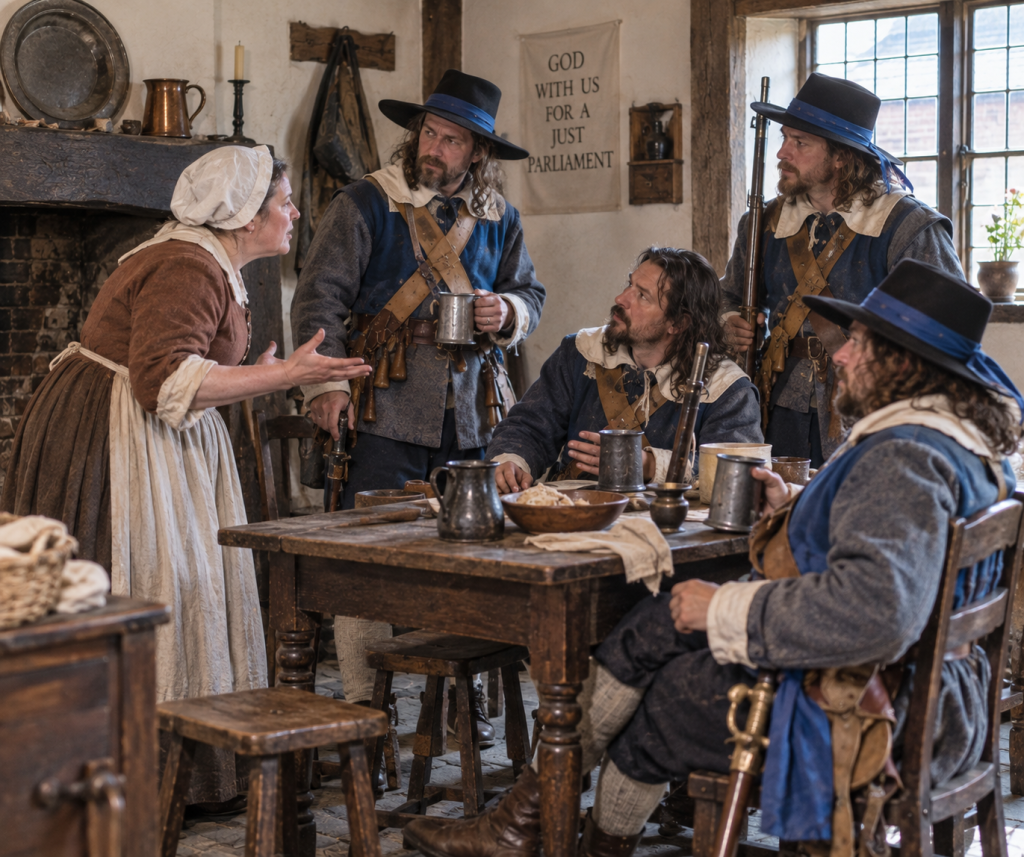
The soldiers themselves should not be made villains in this story. They were caught in the same defective system as the townspeople. They had performed guard duty, maintained Clampe’s formidable defences, and supplied men for campaigns elsewhere. Their mutiny was principally about money they had earned but not received. The difficulty was that every month in which Parliament failed to pay them increased the likelihood that the cost would fall upon somebody in Lynn.
Why the garrison survived
If relations had become so strained by 1647, why did Parliament not simply remove the soldiers? Events soon supplied the answer. England entered a Second Civil War in 1648, making Lynn’s port and fortifications valuable once again. In January 1649 Charles I was executed. Valentine Walton, Lynn’s first Parliamentarian governor and Oliver Cromwell’s brother-in-law, was one of the commissioners who tried the King and signed his death warrant. Under the Commonwealth his responsibilities increased, and Lynn remained part of the defensive system protecting the new republic.
The usefulness of the town as a military centre was demonstrated again in 1651. Charles II and his supporters mounted another challenge, and on 1 August Walton was ordered to assemble a regiment of 1,000 men, five companies drawn from regular garrisons and another five from the militias of Norfolk, Suffolk, and the Isle of Ely. The force moved away under Major Blake and became part of the campaign that ended with Cromwell’s victory at Worcester on 3 September.
The continuing military importance of Lynn was therefore real. From Parliament’s point of view, keeping control of the port after 1643 had been justified repeatedly by subsequent events. The problem was never simply whether the garrison served a purpose. It was who should bear the cost of keeping it there.
That question continued into the 1650s. In May 1650 the Corporation was still protesting about army assessments and seeking a review of the amount demanded from the town. Further representations followed in 1651 and 1652. Even individual soldiers continued pursuing old debts. Two ensigns of the Lynn garrison, Robert Raby and John Whitworth, sought compensation for their service, and in January 1653 the Council of State ordered Walton to appear before the appropriate Parliamentary committee in connection with their claim. Nearly ten years after the siege, the accounts of the garrison had still not been completely settled.
The fortress returns to the town
By the early 1650s the balance was changing. Charles II had been defeated at Worcester and driven into exile, while the Commonwealth was more secure. The government could begin reducing some of the expensive military infrastructure created during the wars.
In February 1652 the governor of Lynn was ordered to send the brass guns from Lynn and Great Yarmouth to the Tower of London and to demolish Lynn’s blockhouse. The Corporation’s reaction is revealing. After years of complaining about the burden of the military presence, it now petitioned to preserve part of the town’s defences. The Council of State postponed demolition of the blockhouse, and the matter was still being discussed in 1653.
There was no real contradiction. Lynn had never objected to being defensible. What the Corporation repeatedly resisted was an expensive permanent military establishment whose costs it could not control. Clampe’s fortifications had altered the strategic position of the town. The Corporation now wanted the benefit of those defences without necessarily retaining the Parliamentary garrison that had accompanied them. In 1653 Lynn itself petitioned for powder and shot, suggesting that responsibility for security was moving back towards the civic authorities.
Walton’s governorship appears to have ended at about the same time. There is no surviving document that allows us to picture him and the last soldiers marching ceremonially through the South Gate on a particular morning. The change seems to have been gradual. Walton was still involved with Lynn garrison affairs in January 1653, while during that year the Corporation was increasingly taking responsibility for its own defence. It is therefore safer to say that the decade of permanent Parliamentarian military control drew to a close around 1653 rather than assign it an exact final day.
Lynn had changed considerably during those ten years. In September 1643 it was a defeated town which Parliament did not trust. It had paid £3,200 to avoid plunder, accepted a garrison, and subsequently lived under a governor authorised to disarm inhabitants whose loyalty he doubted. Richard Clampe then transformed its defences, surrounding much of the town with one of the most sophisticated systems of Civil War earthworks in Britain. Parliament had turned Lynn into a fortress because the port was too valuable to risk losing again.
What Parliament never solved satisfactorily was how to pay for that security. The expense travelled downwards through the system. Government struggled to finance its armies, the Eastern Association struggled to maintain its garrisons, the Corporation petitioned for relief, and suppliers and householders waited for payment. Eventually the soldiers themselves waited for wages that did not arrive. In 1647 the chain almost snapped, producing mutiny and confrontation in the streets of Lynn.
By around 1653 the situation had reversed. Parliament no longer regarded Lynn as a town requiring the same degree of military supervision, while the Corporation was again prepared to take responsibility for its own defence. The earthworks remained. Indeed, they survived long enough to impress Daniel Defoe when he visited Lynn more than half a century later. Clampe’s fortress had outlived the circumstances that created it.
The siege of Lynn had lasted only a few weeks. Its aftermath lasted approximately a decade. For the people who lived through those years, the Civil War was not confined to cannon fire in August and September 1643. It continued in the enormous banks and ditches surrounding their town, beside the guardroom fire, in arguments over taxation, in Corporation petitions, and in the houses where unpaid soldiers waited for wages while their equally frustrated hosts waited to be paid.
Footnote: What was a blockhouse?
In seventeenth-century military terminology, a blockhouse was a small, strongly constructed fort or fortified building, normally positioned to control a strategically important approach. It could contain soldiers and artillery and was intended to operate as a defensible position in its own right. Lynn’s blockhouse stood at the northern end of the town, near the Fisher Fleet and St Ann’s Fort, protecting the approach to the town from the north and the river side. The King’s Lynn Urban Archaeological Database places a small blockhouse north of St Ann’s Fort and says that it is first securely recorded in 1650. That puts it roughly in the later Pilot Street/North End area, close to where the old Fisher Fleet reached the Ouse.
© James Rye 2026
Book a Guided Tour with a Trained and Qualified King’s Lynn Guide Through Historic Lynn
References
Flintham, David. “Richard Clampe, Fortress Engineer, c.1617–1696.” Fort 46 (2018): 3–14.
Flintham, David. “King’s Lynn under Siege: How a Small Field in North Lynn Illuminated Civil War Fortress Engineering.” Current Archaeology, 2023. Read the article at The Past
King’s Lynn Under Siege. Archaeological Investigation Report: July 2022–July 2024. 2025. The excavations provide particularly useful confirmation that Clampe’s drawings correspond closely to the fortifications actually constructed. King’s Lynn Under Siege project
Smith, Peter. Petitionary Negotiation in a Community in Conflict: King’s Lynn and West Norfolk. PhD diss., University of East Anglia, 2012. Particularly useful for the Hall Book evidence, petitions, the 1647 correspondence, garrison finance, and later disputes over military assessments. University of East Anglia copy
The National Archives. Calendar of State Papers Domestic, 1640s–1650s. Council of State and military material concerning Lynn, Walton, army assessments, ordnance, and the garrison.
West Norfolk Borough Council. King’s Lynn Urban Archaeological Database Project Report. 2022, especially section 4.7. The report is valuable for the physical evidence of the Civil War defences, although its siege narrative contains an apparent 1643/1645 dating error. King’s Lynn Urban Archaeological Database report