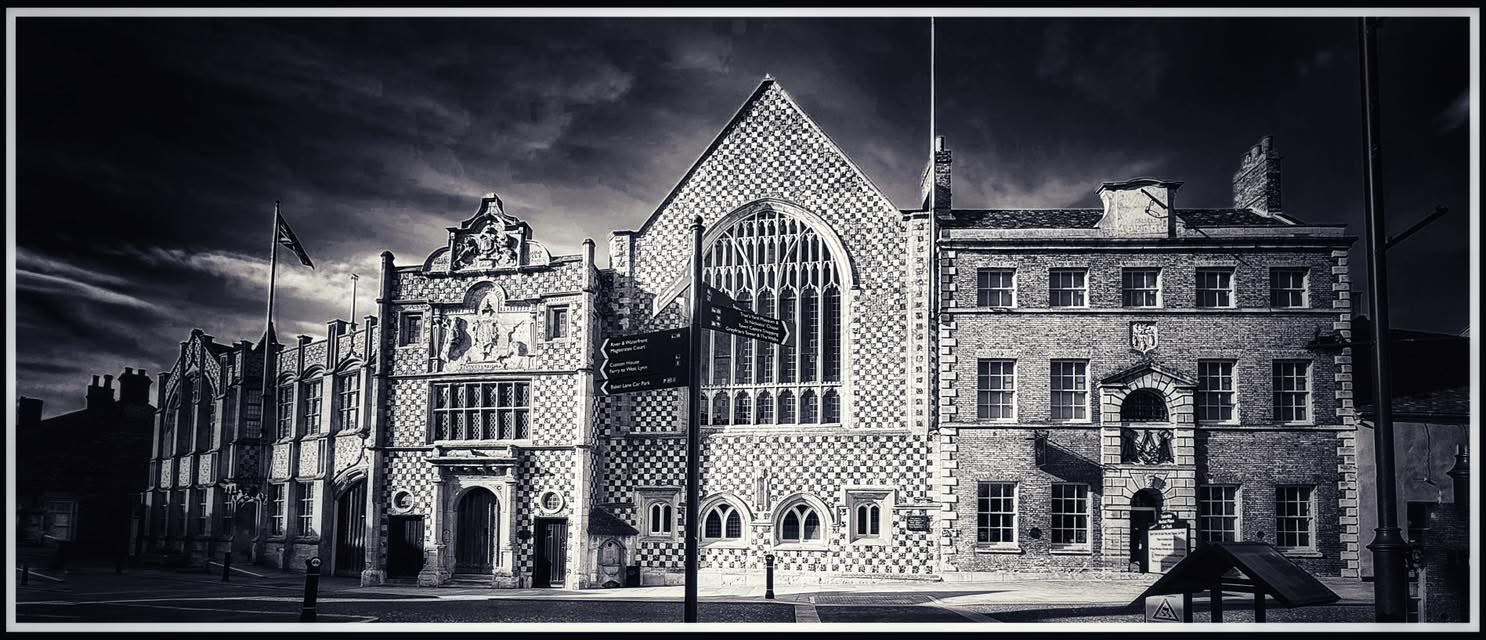
Novels set in King’s Lynn have imagined the town as a Georgian port, medieval Bishop’s Lynn, a centre of queer working-class life, and the headquarters of an extraordinary number of fictional detectives. Ships leave its quays, bodies lie beneath chapels, and skeletons appear behind café walls. The siege of 1643, the flood of 1953, the Mart, and the surviving Hanseatic buildings have all found their way into fiction.

Only a small number of novels take place entirely in King’s Lynn. The wider fictional landscape is much larger. It includes historical novels in which Lynn provides one important setting, crime series based at King’s Lynn police station, and books written by novelists who lived in the town but wrote about somewhere else. Online lists often blur these distinctions, counting any book that happens to mention Lynn.
When Lynn first entered the novel
The earliest novel I have found with an extended episode in King’s Lynn is Lady Emma Carolina Wood’s Seadrift, published in 1871. Most of the story begins elsewhere, but part of its later action takes place in Lynn in and after 1827. Martha and Mrs Clemens sail to the town from north Cornwall, a journey lasting three days. Two years later, Genevieve arrives as a nursery governess and is summoned from Lynn to her father’s deathbed, where she learns more about her family and inheritance. The town is not the centre of the entire novel, but it is much more than a passing reference.
Walter Besant went considerably further in The Lady of Lynn, published in 1901. This was the first novel to construct almost its entire imaginative world from the town. The story opens in 1747 and is narrated by nineteen-year-old Jack Pentecrosse, a mariner serving aboard a ship called The Lady of Lynn. The vessel belongs to Molly Miller, a wealthy merchant heiress who owns eight ships. Her fortune attracts Lord Fylingdale, Lady Anastasia, and a collection of gamblers and confidence tricksters who intend to obtain her money through a fraudulent marriage.
Besant’s Lynn is built around trade. Ships sail for Lisbon, merchants conduct business on the quays, and sailors move between the Common Stath, King’s Stath, warehouses, inns, and St Margaret’s Church. Into this prosperous port comes Sam Semple, who claims to have discovered a medicinal spring. He promotes Lynn as a fashionable spa, complete with a pump room, music, assemblies, gambling, and aristocratic visitors from London.
The spa is largely Besant’s invention, so the novel should not be mistaken for a documentary description of Lynn in 1750. He used real streets, buildings, and maritime practices to create a conflict between two forms of wealth. Molly’s fortune comes from ships, property, and commerce. The newcomers hope to take it through deception, gambling, and social display. The resulting story is part historical romance and part financial conspiracy.
Margery Kempe recreated
Although very much a real person, Margery Kempe has become the town’s most persistent fictional character. Born in Bishop’s Lynn in about 1373, she was the daughter of John Brunham, a prominent merchant and borough official. She married John Kempe, gave birth to fourteen children, attempted several businesses, experienced religious visions, and travelled on pilgrimage. Her loud public weeping and claims of direct contact with Christ attracted suspicion as well as admiration.
The Book of Margery Kempe is not a novel. It is usually described as spiritual autobiography or life writing, although its shaped dialogue, vivid scenes, and carefully controlled narrative voice have made it particularly attractive to modern novelists.
Mary Sharratt’s Revelations, published in 2021, begins in Bishop’s Lynn in 1413. Margery is forty and has recently survived the birth of her fourteenth child. She vows to live chastely, bringing her into conflict with her husband and with the expectations imposed upon a married woman. The novel follows her visions, her encounter with Julian of Norwich, and her pilgrimages through England and continental Europe. Lynn remains the home from which she repeatedly departs and to which she must return.
Victoria MacKenzie’s For Thy Great Pain Have Mercy on My Little Pain, published in 2023, is shorter and more concentrated. Its alternating narratives place Margery’s noisy domestic, commercial, and religious life beside Julian’s enclosed existence in Norwich. Their meeting brings the two stories together. Ffiona Perigrinor’s Reluctant Pilgrim approaches Margery through an invented maidservant who accompanies her from Bishop’s Lynn, while Robert Glück’s experimental Margery Kempe, first published in 1994, connects her religious longing with the modern narrator’s experiences of erotic desire and rejection.
These novels do not simply put modern dialogue into a medieval setting. Each creates a different Margery. Sharratt emphasises the struggle for religious independence, MacKenzie contrasts two women’s forms of devotion, and Glück refuses to keep medieval spirituality separate from physical desire.
Sieges, merchants, and Hanseatic mysteries
Other historical novelists have selected particular episodes from Lynn’s past. Evelyn Tidman’s For the King recreates the siege of 1643 through the Royalist Roger L’Estrange and his fictional relationship with Ruth Pell, a young woman from a Puritan family. The divided loyalties within the town drive the story as Parliament’s army closes in outside the walls.
Robert J. Lloyd’s Restoration thriller The Poison Machine is primarily set in London, but a substantial part of the investigation brings its characters to King’s Lynn. Lloyd uses the Hanse House, the former Kontor, and the Globe Inn. These surviving buildings allow his characters to move through physical remnants of the seventeenth-century trading town rather than through a wholly invented historical setting.
The Hanseatic connection also appears in William M. Aitken’s The Broken Ship: The Hanse Reckoning, published in August 2026. Matthew and Alice Rooke become involved in the northern European trading world after the Black Death, carrying the story from Lynn’s quays into Hanseatic counting houses and commercial rivalries.
Jon Ransom’s town
No recent literary novelist has placed King’s Lynn more firmly at the centre of his work than Jon Ransom. His Lynn is not introduced through famous buildings or civic ceremonies. It is experienced through the river, fishing boats, pubs, rented rooms, family memories, physical work, and casual violence.
The Whale Tattoo, published in 2022, follows twenty-two-year-old Joe Gunner as he returns home after two years away. Joe has been told that a whale has entered the river carrying a message from his dead lover. The idea gives the novel an eerie quality, but the story remains grounded in grief, poverty, sex, family loyalty, and the danger surrounding men who cannot live as others expect them to. The river carries work and memory, but it also offers the possibility of escape. The novel won the Polari First Book Prize in 2023.
Ransom returned to Lynn in The Gallopers, published in 2024. The story begins around the North Sea flood of 1953 and introduces nineteen-year-old Eli Stone, his aunt Dreama, and Jimmy Smart, a showman associated with the King’s Lynn Mart. The title refers to the painted horses of the fairground carousel. As the story moves across several decades, the flood, the Mart, changing attitudes towards sexuality, and the AIDS epidemic become parts of the characters’ personal history.
The Gallopers won the 2024 Polari Book Prize, making Ransom the first writer to win the organisation’s leading awards in consecutive years. Walter Besant had seen Lynn from the position of merchants, captains, and an heiress who owned ships. Ransom looks from much nearer the waterline. His characters live with little security, work with their hands, and carry experiences that respectable Lynn would prefer not to acknowledge.
Why fictional detectives keep coming to Lynn
Crime fiction has created the largest body of novels connected with King’s Lynn. The town offers writers a compact historic centre, a tidal river, old buildings, isolated roads, council estates, and easy access to fen, marsh, villages, and the North Norfolk coast. It also provides a convincing police base for investigations spread across West Norfolk.
Peter Grainger has made the most sustained use of the town, although he calls it Kings Lake and rearranges its geography. His connected DC Smith and Kings Lake Investigation sequence began with An Accidental Death in 2013. By June 2026, it had reached seventeen novels and sold more than a million copies.
The first eight books concentrate on the experienced DC Smith. Later novels continue with the Kings Lake investigators or return to Smith after his retirement. Titles such as The Rags of Time, A Private Investigation, On Eden Street, and The Camera Man build a continuing fictional community rather than treating the town as a convenient background. Grainger has transformed recognisable parts of Lynn while changing names, distances, and street arrangements whenever the story requires it.
Elly Griffiths uses the real town in her fifteen Ruth Galloway novels. Ruth is a forensic archaeologist living at fictional Saltmarsh on the North Norfolk coast, while DCI Harry Nelson works from King’s Lynn. The series ranges across Norfolk, but several investigations bring the action directly into the town.
A Room Full of Bones opens in a King’s Lynn local-history museum, where a medieval bishop’s coffin is about to be opened. The curator is found dead beside it. In The Outcast Dead, Nelson investigates the deaths of three babies in a Lynn house while another child disappears. The final novel, The Last Remains, begins when builders renovating a King’s Lynn café discover a woman’s skeleton concealed behind a wall. Griffiths repeatedly presents Lynn as a place where the past has been buried, neglected, or misunderstood. Ruth turns old bones into archaeological evidence, while Nelson must decide whether they belong to a criminal investigation.
Jim Kelly’s Shaw and Valentine sequence comprises seven novels set in Lynn and along the surrounding coast. The detectives, Peter Shaw and George Valentine, differ in age, temperament, and method. Their investigations move between the historic centre, housing estates, beaches, marshes, and islands in the Wash.
The books have all been reissued under new titles, which has caused them to be counted twice in some online lists. Death Watch, for example, is now sold as Death in King’s Lynn. Its investigation reaches back to September 1992, when fifteen-year-old Norma Jean Judd left her Lynn home and disappeared. The case exposes the consequences of an earlier police failure.
Sadie Norman’s DC Anna McArthur novels provide another West Norfolk sequence. Catfish, subsequently retitled Murder in Norfolk, begins with a body beneath a medieval chapel in a historic King’s Lynn park. Andrea Bramhall’s Norfolk Coast Investigation trilogy follows Detective Sergeant Kate Brannon of King’s Lynn CID, combining coastal investigations with the developing relationship between Brannon and Gina Temple. Ken Ward’s DI Ray Keane novels also use Lynn CID as their base, although many of the crimes occur in villages and Fenland countryside.
These fictional detectives seldom remain within the old borough boundaries. Lynn is their headquarters, but the stories spread outwards along the roads, rivers, and coast. This has allowed crime writers to use the town’s police and civic institutions while drawing on the isolation of the wider Norfolk landscape.
Lynn novelists who wrote about somewhere else
A writer’s connection with King’s Lynn does not necessarily make their books Lynn novels. Frances Burney was born in the town in 1752 and baptised at St Nicholas’ Chapel. Her family moved to London when she was eight. Her novels Evelina, Cecilia, Camilla, and The Wanderer were published long afterwards and are not set in Lynn.
Her half-sister Sarah Harriet Burney was also born in the town and became the author of Clarentine, Geraldine Fauconberg, Traits of Nature, The Shipwreck, and several later novels. Alice Price, born in Lynn in 1840, wrote Victorian domestic fiction including Who is Sylvia?, A Rustic Maid, and A Wilful Young Woman. Neither writer has yet produced a firmly identified Lynn setting.
Joan G. Robinson has a stronger connection as a resident novelist. She lived in King’s Lynn with her husband, Richard Gavin Robinson, and died there in 1988. Her books include the Teddy Robinson and Mary-Mary stories, as well as Charley, The House in the Square, and When Marnie Was There. The last was shortlisted for the Carnegie Medal and later adapted by Studio Ghibli. Its landscape was inspired principally by Burnham Overy Staithe, not by Lynn, although Robinson appears to have written much of her mature work while living in the town.
The prolific historical novelist F. R. Buckley spent his later life at the Exorcist’s House in King Street. He wrote more than fifty books, but it has not been established which were composed during his Lynn years. A film made in the town creates a similar problem. Lynn’s streets and buildings have represented other places on screen, but the use of the town in an adaptation does not change the setting of the original novel. David Copperfield was filmed at several Lynn locations, although Dickens placed the relevant episodes in Great Yarmouth.
The fictional town is rarely the polished Lynn of tourism. Besant’s Molly Miller watches over eight ships and a fortune threatened by London adventurers. More than a century later, Joe Gunner stands beside the same river waiting for a whale that may be carrying a message from the dead.
© James Rye 2026
Book a Guided Tour with a Trained and Qualified King’s Lynn Guide Through Historic Lynn
References
- Besant, Walter. The Lady of Lynn. London: Chatto & Windus, 1901. Project Gutenberg. https://www.gutenberg.org/ebooks/42618
- Bloomsbury. “For Thy Great Pain Have Mercy on My Little Pain.” https://www.bloomsbury.com/uk/for-thy-great-pain-have-mercy-on-my-little-pain-9781526647894/
- Crime Fiction Lover. “The Crime Writing of Jim Kelly.” https://crimefictionlover.com/2012/12/the-crime-writing-of-jim-kelly/
- Griffiths, Elly. “The Ruth Galloway Novels.” https://ellygriffiths.co.uk/my-books/the-ruth-galloway-novels/
- Lloyd, Robert J. “Reviving the Restoration: How I Choose Locations for My Historical Thrillers.” CrimeReads. https://crimereads.com/reviving-the-restoration-how-i-choose-locations-for-my-historical-thrillers/
- McGill University. “Sarah Harriet Burney, 1772–1844.” https://www.mcgill.ca/burneycentre/resources/sarah-harriet-burney-1772-1844
- Norfolk Record Office. “Fanny Burney.” https://norfolkrecordofficeblog.org/fanny-burney/
- Penguin Books. “A DC Smith/Kings Lake Investigation Series.” https://www.penguin.co.uk/series/DCKLIS/a-dc-smith–kings-lake-investigation-series
- Ransom, Jon. The Gallopers. London: Muswell Press, 2024.
- Ransom, Jon. The Whale Tattoo. London: Muswell Press, 2022.
- Sharratt, Mary. “Revelations: A Novel of Hildegard von Bingen.” https://marysharratt.com/main/books/revelations-a-novel-by-mary-sharratt/
- Wood, Emma Carolina. Seadrift. London: Chapman and Hall, 1871. https://books.google.com/books/about/Seadrift.html?id=0LY4AAAAYAAJ