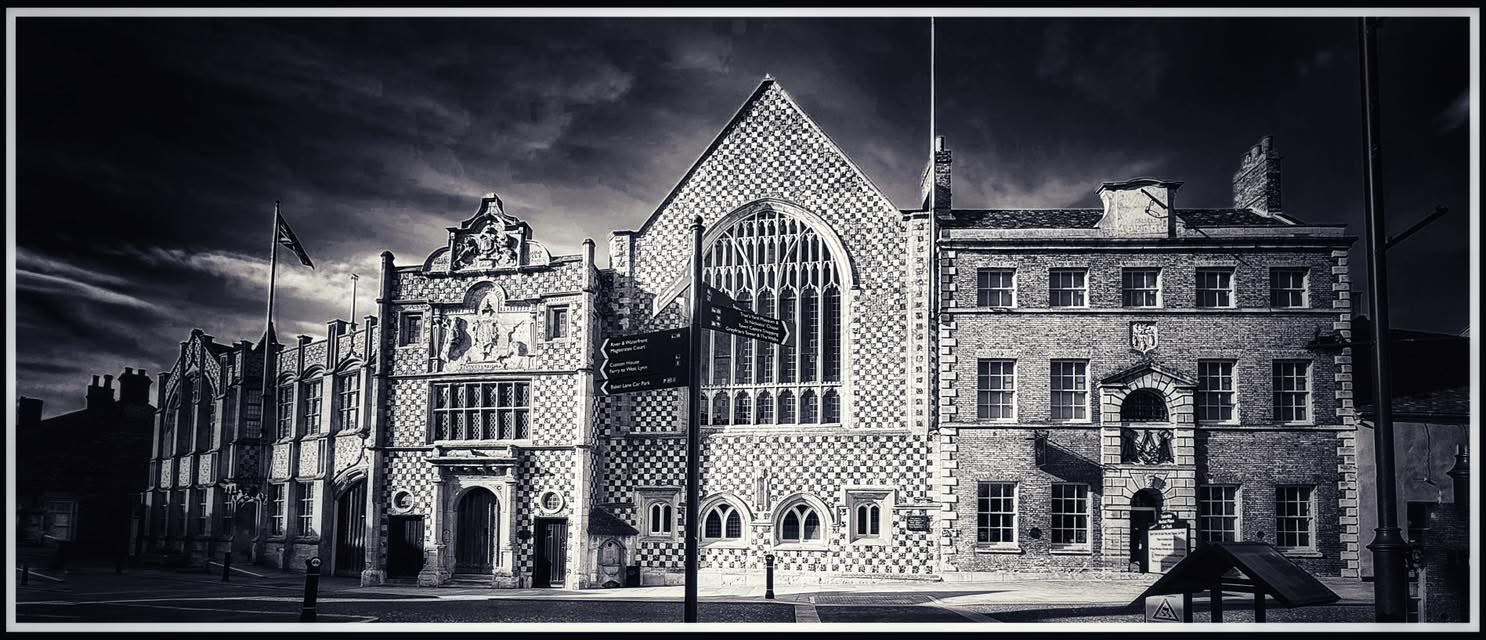
The lawns of St James’ Park cover one of King’s Lynn’s former burial grounds. Men, women, and children still lie beneath the grass, but the headstones which once marked their graves were removed when the cemetery was converted into a public park.
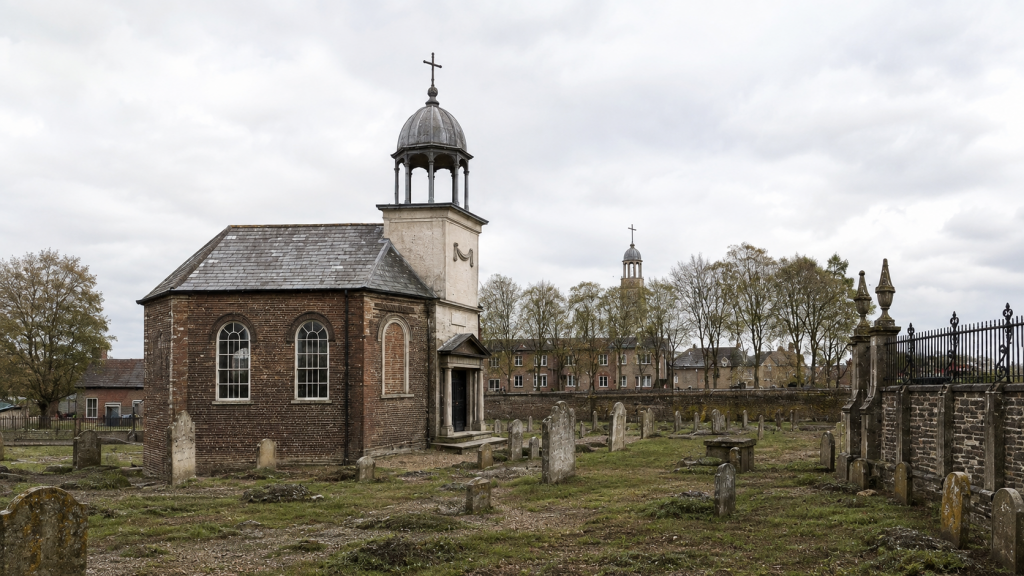
Those memorials which survived were gathered together along one edge of the park. No evidence has been found of a general removal of the bodies. The headstones were moved. The dead remained.
A burial ground beside St James
The name comes from the medieval chapel of St James, which stood near the present junction of St James’ Road and County Court Road. Founded before 1146, it served Lynn’s growing population as a chapel of ease to St Margaret’s. After the Reformation, part of the surviving building became a workhouse. A small fragment remains beside the nursery grounds.
The medieval chapel had its own churchyard. The land immediately to the east was described as “garden ground” in 1760, but by the beginning of the nineteenth century St Margaret’s needed more burial space. Its churchyard beside the Saturday Market Place was full and hemmed in by buildings.
After failing to obtain Corporation land called Paradise Garden, the parish leased a field beside St James’ Workhouse for £10 a year. The ground was enclosed, provided with a chapel, and consecrated by the Bishop of Norwich on 14 December 1803. The work cost £697 14s 2d.
This was St Margaret’s parish burial ground rather than a cemetery reserved for workhouse inmates. For more than half a century, funeral processions passed through Lynn’s streets on their way to the open ground at St James’ End.
The chapel among the graves
The cemetery chapel was Georgian rather than Victorian. William Richards described it as “a neat small chapel” used “merely for the purpose of reading the burial service”. Coffins could be brought inside before being carried to the grave.
Richards’s engraving shows a small octagonal or many-sided building with tall, round-headed windows. A lantern or cupola rose above the roof and was topped by a cross. Headstones and table tombs filled the ground around it.
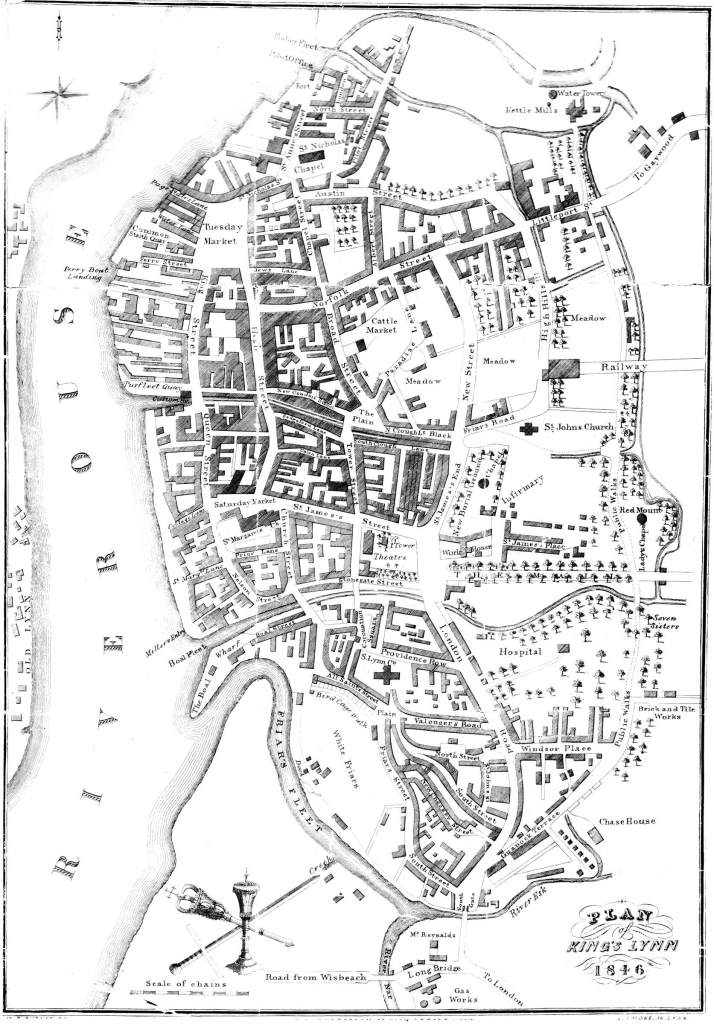
Burnet’s map of 1846 confirms that a small rounded building stood inside the cemetery. Its position appears to have been close to the present fountain, although the surviving maps cannot place it precisely. The chapel had disappeared by the time the Ordnance Survey mapped the area in 1884.
From cemetery to garden
The surrounding district changed rapidly. St John the Evangelist’s Church was completed immediately north of the burial ground in 1846, while the arrival of the railway brought new traffic and development. What had been the edge of Georgian Lynn was becoming part of the expanding Victorian town.
The new cemetery on Hardwick Road superseded St Margaret’s burial ground in 1855, although occasional burials may have continued in existing family graves. The old ground was planted and improved in 1857. More trees and walks followed, gradually softening the appearance of the cemetery.
The change was not immediate. For several decades the site remained recognisably a burial ground, with monuments standing among the trees. The small chapel disappeared, but the headstones remained until the Corporation decided to create a formal public park.
Removing the headstones
St James’ Park was laid out in 1902–03. To create uninterrupted lawns, the Corporation removed the headstones from their original positions. Those retained were placed closely together along one edge of the park. The available accounts do not say whether every memorial was preserved.
Removing the stones made the ground easier to maintain and allowed people to cross it without weaving between graves. It also broke the connection between each memorial and the person buried beneath it. Names and inscriptions survived, but they no longer identified the exact resting places of the dead.
There is no evidence that this landscaping involved a general exhumation. The graves remained beneath the newly laid lawns, paths, and flower beds. A cemetery had been made to look like a garden largely by moving its visible memorials.
At the crossing of the new diagonal paths stood the park’s centrepiece. Frederick John Carpenter, Mayor of Lynn in 1902–03, presented the town with an ornamental fountain in September 1903. Its cherub figures and decorative basins proclaimed the ground’s new purpose as a place for recreation.
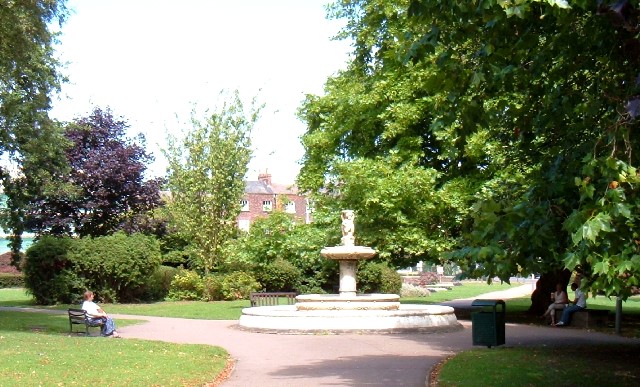
The fountain may stand close to the former site of the burial chapel. If so, the place where funeral services had once been read became the centre of the new public garden.
A tank beside the fountain
In 1919 a British Mark I tank was placed in a railed enclosure near the fountain. It was one of the presentation tanks distributed to towns after the First World War and soon appeared in postcards of the park.
By the late 1920s it was rusting. Savages, the King’s Lynn fairground engineering company, offered £2 for it, but the Council accepted a higher offer of £15 from R. E. Palmer.
For several years, visitors walking across the former cemetery encountered an Edwardian fountain and one of the machines which had transformed modern warfare.
The gravestones today
St James’ Park is now incorporated into The Walks, although it is much younger than the eighteenth-century avenues. The wider landscape underwent a £4.3 million Heritage Lottery Fund restoration completed in 2007, and the fountain was refurbished soon afterwards.
The crossing paths, open lawns, and central fountain preserve the Edwardian arrangement. Along the edge stand the displaced headstones. Closely packed and badly weathered, they are the surviving evidence of the cemetery which once occupied the entire park.
© James Rye 2026
Book a Guided Tour with a Trained and Qualified King’s Lynn Guide Through Historic Lynn
References
- Borough Council of King’s Lynn and West Norfolk. “The Walks.” https://www.west-norfolk.gov.uk/info/20067/parks_and_gardens/409/the_walks.
- Hillen, Henry J. History of the Borough of King’s Lynn. Vol. 2. Norwich: East of England Newspaper Company, 1907. https://archive.org/stream/historyofborough02hill/historyofborough02hill_djvu.txt.
- Historic England. “Church of St John the Evangelist.” National Heritage List for England, entry 1391201. https://historicengland.org.uk/listing/the-list/list-entry/1391201.
- Historic England. “Ruins of St James’ Chapel.” National Heritage List for England, entry 1298188. https://historicengland.org.uk/listing/the-list/list-entry/1298188.
- Historic England. “The Walks.” National Heritage List for England, entry 1001374. https://historicengland.org.uk/listing/the-list/list-entry/1001374.
- King’s Lynn Civic Society. “St James’ Park.” https://www.kingslynncivicsociety.co.uk/pilgrimage/st-james-park/.
- Norfolk Heritage Explorer. “Site of New Burial Ground, St James’ End.” https://www.heritage.norfolk.gov.uk/record-details?Index=60770&MNF72010-Site-of-New-Burial-Ground-St-James%27-End=&RecordCount=64187.
- Norfolk Record Office. “King’s Lynn Tank.” 2 May 2018. https://norfolkrecordofficeblog.org/2018/05/02/kings-lynn-tank/.
- Richards, William. The History of Lynn. Vol. 2. Lynn: W. G. Whittingham, 1812. https://www.gutenberg.org/cache/epub/62372/pg62372-images.html.