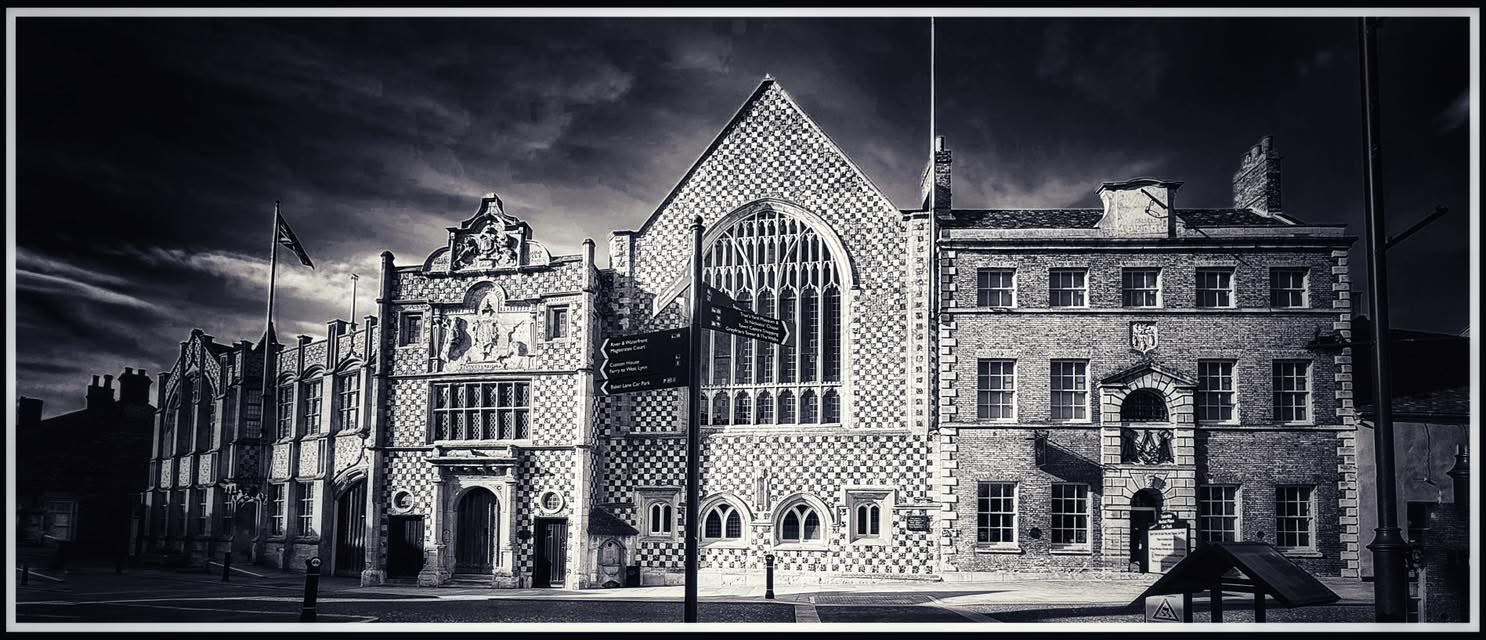

Thomas Thoresby intended to be remembered for ever. When the wealthy Lynn merchant died in 1510, he left behind a college beside St Margaret’s Church where priests would pray for him, his family, and generations of other dead townspeople. The prayers were to continue “as long as the world shall endure”.
They lasted for less than forty years.
Thoresby College still stands in Queen Street, but the religious world for which it was built disappeared during the Reformation. Its courtyard and former chambers belong to a lost Bishop’s Lynn filled with chantry priests, guild altars, burning candles, funeral Masses, and long lists of people whose names were repeatedly spoken after their deaths.
What was a chantry?
A chantry was an endowment created to support Masses and prayers for the dead. It was not necessarily a separate building. A wealthy founder might construct a chapel around his tomb, but many chantries consisted of property producing an income, a priest receiving a stipend, and an altar inside an existing church.
The system depended upon belief in purgatory. Medieval Christians generally expected that people who died within the Church would undergo purification before entering heaven. Prayers, almsgiving, and the celebration of Mass could help them.
This was not quite the crude purchase of salvation sometimes imagined. A chantry could not rescue someone who was condemned. Its prayers were intended to assist a soul already destined for heaven by easing or shortening its purification.
Founders gave houses, shops, fields, rents, quays, ferry rights, and money to maintain these services. The foundation might specify the altar at which Mass was to be celebrated, the persons to be remembered, and the prayers to be used. Income could also provide candles, vestments, books, church repairs, and alms for poor people.
Private chantries existed alongside guild chaplaincies, annual obits, and endowed lights. An obit was a service held on or near the anniversary of a death. A light maintained candles before an altar, image, or tabernacle. These arrangements often overlapped, but they were not interchangeable. The existence of a medieval guild does not prove that it maintained a permanent chantry priest.
Lynn’s guilds and their dead
An antiquarian catalogue names at least thirty-one guilds in medieval Lynn. Their dedications included St George, St Erasmus, St Margaret, St Anne, the Twelve Apostles, St Nicholas, Corpus Christi, the Holy Trinity, and the Holy Rood. There were also guilds of the Shoemakers and merchants trading to Bergen in Norway.
Some were wealthy mercantile organisations. Others were smaller fraternities offering religious observance, companionship, and practical assistance. Members attended funerals, supported brethren who had fallen into poverty, maintained candles, and paid for prayers.
The Guild of St George obtained royal authority during the reign of Henry IV to maintain one or two chaplains. They were to pray for the king and Queen Joan while they lived, for them after death, and for the guild’s members and benefactors.

Six of the Holy Trinity Guild’s thirteen chaplains officiated at St Margaret’s. The medieval interior contained several altars supporting guild and commemorative worship. Photo: John Salmon
The chaplains were supported partly by a tenement and adjoining quay in Checker Street, now King Street. Property on Lynn’s working waterfront was therefore financing prayer inside the town’s churches. River trade, rents, worship, and commemoration were parts of the same economy.
Thirty Masses for a guild member
The ordinances of the Guild of St Giles and St Julian show more clearly what membership offered. The guild was associated with St James’ Chapel and employed a priest. Each brother and sister contributed sixpence a year towards his cost.
The priest prayed for the members every Sunday. When one of them died in Lynn, the guild’s dean summoned the others to accompany the body to church and make an offering. If someone died elsewhere, the members gathered at St James’ and celebrated a service as though the body were present.
The dead member was then to receive thirty Masses.
The ordinances also required the maintenance of a light before St Julian. The guild repaired its chapel, supported an adjoining almshouse, and helped poorer members with burial expenses. Its founders were recorded as Edmund Bellyter, Thomas Constantine, Margaret Constantine, and William Inot. Later benefactors included Walter Coney, Robert Braybroke, William Wallis, and Richard Evelyn.
Their names were entered in a bede roll. The bellman carried a list through the streets so that former benefactors could be remembered publicly. Long after their bodies had been buried, their names continued to move around Lynn.
The altar of St Lawrence
A 1533 inventory records the possessions of a charitable company associated with the altar of St Lawrence in St James’ Chapel. It included three altar cloths, pillows, curtains, candlesticks, a wooden crucifix, and a printed Mass book. There was a rich vestment with a cross of gold and a black worsted pall embroidered with the name of Jesus.
The company also possessed large wooden candlesticks and iron bars for a funeral hearse. This was not a vehicle, but a framework placed over or around a coffin and hung with candles.
The equipment proves that the company maintained an active altar and organised substantial funeral observances. It does not establish that it employed its own permanent priest. Clergy might have been hired when required or supplied through another Lynn foundation.
This uncertainty helps explain why counting the town’s chantries is so difficult. Several organisations could use the same church. A single priest might perform duties for more than one benefactor, and an altar might be maintained by a guild without possessing an independently endowed chaplaincy.
A town lit by wax
Wax was valuable. Guild officers weighed it, stored it, and recorded who was responsible for replacing it.
The Guild of St Fabian and St Sebastian required its officers to ensure that candles were burning around the altar on the saints’ feast day. It also maintained equipment associated with its dead members, although the church containing its altar has not yet been securely identified.
The Corpus Christi Guild maintained a more elaborate display in St Margaret’s Church. During the reign of Henry VI, it placed a large quantity of wax in the keeping of William Marche, a Lynn wax chandler. He had to maintain the lights around the guild’s tabernacle, supply its torches, and erect its funeral hearse each year.

Photo: Matthew Usher
Marche received five marks and ten shillings annually. At the end of his term, he was expected to return the prescribed weight of wax.
The agreement exposes the physical labour behind medieval devotion. Wax had to be repaired, reshaped, and replaced. Candlesticks required cleaning, torches had to be prepared, and someone had to assemble the hearse before each major commemoration.
Thirteen chaplains for the Holy Trinity Guild
Lynn’s greatest clerical establishment belonged to the Guild of the Holy Trinity. By the later fourteenth century, it supported thirteen chaplains. Six officiated at St Margaret’s, four at St Nicholas’, and three at St James’.
They prayed for the king and his ancestors, the peace of the kingdom, guild members and benefactors, and all the faithful departed. They also helped maintain a demanding cycle of sung services at Lynn’s churches and chapels.
These were not undisciplined priests left to collect their stipends. If a chaplain neglected his office or behaved dishonourably, the guild’s alderman could warn him and eventually appoint a replacement.
When a guild brother died, the alderman arranged a solemn Mass. Each of the thirteen chaplains was then required to say thirty Masses. If the rule was followed literally, the death of one member generated 390 Masses.
The guild could support this remarkable programme because it possessed an extensive portfolio of property. Its holdings included houses, warehouses, fields, rents, a mill, a ferry passage, and property around the Common Staithe. Its estates extended into South Lynn, Gaywood, West Winch, Snettisham, Shernbourne, and other neighbouring settlements. It even held property at Brandon Ferry in Suffolk.
The guild’s expenditure was not confined to worship. A fourteenth-century return claimed that it spent about £30 each year helping poor brethren, blind and disabled people, poor scholars, lepers, and religious houses. It contributed to repairs at St Margaret’s, St Nicholas’, and St James’, and supported Lynn’s four communities of friars.
A warehouse rent might finance a priest’s Mass, repair a riverbank, assist a poor scholar, or help someone unable to pay for a funeral. Religion, charity, and town government were closely entangled.
Six hundred names waiting to be read
The Holy Trinity Guild maintained a bede roll recording deceased members. An antiquarian study identified 603 entries in the main roll, followed by a separate list of living brethren. After allowing for repetitions and irregularities, the surviving document contains about 850 names.
The roll was made to be read aloud. At important guild observances, the dead were named so that prayers could be offered for them individually. As the list grew, completing the recitation must have become increasingly difficult. It appears that clerks eventually found abbreviated ways of fulfilling the obligation.
One entry is a John Chaucer, sometimes suggested as a relative of the poet Geoffrey Chaucer. The connection remains uncertain. The roll’s greater value lies in the hundreds of Lynn people it preserves. Some were mayors or wealthy merchants. Others would be almost entirely unknown without the guild’s determination to remember them.
The men who imported wine, exported grain, traded in millstones, controlled ferries, and governed the port expected their names to remain part of Lynn’s spoken life after death.
Thomas Thoresby’s college
The Holy Trinity chaplains originally appear to have lived separately. Thomas Thoresby decided to provide them with a collegiate home close to St Margaret’s.
Thoresby was a merchant, burgess, and three-time mayor. He founded the institution in 1500, although the present ranges were built principally between about 1508 and 1511. He died in 1510 before the work was finished, leaving money so that his executors could complete it.
The priests occupied chambers arranged around a courtyard. The college gave them private accommodation while allowing a degree of shared life. From Queen Street, they could easily reach St Margaret’s or continue to St Nicholas’ and St James’.
The precise composition of the household is not entirely clear. Modern accounts sometimes describe a master and twelve priests. Others refer to thirteen Trinity chaplains, with additional accommodation for Lynn’s charnel priest and Thoresby’s own chantry priests. Thoresby’s will and the college’s foundation documents need to be examined together before the numbers can be settled.
The different offices should not be collapsed into one. The guild chaplains served the fraternity and its dead. The charnel priest prayed for those whose bones were gathered when crowded burial grounds were reused. Thoresby’s personal priests had special obligations towards their founder and his family.
The building was therefore not itself a chantry chapel. It was a residential college supporting several related forms of intercessory prayer.
Prayer as employment
Chantry and guild priests did more than repeat the names of founders. Lynn’s thirteen Trinity chaplains helped sustain sung worship at three churches. Priests elsewhere taught children, assisted at funerals and processions, acted as clerks, and administered property.
Their presence changed the sound of the town. Several Masses could be celebrated at different altars during the morning. Bells announced deaths, anniversaries, and services. Guild members processed through the streets, candles burned before images, and priests sang for men and women who had been dead for generations.
The system also employed chandlers, bellmen, singers, craftsmen, servants, and property managers. Vestments had to be repaired, books copied or purchased, rents collected, and buildings maintained. A chantry endowment created a small institution that could continue working long after its founder’s death.
The prayers stop
Henry VIII’s government began surveying chantries in 1546. Financial need played a considerable part, but the assault became more explicitly religious after Edward VI succeeded to the throne.
Protestant reformers rejected purgatory and denied that Masses could help the dead. Chantries were therefore condemned as institutions supporting false belief.
The Chantries Act of 1547 transferred chantries, guild endowments, free chapels, obits, and lights to the Crown. Commissioners recorded their property, income, goods, priests, and supposed public functions. Land that had been given for perpetual prayer could then be sold or reassigned without continuing the religious obligation.
The Holy Trinity Guild’s property passed to the Crown. A substantial portion was granted to Lynn’s mayor and burgesses on 21 May 1548 because guild income had helped to maintain sea defences, riverbanks, waterways, and other works needed to protect the town. The grant included houses, warehouses around the Common Staithe, agricultural property, and land in neighbouring villages.
Some civic benefits of the guild’s wealth survived. Its Masses did not.
Priests lost their posts, although some received pensions or found other work. Altars were dismantled, lights extinguished, and vestments and plate sold or confiscated. Thoresby College passed into secular ownership.
Thomas Thoresby’s substantial building survived because it could be adapted for new uses. His instructions could not. “As long as the world shall endure” proved to mean until Parliament changed the law.
Chantry Activity in Lynn
Spreadsheet of the known chantry, guild chaplaincy, obit, light, and associated priest in medieval Lynn. Compiled by AI. May contain mistakes and be incomplete.
© James Rye 2026
Book a Guided Tour with a Trained and Qualified King’s Lynn Guide Through Historic Lynn
References
- Blomefield, Francis, and Charles Parkin. “Freebridge Hundred and Half: Lynn.” In An Essay towards a Topographical History of the County of Norfolk. Vol. 8. London, 1808. British History Online.
- Howlett, Richard. “The Early Bede Roll of the Merchants’ Gild at Lynn.” The Norfolk Antiquarian Miscellany. Internet Archive.
- King’s Lynn Preservation Trust. “Thoresby College.” Accessed 17 September 2026. King’s Lynn Preservation Trust.
- Luxford, Julian M., and John McNeill, eds. The Medieval Chantry in England. Leeds: Maney, 2011. University of St Andrews Research Portal.
- Norfolk Historic Environment Service. “King’s Lynn Parish Summary.” Accessed 17 September 2026. Norfolk Heritage Explorer.
- Richards, William. The History of Lynn: Civil, Ecclesiastical, Political, Commercial, Biographical, Municipal, and Military. Vol. 1. Lynn: W. G. Whittingham, 1812. Project Gutenberg.