Photo King’s Lynn Preservation Trust
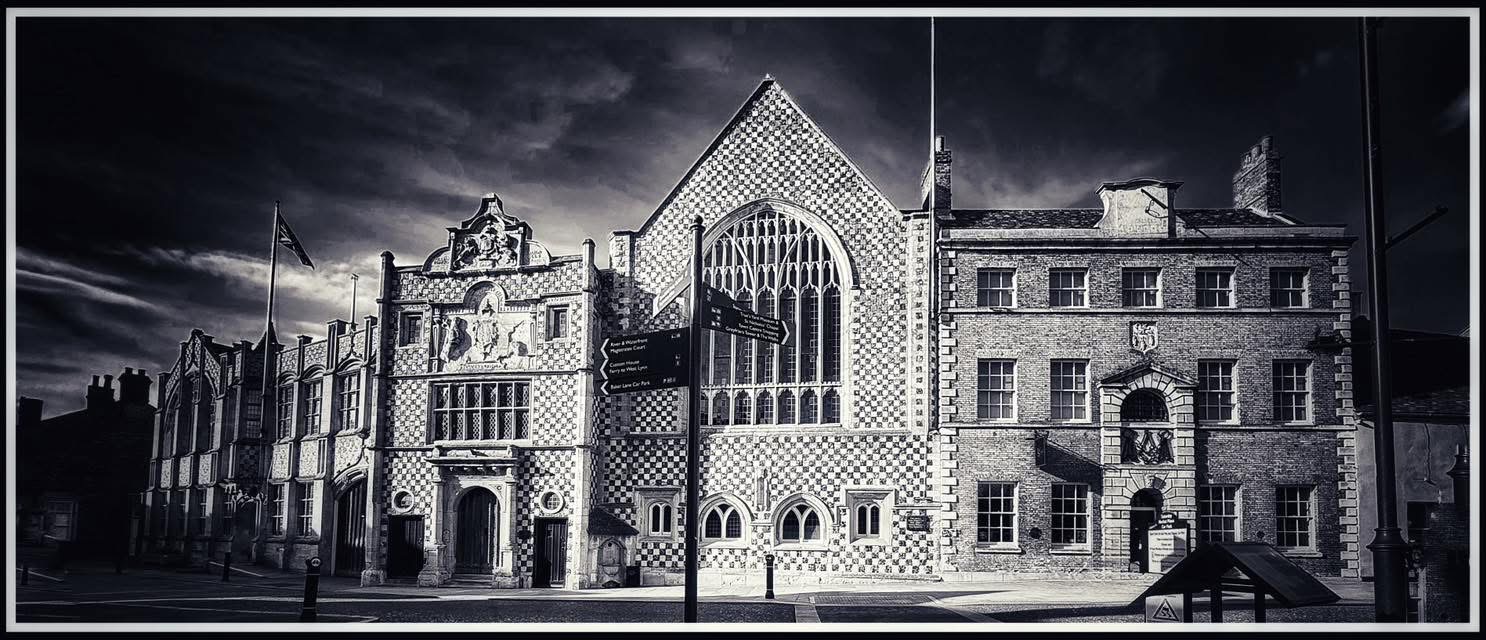
On the corner of King Street and Ferry Lane stands Evershed House, an imposing Georgian-fronted building with a much older history concealed behind its brick façade. Its name does not commemorate a former merchant or wealthy occupant. Instead, it honours a woman whose determination helped save some of King’s Lynn’s finest historic buildings from demolition.
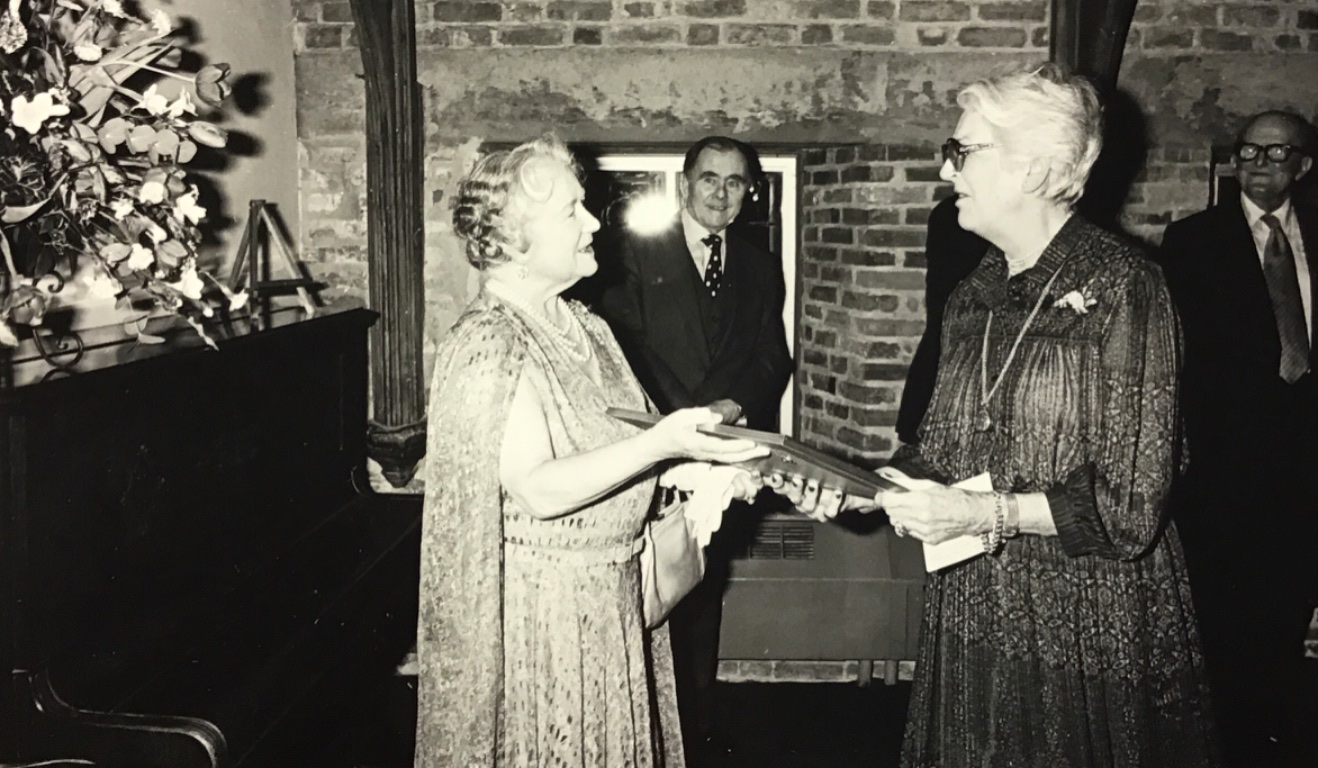
Lady Joan Evershed was the founding chairman of the King’s Lynn Preservation Trust, established in 1958 when much of the town’s architectural inheritance was at risk. For more than a quarter of a century, she led an organisation that rescued buildings which might otherwise have disappeared. Without her and a small group of equally determined conservationists, the King’s Lynn we know today would look very different.
The threat to old Lynn
During the 1950s, many of Britain’s historic towns were undergoing dramatic change. Old buildings were frequently considered inconvenient, expensive to maintain, and unsuitable for modern living. Demolition and redevelopment promised better housing, improved roads, and commercial prosperity. King’s Lynn was no exception.
One building facing an uncertain future was Hampton Court in Nelson Street, an extraordinary collection of medieval and later buildings arranged around a courtyard. Parts dated from the early fourteenth century, when Lynn was one of England’s busiest ports. By the mid-twentieth century, however, the complex had deteriorated badly, and demolition was a real possibility.
In 1954, a local conservationist, Nora Lane, purchased Hampton Court and began restoring two of its wings. It was a formidable undertaking. The building required extensive repairs, and saving the remaining ranges demanded more resources than one individual could reasonably provide.
The challenge attracted members of the King’s Lynn Civic Society, who recognised that Hampton Court was not an isolated problem. Other historic buildings were in similar danger. If they were to be saved, the town needed an organisation capable of raising funds, acquiring property, and overseeing restoration.
Lady Evershed was among those who turned that idea into reality.
A new organisation with an ambitious purpose
Born Cecily Elizabeth Joan Bennett, she had married the distinguished lawyer Francis Raymond Evershed in 1928. Her husband became Master of the Rolls, one of England’s most senior judges, and was created Baron Evershed in 1956. She was generally known in Lynn as Lady Joan Evershed.

Photo King’s Lynn Preservation Trust
On 24 October 1958, the King’s Lynn Preservation Trust was formally launched at a public meeting in the Town Hall. Eight members of the Civic Society formed its first management committee, with Lady Evershed as chairman. She remained in that position until the mid-1980s.
The Trust’s purpose went considerably further than protesting against demolition. It would acquire endangered buildings, restore them, and find suitable uses that would secure their future. This required money, professional advice, and the willingness to take responsibility for properties that commercial developers often regarded as liabilities.
Hampton Court provided the first test. Nora Lane donated the north and south ranges to the new Trust, which restored them between 1960 and 1962. The completed building provided flats for residents, demonstrating that historic architecture could be adapted for ordinary domestic life. In 1970, Lane transferred the remaining parts of the complex to the Trust.
The success of Hampton Court established a model that the organisation would follow for decades. Rather than simply preserve an attractive exterior, the Trust sought to make buildings useful again, thereby giving them a reasonable prospect of surviving.
Lady Evershed was its driving force, but the achievement was collective. Nora Lane had begun the campaign, while Diana Bullock, another founding committee member, worked alongside Lady Evershed for many years. Ruth, Lady Fermoy, a prominent supporter of the arts in Lynn, also played an important part. The Queen Mother became an early patron, lending the organisation considerable public prestige.
Saving the buildings that made Lynn special
The Trust’s second major undertaking was Thoresby College in Queen Street. Built in the early sixteenth century by the wealthy merchant Thomas Thoresby, it had originally accommodated priests associated with Lynn’s powerful Trinity Guild. After the Reformation, the building passed through various uses and eventually became seriously neglected.
In 1963, Lady Fermoy and her daughter, Viscountess Althorp, purchased the property and presented it to the Preservation Trust. Restoration was completed in 1968. The former college became a mixture of residential accommodation, offices, and public meeting rooms, preserving one of the town’s finest surviving medieval courtyards.
Other projects followed. In 1970, the Trust opposed an application to demolish 77 London Road, a substantial nineteenth-century house at the northern end of Buckingham Terrace. After the application was refused, the Trust acquired the building and converted it into six flats.
The rescue of Priory Lane Cottages was especially imaginative. These fourteenth-century buildings were among the last surviving remains of Lynn’s Benedictine Priory. By 1970, they were considered unfit for habitation. The Trust purchased them in 1972 and commissioned architect Michael Gooch to devise a restoration scheme. His solution included reopening a blocked medieval archway and moving the cottages’ entrances to face the churchyard. The completed project received an award during European Architectural Heritage Year in 1975.
Perhaps the most remarkable discovery emerged from the restoration of 28–32 King Street, acquired by the Trust in 1975. Behind later frontages lay the remains of an exceptionally early medieval stone house, with Romanesque architectural features dating from the twelfth century. The survival of such early domestic architecture was an extraordinary reminder of the town’s Norman origins. A severe gale in January 1978 caused part of the brickwork at No. 30 to collapse, making the need for repairs particularly urgent.
The Trust also restored former fishermen’s cottages in Pilot Street and threatened properties around All Saints Street and Church Lane. Its work was not confined to prestigious merchant houses. Modest dwellings and ordinary street scenes were recognised as part of Lynn’s history, too.
These projects took place during Lady Evershed’s chairmanship, although their success depended upon architects, skilled craftsmen, donors, committee members, and public support. Her importance lay in helping sustain an organisation capable of undertaking one difficult rescue after another.
Her contribution received national recognition in the 1977 Silver Jubilee and Birthday Honours, when she was appointed OBE for services to the King’s Lynn Preservation Trust.
The house that carries her name

Photo © Stephen Richards
Lady Evershed’s most visible memorial stands at 23–25 King Street, although its restoration came after her death.
Behind the Georgian façade lie two earlier houses, with wings extending towards the river and unusual stepped gables at the rear. By the 1980s, the property had suffered prolonged neglect. Vandals had damaged the interior, lead had been stolen from the roof, and dry rot had affected the structure.
The Preservation Trust commissioned a feasibility study in 1986. Restoration was expensive and technically demanding, particularly because the building’s historic features had to be retained. The eventual conversion to offices preserved much of the surviving panelling and other architectural details.
The restored building was named Evershed House in memory of the Trust’s founding chairman. It was subsequently sold to a firm of local solicitors in 1992.
Lady Evershed’s memorial is therefore not a statue or commemorative plaque alone, but a historic building brought back into use. It is a particularly fitting tribute to someone who helped establish a practical approach to conservation in King’s Lynn.
The Trust she chaired continued its work after her death, acquiring and restoring further properties and maintaining those still in its care. Its successes are visible throughout the old town, where medieval houses, former religious buildings, and modest cottages continue to serve useful purposes.
Anyone walking through Nelson Street, Queen Street, King Street, or the lanes around St Margaret’s is likely to encounter buildings whose survival owes something to the King’s Lynn Preservation Trust. Many visitors will have no idea how close some came to disappearing.
Lady Joan Evershed helped ensure that they remained part of the town rather than becoming photographs in its archives.
© James Rye 2026
Book a Walk with a Trained and Qualified King’s Lynn Guide
References
- King’s Lynn Civic Society. “Our History.” https://www.kingslynncivicsociety.co.uk/our-history/
- King’s Lynn Preservation Trust. “23–25 King Street: Evershed House.” https://www.klprestrust.org.uk/project/23-25-king-street/
- King’s Lynn Preservation Trust. “28–32 King Street.” https://www.klprestrust.org.uk/project/king-street/
- King’s Lynn Preservation Trust. “Hampton Court.” https://www.klprestrust.org.uk/project/hampton-court/
- King’s Lynn Preservation Trust. “KLPT Timeline.” https://www.klprestrust.org.uk/history/
- King’s Lynn Preservation Trust. “Priory Lane Cottages.” https://www.klprestrust.org.uk/project/priory-lane-cottages/
- King’s Lynn Preservation Trust. “The Beginning: Five Remarkable Women.” https://www.klprestrust.org.uk/klpt-beginnings/
- King’s Lynn Preservation Trust. “Thoresby College.” https://www.klprestrust.org.uk/project/thoresby-college/
- Norfolk Historic Environment Record. “NHER 12914: Evershed House, 23 and 25 King Street.” Norfolk Heritage Explorer. https://nhe.esdm.co.uk/Monument/MNF12914
- The London Gazette. “1977 Silver Jubilee and Birthday Honours.” Supplement 47234, 10 June 1977. https://www.thegazette.co.uk/London/issue/47234/supplement/1
- The Peerage. “Cecily Elizabeth Joan Bennett.” https://www.thepeerage.com/p23394.htm