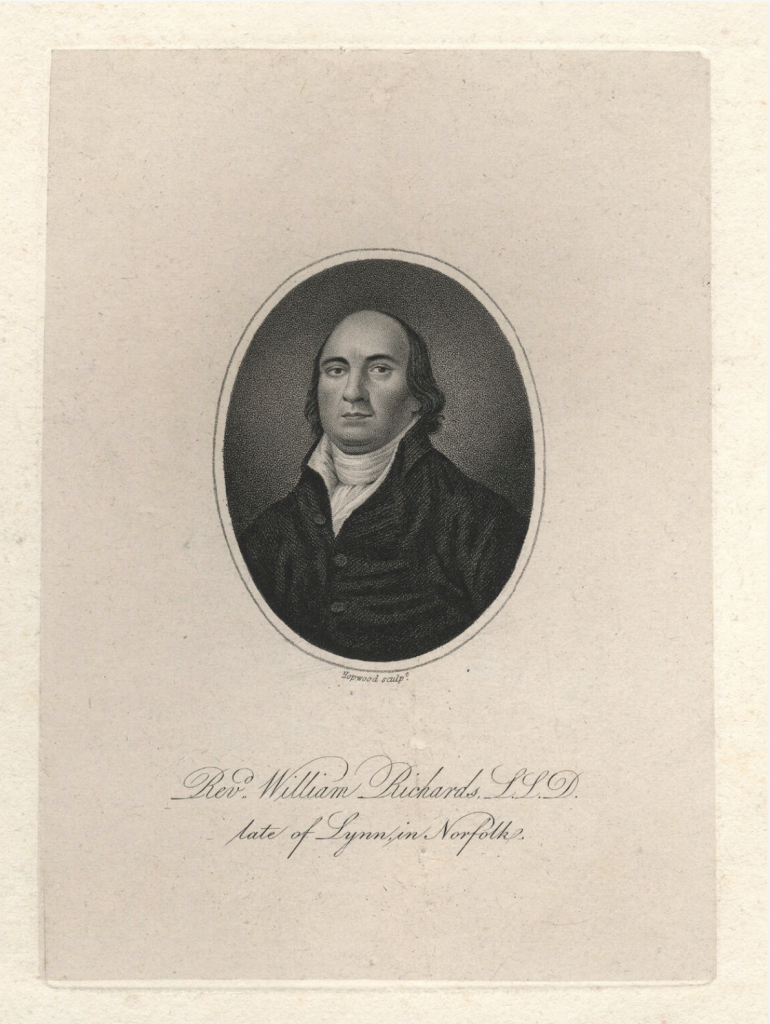
In 1805, the sudden death of William Richards’s twenty-eight year old wife led to his seven-year withdrawal from society. They had only been married for two years. During this period of ‘severe domestic affliction’, Richards found comfort in writing history.
Rev. William Richards of King’s Lynn: Baptist minister, controversialist and historian
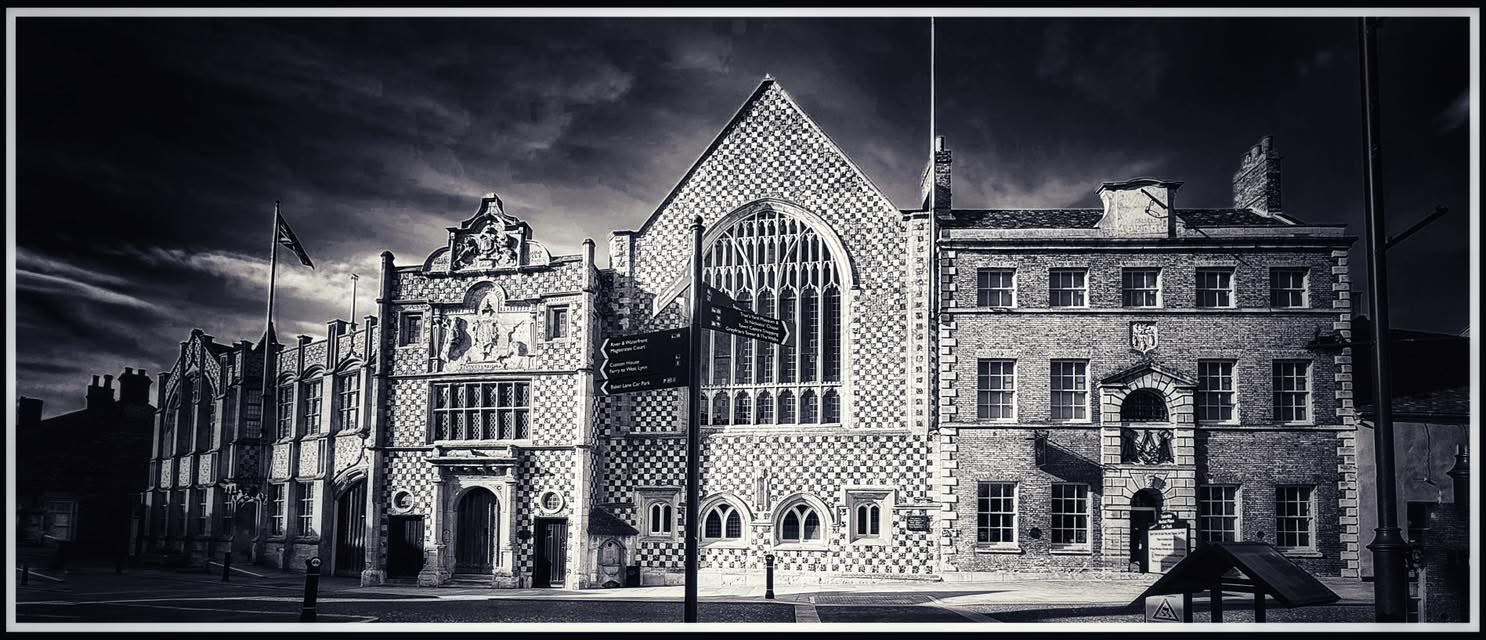
King’s Lynn became the home town of a Welsh Baptist minster – William Richards. He served its small Baptist congregation for many years, argued fiercely about doctrine, opposed slavery, kept close links with American Baptists, and in 1812 published The History of Lynn, still an interesting book for anyone wanting to know more about the town. He was not a smooth or easy figure. He was industrious, learned, combative and often divisive, yet he left King’s Lynn one of the great gifts a town can receive: a substantial record of its own past.
From Pembrokeshire to Broad Street
Richards was born in 1749 at Pen-rhydd in Pembrokeshire and grew up in a Baptist family that later moved to Carmarthenshire. He had very little formal schooling, but he became a preacher, studied for a time at the Bristol Baptist Academy, worked briefly at Pershore, and then came to Lynn in 1776 to serve an unsettled Baptist congregation in Broad Street. Richards initially agreed to come for a year from 7 July 1776. He healed divisions within the congregation, and was established as regular pastor in 1778. That was a substantial achievement in itself. Lynn’s dissenting life was active and argumentative, and congregations could fracture easily. Richards arrived not as a local antiquary but as a working minister brought in to steady a troubled church.
He was also a formidable preacher and conducted three services each Sunday without notes. Contemporaries noticed his strong Welsh accent, and he was not universally liked, but he plainly had stamina, discipline and presence. He remained connected with Lynn for the rest of his life, even after illness weakened his active ministry.
A Baptist, but not a predictable one
Richards began in the orbit of the Particular Baptists, yet he did not remain doctrinally still. The Welsh biographical record says that he abandoned Calvinism and later also Trinitarianism, though he did not simply adopt the label “Unitarian”. At the same time, he held firmly to baptism by immersion and to what Baptists called “close communion”. In plain terms, that meant the Lord’s Supper should be restricted to properly baptised believers, in fellowship with a church of like faith and order, rather than opened to all professing Christians indiscriminately.
That combination made him a disruptive figure. He could move away from inherited orthodoxy while still defending strict Baptist practice. He wrote against infant baptism, issued controversial pamphlets, and entered the bitter disputes that shook Welsh and English Baptist life in the late eighteenth century. The Welsh biography describes him as a theological and political controversialist and notes his fierce involvement in the schisms of the 1790s. This was not a minister content merely to pastor quietly. He wrote, debated and offended.
Politics beyond the chapel
Richards’s interests went well beyond congregational life in Lynn. He admired America, corresponded with Brown University, and received the degree of A.M. from Brown in 1793. Brown’s own library history preserves his warm words about the “growing greatness” of America and records that he owned nearly fifteen hundred volumes. Over time he maintained cordial relations with the college, which later granted him the degree of LL.D. in 1818.
He was also a committed opponent of slavery. He was a strong advocate of slave emancipation and was an honorary member of the Pennsylvanian society formed to promote that cause. His title page to The History of Lynn advertises that affiliation. He also welcomed the French Revolution in its earlier phase and attacked what he regarded as corruption in established religion. In other words, Lynn’s Baptist minister was tied into a much larger Atlantic and political world than the title “local historian” might suggest.
Illness, loss and the writing of The History of Lynn
By the mid 1790s Richards’s health was already poor. He spent long periods back in Wales, notably from 1795 to 1798 and again through 1800 and 1801. After 1802, his ministry at Lynn became largely nominal, though the connection was never formally dissolved. Then came the event that shaped his best known work. He married in 1803, but his wife Emiah died on 3 January 1805 aged only twenty-eight. The DNB says that after her death he secluded himself from society for seven years.
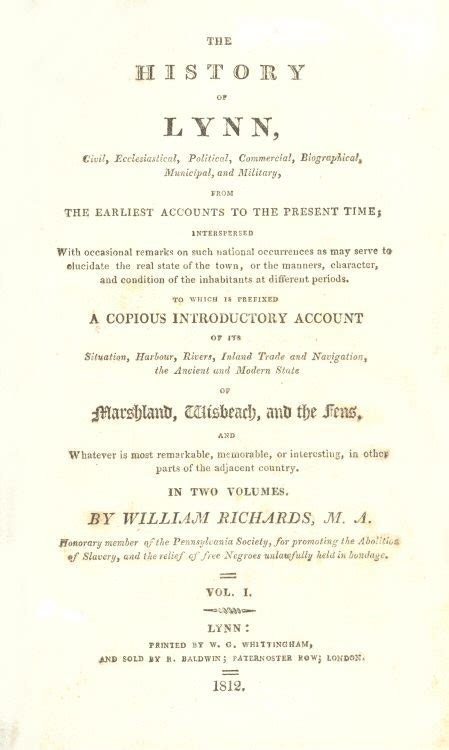
Richards himself explained the result in the preface to The History of Lynn. He wrote that a “sudden and severe domestic affliction” drove him into solitude, where he sought relief in books and literary projects. One of those projects became the great history of Lynn. Published in 1812 in two volumes, it attempted a remarkably full account of the town’s civil, ecclesiastical, political, commercial, biographical, municipal and military history, with additional material on Marshland, Wisbech and the Fens. The book was written under difficulty. Richards complained that some earlier materials were unavailable and that access to municipal records had been limited.
This matters for King’s Lynn because Richards was not simply a minister who happened to write a book. (such citizens are two a penny). He was one of the men who fixed the town’s usable past in print. Later historians have corrected him in places, as they correct everyone, but no serious study of Lynn can ignore him. His history is still full of topographical, statistical and ecclesiastical detail that would otherwise be much harder to recover.
His final years
Brown University conferred the degree of LL.D. on Richards on 6 September 1818, but he died at Lynn on 13 September before he knew of the honour. He was buried a few days later at the General Baptist chapel graveyard in Wisbech. His library, described by Brown as the Richards Legacy, became one of the most important gifts received by the university in the early nineteenth century. Brown still remembers it as the largest gift to the library in that period. That is an extraordinary afterlife for a man who spent so much of his career arguing in provincial chapels and writing in relative seclusion at Lynn.
Richards deserves to be remembered in King’s Lynn not only because he ministered there, but because he connected the town to larger religious and intellectual currents. He stands at the meeting point of Welsh dissent, Baptist controversy, anti-slavery politics, American connections and local historical writing. For Lynn, that is more than a footnote. It is a substantial chapter in the town’s cultural history.
© James Rye 2026
Book a Guided Tour with a Trained and Qualified King’s Lynn Guide Through Historic Lynn
References
- Brown University Library. “The Early 19th Century.” Special Collections of the Brown University Library: A History & Guide. Accessed April 6, 2026. https://library.brown.edu/guide/03.html
- Gordon, Alexander. “Richards, William (1749–1818).” Dictionary of National Biography, 1896, reproduced at Wikisource. Accessed April 6, 2026. https://en.wikisource.org/wiki/Dictionary_of_National_Biography%2C_1885-1900/Richards%2C_William_%281749-1818%29
- Historic England listing, via British Listed Buildings. “Stepney Chapel, King’s Lynn.” Accessed April 6, 2026. https://britishlistedbuildings.co.uk/101298167-stepney-chapel-kings-lynn-and-west-norfolk-st-margarets-with-st-nicholas-ward
- Hill, William. The History of the Borough of King’s Lynn, vol. 2. King’s Lynn, 1908. Archive.org text version, accessed April 6, 2026. https://archive.org/stream/historyofborough02hill/historyofborough02hill_djvu.txt
- Jenkins, R. T. “RICHARDS, WILLIAM (1749–1818), General Baptist minister, theological and political controversialist, and antiquary.” Dictionary of Welsh Biography, 1959. Accessed April 6, 2026. https://biography.wales/article/s-RICH-WIL-1749
- Richards, William. The History of Lynn, Vol. 1 [of 2]. London and Lynn, 1812. Project Gutenberg edition, accessed April 6, 2026. https://www.gutenberg.org/cache/epub/62365/pg62365-images.html
- Southern Baptist Theological Seminary, Southern Equip. “What is ‘open’ or ‘closed’ communion — and why does it matter?” Accessed April 6, 2026. https://equip.sbts.edu/publications/towers/open-closed-communion-matter/