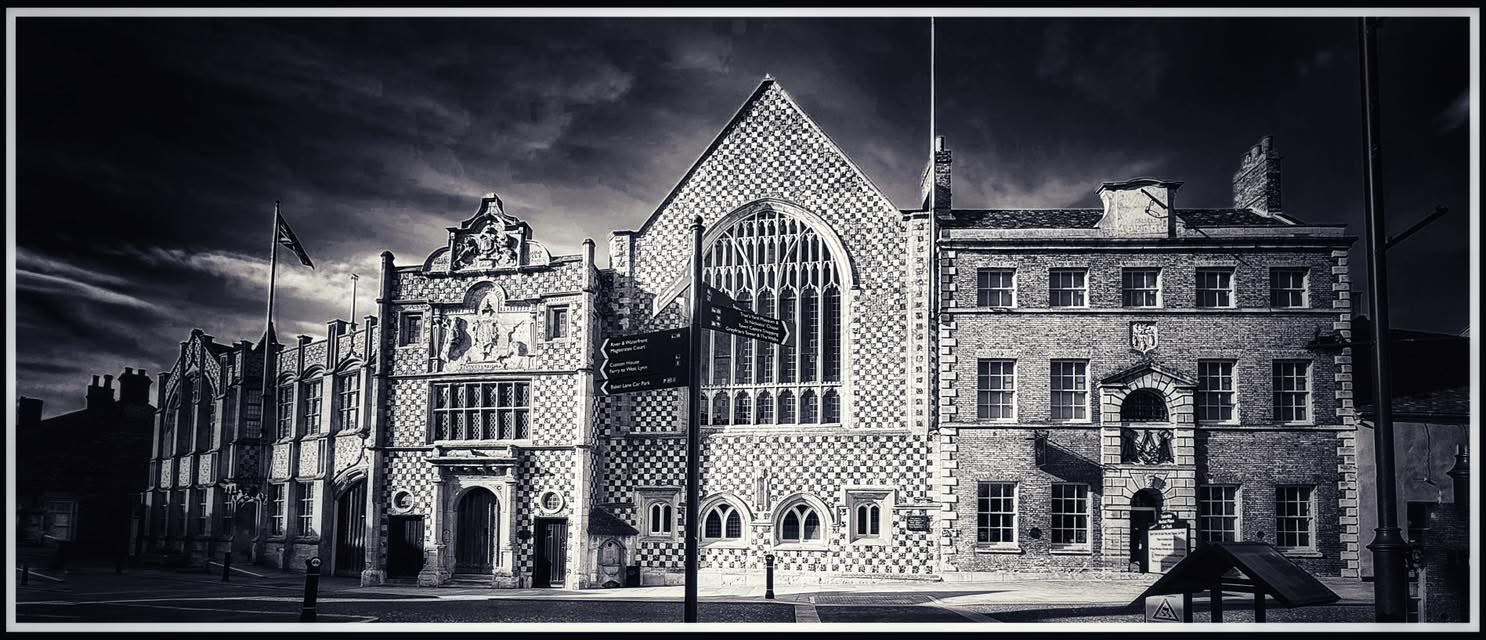
King’s Lynn Minster is a building that tends to make people look up. The stone pulls the eye into height and distance, and the effect can be slightly impersonal, as if the past is something you observe rather than meet. That is one reason Rosemary Goodenough’s A Woman in Motion works so well there. It is not monumental. It does not try to compete with the architecture. Instead it draws you down and inward, and it does so in a place that matters. This is Kempe’s own church, St Margaret’s, now the Minster, the setting for much of her ordinary devotional life as well as the starting point for the extraordinary parts.
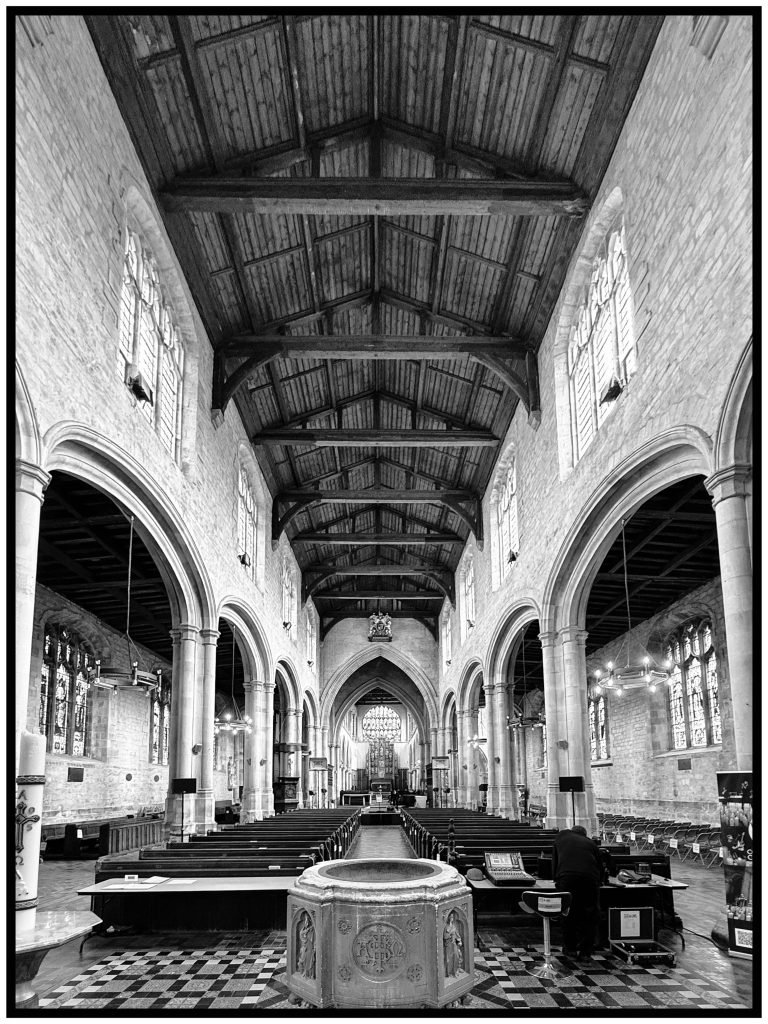
Photo © James Rye 2026
The sculpture was unveiled on 4 February 2023, commissioned as a permanent installation marking the 650th anniversary of Kempe’s birth (c. 1373). The service itself was intentionally public and civic as well as ecclesiastical, with Lord Dannatt unveiling the work and the Bishop of Norwich, Graham Usher, preaching. That framing matters because it signals a choice: the Minster is not merely acknowledging Kempe as a famous person to be “mentioned”, but taking a clear line that she belongs within the building’s story and within the town’s present-day identity.
Not a “Portrait Statue”
We are used to commemorative sculpture that offers certainty: a recognisable face, a confident pose, a tidy message. Goodenough does none of that, and it is not a failure of likeness. It is a refusal of a kind of memorial language that Kempe, of all people, would not fit.
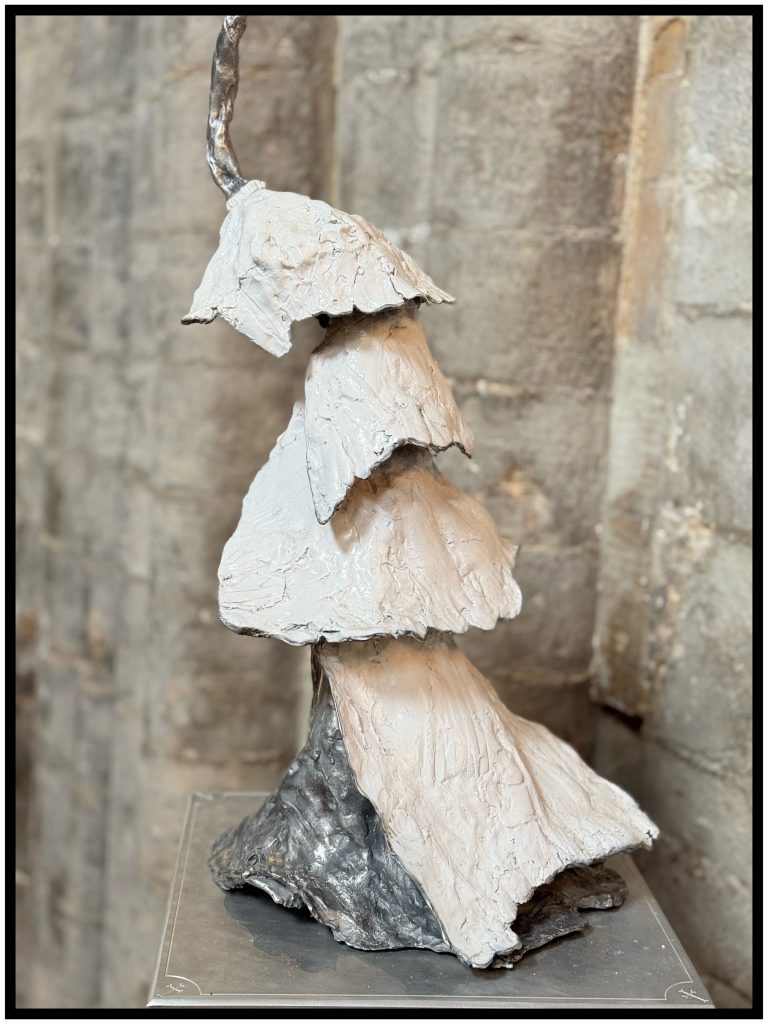
Photo © James Rye 2026
Kempe is a figure known chiefly through words, and not through words that allow the reader to settle comfortably. In her Book, she is devout, dramatic, persistent, sometimes courageous, sometimes exasperating, and frequently at odds with those around her. A conventional portrait would risk turning her into an agreeable emblem. A Woman in Motion is better described as a visual argument about what sort of person Kempe was, or at least how she is best remembered: not settled, not quiet, not easily contained.
Even the title performs that argument. It begins with “woman”, not mystic, not saint, not visionary, and then places “motion” at the centre. That choice is historically alert. Kempe’s spiritual life was never purely interior. It spilled out, literally, into streets and ships, shrines and hostels, courts and church porches. A static, polished Kempe would be a contradiction.
Commission, Material, and Scale
Goodenough’s own information about the work provides two practical details that strongly shape the viewer’s experience. First, scale. She lists the sculpture at roughly 76 cm high, with a narrow width and depth, and records it as part of a limited edition, the Minster casting being “#1 of 12”. This is not a grand civic monument in the market place. It is closer to human encounter. You approach it as you would approach a person who has paused, not as you would approach a structure.
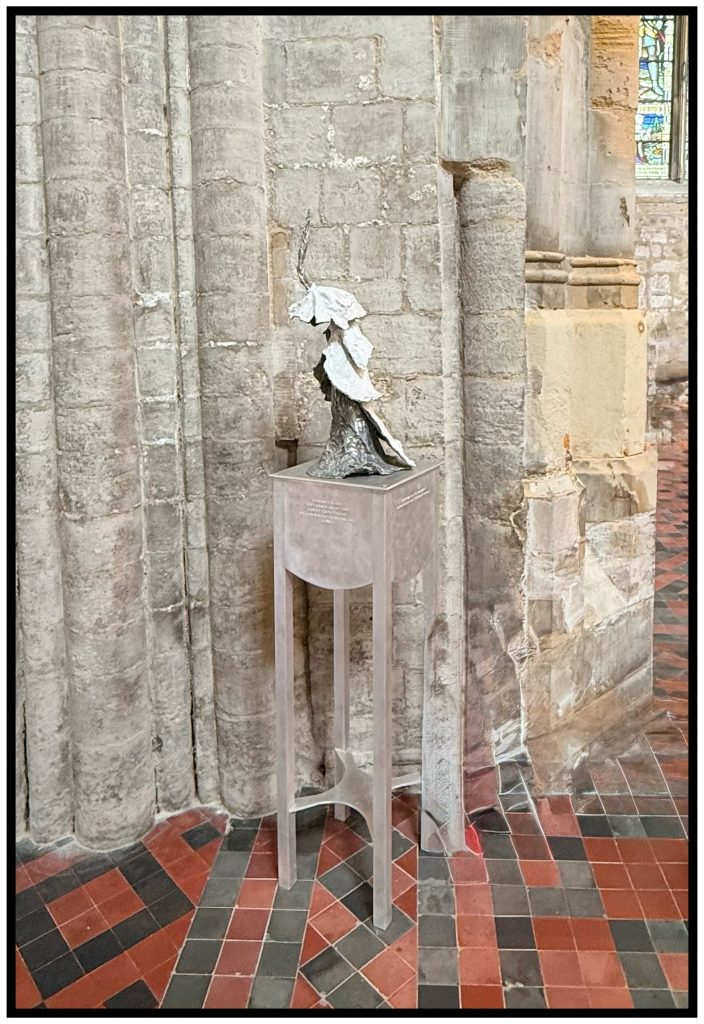
Photo © James Rye 2026
Second, material. The sculpture is cast in aluminium, and Goodenough treats that as meaningful rather than simply functional, connecting it to ideas of abundance and endurance, and linking those to Kempe’s life as a mother as well as her life as a pilgrim. In the Minster setting, the metal also matters because it responds to light in a way stone cannot. The figure does not feel visually fixed. It shifts as you shift, which reinforces the work’s central theme without requiring any explanatory label.
A Pilgrim, Not a Town Mascot
The immediate impression is not of a respectable local benefactor or a softened “heritage Margery”. It is of a traveller, a pilgrim, someone marked by leaving and returning. That emphasis is a corrective. It pushes against the habit of treating Kempe as simply a local curiosity or a convenient “first” in literary history.
Modern pilgrimage writing has increasingly presented her in exactly these terms. Pilgrim Ways describes her as an “indefatigable” pilgrim and uses the Minster as an anchor point in the geography of her life, a place of worship that stands behind the more dramatic narrative of travel. In that reading, the sculpture is doing something quite subtle: it fixes Kempe in her home church while simultaneously insisting that what defines her is the road.
There is also a deeper honesty in presenting her as a pilgrim rather than as a saintly icon. Pilgrimage in late medieval life could be admirable, suspicious, socially disruptive, spiritually productive, and practically dangerous, sometimes all at once. Kempe’s own journeys attracted admiration from some and hostility from others. A pilgrim Kempe belongs to that messy reality. A domesticated Kempe does not.
Facing the West Door
One short detail, noted by the Margery Kempe Society, sharpens the whole installation: the figure faces the West Door, the threshold through which Kempe would have stepped out into the medieval world. It is the sort of choice that looks obvious only after someone has made it.
The effect is powerful because it ties posture to direction. The head inclines, suggesting prayer and inwardness, but the body’s orientation suggests departure. The Minster becomes not only the site of devotion, but the last interior space before the road. It gives visitors an easy way to grasp the tension that runs through Kempe’s life: rootedness without stillness, belonging without containment.
For a guided explanation, this is the single best point to begin with. It is concrete, visual, and it avoids reducing Kempe to slogans. Most people can understand “she is praying, but she is facing the door” in a heartbeat. From there you can unfold the larger story.
An Awkward Medieval Woman
Installing a contemporary sculpture is, inevitably, a decision about modern values as well as medieval history. The Minster could have commissioned a safe, quasi-medieval figure that would sit politely in the visual background. Instead it accepted a work that many viewers find striking, and some find unsettling. That too is appropriate. Kempe’s contemporaries did not experience her as comfortable.
Her authority was repeatedly contested in her own lifetime. She was a laywoman, married, a mother, and she insisted on a kind of devotional presence that many people did not grant to women in that form. She travelled, spoke, wept publicly, and refused to withdraw into the private sphere when others demanded it. To place her permanently in the Minster now is to take the risk of remembering her honestly. It is to say, in effect, that sanctity or spiritual seriousness is not always neat, and that the parish church has room for a figure who challenged the expectations of her neighbours.
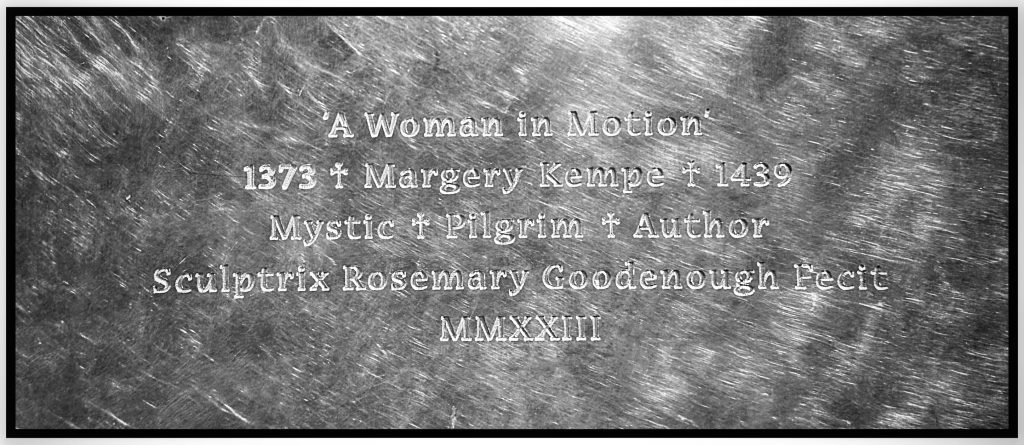
Photo © James Rye 2026
What the Sculpture Achieves
Seen in person, A Woman in Motion feels like a pause rather than a conclusion. It does not tell you what to think about Kempe, and it does not pretend that she was universally admired. Instead it gives you a stance and a direction, prayer and departure held together, and it lets the Minster’s space complete the meaning.
In that sense it is an unusually successful piece of public history. It does not flatten Kempe into a “first autobiographer” label, nor does it sentimentalise her into a harmless local saint. It preserves the defining truth: she belonged to Lynn, and she did not stay put.
© James Rye 2026
Book a Walk with a Trained and Qualified King’s Lynn Guide Through Historic Lynn
References
- Diocese of Norwich. “The Unveiling of the Margery Kempe Sculpture.” Diocese of Norwich (website), February 4, 2023. Accessed February 24, 2026. https://www.dioceseofnorwich.org/the-unveiling-of-the-margery-kempe-sculpture/
- Goodenough, Rosemary. “Exhibition History.” Rosemary Goodenough (official website). Accessed February 24, 2026. https://www.rosemarygoodenough.co.uk/exhibitionhistory
- Goodenough, Rosemary. “Sculptures.” Rosemary Goodenough (official website). Accessed February 24, 2026. https://www.rosemarygoodenough.co.uk/sculptures
- Margery Kempe Society. “New Margery Kempe Sculpture by Rosemary Goodenough.” By Laura Varnam. The Margery Kempe Society (blog), March 17, 2023. Accessed February 24, 2026. https://themargerykempesociety.wordpress.com/2023/03/17/new-margery-kempe-sculpture-by-rosemary-goodenough/
- Pilgrim Ways. “Margery Kempe: a ‘woman in motion’.” Pilgrim Ways (website), November 14, 2023. Accessed February 24, 2026. https://www.pilgrimways.org.uk/margery-kempe-m-a-woman-in-motion
- Windeatt, B. (Translator) (1965) The Book of Margery Kempe, Penguin (Modern English version)