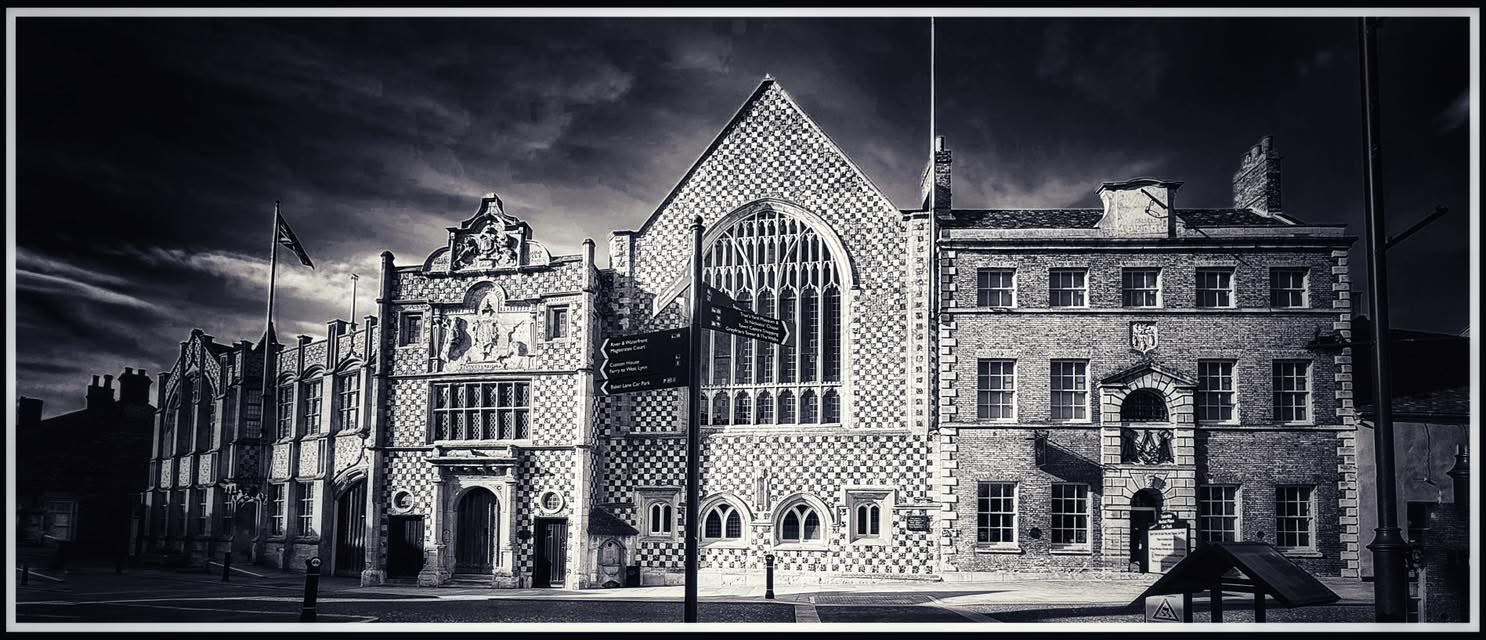
Cooper Roller Bearings in King’s Lynn: a local factory behind a world-class idea
If you want a reminder that King’s Lynn has never been only a port and a market town, you could do worse than start on Wisbech Road. For well over a century, the Cooper works in South Lynn has been turning out an engineering product most people never see, yet many industries cannot do without: the roller bearing. In Cooper’s case, the story hinges on one deceptively simple notion, first patented in the early twentieth century and still central to the firm’s identity today, namely the split roller bearing, made so it can be fitted around a shaft without dismantling the whole machine.
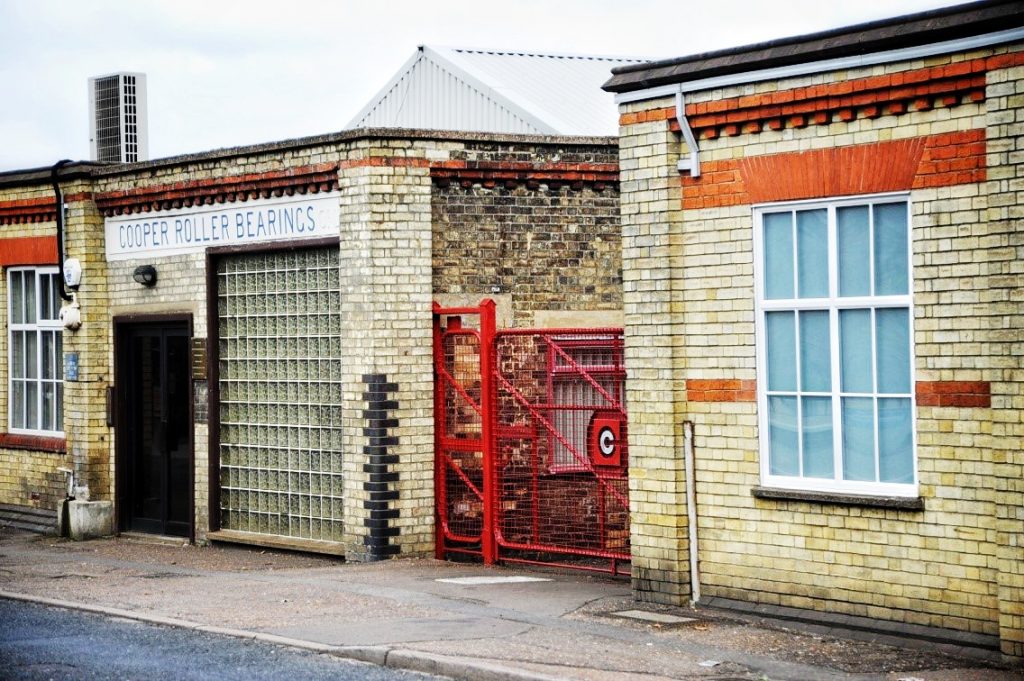
Photo: King’s Lynn Civic Society
That single design choice sounds modest, but it sits behind a business history that runs from late Victorian invention culture, through wartime production and mid-century engineering prestige, to modern global ownership under a Swedish industrial giant, while keeping manufacture rooted in King’s Lynn.
Thomas Cooper and the Founding of the Works, 1894
The firm begins with Thomas Cooper, born around 1855 and described as a brilliant engineer and prolific inventor. Before King’s Lynn, Cooper had already built a reputation in Norfolk engineering circles, including managerial work at iron works and a connection with the Farmers’ Foundry at Ryburgh. His early interests ranged widely across power transmission and bearing design, which matters because it places him in that late nineteenth-century world where practical mechanics, foundry work and inventive tinkering all fed directly into commercial enterprise.
In 1894 Cooper established operations in King’s Lynn at what became known as the Steel Works on Wisbech Road. It is worth picturing what that meant locally. Lynn in the 1890s was not Birmingham or Sheffield, but it did have a growing industrial base with strong ties to agriculture, engineering and the working life of a port town. Cooper was not dropping a factory into a cultural vacuum: he was building on an existing local economy that needed machinery, repair skills and metalworking.
Cooper’s initial commercial focus was not bearings at all, but agriculture. His first major invention, as presented here, was a “revolutionary steam digger” for arable farming, aimed at the needs of Norfolk’s agricultural economy. That detail matters because it reminds us that the company’s roots are in solving practical regional problems: how to mechanise heavy work in a landscape dominated by large-scale arable farming. From that base, it is less surprising that Cooper soon moved into the business of reducing friction, improving reliability and keeping machines running.
The Breakthrough: the Split Roller Bearing, 1907
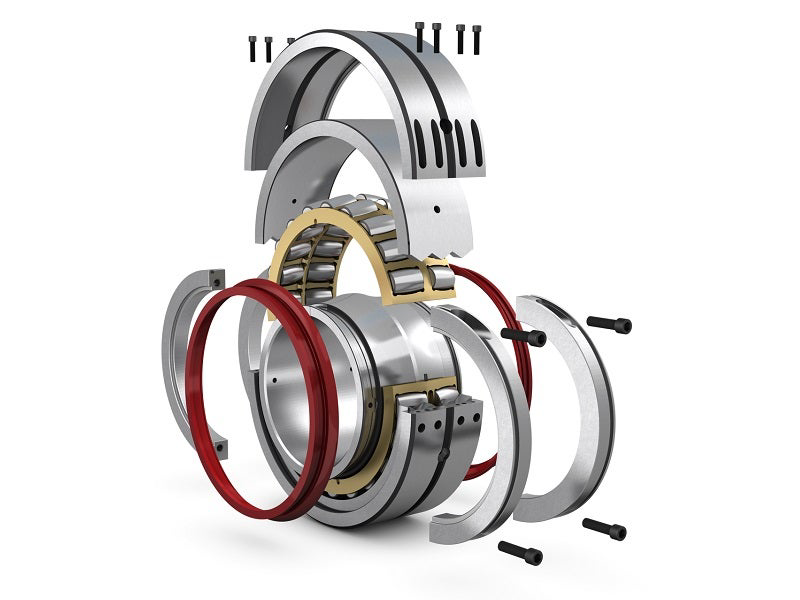
Cooper’s defining moment came in 1907, with the patenting of the world’s first split roller bearing (also described as a split-to-the-shaft bearing). The key advantage is straightforward: the bearing can be assembled around an existing shaft, rather than requiring the shaft and surrounding equipment to be stripped down so a solid bearing can be slid into place.
For adult readers who have never had to change a bearing on industrial machinery, the importance lies in what is not happening. You are not disconnecting couplings, lifting motors, removing gearboxes, dragging a shaft out of alignment, or dismantling guarding and housings simply to get access. In heavy industry, the cost of a bearing failure is often dominated by the cost of stopping production and the labour and lifting equipment required to reach the component. Cooper’s split design attacks that expensive part of the job.
There is a nice historical coincidence in the same year: 1907 is also when Sven Wingquist founded SKF after inventing the self-aligning ball bearing. At the time, these were separate stories of innovation; later, they would converge when Cooper became part of the SKF group.
Reduced Costs
Cooper’s split bearing reduced costs by reducing downtime and the knock-on work that downtime forces on an industrial site. If a conventional bearing sits on a “trapped” shaft, wedged between other components, you often have no option but to dismantle large sections of machinery to reach it. That means more fitter hours, more crane or hoist time, more disruption to alignment, and often additional replacement parts because dismantling creates its own damage and wear.
The split bearing changes the economics because you can open the bearing at the point of use, fit it around the shaft in situ, and close it up again. When you turn a multi-day strip-down into a job measured in hours, the savings are not just the price of labour. The larger saving is the avoided loss of production in continuous or high-throughput industries. In other words, Cooper sold time as much as it sold metal.
Early Patents, Marketing, and a Specialist Firm
By 1899 Thomas Cooper collaborated with William Hugh Woodcock on a patent for roller bearings, and by 1906 there were U.S. patent applications for improvements in roller bearing designs. By around 1910, the company’s advertising presented it as “THE COOPER COMPANY Specialists in Economical Power Transmission”, claiming over 38,000 roller bearings in use worldwide.
War and Invention
The Wisbech Road works did not exist in isolation from national events. During the First World War, the material states that the factory contributed to the war effort and that Thomas Cooper invented and produced some of the first small aerial bombs, supporting early aviation munitions capability. It also notes that the site was one of two main munitions-related facilities in the town. That is a striking reminder that a local engineering business could be pulled rapidly into wartime priorities, reshaping what the factory made, what skills it needed, and how it was regarded.
Coopers: A Bearing Company, 1923–1924
Thomas Cooper died in 1923 (aged about 68). The following year, the firm was formally incorporated as Cooper Roller Bearings Company Limited in 1924, and the “Cooper Steam Digger” business was absorbed into the bearing operations. That sequence is telling: the founder’s earlier agricultural invention matters historically, but the company’s future identity lay in bearings, and specifically in the split design. In a sense, the business simplified itself after Cooper’s death, narrowing from broad inventive engineering into a world-leading niche.
Sydney Kay and Mid-Century Prestige
If Thomas Cooper represents the late Victorian inventor-entrepreneur, Sydney Kay represents the twentieth-century engineering leader: a figure associated with refinement, reliability, and industrial recognition.
Engineering and production improvements continued into the 1920s, including a 1928 patent by Sydney Kay for “improvements relating to roller bearings”. It also records that Kay later became Director and Chief Engineer and that he received an OBE in 1952. Those details sketch a company whose technical leadership was being noticed nationally, and whose product was not a curiosity but an established industrial solution.
At the company there was a “family-oriented culture” with long employee tenures (an average of 22 years in later records). Whether one reads that as affectionate loyalty or hard-headed stability, it points to a factory where skills and experience stayed in place. For a product where fit, finish, tolerances and practical know-how matter, long service is not a sentimental footnote: it is part of how a specialist manufacturer maintains quality.
Coopers and The Jodrell Bank Telescope
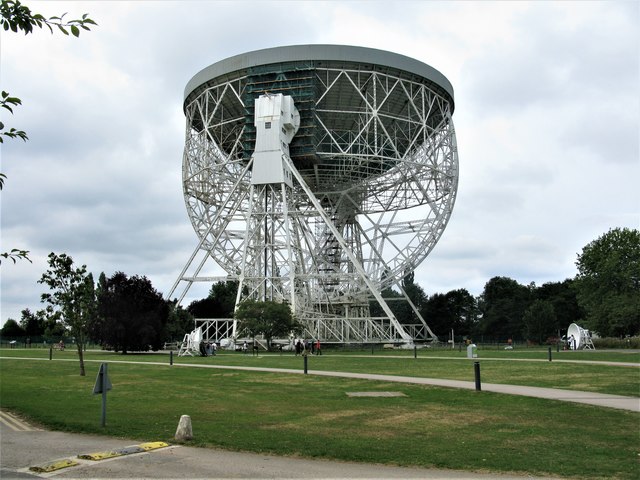
Local industrial history often attracts “it was used in…” claims that are hard to pin down. It has been claimed that Cooper split roller bearings were used in both the construction of the Sydney Harbour Bridge and in the Jodrell Bank Telescope. At the time of writing, the current author has been unable to find material to support the Sydney Harbour claim, but the claim about the part Coopers played in the construction of Jodrell Bank claim is very strong.
https://s0.geograph.org.uk/geophotos/05/86/67/5866718_bbb08cbb.jpg
The telescope in question is the Lovell Telescope at Jodrell Bank, begun in 1952 and brought into operation in 1957. The key evidence is an October 1954 issue of Contact, an in-house industrial magazine of David Brown companies. It claims that large cast steel bearing housings for the Jodrell Bank radio telescope were cast by David Brown Foundries (Penistone), machined by Buckley & Taylor (Oldham), and then delivered to “Cooper Roller Bearing Company Ltd.” for assembly. Martin Caspall (Product Engineering Manger for SKF) has confirmed the Jodrell Bank link and revealed that Cooper bearings were also used in the Middlesborough Lift Bridge.
Ownership Change, Global Brands
The Cooper story is also a reminder that “local manufacture” and “global ownership” are not opposites. In 1991 the U.S.-based Kaydon Corporation acquired the company. In 2013 SKF acquired Kaydon, bringing Cooper into the SKF group. By 2019 the brand was fully rebranded as SKF Cooper, combining the King’s Lynn heritage with SKF’s scale and global reach.
What comes through clearly in your material is continuity of manufacturing in King’s Lynn. Production remained in the town and the firm has continued to trade on the strength of its long-running specialism and “Made in England” identity.
© James Rye 2026
Book a Guided Walk with a Trained and Qualified King’s Lynn Guide
References
- Agg-Net. “Brand name change for Cooper Roller Bearings” (16 January 2018). https://www.agg-net.com/news/brand-name-change-for-cooper-roller-bearings
- Bearing News. “Making bearing conversions easy with the Cooper SNQ pedestal – Simple fitting, less downtime.” https://www.bearing-news.com/making-bearing-conversions-easy-with-the-cooper-snq-pedestal-simple-fitting-less-downtime/
- Borough Council of King’s Lynn & West Norfolk. “West Norfolk businesses open their doors on National Manufacturing Day” (30 September 2025). https://www.west-norfolk.gov.uk/news/article/1943/west_norfolk_businesses_open_their_doors_on_national_manufacturing_day
- Caspall, M. (2026) Private correspondence with SKF’s Product Engineering Manager
- Companies House (GOV.UK). “COOPER ROLLER BEARINGS COMPANY LIMITED (01643976).” https://find-and-update.company-information.service.gov.uk/company/01643976
- Contact (David Brown publication). Vol. 6, No. 10 (October 1954), article “Star Gazing” (PDF hosted by Penistone Archive). https://penistonearchive.co.uk/wp-content/uploads/2018/07/DB.-Vol-6.-No-10.-Oct-1954-OCR-125.pdf
- Encyclopaedia Britannica. “Jodrell Bank Observatory” (history section). https://www.britannica.com/topic/Jodrell-Bank-Observatory
- Jodrell Bank Centre for Astrophysics. “Construction of the Lovell Telescope.” https://www.jb.man.ac.uk/aboutus/lovell/build.html
- Kaydon Bearings. “SKF successfully closes offer to acquire Kaydon Corporation” (October 2013). https://www.kaydonbearings.com/news_SKF_acquires_Kaydon.htm
- King’s Lynn Civic Society. “Wisbech Road (east) Cooper Roller Bearings factory frontage.” https://www.kingslynncivicsociety.co.uk/local_list/wisbech-road-east-cooper-roller-bearings-factory-frontage/
- PES Media. “£720K investment at Kings Lynn foundry boosts productivity” (14 February 2020). https://www.pesmedia.com/skf-cooper-kings-lynn-foundry-investment-140220