Hunger on the Quay: When Bishop’s Lynn Stopped the Grain Ships
A June day at the waterfront
The grain was already on the move.
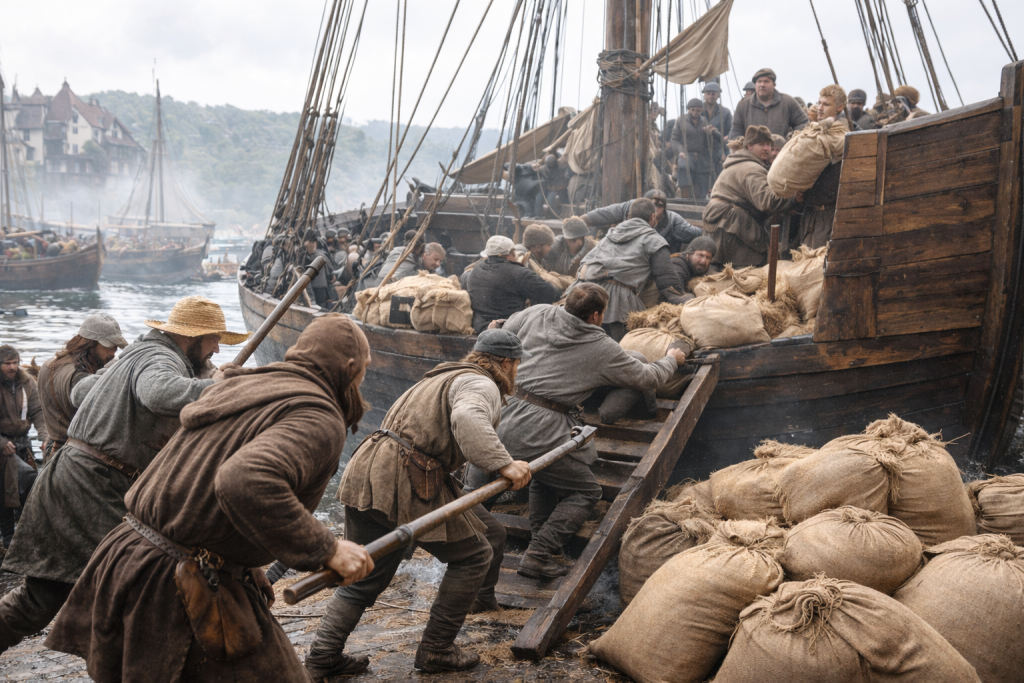
On 16 June 1347, at the busy port of Lynn, a crowd went down to the ships, boarded two vessels licensed to carry grain abroad, and unloaded them. Grain being brought into the town was seized and sold locally. This was not a drunken scuffle or a burst of aimless damage on the quayside. It was a direct attack on the movement of food out of a town that believed it could not spare it.
That is why the episode matters. Medieval riots are often imagined as noise, fury, and broken property. This one was something colder and more purposeful. People at Lynn saw corn being shipped away in a year of shortage, and they intervened.
A port rich enough to cause trouble
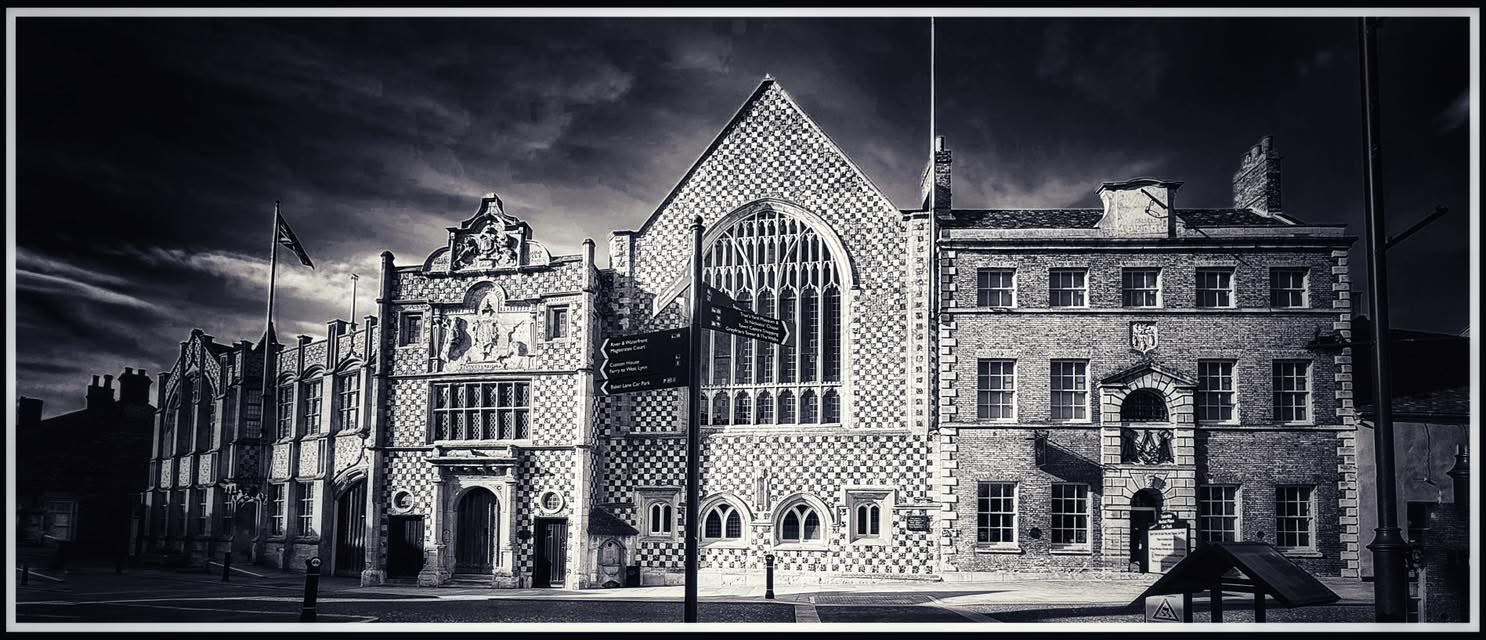
To understand why this happened at Lynn, it helps to begin with the town itself. Fourteenth-century Lynn was one of the chief ports of England, a place of warehouses, quays, tolls, merchants, carts, river traffic, and seagoing trade. It was tied into the producing countryside of Norfolk and beyond, and linked by water to wider markets around the North Sea and the Channel. Grain did not merely feed the town. It passed through it. That fact brought wealth, but it also brought danger in lean years.
A port sees scarcity differently from an inland village. In a village, shortage might be felt in the emptying bin or the rising market price. In a port, shortage might be visible on the quay itself. Sacks are loaded, accounts are settled, ships are prepared, and food that could have stayed is watched as it leaves. The trade becomes public. Everyone can see it.
That visibility sharpened resentment. What may have looked like lawful commerce to merchants, shipowners, or royal officials could look, to townspeople and nearby consumers, like a scandal enacted in full view. The grain was there. That was the point. It was present, countable, tangible, and yet still on its way out of the town.
Why was there a shortage?
The shortage was not caused by one single event. It appears to have grown from several pressures meeting at once.
The first was a year of dearth. England in 1347 was not in the grip of a catastrophe on the scale of the Great Famine a generation earlier, but harvest conditions had been poor enough to tighten supply and raise anxiety. Grain prices were under pressure. In such years, even a modest disturbance in supply could feel alarming, especially in a town dependent not only on local produce, but on the wider movement of food through trade.
The second pressure was export. Large quantities of grain were being licensed for shipment overseas, above all to Gascony. Lynn was one of the ports involved in that trade, and substantial amounts of grain moved out from the town in May and early June 1347, only days before the riot itself. That timing matters. It suggests not a long-smouldering civic grievance, but a sudden and immediate sense that food was being drained away at precisely the wrong moment.
Then there was the Hundred Years’ War with France. Gascony was still an English possession, and supplying it was bound up with the Crown’s military and political priorities. Grain exports were not merely private ventures in search of profit. They formed part of a wider system of royal licensing, overseas commitment, and strategic need. What was prudent policy in one context could look, from Lynn quay, like a dangerous betrayal of local subsistence.
Put those things together, and the shape of the crisis becomes clearer. A town in a year of shortage watched grain leave under lawful authority for an overseas destination favoured by the Crown. The legal position was one thing. The local moral position was another.
The crowd’s argument
The people who acted at Lynn do not seem to have thought of themselves as common thieves. That matters, because medieval food riots were often less concerned with destroying property than with correcting the market by force. The crowd did not simply wreck the ships and disperse. They unloaded grain and redirected supply into local sale. That points to a rough but recognisable principle. Food should feed people before it fed profit. In a hungry market, export looked like an offence against the proper order of things.
This was a claim about priority. Grain was a commodity, certainly, but not an ordinary one. Bread was not cloth, pepper, or timber. When food was short, many people believed that its movement ought to be governed by duty as well as by licence and price. The Lynn riot sits squarely within that way of thinking. It was not a rejection of the market altogether. It was a demand that the market behave properly in a time of want.
That is why the episode feels so modern in outline, even though it belongs firmly to the medieval world. The crowd saw supply leaving a strained town and decided that formal permission was not enough to make it right.
What exactly happened?
The surviving evidence gives the outline more clearly than the atmosphere. We can say that on 16 June 1347 a crowd boarded two ships at Lynn that had been licensed to export grain. The grain was unloaded. Other grain being brought into the town was seized and sold locally. That combination is revealing. The first action stopped food leaving. The second pushed food back into the town’s market. This was not merely obstruction. It was intervention.
What we lack is the fuller texture. We do not have, at least not readily in printed form online, a vivid local narrative telling us who first raised the alarm, who led the crowd, what was shouted on the quay, how the shipmen reacted, or whether the mayor tried to restrain the townspeople before matters got out of hand. The legal and administrative record fixes the event securely enough, but the human scene comes to us only in fragments.
Even so, the fragments are enough to suggest order within the disorder. A crowd that knows which ships to board, which cargo to unload, and how to force grain into sale is not acting blindly.
A short crisis with a sharp edge
One striking feature of the Lynn riot is how compressed the chronology seems to have been. Heavy exports from the town were taking place in May and early June. The riot came on 16 June. That narrow gap gives the episode its sharpness. This was not the end of a long campaign. It looks much more like a sudden popular response to visible and immediate pressure. Shortage was being felt, grain was being shipped, and the crowd chose to stop it.
Lynn was not alone
The Lynn disturbance belonged to a wider wave of unrest. Other towns also saw disorder over grain in 1347, including Bristol and Boston, and there is evidence that similar agitation spread inland as well. That wider pattern matters. It shows that Lynn was not behaving in some eccentric local fashion. Rather, the town was one point in a broader English crisis, where scarcity, export, and state priorities collided.
Still, Lynn’s position as a major port gave its riot a particular force. In a place so deeply tied to maritime commerce, the conflict between local need and long-distance trade was unusually stark. The ships themselves became the argument.
How did the authorities respond?
This was no minor disturbance. The crowd was accused not only of unloading licensed grain and forcing its sale, but of arresting corn merchants, sending owners or carriers to the pillory without due process, and even arresting the mayor and other inhabitants. Later summaries also suggest that the town itself was later fined £40. The Crown had every reason to treat such an event as dangerous. It challenged not only property, but royal authority over trade and supply.
Yet the government’s own position was not entirely steady. As scarcity deepened in 1347, grain exports were restricted more tightly. That does not mean the crowd at Lynn got its way in any simple sense, nor that the riot alone changed policy. It does show that official anxiety about supply was real. The people on the quay were not inventing a shortage that did not exist.
Broken Order
The crowd that stopped the grain in 1347 forced that tension into the open. For a moment, local need outweighed licence, custom, and the wider interests of the Crown overseas. That is why the riot deserves remembering. It is among the earliest clearly recorded food riots in England, and it shows with unusual clarity how medieval people could turn against the market not because they rejected order, but because they believed order had been broken already.
© James Rye 2026
Book a Guided Walk with a Trained and Qualified King’s Lynn Guide
References
Blackmore, Robert A. The Political Economy of the Anglo-Gascon Wine Trade, 1154–1500. PhD diss., University of Southampton, 2018. University of Southampton Research Repository. https://eprints.soton.ac.uk/425276/1/LIBRARY_COPY_RBlackmore_The_Political_Economy_of_the_Anglo_Gascon_Wine_Trade_eThesis.pdf
Bohstedt, John. “Riot Census I.” University of Tennessee PDF hosted with materials related to The Politics of Provisions. https://web.utk.edu/~bohstedt/files/RCI_Ch2inPP_1580-1650.pdf
British History Online. “The Wine Trade with Gascony.” In The London Lay Subsidy of 1332. https://www.british-history.ac.uk/manchester-uni/london-lay-subsidy/1332/pp256-311
Owen, Dorothy M., ed. The Making of King’s Lynn: A Documentary Survey. London: Published for the British Academy by Oxford University Press, 1984. Internet Archive record. https://archive.org/details/makingofkingslyn0000unse
Sharp, Buchanan. Famine and Scarcity in Late Medieval and Early Modern England: The Regulation of Grain Marketing, 1256–1631. Cambridge: Cambridge University Press, 2016. Chapter 3, “The Food Riots of 1347.” https://www.cambridge.org/core/books/famine-and-scarcity-in-late-medieval-and-early-modern-england/food-riots-of-1347/956430FA73635CF748AC053C838AF4DC