A market monument at the heart of King’s Lynn
At the northern end of King’s Lynn’s Tuesday Market Place there once stood one of the town’s most striking lost buildings: the Market Cross. It was not an isolated ornament, nor merely a picturesque survival from an older age. It stood in the middle of trade, noise, bargaining, regulation, and public life. The Borough Council’s own history of the markets notes that Tuesday Market Place was marked by a market cross with shambles and shops around it, and that the last structure on this site was an ornate cross designed by Henry Bell, built in 1710, demolished in 1831, and functionally succeeded by the Market House of 1832 and then the Corn Exchange of 1854. That sequence gives the broad outline, but it does not convey just how important the Cross once was to the life of Lynn.
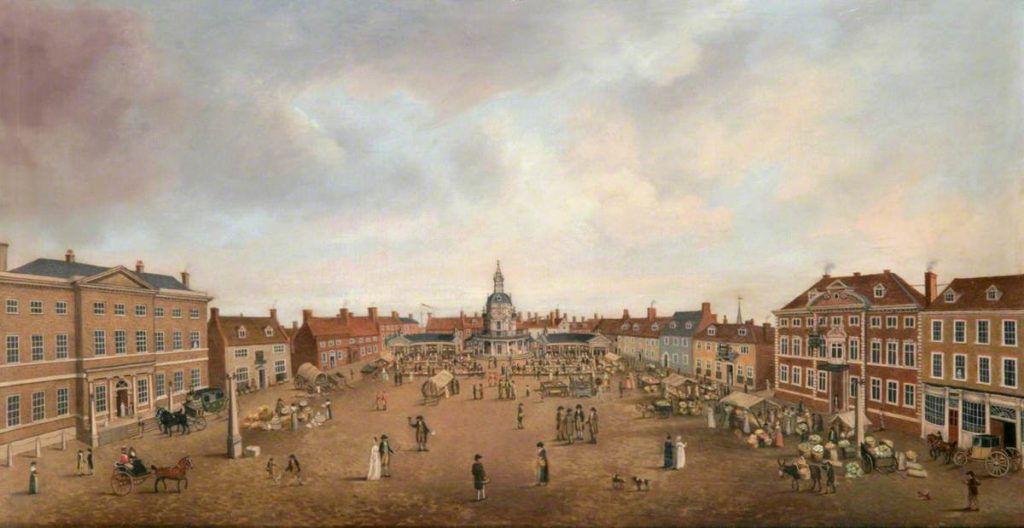
The Tuesday Market itself was probably given clearer legal shape by Henry VIII’s charter of 7 July 1529, which allowed the town to hold two markets each week. From the medieval period onward, both market places were laid out with rails and semi-permanent stalls or shops. In other words, the Cross belonged to a long commercial tradition. It should be imagined not in splendid isolation, but as part of a crowded working market, framed by butchers’ shambles, shop fronts, inns, and the daily movement of people and goods.
Before Bell: earlier crosses on the same King’s Lynn site
One of the first things to say is that Bell’s Market Cross was not the first on the site. Hillen wrote that “a succession of market crosses” had graced the Tuesday Market. He preserved an uncertainty that is itself revealing. According to one antiquarian note, the “old” market cross was built in 1618; according to another, in 1660 or 1661; yet Hillen was clear that there had been a cross there even earlier, in the reign of Mary or Elizabeth. The precise dating of the pre-Bell structure is therefore not entirely secure, but the continuity of the site is. This was an old civic focus before Bell touched it.
There is another useful clue. Hillen remarks that in the flood of 1606–07 the tide reached the Market Cross, which shows that the Cross was already a recognised landmark in the townscape by the early seventeenth century. That detail matters because it anchors the earlier cross in a real event rather than in later antiquarian guesswork. By the time Bell came to redesign the structure, the site had already been part of Lynn’s public geography for generations.
The older cross was also a working building. In the old Market Cross there was a guard room where the town’s “Red Coats” or javelin men kept watch over peace and property during the mart. The market cross was bound up with supervision, order, and the practical management of the market. It was not simply a symbol; it was part of the town’s apparatus.
Bell’s rebuilding: the 1710 Lynn Market Cross
The Cross for which the site is best remembered was the one built from designs by Henry Bell and completed in 1710. The older seventeenth-century cross had become unsafe and was taken down, after which a new one was erected from Bell’s plans. The cost, £596 10s., was supplied by interested subscribers. That is a revealing little detail. The Cross was civic architecture, but it was also a subscription project supported by townspeople with a stake in the market and in Lynn’s public appearance.
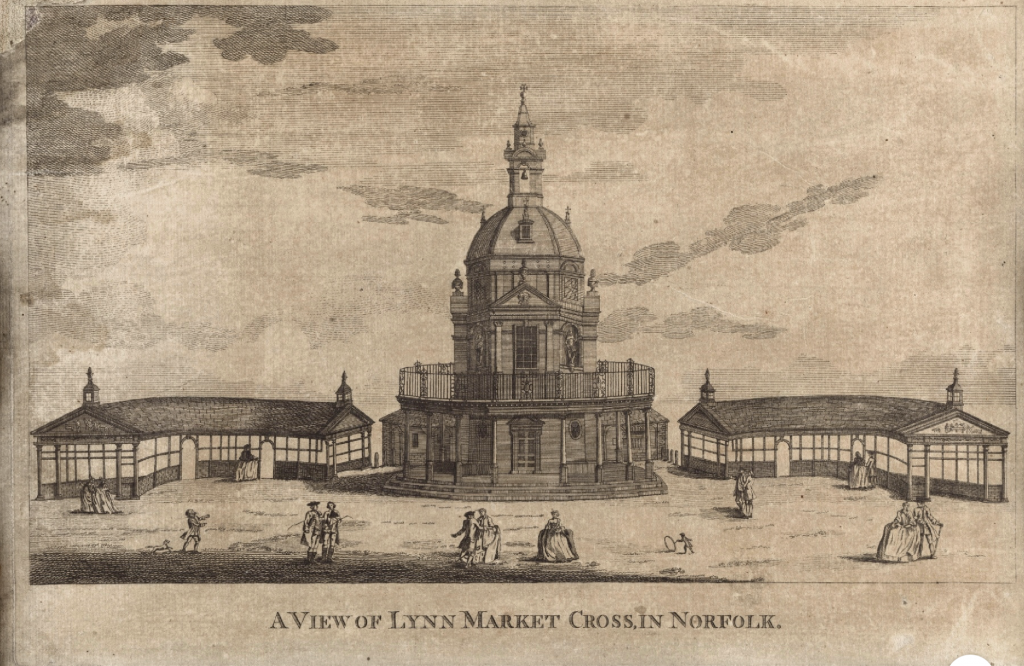
Hillen’s description of Bell’s structure is unusually full and gives us a clear sense of its ambition. It was built of freestone. Its core was a peristyle of sixteen Ionic columns carrying an octagonal upper room. On four alternate sides of that room, where there were no windows, stood statues. On each side were shambles and shops, the plan forming quadrants terminated by low turrets. Above the central mass rose a cupola, then a bell turret, and finally a small cross. The entire structure reached about seventy feet in height. Even on paper, this is a theatrical composition. It was much more than a practical shelter for traders. It was a piece of urban display, a deliberate statement that the Tuesday Market was the ceremonial and commercial centre of an important provincial town.
This helps explain why Bell’s Market Cross lingers so strongly in the memory of Lynn, even though it no longer exists. Bell is naturally remembered above all for surviving buildings such as the Customs House and the Duke’s Head, but the lost Cross seems to have been among his boldest civic conceptions. The Cross took the older English idea of a market cross and refashioned it in a more classical and architecturally assertive manner. Its Ionic columns, octagonal upper chamber, statuary, cupola and bell turret gave Tuesday Market Place a skyline feature of real distinction.
More than a building: trade, politics, discipline
It would be a mistake to write about the Market Cross as though it were only an architectural curiosity. Its setting and uses matter just as much. The Borough Council’s market history stresses that the Cross stood among shambles and shops. The Cross therefore belonged to the daily economy of Lynn. It was a centre around which meat selling and retail activity were organised, and it gave architectural form to the commercial life of the square.
It also played a part in elections. Hillen records that hustings were erected immediately in front of the Market Cross, with a raised central platform for speeches and side enclosures for poll clerks and checkers. There the freemen tendered their votes, and there the formalities surrounding bribery and corruption were read out. That detail brings the building very close to the political life of the unreformed borough. The Cross was not merely beside the action. It was part of the stage on which civic and parliamentary drama unfolded.
There was a harsher side too. Culprits were once made to stand before the Cross labelled with the nature of their offences. Nearby stood the pillory on the Tuesday Market Place, a necessary emblem of market jurisdiction and public discipline. The area around the Cross was therefore one in which trade, authority and shame met each other in plain sight. To modern eyes that may seem severe, but in an early modern market town it made a grim kind of sense. Buying, selling, policing and punishing all belonged to the same public arena.
Why the Market Cross disappeared
For all its grandeur, Bell’s Cross had a fatal weakness. It was partly built upon an arch turned over a well on the east side. In time it settled unevenly and leaned ominously westward. After about 120 years it was demolished. The materials were sold by public auction in April 1831 for £160 and bought by Sir W. J. M. B. Ffolkes, who used them in constructing the lodge at Hillington.

The end came in stages rather than in a single dramatic moment. Corporation minute book entries showing that in February 1826 there was already discussion of rebuilding the Cross and erecting new shambles. In February 1828 plans for a new Market House were laid before the Corporation. On 23 July 1829 the Tuesday Market Committee was authorised to take down the Cross, with explicit instructions to preserve the pool or well beneath it. At the same time the Angel Inn was ordered to be taken down. A new Market House was then erected on the Angel site, with its foundation stone laid in April 1830; later it gave way to the present Corn Exchange. Historic England’s listing for the Corn Exchange confirms the same broad sequence: Market House on the Angel site, replacing the demolished Market Cross and surrounding shambles, then Corn Exchange in 1854.
That sequence is worth pausing over because it shows what the town thought it was doing. Lynn was not carelessly sweeping away an old monument for no reason. Rather, it was transferring the functions of the old market complex into a new nineteenth-century form. The Cross disappeared because it had become unstable, but the commercial logic of the site continued. In that sense, the Market House and then the Corn Exchange were heirs to the old Cross even though they looked utterly different.
Conclusion
The Market Cross of Tuesday Market Place was one of King’s Lynn’s most important lost buildings. It stood on a site with a longer history than Bell’s rebuilding alone suggests. It united architecture with commerce, politics, policing and ceremony. Bell’s 1710 structure gave the market an imposing classical centrepiece, but its unstable foundations condemned it, and by 1831 it had gone. What remains is a trail of documentary and visual evidence strong enough to show that this was no minor feature of the square. It was one of the defining monuments of Georgian Lynn, and its loss altered the character of Tuesday Market Place for good.
© James Rye 2026
Book a Guided Tour with a Trained and Qualified King’s Lynn Guide
References and further reading
- Art UK. “Old Market Cross.” Art Detective, Norfolk Museums Service / King’s Lynn Museums. Accessed March 11, 2026. URL:
https://artuk.org/artdetective/propose-a-discussion/painting/old-market-cross-467615 - Art UK. “Tuesday Market Place, King’s Lynn, Norfolk.” Accessed March 11, 2026. URL:
https://artuk.org/discover/artworks/tuesday-market-place-kings-lynn-norfolk-27 - Borough Council of King’s Lynn and West Norfolk. “History of Markets.” Accessed March 11, 2026. URL:
https://www.west-norfolk.gov.uk/info/20186/markets/407/history_of_markets - Google Arts & Culture. “Market Cross.” After Henry Bell, 1745/1755. Lynn Museum, King’s Lynn. Accessed March 11, 2026. URL:
https://artsandculture.google.com/asset/market-cross-after-henry-bell/8wHZavwLAvfjOA - Hillen, Henry J. History of the Borough of King’s Lynn. Vol. 2. Norwich: East of England Newspaper Co., 1907. Accessed via Internet Archive, March 11, 2026. URL:
https://archive.org/details/historyofborough02hilland text viewhttps://archive.org/stream/historyofborough02hill/historyofborough02hill_djvu.txt - Historic England. “Corn Exchange, Non Civil Parish.” List entry 1212488. Accessed March 11, 2026. URL:
https://historicengland.org.uk/listing/the-list/list-entry/1212488 - Historic England. “Customs House including North Bank of Purfleet Quay.” List entry 1195414. Accessed March 11, 2026. URL:
https://historicengland.org.uk/listing/the-list/list-entry/1195414 - KL Magazine. “How Henry Bell Changed the Face of King’s Lynn.” Accessed March 11, 2026. URL:
https://www.klmagazine.co.uk/articles/henrybell