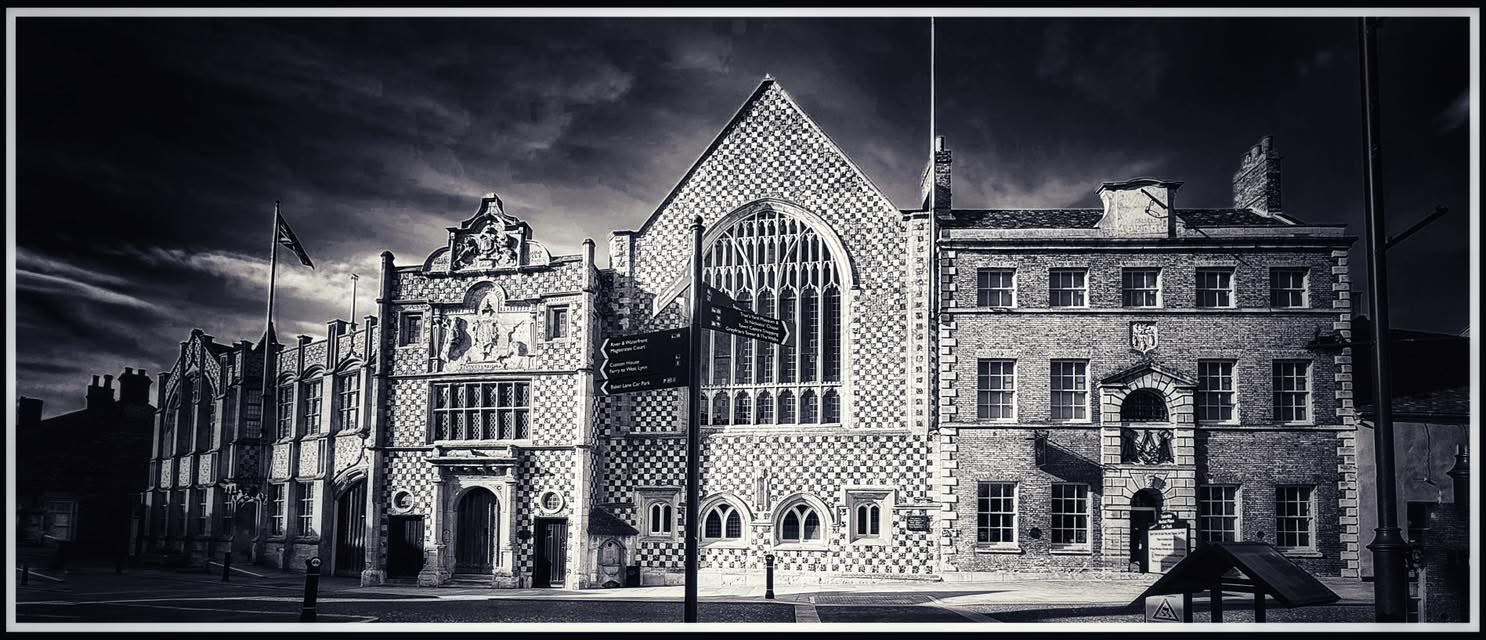
Refugee in King’s Lynn Minster: Naomi Blake’s Quiet Monument in the Holy Trinity Chapel
Finding the sculpture
If you make your way beyond the choir stalls at King’s Lynn Minster, you will find a small bronze-coloured sculpture titled Refugee. It is the sort of work people often notice twice: first as a human shape held tightly in on itself, then as something that belongs to the building’s moral atmosphere as much as its visual one. KL Magazine records that the sculpture is “unique to the Holy Trinity Chapel” and, importantly, that it was donated to the Minster by Naomi Blake herself.
Naomi Blake, and why this subject was never abstract for her
Naomi Blake (1924–2018) survived Auschwitz and went on to train at Hornsey School of Art, building a career in Britain that often returned to themes of persecution, protection, and human endurance. The Royal British Society of Sculptors places her biography and artistic purpose side by side, noting her experience of the Holocaust and her commitment to commemoration and interfaith understanding.
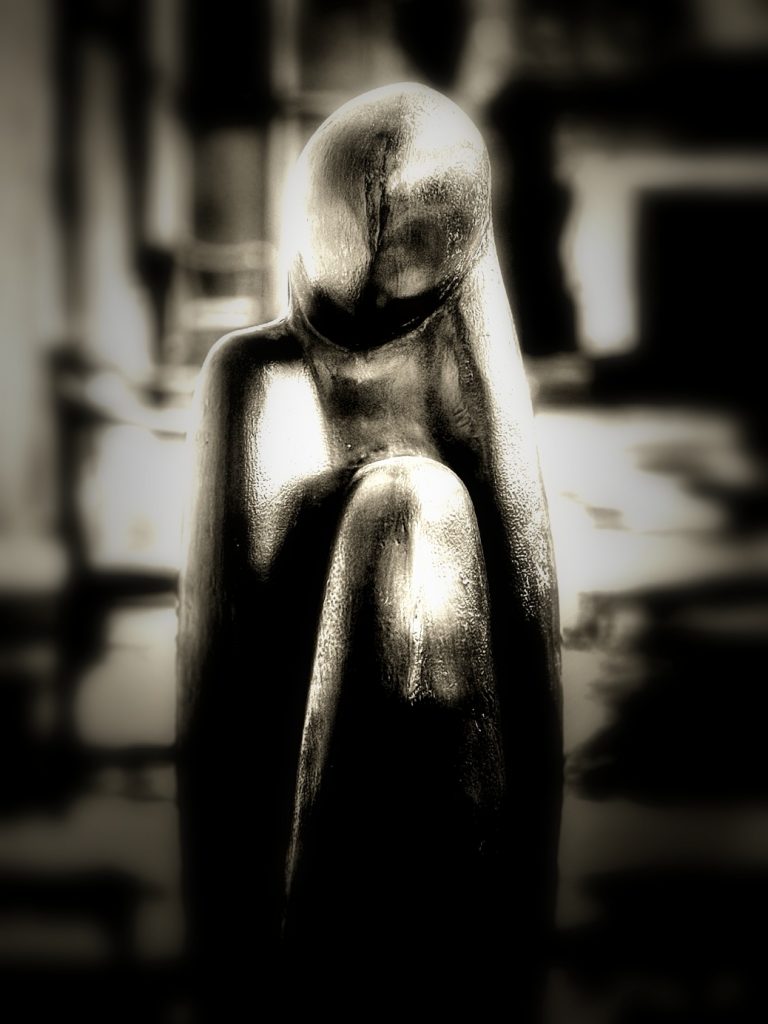
Photo © James Rye 2026
For King’s Lynn there is also a firm point on the timeline. Blake’s own published chronology records the public unveiling of Refugee at St Margaret’s Church, King’s Lynn, in 1990. That date anchors the piece in the town’s late twentieth-century story rather than making it feel like a recent “interpretive” addition.
What the form communicates, without any label at all
Blake’s sculpture is pared down and direct. The figure is compressed into a guarded posture, head lowered, body drawn inward. You do not need to be told it is about fear and fatigue. It reads quickly, but it does not finish quickly. The longer you look, the more the shape suggests the uneasy mixture that sits inside the word “refuge”: shelter, certainly, but also constraint, dependence, and the suspicion that safety can be provisional.
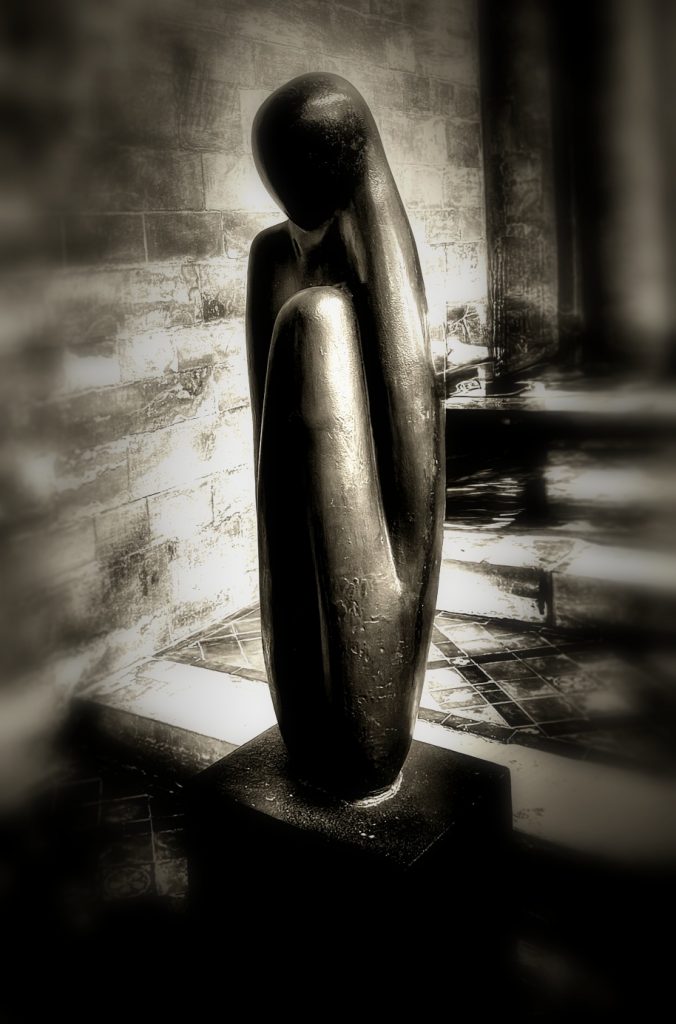
Photo © James Rye 2026
This is one reason the work suits a chapel rather than a busy aisle. The Holy Trinity Chapel gives it the quiet it needs. Visitors can stand close, step back, circle slightly, and notice how much of the emotional force comes from silhouette and posture rather than from detail.
When the Minster carried it out into the Market Place
The King’s Lynn sculpture has also done something rare for an artwork in a church. During the first days of Russia’s full-scale invasion of Ukraine in 2022, the Diocese of Norwich recorded that King’s Lynn Minster held a public vigil and took “our sculpture called ‘Refugee’ by Naomi Blake” into the Market Place to represent those fleeing.
That moment is worth holding on to, because it shows how the Minster understands the sculpture. It is not only an object to be looked at. It can be carried into civic space as a focus for public grief, solidarity, and prayer. St Margaret’s has always been more than a private interior, and Refugee has, in its own way, joined that tradition.
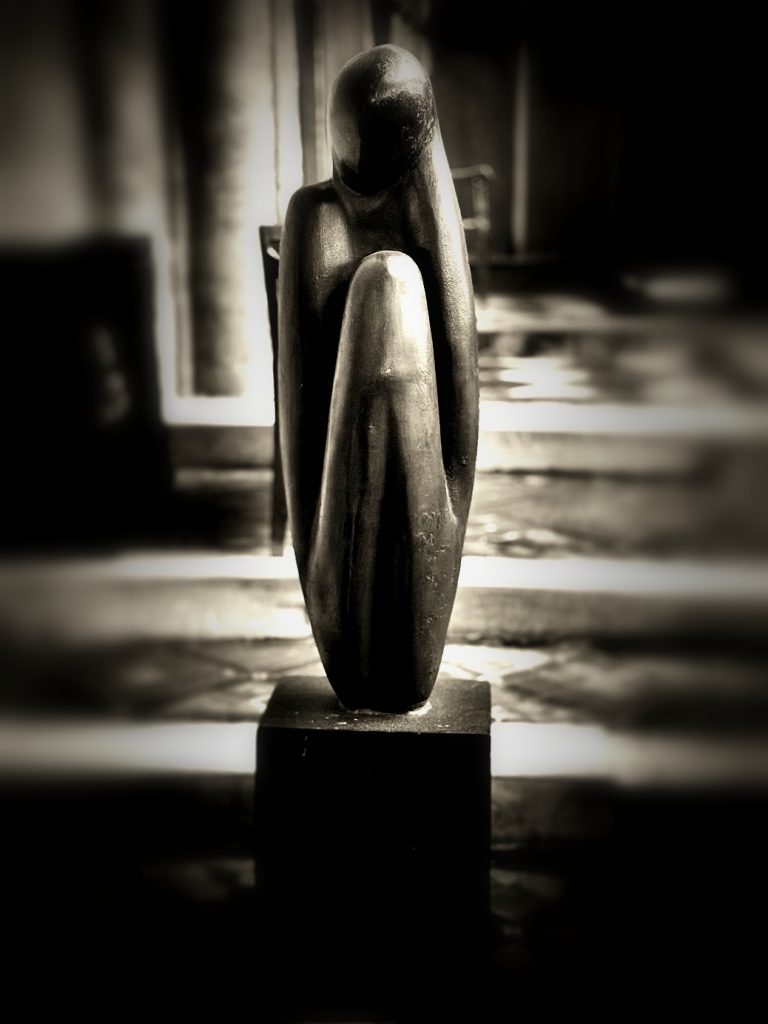
Photo © James Rye 2026
Other Naomi Blake works in churches and cathedrals
King’s Lynn sits within a wider pattern. Blake’s sculpture often appears in religious settings, which give her subjects a public visibility without forcing them into the language of slogans. The Art and Christianity (Ecclesiart) listing for Blake’s Family Group conveniently draws together several of these works: Refugee at Bristol Cathedral (1980), Mother and Child at Norwich Cathedral (1984), and Sanctuary at St Botolph without Aldgate, London (1985), among others.
Bristol is especially suggestive. Art UK records a Refugee by Blake at Bristol Cathedral, sited in the churchyard. Taken together with King’s Lynn, it points to a repeated choice: to place a refugee figure where anyone might encounter it, not only those who come looking for art.
Norwich Cathedral’s Mother and Child gives a different emphasis, but it still belongs to the same moral world. The Registry of Archived Commissions in Norfolk and Suffolk notes the work and its dedication “to the promotion of understanding.” Then, at St Botolph without Aldgate, Sanctuary carries an explicit dedication to victims of oppression, recorded in a Geograph entry for the sculpture. These are not neutral decorations. They are ethical statements set at the boundary between private devotion and public life.
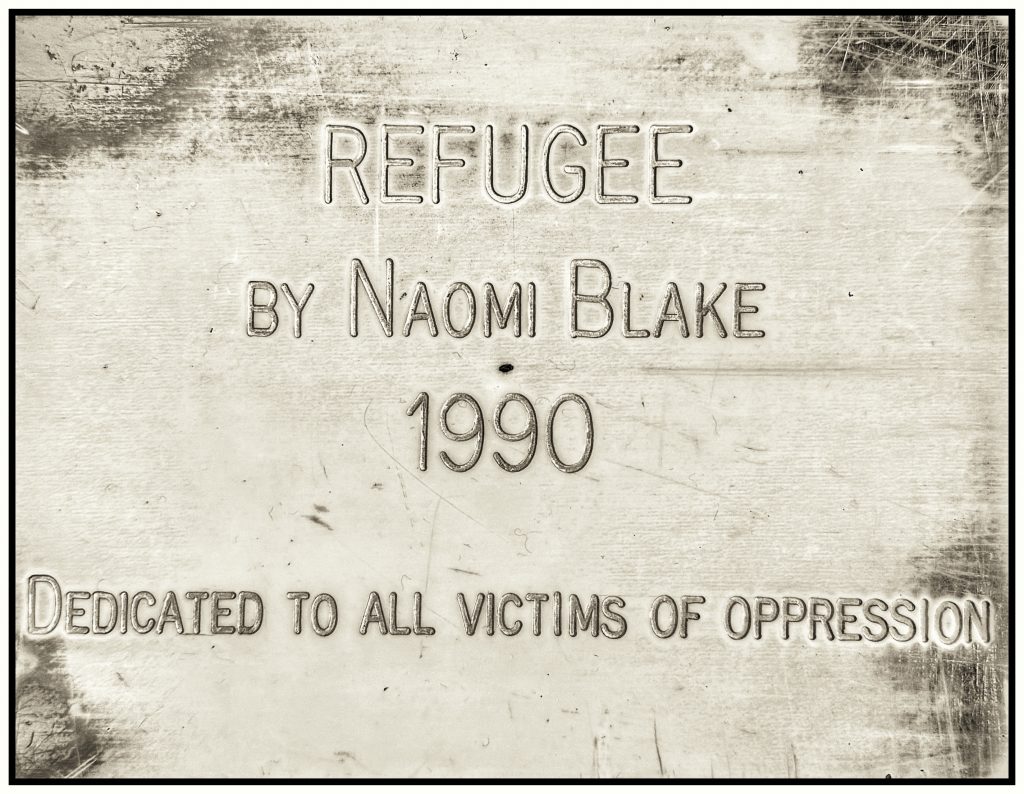
Photo © James Rye 2026
Why it matters in King’s Lynn
For a visitor today, Refugee can be encountered simply as a powerful figure in a quiet chapel. Yet it also fits, neatly and without fuss, into the long civic role of the Minster. The unveiling in 1990 situates it in the recent history of the town, while the 2022 vigil shows it still has the capacity to speak into the present. If you stand with it for a moment, it becomes difficult to treat “refuge” as an abstract topic. Blake, who knew what it meant in the hardest sense, created a work that asks the rest of us to look steadily and not look away.
© James Rye 2026
Book a Guided Walk with a Trained and Qualified King’s Lynn Guide
References
- Art and Christianity. “Naomi Blake: Family Group.” Published January 10, 2024. https://artandchristianity.org/ecclesiart-listings/naomi-blake-family-group
- Art UK. “Refugee.” Accessed March 1, 2026. https://artuk.org/discover/artworks/refugee-284229
- Diocese of Norwich. Prayer Diary 4 (Summer 2022). PDF. Published 2022. https://www.dioceseofnorwich.org/wp-content/uploads/2022/05/Prayer-Diary-4-Summer-2022.pdf
- Geograph. Oliver Dixon. “TQ3381: ‘Sanctuary’ by Naomi Blake.” Published March 15, 2016. https://www.geograph.org.uk/photo/4863953
- KL Magazine. “The Minster, King’s Lynn.” Accessed March 1, 2026. https://www.klmagazine.co.uk/articles/kl-minster
- Naomi Blake (official website). naomi blake timeline updated Sat 11 edited gs. PDF. Accessed March 1, 2026. https://naomiblake.co.uk/naomi%20blake%20timeline%20updated%20Sat%2011%20edited%20gs.pdf
- Registry of Archived Commissions in Norfolk and Suffolk (RACNS). “Mother and Child.” Accessed March 1, 2026. https://www.racns.co.uk/sculptures.asp?action=getsurvey&id=22
- Royal British Society of Sculptors. “Naomi Blake FRBS.” Accessed March 1, 2026. https://sculptors.org.uk/about/our-archive/pioneering-women/naomi-blake
- Flickr. mira66. “Refugee by Naomi Blake, 1990, dedicated to all victims of oppression.” Uploaded January 22, 2011. https://www.flickr.com/photos/21804434@N02/5377827148/