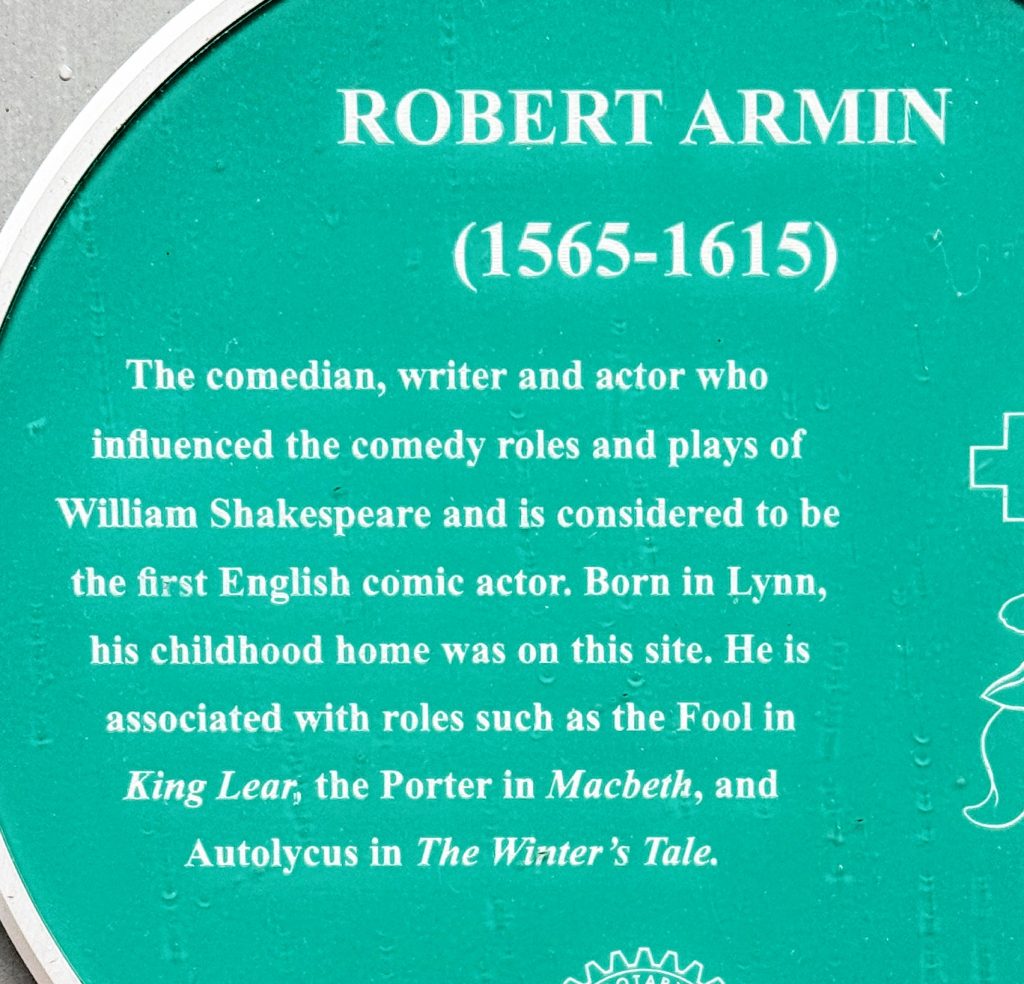
A green plaque on the High Street
On King’s Lynn’s High Street, a green plaque marks the house now associated with Robert Armin: 78 High Street, one street from St George’s Guildhall. It is a modest setting for a man who became one of the most interesting comic performers in Shakespeare’s England.
The local claim needs careful handling. The firmest early document is not a birth certificate but an apprenticeship record. On 13 October 1581, “Robart Armyn,” son of John Armyn of Lynn in Norfolk, tailor, was apprenticed in London to John Lonyson, citizen and goldsmith. That entry anchors Armin securely in Lynn and in a family of middling craft status. Modern local research and commemoration place his early home at what is now 78 High Street.
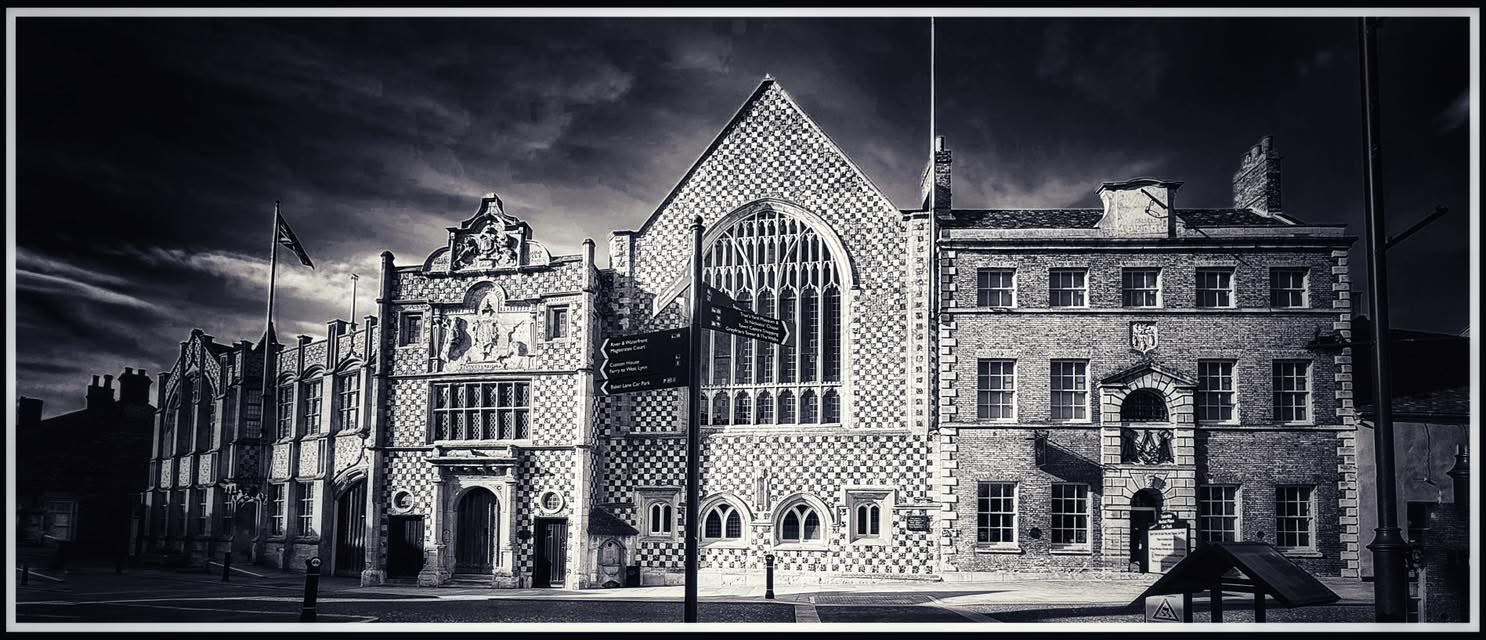
Tudor Lynn was a substantial port, proud of its civic institutions, guild traditions, river trade, and London links. Until Henry VIII’s reign it had been Bishop’s Lynn; after 1537 it was King’s Lynn. Armin grew up in a town where medieval buildings, Reformation change, mercantile life, and public entertainment met in close streets and open halls.
St George’s Guildhall is central to Lynn’s Shakespeare story, and it is tempting to imagine young Armin watching performances there. The evidence does not let us say that. What we can say is firmer: a Lynn tailor’s son entered London through apprenticeship and became one of the King’s Men, Shakespeare’s own company.
The apprentice with a sharp tongue
Armin’s apprenticeship was to last eleven years. A goldsmith’s workshop was a disciplined world of craft, calculation, trust, and urban company life. It was also a route by which a provincial youth could enter the capital’s networks.
A later theatrical anecdote claimed that Armin was noticed by Richard Tarlton, Queen Elizabeth’s famous clown. The story has Armin, still a young apprentice, showing off his wit in a chalked verse over an unpaid debt. Tarlton supposedly recognised him as a comic heir.
It is a good story, but still a story. The apprenticeship record is stronger evidence than the Tarlton tale. Even so, the anecdote shows how Armin was remembered: not simply as a tumbler or jester, but as a verbal comedian.
Into Shakespeare’s company
By the 1590s, Armin had become a professional player. He was associated with Lord Chandos’s company before joining the Lord Chamberlain’s Men, probably around 1599. That date matters because Will Kemp, Shakespeare’s earlier comic star, left the company around the same time.

In 1603, when James I came to the throne, the Lord Chamberlain’s Men became the King’s Men. Armin’s name appears in the royal patent with Shakespeare, Richard Burbage, John Heminges, Henry Condell, Augustine Phillips, William Sly, and others. The Lynn man had entered the central company of the English public theatre.
Armin is often linked with Touchstone in As You Like It, Feste in Twelfth Night, and the Fool in King Lear. We do not have cast lists proving these parts. The case rests on timing, company membership, Armin’s musical and verbal gifts, and the striking fit between his interests and Shakespeare’s later fools.
After Kemp: the clever fool
Kemp’s comedy was bodily, festive, rustic, and crowd-pleasing. Armin’s appears to have been sharper, more verbal, more musical, and more inward.
Shakespeare’s later fools do not merely interrupt the plot with jokes. They test language. They expose self-deception. They move between song, satire, and truth-telling.
Touchstone mocks the conventions of pastoral romance. Feste moves through Twelfth Night as singer, servant, commentator, and survivor. Lear’s Fool is comic, loyal, frightened, riddling, and devastating. He is not there only to amuse Lear. He is there to tell the king, in broken comic form, that he has torn apart his family and kingdom.
Jack Oates and the comedy of misrule
Jack Oates appears in Armin’s Foole upon Foole, first published in 1600 under the comic pseudonym “Clonnico de Curtanio Snuffe.” Armin later reworked the material in A Nest of Ninnies in 1608, this time under his own name and with a more reflective frame.
Jack is introduced as “a flat foole,” one of six fools described in the book. The language is unkind, and Armin’s world is not ours. Early modern writers often treated people with intellectual disability, eccentric behaviour, or unusual speech as household entertainment. Yet Armin’s handling is more observant than simple mockery. He notices how folly works inside households and how the supposed fool can disturb the confidence of the supposedly wise.
In one episode, Jack plays cards alone. Seeing a knave in the pack, he speaks to it as a knave. A servant nearby thinks Jack has insulted him, another servant joins in, and a quarrel grows from a pun. One word has slipped from playing card to insult to social identity.
In another episode, a nobleman kisses Lady Holles in courteous greeting. Jack, misunderstanding the code of aristocratic manners, boxes him on the ear. He has grasped the rule of marriage but missed the rule of ceremony. Armin calls this “wit in simplicity,” a phrase that catches much of his comic method. Jack is wrong, but his wrongness has its own logic.
The best-known Jack Oates scene is the quince pie. Sir William Holles wants a special quince pie, and the household goes to trouble and expense to prepare it. Jack steals it, hides it under his coat, finds it too hot, jumps into the moat, and eats it there while the household watches from the windows. Appetite defeats hierarchy. The master’s delicacy becomes the fool’s feast.
Natural and artificial fools
Armin returns often to the distinction between the “natural” fool and the “artificial” fool. In early modern usage, a natural fool meant someone understood as foolish by nature or condition. An artificial fool was a performer, someone who played the fool by craft.
The distinction is not simple. Armin shows that folly can be both condition and performance. The artificial fool uses wit to lay traps and feeds the eyes of spectators. The natural fool does not choose folly, but may still expose the folly of everyone else.
When Armin revised Foole upon Foole as A Nest of Ninnies, he made this idea clearer. The later book adds a frame involving Sotto and the World. Folly becomes a mirror. The world looks at fools and is invited to recognise itself.
Will Sommers and useful folly
Armin’s account of Will Sommers, Henry VIII’s famous jester, adds another layer. Sommers is not presented merely as a comic dependent. He appears as a man who could cheer the king, intercede for poor people, assist widows, and use comic licence near power.
This was one privilege of the fool. He could speak slantwise. He could ask what courtiers dared not ask. He could soften anger with absurdity or reveal truth through laughter.
That helps explain why Armin’s likely Shakespearean roles matter. Feste sees through Olivia, Orsino, Malvolio, and Sir Toby. Touchstone tests lovers, shepherds, and courtiers. Lear’s Fool has no power, but he sees what the king has done.
Armin the writer
Armin also wrote for the stage. The History of the Two Maids of More-clacke was printed in 1609. Its title page describes him as “servant to the King’s most excellent Majesty,” a reminder that theatrical service under James I was recognised status.
He also belongs to the printed culture of comic pamphlets and performance books. Quips upon Questions, Foole upon Foole, A Nest of Ninnies, and The Italian Taylor and his Boy show a man alert to verbal play, social type, and comic misunderstanding.
Armin understood persona, timing, and the licensed freedom of the fool. He knew that laughter could flatter an audience, trap it, or turn suddenly against it.
Last years in Aldgate
Armin’s later years are only partly visible. The registers of St Botolph Aldgate record children of Robert Armin, player, and his own burial in November 1615. The burial entry describes him as “free of the Goldsmiths and a Player.” It is a compact life in two phrases: the city apprentice who became a freeman, and the freeman who became a player.
His name also appears among the principal actors listed in Shakespeare’s First Folio of 1623, printed after both Shakespeare and Armin were dead.
For King’s Lynn, Armin deserves more than a local footnote as “the man who knew Shakespeare.” A tailor’s son from Lynn, now associated with 78 High Street, entered London through the Goldsmiths’ Company and helped reshape English stage comedy. He belonged to the world in which Shakespeare’s fools became cleverer, sadder, more musical, and more dangerous.
The best fools are never only fools. Robert Armin knew that. Shakespeare, very probably, knew it partly through him.
© James Rye 2026
Book a Guided Tour with a Trained and Qualified King’s Lynn Guide Through Historic Lynn
References
Armin, Robert. A Nest of Ninnies. London, 1608. Reprinted in Fools and Jesters: With a Reprint of Robert Armin’s Nest of Ninnies, 1608. London: Shakespeare Society, 1842. https://www.helsinkicorpus.arts.gla.ac.uk/browse.py?format=hc&fs=100&highlight=¶ms=true&pb=true&pln=false&text=armin&toc=author
Armin, Robert. Foole upon Foole, or, Six Sortes of Sottes. London: William Ferbrand, 1605. Early English Books Online 2, University of Michigan Library Digital Collections. https://quod.lib.umich.edu/e/eebo2/B01234.0001.001
Armin, Robert. The History of the Two Maids of More-clacke. London: N. O. for Thomas Archer, 1609. Folger Early Modern English Drama. https://emed.folger.edu/tmmc
Denkinger, Emma Marshall. “Actors’ Names in the Registers of St. Bodolph Aldgate.” PMLA 41, no. 1 (1926): 91-109. https://www.jstor.org/stable/457652
Henze, Catherine A. “Robert Armin.” In The Cambridge Guide to the Worlds of Shakespeare, edited by Bruce R. Smith, 948-53. Cambridge: Cambridge University Press, 2016. https://www.cambridge.org/core/books/cambridge-guide-to-the-worlds-of-shakespeare/robert-armin/90199D86F73FF3A20EE003AED7BA5AD0
Mullini, Roberta. “‘These Sixe Parts of Folly’: Robert Armin’s Moralising Anatomy of Fools’ Jests.” In Theta XI: Théâtre Tudor, 23-40. Tours: Centre d’Études Supérieures de la Renaissance, 2013; online 2014. https://sceneeuropeenne.univ-tours.fr/wp-content/uploads/2025/07/THETA11.pdf
National Trust. “The History of St George’s Guildhall.” https://www.nationaltrust.org.uk/visit/norfolk/st-georges-guildhall/the-history-of-st-georges-guildhall
Norfolk Heritage Explorer. “King’s Lynn Parish Summary.” Norfolk County Council. https://www.heritage.norfolk.gov.uk/record-details?TNF1488-King%27s-Lynn-%28Parish-Summary%29=
Wiles, David. Shakespeare’s Clown: Actor and Text in the Elizabethan Playhouse. Cambridge: Cambridge University Press, 1987.