Stone has a special force in medieval miracle stories. It is heavy, visible, and public. A fever may leave little for witnesses to inspect; a vision may depend on the trustworthiness of the person who saw it. A fallen stone is different. It can be shown, weighed, carried, remembered, and sometimes built into the reputation of a saint, shrine, or town.
These stories are not neutral accident reports. They are religious narratives, often shaped by monastic writers, shrine communities, friars, local memory, or institutional pride. Yet they are valuable for precisely that reason. They show how medieval people interpreted sudden danger. A stone fell; a body survived; meaning was built afterwards.
Edward I and Our Lady of Walsingham
One of the neatest examples belongs to Edward I and the shrine of Our Lady of Walsingham. The story, preserved in the Walsingham tradition and reported by later chroniclers, places Edward as a young man in a vaulted chamber, playing chess. For no clear reason, he rises and moves away. At that moment, a large stone falls from the roof onto the place where he had just been sitting. His escape is attributed to the Virgin, and Edward is said thereafter to have honoured Our Lady of Walsingham with special devotion.
The tale is shaped with admirable economy. Edward does not save himself by speed, strength, or judgement. He is moved before he understands the danger. The stone gives physical proof of what might have happened. The shrine receives the gratitude.
This matters because Edward’s devotion to Walsingham was not imaginary. He is recorded at the shrine on a number of occasions during his reign, and J. C. Dickinson counted twelve visits. The falling-stone story therefore does more than entertain. It gives a sacred explanation for a real royal pattern: repeated favour shown by one of England’s most formidable kings to a Norfolk shrine.
Margery Kempe in St Margaret’s, Bishop’s Lynn
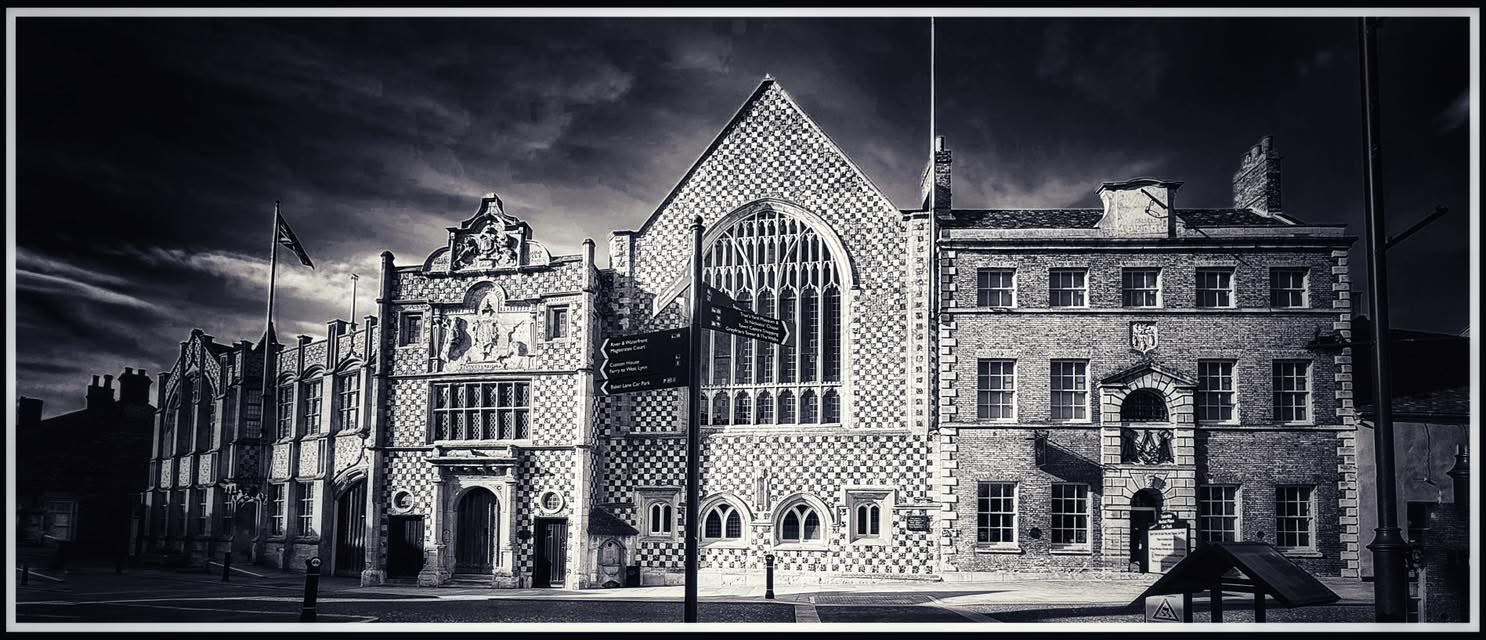
The finest Norfolk example is Margery Kempe’s experience in St Margaret’s church at Bishop’s Lynn, now King’s Lynn. In The Book of Margery Kempe, the incident takes place on the Friday before Whitsun Eve. Margery is hearing Mass in the church. Some people have been saying that God should take vengeance on her. She kneels in prayer, head bowed, with her book in her hand.
Then the building itself seems to answer. From the highest part of the church vault, from beneath the foot of a spar, a stone falls onto her head and back. A short piece of timber falls with it. The book gives the weights: the stone is three pounds, and the timber six pounds. Margery thinks her back has broken. She cries, “Jesus, mercy,” and the pain disappears. For twelve weeks afterwards, the book says, she feels no pain.

The reaction is more interesting than the escape itself. John of Wyreham comes to her, assuming she must be badly hurt. Master Aleyn, a White Friar and doctor of divinity, investigates the matter, obtains the stone, weighs it, and recovers the timber after a church keeper has put it on the fire. He declares the event a miracle. Some people glorify God. Others refuse that interpretation and prefer to see the fall as a token of wrath and vengeance.
This is the most human of the stories. The stone does not settle Margery’s reputation. It becomes part of the argument. To her supporters, it proves divine preservation. To her critics, the blow itself looks like judgement. A parish church in Lynn becomes the stage for a dispute over holiness, gender, authority, and public behaviour.
It is also a reminder that medieval churches were not only sacred spaces. They were physical buildings, with roofs, vaults, beams, stones, keepers, hazards, and maintenance problems. In Margery’s story, the spiritual and architectural worlds meet with a thud.
St William of York and the Stone as Evidence
York Minster supplies another strong example, this time in glass. St William of York, the twelfth-century archbishop canonised in 1226, became the focus of a vigorous cult. His great window at York Minster, made in the early fifteenth century, presents his life and miracles in a rich visual sequence.
Among those miracles is a servant who falls asleep during Matins, resting against the pulpit. A stone column of considerable weight falls onto his head. He is unharmed, gives thanks to St William, and walks away. Another sequence shows a man hanging decorative textiles in a church when a stone falls and strikes him. In the following scene, the man carries the stone in procession before St William’s portable reliquary.
That last detail is splendid. The stone is not thrown away. It is not treated as a shameful accident. It becomes the proof. York Minster even preserves a block of stone with a medieval Latin inscription identifying it as the stone that fell on the head of Roger of Ripon. The dangerous object becomes a witness.
Here the miracle is almost legal in its handling of evidence. There is an injured man, an object, a saintly intervention, and a public act of thanksgiving. The stone is carried because it speaks.
St Edmund of Abingdon and the Empty Seat
A similar pattern appears in the Oxford legend of St Edmund of Abingdon, later Archbishop of Canterbury. The story says that Edmund, while a young scholar, was sitting at his desk when he rose and moved away. A stone then broke loose from the masonry and destroyed the seat where he had been.
This is the same narrative shape as Edward I’s chessboard story: an unexplained movement, an empty place, a falling stone, and a life preserved. In such stories, survival depends not on seeing the danger but on being removed from it in time.
It is also a place-making legend. St Edmund Hall still uses the story as part of the memory of its name and early identity. Whether the incident can be recovered as historical fact is another question. Its importance lies in the way sanctity was anchored to a building, a seat, and a moment when death arrived just too late.
St Thomas Becket and the Child beneath the Wall
At Canterbury, the miracle tradition of St Thomas Becket gives us a domestic version. In the Becket Miracle Windows, made for the area around the shrine, one sequence concerns Geoffrey of Winchester, a child of about sixteen months. After an earlier healing, disaster strikes again: a wall falls on his cradle and buries him. His family call upon St Thomas. The rubble is cleared. The child is found unharmed.
This is not a single stone falling from a vault, but it belongs to the same family of stories. A heavy built structure collapses; a vulnerable body should be crushed; the expected harm does not happen. The survival becomes part of the saint’s public record.
Canterbury’s version also shows how domestic terror could become shrine art. A household accident is translated into stained glass. Private fear is made visible to pilgrims. The cradle, the rubble, the praying family, and the rescued child all point towards Becket’s continuing power after death.
St John Thwing of Bridlington
St John Thwing, better known as St John of Bridlington, adds a Yorkshire example, though one that needs more caution. John was born at Thwing in the Yorkshire Wolds around 1320, became an Augustinian canon at Bridlington Priory, served as prior, died in 1379, and was canonised in 1401. His cult developed quickly, and his tomb at Bridlington became a place of pilgrimage.
A modern account of his miracles records that John was struck by a large falling stone but suffered no ill effects. This is much briefer than the accounts attached to Margery Kempe or St William of York, and it would be worth checking against the printed miracle material before leaning too heavily on it. Even so, it fits the pattern: the saint’s body is marked out by the failure of stone to do what stone normally does.
Our Lady of the Crag, Knaresborough
The chapel of Our Lady of the Crag at Knaresborough gives the motif a Marian and architectural ending. The chapel was associated with John the Mason and a foundation date of 1408. The local story says that John’s son was in the path of a sudden rockfall in the quarry. John was too far away to rescue him, so he cried out to the Virgin Mary. The boy survived, and John carved or founded the chapel in thanksgiving.
The chapel’s own historical account is properly cautious: the foundation story is described as legend or conjecture, not secure documentary fact. Still, it is a fine example of the same religious imagination. Falling stone threatens life; Marian protection is invoked; gratitude becomes a building.
Why Falling Stone Made Such Good Miracle Material
These stories worked because they joined danger to evidence. The object remained. Margery’s stone and timber were weighed. Roger of Ripon’s stone was carried before St William’s reliquary. Edward’s stone marked the place where a future king had been sitting. Edmund’s stone destroyed an empty seat. Becket’s miracle windows showed the rubble around a child’s cradle.
They also worked because the medieval church was both sacred and material. People prayed beneath roofs that might leak, vaults that might crack, towers that might shift, and timbers that might fail. The setting was already holy, but it was never weightless. A falling stone inside a church brought together two truths that medieval people did not keep apart: the body was vulnerable, and the built world could be read for signs.
The interpretations were not always peaceful. Margery Kempe’s case shows this best. A miracle could be praised by some and rejected by others. A survival might be read as mercy, while the same blow was read by hostile neighbours as punishment. The stone did not remove disagreement. It hardened it.
The Weight of Proof
The appeal of these stories lies in their bodily simplicity. Stone should crush. Flesh should yield. When it does not, medieval observers ask why.
Their answers differ. The Virgin has preserved a prince at Walsingham. Christ has spared a controversial woman in Lynn. St William has saved a servant and a man named Roger of Ripon at York. St Edmund has risen from the fatal seat in Oxford. St Thomas has protected a child beneath a fallen wall at Canterbury. St John of Bridlington’s sanctity is shown, briefly but tellingly, by an unharmed body. At Knaresborough, a rockfall becomes the remembered beginning of a chapel.
To write about these stories well, we need neither sneer at them nor flatten them into fact. Their historical value lies in the act of interpretation. They show how accident could become testimony, and how a piece of fallen stone could be turned into a sign, an argument, an offering, or a foundation.
The stones fell. The bodies survived. The meanings were built afterwards.
© James Rye 2026
Book a Guided Tour with a Trained and Qualified King’s Lynn Guide Through Historic Lynn
References
A Guide’s Guide. “Trinity Chapel South.” A Guide’s Guide to Canterbury Cathedral. https://guides-guide.org/tour/trinity-chapel-south/
Bridlington.net. “John of Thwing: Celebrating a Hidden Saint in Bridlington.” Bridlington.net. https://bridlington.net/john-of-thwing/
Canterbury Cathedral. “Miracles and Masterpieces.” Canterbury Cathedral. https://www.canterbury-cathedral.org/visit/what-will-you-discover/miracles-and-masterpieces/
Dickinson, J. C. The Shrine of Our Lady of Walsingham. Walsingham Archives. https://www.walsinghamanglicanmedieval.org.uk/dickinson1.htm
Kempe, Margery. The Book of Margery Kempe: Book I, Part I. Middle English Texts Series. University of Rochester, Robbins Library Digital Project. https://metseditions.org/read/3L34BgNubNPUyz9TMz9ZcV6Y24X0l8
Sanok, Catherine. “John of Bridlington, Mitred Prior and Model of the Mixed Life.” In Religious Men and Masculine Identity in the Middle Ages, edited by P. H. Cullum and Katherine J. Lewis, 143–159. Woodbridge: Boydell & Brewer, 2013. https://www.cambridge.org/core/books/abs/religious-men-and-masculine-identity-in-the-middle-ages/john-of-bridlington-mitred-prior-and-model-of-the-mixed-life/688C35243BDE236A836A48FE8A015CAE
St Edmund Hall, University of Oxford. “St Edmund of Abingdon and the Origins of the Medieval Hall.” 22 October 2019. https://www.seh.ox.ac.uk/blog/origins-of-hall
St Mary’s Knaresborough. “The Chapel of Our Lady of the Crag.” https://www.stmarysknaresborough.org/chapel-of-our-lady-of-the-crag
The Chapel of Our Lady of the Crag. “History 1408–1916.” https://www.ourladyofthecrag.org/history-1408-1915
York Glaziers Trust. “The St William Window.” Stained Glass Navigator. https://stainedglass-navigator.yorkglazierstrust.org/window/st-william-window/explore
York Glaziers Trust. “22d: The Man Is Hit on the Head by a Falling Stone.” Stained Glass Navigator. https://stainedglass-navigator.yorkglazierstrust.org/window/st-william-window/panel/22d
York Glaziers Trust. “22e: Carrying the Stone, the Man Leads the Portable Reliquary in Procession.” Stained Glass Navigator. https://stainedglass-navigator.yorkglazierstrust.org/window/st-william-window/panel/22e
York Minster. “The Miracles of St William of York.” York Minster. https://yorkminster.org/discover/behind-the-scenes/the-miracles-of-st-william-of-york/