On a summer evening two centuries ago, a small group of men left the edge of King’s Lynn and walked east toward a wooded clearing at Reffley. Lantern light flickered among the trees and was reflected in the iron-rich waters of a spring, long believed to possess restorative powers.
Nearby stood an obelisk dedicated to Bacchus and Venus, and beyond it a modest octagonal building known as Reffley Temple. Here, once each year, members of a local brotherhood gathered to dine, drink punch made from the spring, and repeat ceremonies already old when they themselves first attended.
The building has vanished, the society dissolved, and the landscape transformed by modern housing, yet for more than two centuries this secluded place formed one of the most unusual centres of social life connected with King’s Lynn.
Although no single contemporary account describes a gathering at Reffley in full, scenes such as the above can be reconstructed with unusual confidence. A late seventeenth-century landscape painting, surviving photographs of the Temple before its demolition, archaeological discoveries around the spring, and scattered references in local records together allow the outline of the society’s practices to emerge. What at first appears a curious rural tradition proves, on closer examination, to be part of a much longer story linking landscape, memory, and sociability on the outskirts of King’s Lynn.
Reffley Temple: A Place Half Remembered
On the eastern side of King’s Lynn, beyond the historic town and once separated from it by open fields and managed woodland, stood a building whose importance lay less in architecture than in continuity of custom. Reffley Temple, demolished in the later twentieth century, was the meeting place of a convivial society that preserved traditions extending across at least two centuries and possibly longer. Today the site survives only as fragments: a circular stone basin marking the former spring, buried structural remains, scattered artefacts recovered by archaeologists, and a small but valuable body of paintings and photographs. Yet when assembled together these sources reveal a ceremonial landscape that played a distinctive role in the social history of the town.
Unlike Lynn’s guildhalls, churches, or civic buildings, Reffley Temple existed outside formal authority. It belonged neither to parish structures nor municipal governance. Its significance rested instead upon voluntary association and repeated ritual gathering. The Temple’s story therefore illuminates an aspect of provincial English life that rarely survives clearly in the historical record: the informal institutions through which communities expressed loyalty, friendship, humour, and shared identity.
The Spring and the Early Landscape near King’s Lynn
The origin of the site lies not in a building but in water. A chalybeate spring emerged in low ground east of Gaywood, its iron-rich waters long believed to possess restorative qualities. Mineral springs attracted attention throughout early modern England, where medical theory, curiosity, and leisure combined to create modest centres of sociability far from major spa towns. Reffley never developed into a commercial resort, yet evidence shows that it became locally significant at an early date.
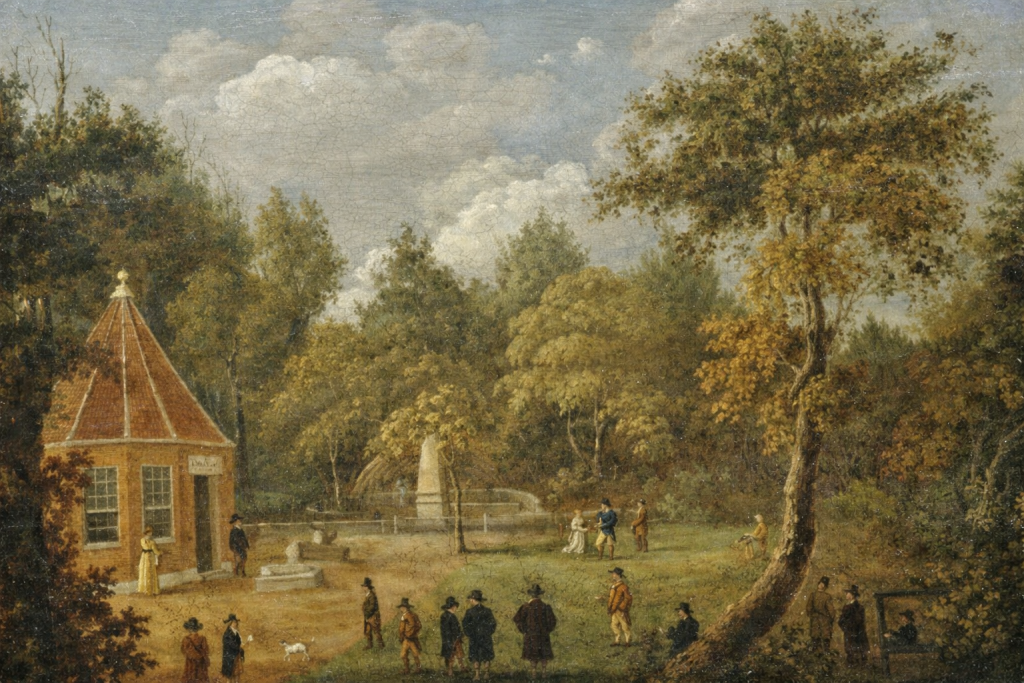
Norfolk Museums Service (Lynn Museum), via Art UK
There is some documentary evidence (medieval Latin records using forms such as capella de Refleia or capella de Refley) indicating that the site may have had a small chapel during the C12th-C14th, serving the local population of Gaywood, possibly connected with the Benedictine Priory of St Faith at Horsham St Faith. However, by the early C15th if it was associated with this site, it had fallen out of use.
By the C17th, the site had a different usage. A painting usually dated to about 1697, preserved within the Norfolk Museums Service collections and catalogued through Art UK, depicts visitors gathered around a stone-lined basin set within a managed woodland clearing. The landscape is neither wild nor agricultural but intentionally shaped, suggesting regular visitation. An obelisk appears beside the spring, indicating that the site had already acquired symbolic meaning by the later seventeenth century. The painting is invaluable because it demonstrates that communal activity at Reffley preceded the construction of the Temple itself.
This early evidence alters how the site should be understood. The Temple was not the origin of the tradition but its architectural expression. The spring was the constant element around which later ceremony developed.
The Reffley Brethren and the Culture of Convivial Societies
Associated with the spring was a group known as the Reffley Brethren, sometimes called the Sons of Reffley. It has been claimed that the Reffley Brethren was an organisation founded in King’s Lynn in the 17th century in defiance of a Cromwellian order which forbade the assembly of thirty persons or more, though there are no written records. After the restoration of the monarchy the objects of the club were ‘conviviality and good fellowship’.
The principal drink at the annual meeting was a punch prepared from a secret recipe containing water from the nearby spring which is in the same enclosure as the Temple. By the eighteenth century they functioned as a convivial society composed of local gentlemen, professionals, military officers, merchants, and landowners. Their gatherings centred on annual meetings involving shared meals, ritual drinking, speeches, and inherited customs that reinforced continuity between generations.
Such societies were widespread in Georgian England. Dining clubs, friendly societies, and informal brotherhoods provided structured sociability outside church and state, allowing participants to cultivate identity through ceremony. The Reffley Brethren fit comfortably within this broader pattern, yet retained a distinctive attachment to place through their association with the spring.
Accounts emphasise that the society pursued no political programme. Its activities were social rather than ideological, though its symbolism retained echoes of Royalist sentiment. Membership appears to have crossed occupational boundaries while remaining socially selective, reflecting the provincial elite culture of eighteenth- and nineteenth-century Lynn.
Archaeological discoveries at the site strongly support documentary descriptions. Excavations undertaken by the West Norfolk and King’s Lynn Archaeological Society recovered fragments of fine tableware, clay tobacco pipes, and domestic refuse associated with repeated feasting episodes. These finds confirm sustained ceremonial dining rather than casual recreation.
Classical Imagery and the Making of a Ceremonial Landscape
During the mid-eighteenth century the Brethren reshaped the spring into a consciously symbolic setting. The obelisk was dedicated to Bacchus and Venus, invoking classical associations with wine, pleasure, and sociability. The adoption of pagan imagery was typical of Georgian antiquarian humour, in which classical references lent mock gravity to convivial activities.

Wikipedia Commons
The obelisk reportedly carried a dramatic inscription warning that anyone removing it should die the last of his race. Such language reflected theatrical playfulness rather than superstition, yet it contributed to the aura of inherited tradition surrounding the site. Later photographs record sphinx sculptures flanking the entrance to the Temple, reinforcing the classical aesthetic. These decorative choices align closely with eighteenth-century garden design, where temples and symbolic monuments transformed rural settings into landscapes of meaning.
The important point is that Reffley was never religious in purpose. Classical symbolism provided a language through which fellowship could be ritualised without ecclesiastical authority. The landscape itself became a stage upon which continuity was performed.
Print, music, and a painted memory
Reffley was not only an oral tradition. It entered print. The Norfolk Topographer’s Manual records John Grisenthwaite’s Reffley Spring, an Epistle in Verse, printed at Lynn in 1804, and a broadsheet titled Revised Rules of Reffly, printed at Lynn in 1830. These titles show the Reffley world as literary, rule-bound, and locally self-conscious.
There was also music. Thomas Arne, the composer best known for “Rule, Britannia!”, wrote a cantata called Reffley Spring. A scholarly list of Arne’s secular solo cantatas gives the work as published in London by C. and S. Thompson, probably in 1764. Reffley Spring had acquired a wider cultural identity by the 1760s.
A visual record also survives. Lynn Museum holds a painting titled Reffley Spring, dated to about 1818 and believed to be by William H. Oldmeadow. It shows the spring, temple, and brethren. It is one of the richest surviving images of the place, though it should be read with care. A painting may record, arrange, idealise, and commemorate all at once.
Sir Martin Browne Folkes and public celebration
Reffley was not only a private club in woodland seclusion. It could also be drawn into the public and political life of Lynn. Henry J. Hillen’s history of King’s Lynn records a large festival at Reffley on 18 June 1818 to celebrate the return of Sir Martin Browne Folkes. The gathering took place near the chalybeate spring, with a large pavilion and punch made from the spring water. Hillen identifies Sir Martin as owner of the soil and patron of the Spring.
This places Reffley within the social leadership of the borough and its hinterland. Sir Martin Browne Folkes belonged to a major west Norfolk family, and his role as patron links the spring to landownership, parliamentary politics, public loyalty, and dining culture. A spring festival in 1818 was not simply a picnic. It was a staged occasion in which local hierarchy and sociability met under the trees.
That pattern continued through the nineteenth century. Clapham’s newspaper extracts record repairs and improvements in 1831, including enlargement of the temple and kitchen, annual dinners in the 1840s and 1850s, and a celebration in 1855 after the fall of Sebastopol during the Crimean War. By then, Reffley was a place where fellowship, old club custom, patriotic feeling, and local public life overlapped.
Construction of the Temple
The Temple emerged gradually from this evolving landscape. Tradition associates an early structure with the Ffolkes family, long-standing owners of the surrounding estate, though firm documentary evidence becomes clearer only in the later eighteenth century. An inscription recorded above the entrance stated that Reffley Temple was erected by a Friendly Society in 1789 and enlarged in 1841. By this period the building had assumed the elongated octagonal form visible in surviving photographs.

Wikipedia Commons
Architecturally the structure was modest, built in brick and designed primarily as a meeting lodge. Its scale surprises modern observers who encounter the name “Temple” without visual context. Rather than a grand classical monument, it resembled a society pavilion or garden lodge, suited to dining and assembly. Inside stood a long table where members gathered by candlelight during annual ceremonies.
The terminology of “Friendly Society” places the Brethren within a wider eighteenth-century culture of organised sociability. Friendly societies commonly provided mutual aid, though the Reffley group appears primarily ceremonial. The building’s enlargement in 1841 suggests continuing vitality and possibly expanding membership during the Victorian period, when club culture flourished across Britain.
Ritual Life at Reffley Temple
Descriptions preserved in local accounts portray gatherings that blended formality with humour. Meetings centred upon communal dining and the preparation of a traditional punch made using water drawn directly from the spring. Members smoked long clay pipes, exchanged speeches, and observed inherited customs whose precise origins were already obscure to participants themselves.
What matters historically is repetition. Each gathering reaffirmed continuity with predecessors, transforming the Temple into a vessel of collective memory. The rituals were neither spontaneous nor purely recreational. They followed established patterns that linked present members with earlier generations, producing a sense of antiquity even as society changed around them.
Material evidence again supports these descriptions. The concentration of ceramics and pipe fragments recovered archaeologically demonstrates repeated large-scale meals across extended periods. Reffley Temple functioned not occasionally but regularly as a ceremonial dining space.
Survival into the Twentieth Century and Sudden Loss
Photographs show the Temple still standing during the mid-twentieth century, its inscription intact and sphinx figures guarding the entrance. Gatherings continued after the Second World War, and accounts describe ceremonies still taking place during the 1970s. By this time, however, the surrounding environment had altered dramatically. Post-war housing development transformed former woodland into suburban neighbourhoods, removing the isolation that had long protected the site.
Exposure brought vandalism. Damage accumulated during the later twentieth century, and the building was eventually dismantled and demolished. Decorative elements disappeared, the obelisk was lost, and the spring ceased functioning properly. Within a remarkably short period, a tradition maintained for generations lost its physical centre.
The temple was demolished in 1982, some of its contents being placed in the museum and the sphinxes taken into private care. By 1988 the site had been completely cleared.
Wikipedia Commons
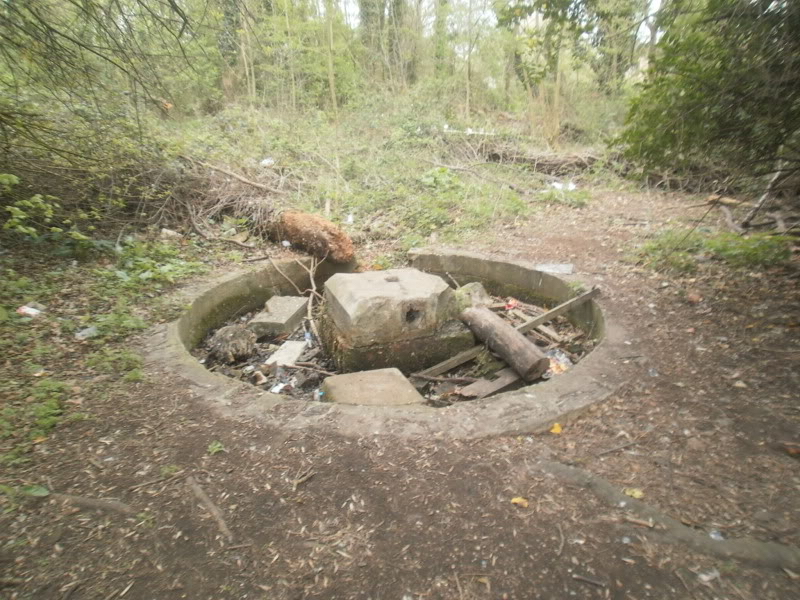
Although the Temple itself vanished, the site retains archaeological importance. The circular stone kerb of the spring remains visible, together with the square base once supporting the obelisk. Subsurface foundations are believed to survive beneath the ground. Excavated artefacts now provide some of the clearest testimony to the society’s activities.
The modern visitor encounters little that immediately conveys the site’s former significance. Yet beneath the surface lies a palimpsest of ceremonial use extending across centuries, demonstrating how landscapes can retain historical meaning long after architecture disappears.
Legend and Evidence
Reffley Temple has long been associated with stories of clandestine Royalist meetings during the Interregnum following the execution of Charles I. According to later tradition, supporters of the monarchy gathered secretly at the spring when political assembly was dangerous. While attractive, this narrative rests largely on retrospective accounts rather than contemporary documentation.
No surviving seventeenth-century records confirm organised Royalist meetings at Reffley. The earliest firm evidence for structured activity dates from the later seventeenth or early eighteenth century, suggested by the landscape painting and subsequent references to the Brethren. It is therefore likely that Civil War origins represent a foundation legend constructed by later members to confer antiquity and romantic prestige upon the society.
Such invented traditions were common among eighteenth-century clubs. Claiming ancient or politically charged origins strengthened group identity even when documentary proof was absent. The legend should therefore be understood not as deliberate falsehood but as cultural self-fashioning. Whether or not Royalists ever gathered secretly at the spring, later generations clearly believed they were participating in a tradition rooted in loyalty and endurance.
Appendix I: Reffley Temple – Comparable Georgian Society Lodges and Garden Temples
Reffley Temple becomes easier to understand when viewed alongside a broader eighteenth-century fashion for society lodges and garden temples. Across Britain, landowners and clubs constructed small classical buildings intended not for worship but for sociability, reflection, or controlled theatrical experience.
One useful comparison is the series of garden temples created within landscaped estates such as Stowe in Buckinghamshire during the early eighteenth century. Structures like the Temple of Friendship or Temple of Ancient Virtue functioned symbolically rather than practically. They provided settings for conversation, dining, and philosophical play, using classical architecture to frame social interaction within an imagined antiquity. While Stowe operated on an aristocratic scale far beyond Reffley, the underlying cultural impulse was similar: architecture as a stage for shared identity.
Closer parallels appear in provincial dining lodges associated with clubs and hunting societies. Throughout the eighteenth century, fox-hunting and dining clubs frequently maintained small rural pavilions used annually or seasonally. These buildings were rarely grand, often octagonal or polygonal, and designed primarily around a communal table. Surviving examples in parts of Yorkshire and the Midlands demonstrate similar characteristics: modest brick construction, symbolic decoration, and strong attachment to ritualised gatherings rather than everyday use.
Masonic lodges also offer partial comparison, though Reffley shows no firm evidence of formal Masonic affiliation. The use of symbolic guardians, controlled entry, and ceremonial dining nevertheless parallels wider eighteenth-century associational culture, in which architecture reinforced shared identity through spatial experience.
Perhaps the closest cultural analogue lies in the numerous “temples” erected within Georgian pleasure gardens. These were intentionally ambiguous structures, borrowing sacred terminology while serving secular purposes. Visitors understood the irony. Calling a convivial meeting house a “temple” elevated sociability itself into a form of ritual, a pattern entirely consistent with the Reffley Brethren’s classical dedications and theatrical inscriptions.
Seen in this wider context, Reffley Temple was not an eccentric anomaly but a provincial expression of a national cultural phenomenon. What makes it unusual is its longevity. Many comparable lodges vanished within decades as fashions changed, whereas the Reffley Brethren maintained their traditions into the late twentieth century, long after the cultural moment that produced such buildings had passed.
© James Rye 2026
Book a Walk with a Trained and Qualified King’s Lynn Guide
Further Reading
Art UK. Reffley Spring. Norfolk Museums Service collection, Lynn Museum. Oil painting, c. 1697. Collection record accessed via Art UK database, https://artuk.org.
Beresford, Maurice W., and John Hurst. Deserted Medieval Villages: Studies. London: Lutterworth Press, 1971.
Clapham, Andy. Reffley Spring: A Local History Study. King’s Lynn local history research website. Accessed 2023–2025. https://andyclapham2.wixsite.com/reffley-spring-book.
King’s Lynn Civic Society. “East of Reffley Lane: Spring and Site of Reffley Temple.” Local Heritage Listing and Survey Record. King’s Lynn Civic Society, King’s Lynn, Norfolk.
Lynn News. “Spring Rumoured to Have Magical Healing Properties.” Lynn News, local history feature article, published 2023.
Page, William (ed.). The Victoria County History of Norfolk, Vol. 8 (Gaywood).British History Online. https://www.british-history.ac.uk/vch/norf/vol8
Porter, Roy. The English Spa, 1560–1815: A Social History. London: Longman, 1990.
West Norfolk and King’s Lynn Archaeological Society. Excavation notes and artefact reports relating to Reffley Spring investigations. Unpublished society archive material, King’s Lynn.
Wilson, Kathleen. The Sense of the People: Politics, Culture and Imperialism in England, 1715–1785. Cambridge: Cambridge University Press, 1995.
Wikipedia contributors. “Listed Buildings in King’s Lynn.” Wikipedia, last modified 2024.