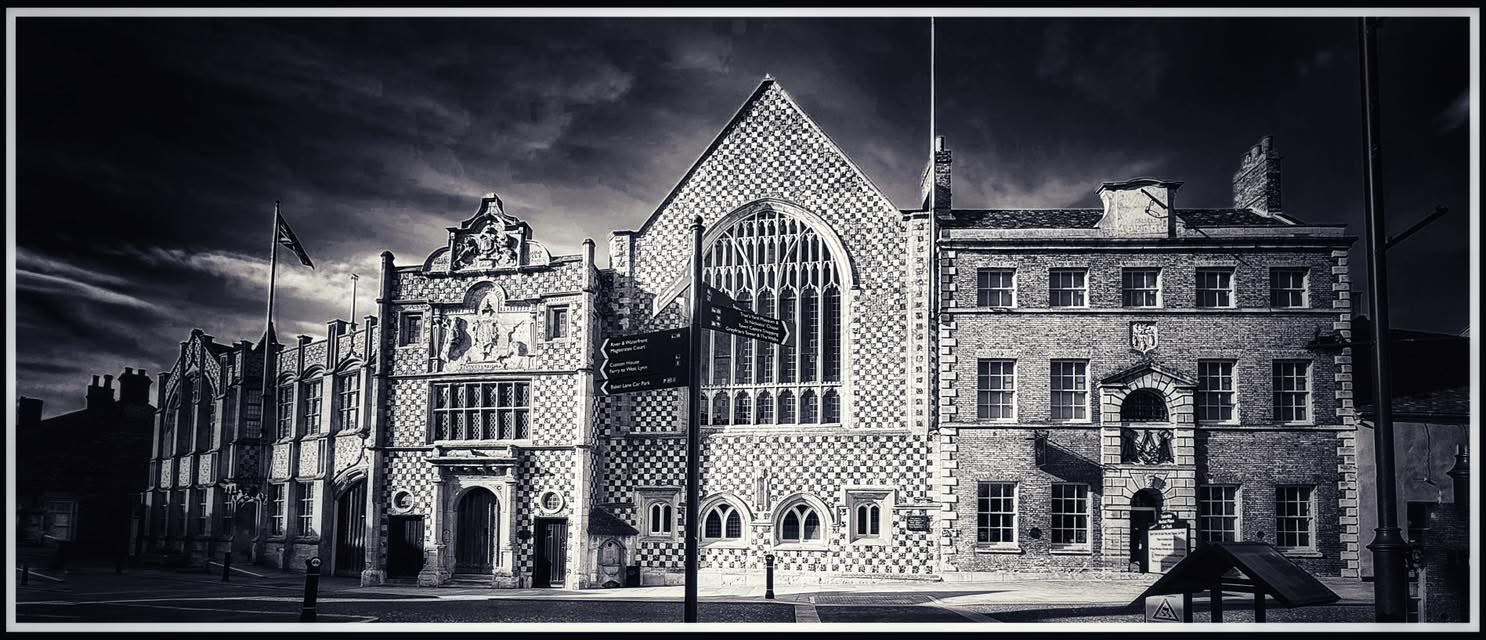
Medieval Bishop’s Lynn was not a quiet place. It was a port, market town and pilgrimage crossroads, with ships moving along the haven, carts passing through its gates, bells sounding from St Margaret’s and St Nicholas, and friars living in large religious precincts close to the town’s working streets. Yet within that crowded town there were also people who chose a life of religious withdrawal. Some were enclosed in cells. Others lived as solitary religious figures near churches, gates, roads or the haven.
The distinction matters. A medieval anchorite or anchoress was enclosed, usually in a cell attached to a church, chapel or religious house. A hermit might also live a solitary religious life, but was not necessarily sealed permanently into one place. The anchorite never left the cell and depended on others for support, while the hermit, though withdrawn, could move more freely. Lynn had both, and the evidence is richer than might first be expected.
I. The enclosed lives: anchorites, anchoresses and recluses
The strongest evidence begins at All Saints, South Lynn. Historic England describes All Saints as Lynn’s earliest parish church, with eleventh-century origins and rebuilding in the fourteenth and fifteenth centuries. Its official listing also states that the south chancel was the site of a thirteenth-century anchorite cell, with scars still remaining in the fabric; a small gabled structure at the east end of the south side may also be connected with the cell.
That surviving trace is important because the written evidence points in the same direction. Hillen records anchorites in connection with South Lynn in 1367, All Saints in 1385 and 1510, and “recluses” of All Saints in 1276 and 1408. A church leaflet mentions benefactions made by Katharine Sampson and Isabella who made their vows before the bishop and then entered the cell. Hillen also says that Margaret, widow of John Lok, left twenty shillings in 1408 to the “anchorite recluse” of All Saints. This is one of the clearest pieces of evidence for an enclosed religious life in medieval Lynn. It is not just a later tradition attached to a picturesque cell. It is a named bequest to a recognised figure in the religious life of South Lynn.

The anchorhold at All Saints, South Lynn. Historic England records the south chancel as the site of a thirteenth-century anchorite cell, with traces still visible in the fabric.
Twenty shillings was a serious sum. The All Saints recluse was not being given a token penny by a passing donor. She or he was being remembered in a will. The cell was a place of withdrawal, but not a place of disappearance. The anchorite prayed for the living and the dead; the parish, guilds and benefactors helped to keep the anchorite alive.
The Holy Trinity Gild evidence sharpens the picture. Published extracts from the guild accounts record that in 1343–44 alms were given to the anchoress of South Lynn, who received twenty shillings. The same entry records six shillings and eight pence for Clarice Sorel, described as a poor woman, six shillings and eight pence for Little John with the broken back, and five shillings for the hermit of St Nicholas. In 1385–86, the guild paid six shillings and eight pence to the hermit outside the South Gate and twenty shillings to the anchoress of All Saints in South Lynn. In 1406–07, it paid six shillings and eight pence to Katherine, who had been the anchoress’s servant.
That last detail is revealing. An anchoress might be enclosed, but she was not self-sufficient. Someone had to bring food, fuel and messages. Someone had to deal with practical needs and visitors. The religious ideal was withdrawal from the world, but the daily reality depended on neighbours, servants, guild officers and parish charity.
All Saints therefore deserves a larger place in Lynn’s medieval story. Its anchorhold is not a decorative curiosity. It is the visible trace of a documented tradition stretching from at least the later thirteenth century into the early sixteenth.
The second major anchoritic site was the Whitefriars, the Carmelite friary in South Lynn. The Historic England research record for Whitefriars describes a Carmelite friary founded before 1260 and dissolved in 1538. It also records that St Mary’s Priory stood in South Lynn between All Saints and the river, and that an “Anchoretage” belonged to the convent and was situated near it. The gateway is now the chief standing survival.
Hillen names anchorites in connection with the Whitefriars monastery: John with the Broken Back in 1367 and William Clays in 1510. John needs cautious handling, because the Trinity Gild extract also mentions Little John with the broken back as a recipient of alms without, in that extract, calling him an anchorite. William Clays, however, is supported by later Carmelite scholarship as a Lynn Carmelite anchoritic figure in 1510.
The most striking Carmelite figure is Joanna Catfelde. Kevin Alban’s study of Thomas Netter, drawing on John Bale, lists Joanna Catfelde as an anchorite or anchoress associated with Lynn Priory in 1421. The same table lists William Clays at Lynn Priory in 1510 and places Carmelite Lynn among mendicant houses associated with anchoritic or eremitic affiliations.
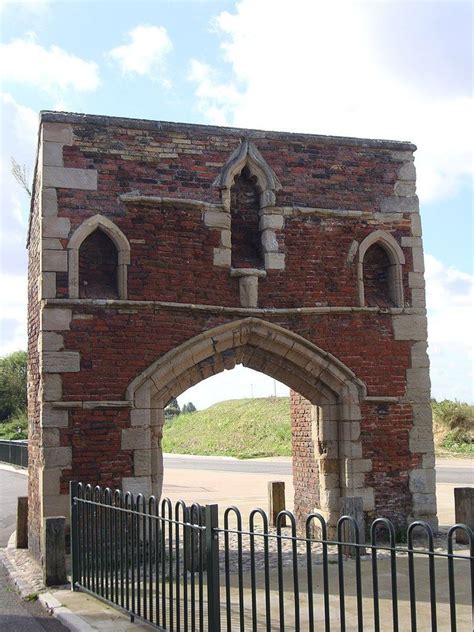
Whitefriars Gate, the main survival of Lynn’s Carmelite friary. The friary had an “Anchoretage” belonging to the convent, and records connect Joanna Catfelde and William Clays with Lynn’s Carmelite anchoritic story.
This Carmelite connection makes good sense. The Whitefriars were urban friars, not monks hidden away in a rural abbey. They lived among merchants, householders, pilgrims and spiritually serious laypeople. Lynn’s Carmelite world also touched the life of Margery Kempe. Margery herself was not an anchoress and should not be called one, but she lived in a town where enclosed prayer, friary counsel and lay devotion stood close together.
The Blackfriars, Lynn’s Dominican friary, bring in a more cautious but still important line of evidence. Rotha Mary Clay wrote that Dominican friars were enclosed at Lynn, Lancaster, Newcastle, Arundel and Canterbury. Clay also identifies Geoffrey, a Dominican of Lynn, known as “the Grammarian”, as the compiler in 1440 of the Promptorium Parvulorum, an English-Latin dictionary. She says the writer introduces himself as a recluse of the Friars Preachers of Bishop’s Lynn. This gives real substance to the Dominican evidence.
A later scholarly discussion also identifies John Lot, recluse at Lynn, as being licensed in 1497 to choose a confessor to hear his confession once a month. I would still keep John Lot slightly to one side until the original reference can be checked, but he is no longer a mere stray name. The Dominican material should be included, with care, as part of Lynn’s broader anchoritic and reclusive landscape.
Thomas Thoresby’s will gives the story a late and revealing turn. Thoresby’s will was made in 1510, an contains a clause relating to the Free Grammar School: Sir Robert Burgh was to teach six children freely in grammar and song, so that they could maintain the choir of St Margaret’s in divine service. The endowment was tied to lands in Gaywood beside Goldsmith’s Garden.
Then comes the important anchorite detail. Hillen says the charnel priest was to be assisted by two secular priests, identified as the anchorites of the Whitefriars’ monastery and All Saints’ church. Suitable quarters were to be reserved for them in Thoresby’s new college, and they were to perform daily divine service after the testator’s death. The children taught by the charnel priest were also to pray at Thoresby’s tomb and sing for him.
In 1510, just before the Reformation broke apart much of this world, Lynn’s anchorites were still visible enough to be included in formal religious planning.
II. The wider solitary world: hermits, gates and the haven
The hermits belong in the same story, but not in the same category. Hillen lists them separately, and that separation should be preserved.
He records John living in or near St Margaret’s in 1406, and Thomas near St Margaret’s in 1428. He records John, hermit of St Nicholas, in 1367 and 1428. He also names Thomas at the South Gate in 1386 and Anne Whyote at the East Gate in 1385. These people were solitary religious figures.
The St Nicholas evidence is particularly tempting, because St Nicholas was such a major chapel. The Trinity Gild account of 1343–44 gives five shillings to the hermit of the church of St Nicholas, and Hillen later names John as hermit there. This is good evidence for a recognised solitary religious presence at St Nicholas. It is not, by itself, proof of a strictly enclosed anchorite.
The gate hermits are especially vivid. Thomas at the South Gate and Anne Whyote at the East Gate lived at thresholds. Medieval gates were places of movement, control, begging and danger. Travellers passed through them, officials watched them, goods entered and left, and townspeople crossed them daily. A hermit at a gate was not hidden from urban life. He or she stood where town, road and charity met.
The most memorable of Lynn’s hermits is John Puttock. In 1349, the town, through mayor John de Couteshale, petitioned William Bateman, Bishop of Norwich, asking that Puttock be accepted as a hermit. Hillen says he lived in a cave on the western side of the haven, at a desolate place dangerous to early mariners. There he built, at his own cost, a remarkable cross said to be 110 feet high. It became known as the Lenne Crutch, or Lynn Cross, and served sailors as a landmark.
That episode belongs unmistakably to a port. Puttock’s cross was devotional, but it was also practical. It rose over a hazardous riverside landscape as a sign of prayer and a guide for shipping. In Lynn, even a hermit could become part of maritime life.
Another case takes us beyond the East Gates. Hillen places the Hermitage of St Catherine on the north side of the common way against Roude’s Hill, later associated with the Spread Eagle Estate. He connects it with John Consolif, who wished to live there on the alms of good people. In 1382, Bishop Despenser wrote to Roger Paxman, the mayor, and the burgesses, asking them to surrender their part of the house so that Consolif could live there.
This shows how public a solitary life could be. Consolif’s withdrawal required episcopal support, civic cooperation and property arrangements. Medieval solitude was rarely simple. Someone had to permit it, house it, feed it and defend its place in the town.
Put together, the evidence is unusually rich. Lynn had enclosed recluses at All Saints, an anchoritic tradition at Whitefriars, Dominican recluses at Blackfriars, hermits at St Margaret’s and St Nicholas, solitary figures at the town gates, John Consolif at St Catherine’s, and John Puttock beside the haven. This was not a town with one picturesque cell. It was a busy medieval port with a whole geography of withdrawal.
Conclusion
All anchorites were solitary religious figures, but not all Lynn’s solitary religious figures were anchorites. All Saints and Whitefriars give the strongest anchoritic evidence. Blackfriars deserves a careful place in the same section because of Geoffrey and the Dominican reclusive tradition. St Nicholas, St Margaret’s, the town gates, St Catherine’s and the haven belong mainly to the wider world of hermits.
Medieval Lynn was not just rich in churches, friaries and guilds. It was rich in forms of religious withdrawal, some enclosed behind walls, others standing in full view at the edges of ordinary town life.
© James Rye 2026
See also: The Perpetual Prison of Lynn’s White Martyrs
Book a Guided Tour with a Trained and Qualified King’s Lynn Guide Through Historic Lynn
References
- Alban, Kevin. “Thomas Netter: Pushing Back the Boundaries of Affiliation in the Carmelite Order.” Carmelus 61, no. 1 (2014): 9–29. https://carmelus.com/index.php/carmelus/article/download/209/209/666
- Clay, Rotha Mary. The Hermits and Anchorites of England. London: Methuen, 1914. https://archive.org/stream/hermitsanchorite00clayuoft/hermitsanchorite00clayuoft_djvu.txt
- Hillen, Henry J. History of the Borough of King’s Lynn. Vol. 1. Norwich: East of England Newspaper Co., 1907. https://archive.org/stream/historyofborough01hill/historyofborough01hill_djvu.txt
- Historic England. “Church of All Saints, Church Lane, King’s Lynn, List Entry Number 1195345.” https://historicengland.org.uk/listing/the-list/list-entry/1195345
- Historic England Research Records. “Kings Lynn Whitefriars, Hob Uid 356280.” Heritage Gateway. https://www.heritagegateway.org.uk/Gateway/Results_Single.aspx?resourceID=19191&uid=356280
- Jones, E. A. “The Hermits and Anchorites of Oxfordshire.” Oxoniensia 63 (1998): 51–77. https://www.oxoniensia.org/volumes/1998/jones.pdf
- Jones, E. A. “‘Vae Soli’: Solitaries and Pastoral Care.” In Texts and Traditions of Medieval Pastoral Care: Essays in Honour of Bella Millett. York Medieval Press, 2009. Cambridge Core PDF: https://resolve.cambridge.org/core/services/aop-cambridge-core/content/view/0336345E5F01EF5392418E01E3DCF6BA/9781846157691c1_p11-28_CBO.pdf/vae-soli-solitaries-and-pastoral-care.pdf
- Jones, E. A., ed. and trans. Hermits and Anchorites in England, 1200–1550. Manchester: Manchester University Press, 2019.
- Rosser, Gervase, ed. and trans. Towns in Medieval England: Selected Sources. Manchester: Manchester University Press, 2016. Online text: https://dokumen.pub/towns-in-medieval-england-selected-sources-9781526135193.html