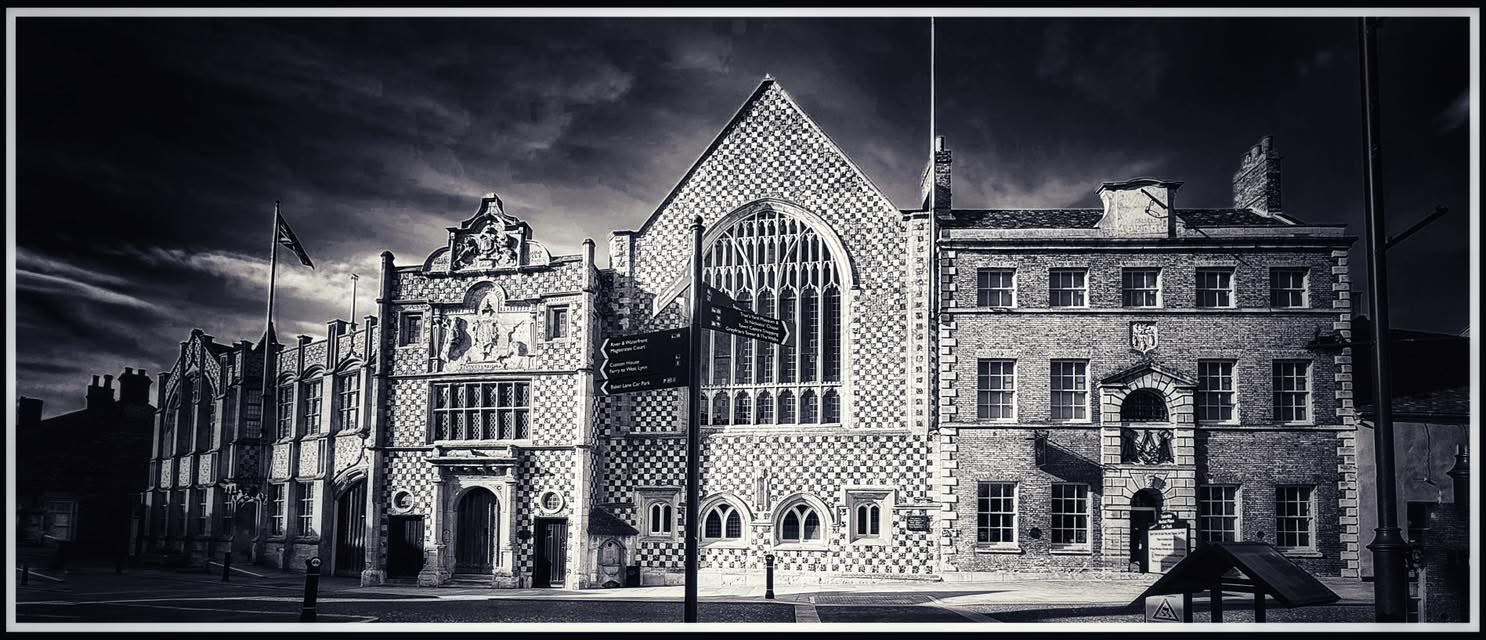
The monument that looks like a boat
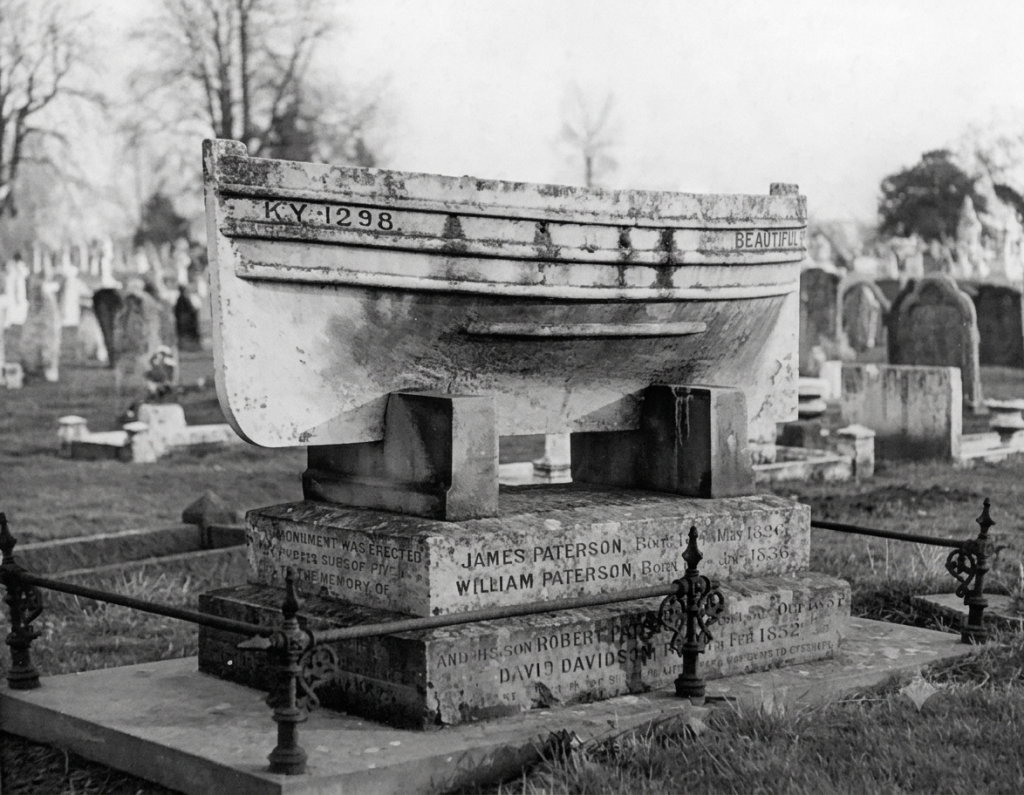
In Hardwick Road Cemetery, King’s Lynn, there is a memorial unlike almost any other in the town. It is not a cross, column, angel, or urn, but a stone fishing boat. On it are the words Beautiful Star, the registration KY1298, and St Monance, the older spelling of St Monans, a fishing village in the East Neuk of Fife.
The monument marks the grave of eight Scottish fishermen who were buried in King’s Lynn after the great gale of November 1875. They were not Lynn men. They came from Fife. Yet their bodies were brought into Lynn, identified in Lynn, mourned in Lynn, buried in Lynn, and commemorated by money raised in Lynn.
That is why the Beautiful Star disaster belongs to the history of King’s Lynn as well as to the fishing communities of St Monans and Cellardyke. It is a story of wreck and weather, but also of quays, public houses, processions, voluntary societies, cemetery ritual, and civic sympathy in a Norfolk port.
Fife boats on the East Anglian coast
By the 1870s, Scottish fishing crews were a regular part of the seasonal life of the East Anglian herring fishery. Men from the East Neuk of Fife sailed south to work off Yarmouth and Lowestoft, while Scottish fisherwomen travelled by train to gut, salt, and pack the catch. This was not a casual venture. It was an organised seasonal migration, repeated year after year, and it tied Fife fishing villages to the ports and markets of the English east coast.
In September 1875, around ninety twin-sailed boats left the East Neuk for the autumn herring season. Among them was the Beautiful Star, recently built at St Monans for James Paterson, who was also her skipper. She was one of the small working vessels on which families, credit, food, and village economies depended.
The season itself was not the disaster. The men were caught as the fleet was beginning its return north. On 19 November 1875, a violent gale struck the returning boats. Five Fife vessels were lost with all hands: three from St Monans, the Beautiful Star, the Thane, and the Quest, and two from Cellardyke, the Janet Anderson and the Vigilant. Each carried a crew of seven, making thirty-five men lost from those five boats. Two more Cellardyke men were washed overboard from other vessels, bringing the usual total to thirty-seven dead.
For St Monans the blow was terrible. The village lost three boats and twenty-one men. For Cellardyke, sixteen men were gone. Behind those numbers were widows, children, elderly parents, debts, boat shares, and houses suddenly emptied of working men.
The Beautiful Star is brought into Lynn
For King’s Lynn, the disaster became real when the Beautiful Star appeared in the Wash.
Several days after the gale, the steamer Sea Nymph, travelling from Hull to King’s Lynn, came upon the disabled fishing boat and towed her into the town. She was brought to Boal Quay, part of Lynn’s working waterside, where vessels, cargo, fish, mud, tide, and rumour all met.
At first no crew could be seen. The following morning, when men returned to the boat and opened the forward cabin, they found five bodies inside. The dead were brought ashore and taken to the nearby Mariner’s Arms on South Quay. In a port town, a public house by the water was not simply a place of drink. It was part of the maritime landscape: a meeting point, a waiting place, a place where sailors, fishermen, boatmen, and harbour workers crossed paths.
The name St Monance on the boat helped identify the community from which the men had come. A telegram was sent to Fife. David Duncan travelled by train from Scotland to King’s Lynn to identify the bodies. The story had now crossed from wreckage into human recognition. The men were no longer unknown dead from the sea. They were named fishermen from known families and a known village.
The five men from the Beautiful Star later commemorated at King’s Lynn were James Paterson, William Paterson, Robert Paterson, David Allan, and David Davidson.
The first funeral: South Quay to Hardwick Road
The first funeral took place on 1 December 1875. Five hearses carried the dead from South Quay to Hardwick Road Cemetery. The route mattered. It carried the tragedy from the waterfront into the civic and religious space of the town. Lynn did not hide the dead away. It processed them publicly.
The cortege included Scottish relatives, Good Templars, Naval Reservists, North End fishermen, seamen, and townspeople. Many others lined the streets. At the graveside, the service was conducted by the Revd J. Simon of the Methodist New Connexion.
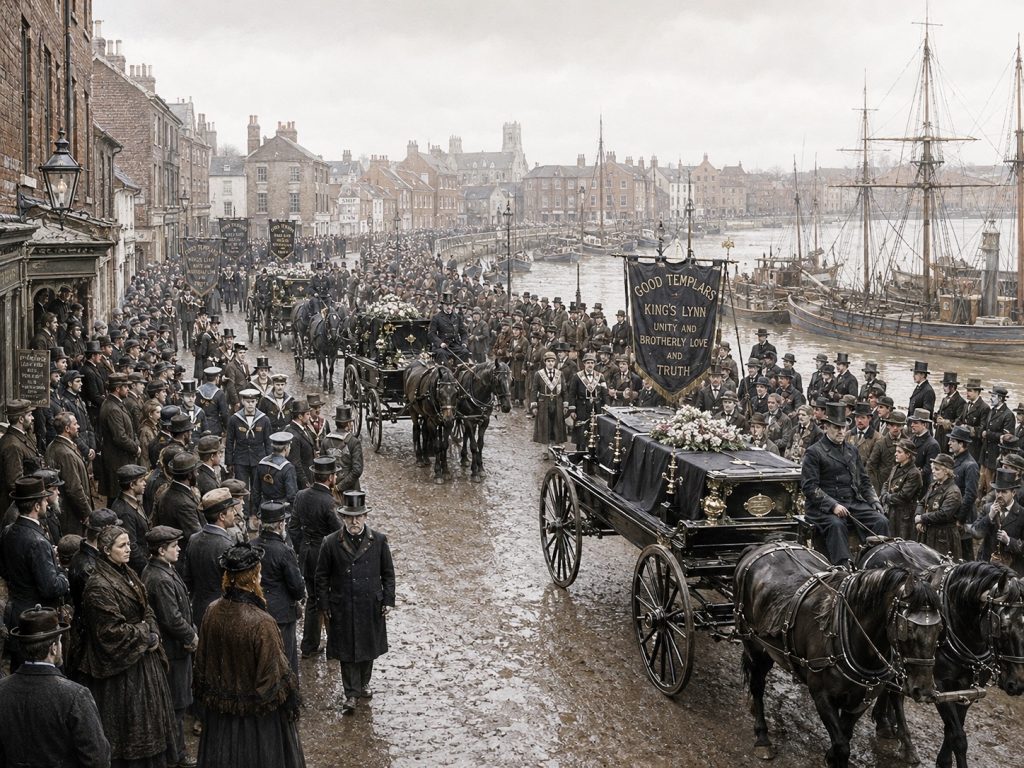
The Good Templars played a large part in Lynn’s response. They were a temperance and self-help organisation, and several of the drowned fishermen were connected with the brotherhood. The Methodist New Connexion chapel on Railway Road was closely associated with the movement locally. The funeral costs were covered through this network of voluntary support.
The procession was carefully counted in one account: 55 Good Templars, 60 Naval Reservists, 58 fishermen from the North End, and 30 seamen. These figures are worth pausing over. They show that the funeral was not merely attended by civic dignitaries. It was carried emotionally by Lynn’s seafaring and working communities.
The Thane and the second burial
The disaster drew Lynn in still further on 2 December, when a second St Monans boat, the Thane, was found overturned by a Lynn fishing smack. Three bodies were discovered in the cabin. Another Lynn boat brought them to the Fisher Fleet, the old watery artery of the town’s fishing life.
An inquest was held at the Town Hall. David Duncan, who had remained in Lynn to arrange matters connected with the Beautiful Star, identified two of the men. The dead from the Thane later named on the memorial were Alexander Duncan, Thomas Lowrie, and Thomas Fyall. Spellings of nineteenth-century names can vary between sources, but these are the names given in the Scottish Fisheries Museum record of the King’s Lynn memorial.
Their funeral took place on Sunday 5 December 1875. Three hearses followed the same route from South Quay to Hardwick Road Cemetery. Once again the streets were lined with mourners. The Good Templars paid for the hearses, and the procession was even larger than before: 76 Good Templars, 137 fishermen, 60 Naval Reservists, and 32 shipmasters and sailors. Five relatives from St Monans walked behind the hearses.
At the cemetery, the three men from the Thane were laid beside the five from the Beautiful Star. A crowd of about 1,000gathered at the graveside. That evening, a service was held at the Tabernacle on Railway Road, attended by many Lynn fishermen.
The North End and the meaning of sympathy
Why did Lynn respond so strongly to the deaths of strangers?
The answer lies partly in the town’s own fishing culture. The North End was King’s Lynn’s old fisherfolk district. Its families knew the risks of weather, tide, seasonal work, uncertain earnings, and men not returning when expected. They did not need to be told what the loss of five boats meant. They understood the arithmetic of grief: one wreck was a household; five wrecks were a village wounded.
Lynn’s response was therefore not distant philanthropy. It was recognition. The Scottish fishermen had come from another coast, but they belonged to the same seafaring world. Their boats were different, their speech was different, and their home villages lay far to the north, but the danger was familiar.
The memorial fund
After the funerals, Lynn’s sympathy took permanent form. The local newspaper invited contributions to a memorial fund, supported by Mayor F. J. Cresswell. The sum raised was about £43. Of this, £32 paid for a stone monument representing the Beautiful Star. The remaining money was sent to Fife to support the wider relief fund for widows and orphans.
The monument was made by A. W. Bone of London Road, King’s Lynn. The actual Beautiful Star was used as the model. That decision gave the memorial its force. It was not a generalised maritime emblem. It was a stone version of the boat whose arrival had brought the disaster into Lynn’s hands.
The memorial was unveiled in April 1876. It stands on a stepped base, the boat set on cross pieces, with inscriptions naming the dead and recording that it was erected by public subscription. One end carries the words “Life How Short”. The wording is Victorian, but the feeling behind it is plain enough.
Historic England now lists the monument at Grade II, noting both its unusual boat-shaped design and its value as evidence of the connection between Norfolk and the Scottish fishing industry. Hardwick Road Cemetery itself is one of Lynn’s notable nineteenth-century burial landscapes, established in 1849, and the Beautiful Star memorial is among its most distinctive monuments.
What the disaster changed in King’s Lynn
The Beautiful Star disaster did not alter the port’s trade, rebuild the fishing industry, or redirect Lynn’s economy. Its effect was of a different order.
It revealed how a Victorian port could respond when the sea brought strangers to its door. Lynn provided identification, inquests, hearses, burial, religious services, public mourning, fundraising, and a permanent memorial. The town’s institutions and communities each played a part: the waterfront received the dead; the Mariner’s Arms held them; the Town Hall examined the circumstances; the Good Templars paid and organised; ministers conducted the rites; North End fishermen and seamen walked in procession; the mayor supported the subscription; a Lynn craftsman made the monument; and the cemetery gave the men a resting place.
The disaster also widened the emotional map of the town. King’s Lynn was not only a Norfolk port looking inland to its market hinterland and outwards through the Wash. In 1875, it became bound in memory to St Monans and Cellardyke. The connection was made through death, but also through care.
Memory across two coasts
The memory has lasted. In 2025, the 150th anniversary of the gale was marked in King’s Lynn. A service was held at St Nicholas’ Chapel, followed by wreath-laying at the Beautiful Star memorial in Hardwick Road Cemetery. Representatives from Fife came to Lynn, renewing a connection first made in grief in 1875.
A visitor to Hardwick Road Cemetery today may see only a small stone boat. But it carries a large story: of a storm in the North Sea, of Fife fishermen on the East Anglian herring grounds, of bodies brought into Lynn, of processions from South Quay, of North End sympathy, of public subscription, and of a town that chose to make compassion visible in stone.
© James Rye 2026
Book a Guided Tour with a Trained and Qualified King’s Lynn Guide Through Historic Lynn
References
Borough Council of King’s Lynn & West Norfolk. “150th Anniversary of the St Monans Fishing Disaster Marked in King’s Lynn.” Published 11 December 2025. https://www.west-norfolk.gov.uk/news/article/1983/150th_anniversary_of_the_st_monans_fishing_disaster_marked_in_kings_lynn
Cellardyke Trust. “Cellardyke: In Memoriam, Losses to the Sea, Page 6.” Accessed 10 June 2026. https://www.cellardyketrust.org/further-cellardyke-research/cellardyke-in-memoriam-losses-to-the-sea/6/
Gourlay, George. Fisher Life; or, The Memorials of Cellardyke and the Fife Coast. Cupar: “Fife Herald” Office; Anstruther: George Gourlay, Bookseller, 1879. Digitised by Internet Archive. https://archive.org/stream/fisherlifeormem00gourgoog/fisherlifeormem00gourgoog_djvu.txt
Historic England. “Fife Fishing Disaster Monument at Hardwick Cemetery, Hardwick Road, King’s Lynn.” National Heritage List for England, List Entry 1391461. https://historicengland.org.uk/listing/the-list/list-entry/1391461
KL Magazine. “Bound by Sea, Sorrow and Spirit.” https://www.klmagazine.co.uk/articles/paul-richards-sea-tradegy
Norfolk Heritage Explorer. “Fife-Fishing-Disaster-Memorial.” Norfolk Historic Environment Record, MNF33215. https://www.heritage.norfolk.gov.uk/record-details?Index=30442&MNF33215-Fife-Fishing-Disaster-Memorial=&RecordCount=57339&SessionID=cf2596db-8e4e-4ea4-a210-55fb23301516
Scottish Fisheries Museum Photo Library. “‘Beautiful Star’ Memorial, Hardwick Road Cemetery, King’s Lynn.” Item 1134. Uploaded 17 May 2022. https://photosearch.scotfishmuseum.org/view-item?key=SnsiUCI6eyJpdGVtaWQiOjExMzIsInBlcmNlbnRUZXJtc1RvTWF0Y2giOiIwLjYiLCJtYXhRdWVyeVRlcm1zIjoiMjAiLCJtaW5Eb2NGcmVxIjoiMSIsIm1pblRlcm1GcmVxIjoiMSJ9fQ&pg=5
The Friends of Hardwick Road Cemetery. “A Short History of Hardwick Road Cemetery, King’s Lynn.” https://www.hardwickroadcemetery.co.uk/history.html
True’s Yard Fisherfolk Museum. “True’s Yard Fisherfolk Museum.” https://truesyard.co.uk/