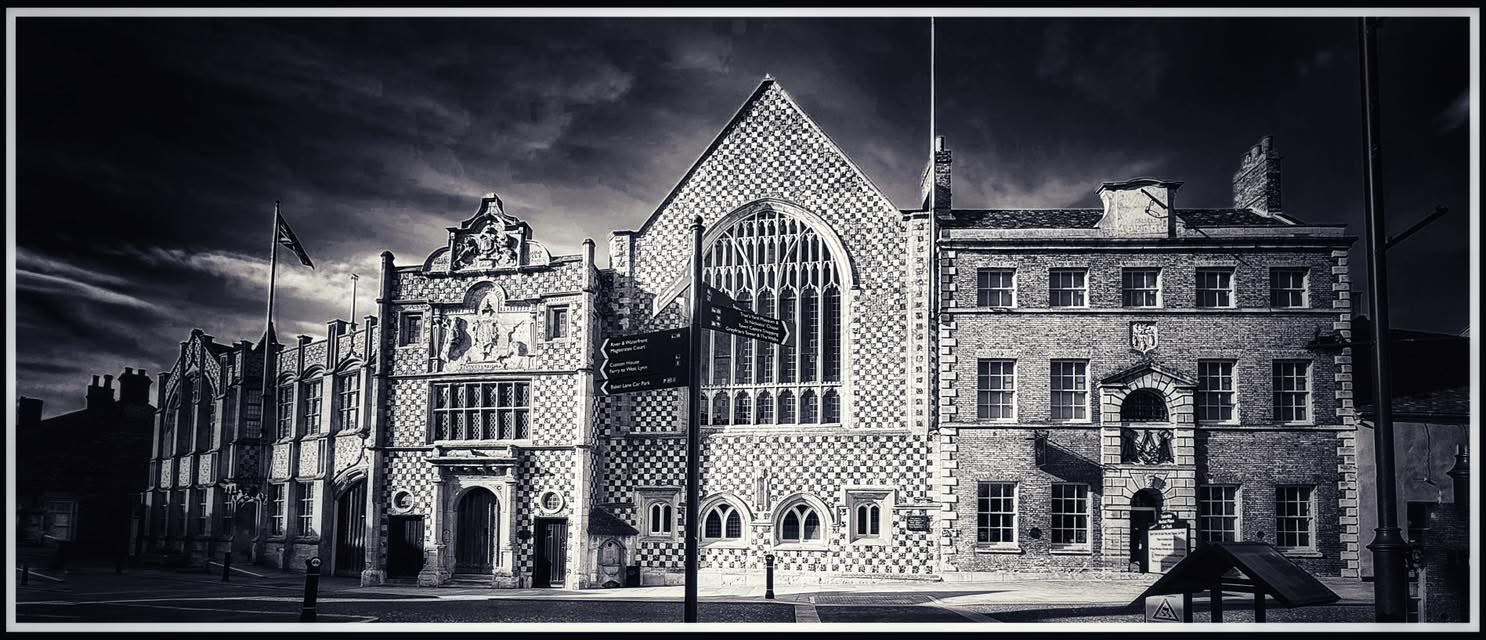
In fifteenth-century Lynn, “aliens” were changing what people drank.
The word did not carry its modern science-fiction meaning. It was the legal term for anyone born outside the English king’s dominions. Many of Lynn’s aliens came from the Low Countries, and among the skills they brought across the North Sea was the brewing of hopped beer. Unlike traditional English ale, beer kept longer, travelled better and had a sharper, more bitter taste. Lynn’s drinkers evidently liked it. Imported beer had been sold in the town since at least 1359, and by the fifteenth century immigrant brewers were producing it beside the Great Ouse.
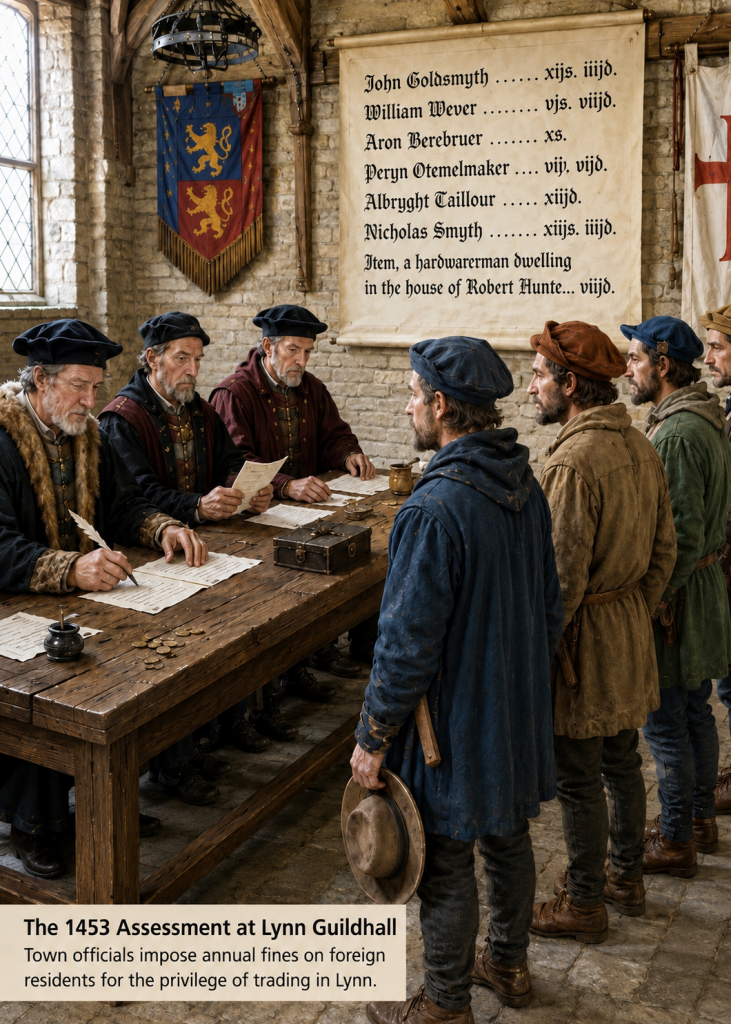
Their success did not pass unnoticed. In 1453, Lynn’s officials compiled a list of fifteen foreign residents who were required to pay for permission to trade. Aron Berebruer, whose occupation was recorded in his name, was charged ten shillings. Nicholas Smyth owed thirteen shillings and fourpence, while Albryght Taillour paid only twelve pence. The amounts varied, but the principle was the same: foreigners could work in Lynn, provided they paid for the privilege.
The list was intended to defend the rights of the town’s burgesses. Instead, it preserved a vivid picture of an immigrant community already woven into Lynn’s daily life. These newcomers brewed beer, made shoes, stitched clothes, worked metal and rented premises close to the quays. Some stayed briefly. Others built businesses, raised families and eventually took part in the government of the town.
Susan Maddock’s study of Lynn’s borough records and national taxation returns has identified at least 290 immigrants living in the town at some point between 1421 and 1525. Their story begins with fines and restrictions, but it does not end there. Over the course of the century, people officially classed as aliens became tenants, employers, voters and neighbours.
The people known as the “Duche”
Most of Lynn’s immigrants came from the Low Countries. Contemporary clerks usually described them as “Duche”, a broad term applied to people speaking related languages across areas that now include the Netherlands, Belgium and parts of Germany. It should not be understood as meaning simply “Dutch” in the modern national sense.
Where places of origin are recorded, Lynn’s immigrants included people from Holland, Brabant, Zeeland, Flanders and Friesland. Smaller numbers came from France, Scotland, Ireland and Orkney. By the later fifteenth century, Zeeland was the most commonly recorded Low Countries birthplace.
Their names sometimes reflected their work. The records mention Christopher Lanternmaker, James Pursemaker and Herman Clokmaker. A person might also appear under several different forms of name. Baldwin Ducheman, a shoemaker from Brouwershaven in Zeeland, was elsewhere recorded as Baldwin Williamsone.
Such variations can make individual lives difficult to trace. Even so, the surviving evidence gives an unusually detailed picture of the community. Between 1421 and 1466, Maddock found forty foreign tailors, twenty-seven cordwainers or shoemakers, twenty-three beer brewers, twelve hardware dealers and ten weavers. Other immigrants worked as smiths, dyers, skinners, goldsmiths and makers of wooden pattens worn beneath shoes [Maddock 2025, 160–61].
These totals accumulated over several decades. They do not mean that forty foreign tailors were working in Lynn at the same moment. Many immigrants stayed only a few years. Of the forty recorded tailors, just eight can be shown to have remained for at least a decade.
Shoemaking had a more visible foreign presence. During the 1420s, immigrants may have formed about a third of Lynn’s shoemakers. Anyone purchasing boots, repairing worn soles or ordering new leatherwork would therefore have been familiar with craftsmen from across the North Sea.
The brewers who changed Lynn’s drinking habits
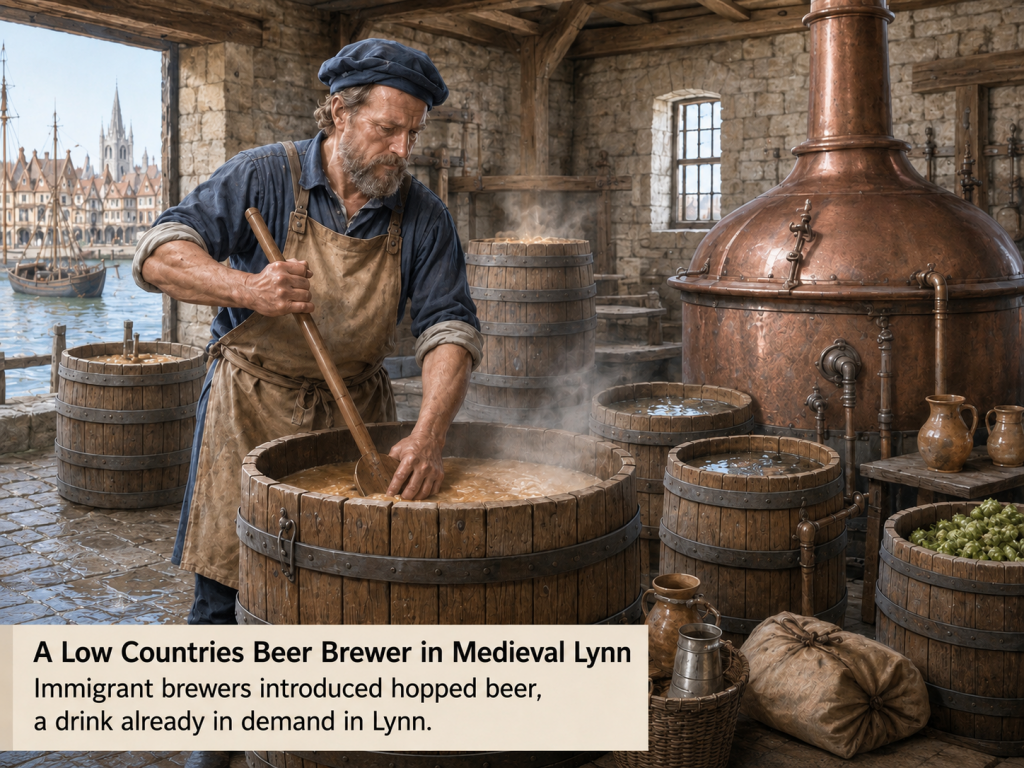
Beer brewing was the occupation most strongly associated with immigrants. Until the closing years of the fifteenth century, all the identifiable professional beer brewers in Lynn appear to have been foreign-born.
Medieval ale and beer were different drinks. English ale was generally brewed without hops and spoiled relatively quickly. The hopped beer made in northern Germany and the Low Countries had a bitterer flavour, but it could be stored for longer and transported by sea. Imported beer was being sold in Lynn by 1359. Later, immigrant brewers established businesses inside the town.
One of the most prosperous was Peter Berebruer, who may also have been known as Peter Johnson. He rented property from Margaret Frank for about twenty years. In 1440, he was assessed at twenty-six shillings and eightpence, twice the amount charged to any other immigrant that year. By 1450, he headed his own household and employed two foreign servants.
The high assessments imposed on some brewers suggest that beer production could be profitable. In 1466, the town’s only listed brewer was charged more than three times as much as any of the other fifteen assessed immigrants.
The immigrant brewers were not merely bringing unfamiliar skills into Lynn. They were responding to an existing demand. Beer already arrived through the port, and Lynn’s inhabitants had acquired a taste for it. Foreign brewers found a market where their methods and connections were commercially useful.
Why Lynn made foreigners pay
The annual fines began in 1421 after Lynn merchants complained that foreign residents were damaging their trade. The main dispute was not over the making of shoes, clothes or beer. It concerned the boundary between craft production and mercantile dealing.
Lynn’s merchant-burgesses claimed the privileged right to buy and sell goods on their own account. Some immigrant artisans were accused of crossing that boundary. A tailor might manufacture clothing but also trade in cloth. A broker might board an arriving ship and purchase goods before they reached the open market.
There was evidence that this occurred. In 1416, a tailor from Zeeland and a broker named Albrecht Broun were accused of boarding newly arrived ships to buy merchandise before it was formally offered for sale.
On 27 January 1421, representatives from Lynn’s wards presented lists of English and foreign tradesmen at a meeting in the Guildhall. Selected immigrants were ordered to pay annual fines in return for permission to continue trading. Broun refused and apparently left the town. Most of the others paid.
English artisans were treated differently. Those thought wealthy enough were encouraged to purchase the freedom of the borough for forty shillings. A freeman, or burgess, acquired recognised trading rights and could participate more fully in town government. Immigrants initially remained outside this system and were made to pay year after year.
The policy was plainly discriminatory, but it was not designed simply to remove foreigners. Lynn’s rulers wanted to control them, limit their commercial freedom and extract revenue from their presence. At the same time, merchants and property owners benefited from their labour, rents and purchasing power.
The arrangement endured because immigrants could still make a living. The charges were an obstacle, but not always one severe enough to outweigh the advantages of remaining in a busy English port.
A community beside the quays
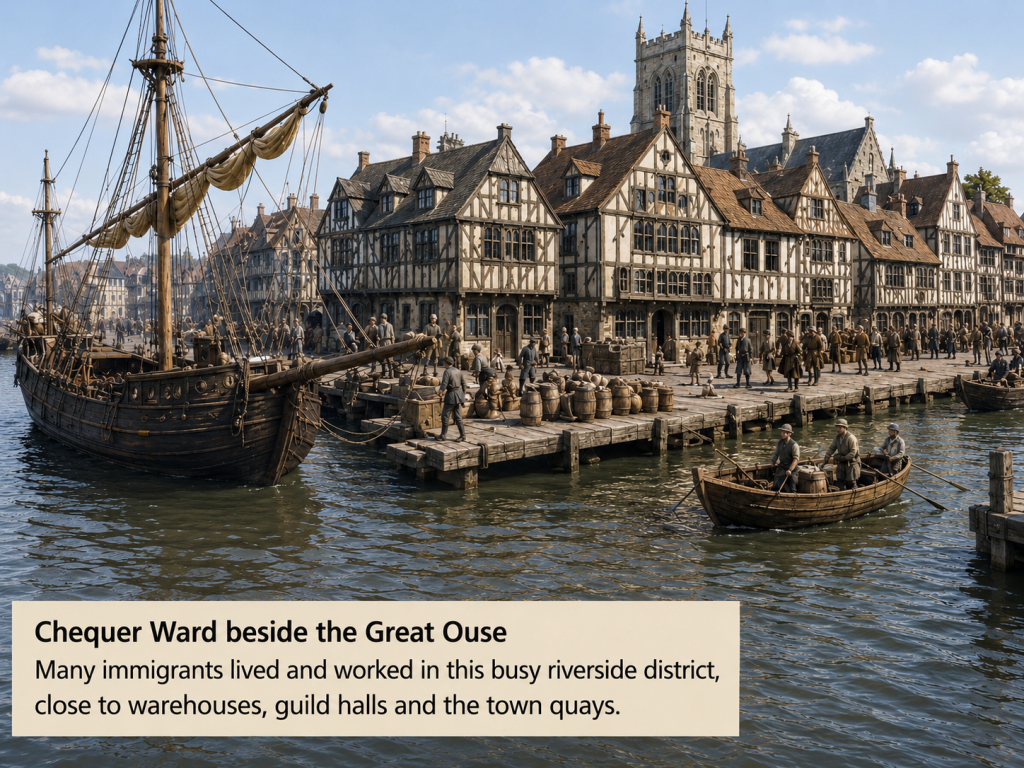
Most foreign residents did not live on the poorest edge of Lynn. Many rented property in Chequer ward, the central riverside district that included parts of modern King Street and the lanes leading towards the Great Ouse.
During the 1420s, more than half of those whose addresses can be identified lived there. Chequer contained valuable warehouses, merchants’ houses and commercial premises close to the quays. By contrast, no immigrant has been found in Kettlewell ward, the town’s principal inland industrial district.
Foreign craftsmen rented rooms, houses, workshops, cellars and yards from native owners. Their landlords included merchants, former mayors, religious guilds and clergy. Several tailors occupied property belonging to the Guild of St George, whose surviving hall still stands on King Street. Others rented premises from the wealthy Corpus Christi Guild.
The guild’s accounts suggest that immigrants were not routinely charged higher rents. In 1459–60, an English merchant-burgess and two unnamed “Duchemen” each paid threepence a week for cellars or yards.
Foreign residents could not normally purchase freehold land, but landlords seem to have been willing to accept them as tenants. They were not confined to a separate foreign quarter. They lived among English craftsmen and wealthy merchants in the part of Lynn most closely connected with overseas commerce.
Their daily lives must have been conducted in several languages. Ships arrived from the Low Countries carrying fish, beer and manufactured goods. Sailors, merchants and brokers moved through the same streets. News and letters could cross the North Sea along the commercial routes that had brought many of the immigrants to Lynn.
In 1466, the assessors recorded that the mother of Wynkyn Taillour was living with him. Wynkyn had rented property in Chequer for more than ten years. His mother may have travelled from the Low Countries after her son had established himself. The bare entry suggests that migration was not always the journey of an isolated young man. Families could follow.
From alien fines to ward elections
Lynn’s political system had already begun to change before the immigrant fines were introduced. During the early fifteenth century, disputes within the town weakened the dominance of its older merchant elite. A common council was established in 1418, and in 1425 the formal political distinction between merchant and artisan burgesses was removed.
A native craftsman who obtained the freedom could now, in principle, serve on the council or even become mayor. Foreigners were admitted more cautiously.
In 1428, John Baudryk, a patten-maker from Brabant, and Baldwin Williamsone, the Zeeland shoemaker, became the first known immigrant artisans to enter Lynn’s freedom. Each paid £4, twice the normal fee. Their admission did not remove prejudice, but it offered a route into the recognised civic community.
Another Zeelander, Hugh Smyth, became a burgess in 1450. He supplied nails, hinges, hooks and other ironwork used in repairs to borough buildings and mills. After the annual alien fines were abandoned in 1466, his name appeared repeatedly among those choosing Chequer ward’s representatives on the common council. Between 1467 and 1484, he took part in almost every surviving election.
The electorate was broader than the body of burgesses. In 1440, only eighty-seven of the 238 recorded ward electors were burgesses. After 1466, foreign householders also began to appear. At least one immigrant participated in thirty of the forty-one surviving annual elections between 1467 and 1514 [Maddock 2025, 165–68].
These men could vote for councillors without possessing full English legal status. Their participation suggests that residence, reputation and responsibility within the ward could sometimes count for more than birthplace.
Abraham Powlesson: from immigrant to Lynn alderman’s father
The most striking example of advancement was Abraham Powlesson, a Burgundian merchant who settled permanently in Lynn.
He became a burgess in 1498, paying the higher £4 admission fee required from foreigners. In 1515, he obtained royal letters of denization. These gave him and his descendants most of the legal rights enjoyed by English-born subjects, including greater freedom to hold property and use the royal courts.
Powlesson accumulated land and property in Lynn, West Winch, Hardwick and Runcton. By 1510, he was leasing Sparrow Hall, a substantial house situated between the Saturday Market and the river. In the taxation of 1524–25, his goods were valued at £66 13s. 4d., making him far wealthier than Lynn’s other recorded alien taxpayers.
Prosperity did not always make him obedient. Between 1514 and 1520, he was punished on at least three occasions for buying fish from “Duche” vessels before their cargoes had been landed and exposed for sale. It was precisely the sort of privileged dealing that Lynn’s merchants had objected to a century earlier.
When Powlesson died in 1539, he asked to be buried in St Margaret’s Church in front of his customary seat. He left the bishop of Norwich a gold ring engraved with an image of Abraham and requested his protection for his son Sybrand.
Sybrand Powlesson was already thoroughly established in Lynn. He became a burgess, served as a ward constable and joined the common council. In 1541, he was appointed one of Lynn’s twelve aldermen.
The son of a foreign merchant had entered the governing elite of the borough.
Outsiders who became neighbours
Medieval Lynn did not offer immigrants equality. They were taxed separately, restricted in their ownership of property and often charged more for admission to the freedom. The town welcomed their skills while guarding its own commercial privileges.
Yet Lynn’s treatment of foreigners cannot be reduced to hostility. Immigrants found work, rented central properties and sometimes remained for decades. After 1466, they increasingly took part in ward politics. A few entered the freedom, acquired wealth and raised children who became civic leaders.
The fifteen people listed in 1453 were not merely temporary strangers passing through an English port. They were brewers and shoemakers, tenants and employers. They lived near the quays, attended local churches and negotiated with Lynn’s officials.
The borough continued to call them aliens. In the streets of Chequer ward, however, many had already become neighbours.
© James Rye 2026
Book a Guided Tour with a Trained and Qualified King’s Lynn Guide Through Historic Lynn
References
- England’s Immigrants 1330–1550. University of York, Humanities Research Institute. Accessed 21 June 2026. https://www.englandsimmigrants.com/
- Maddock, Susan. “Livelihoods and Liberties of Low Countries Immigrants in Late Medieval Lynn.” History 110, no. 390 (2025): 154–172. https://doi.org/10.1111/1468-229X.13436
- Ormrod, W. Mark, Bart Lambert, and Jonathan Mackman. Immigrant England, 1300–1550. Manchester: Manchester University Press, 2019. https://manchesteruniversitypress.co.uk/9781526109149/