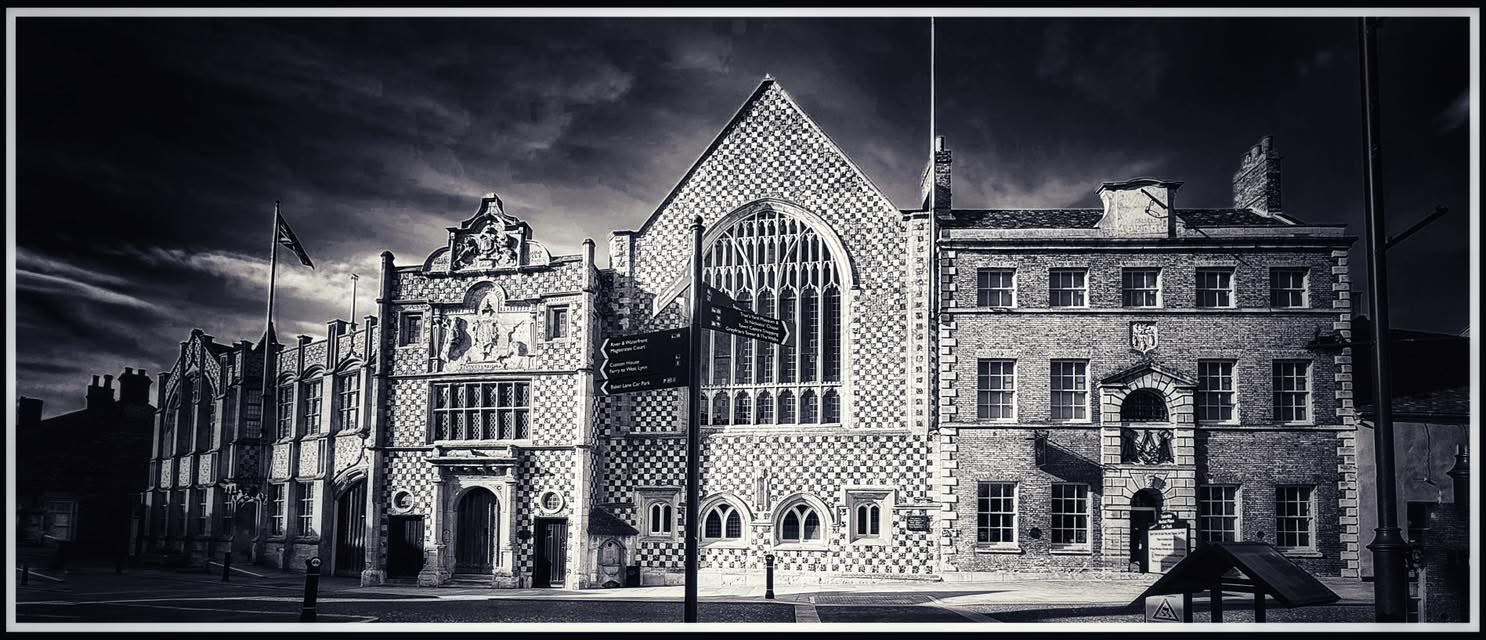
Walk from the Tuesday Market Place towards the Custom House and you pass through much of the history of King’s Lynn in less than a quarter of a mile. King Street contains medieval merchants’ houses, the largest surviving medieval guildhall in England, Georgian residences, former inns and the remains of industrial yards. Behind its orderly façades once stood breweries, maltings, warehouses and passages leading towards the river.
The street’s importance arose from its position. In medieval Lynn, the Great Ouse flowed much closer to King Street than it does today. Merchants settled there because it placed their houses within easy reach of ships, markets and quays. Goods could be brought from a vessel into a warehouse behind the merchant’s home and then sold in the town or carried inland.
King Street was therefore never simply a residential street. It was one of the places where Lynn’s overseas commerce entered the town and where commercial wealth was converted into civic influence.
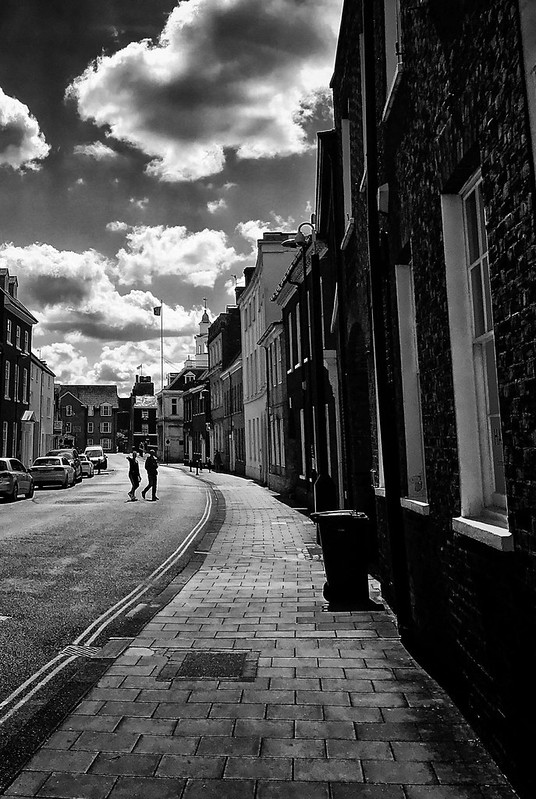
Photo © James Rye 2017
The edge of the medieval town
The oldest part of Lynn developed around St Margaret’s Church and the Saturday Market Place. During the twelfth century a planned northern extension, known as the Newland, was laid out around the Tuesday Market Place.
King Street formed the western edge of this extension. Its course followed the riverbank, while long and narrow properties ran back from the road. Buildings initially stood mainly on the older ground to the east. As silt accumulated and the riverbank was reclaimed, houses, warehouses and yards appeared on the western side as well.
The gradual movement of the river can still be read in the shape of the plots. A house might face King Street, with a gateway leading into a courtyard. Behind it stood kitchens, stables, brewhouses or warehouses. At the western end, a watergate or quay gave access to the Ouse.
Owners altered these properties repeatedly, but the basic commercial arrangement survived for centuries. King Street’s architecture was shaped as much by river trade as by domestic comfort.
Stockfish Row and Chequer Street
The earliest known name for part of King Street was Le Stocfisrowe, recorded in 1325. Stockfish was fish, usually cod, preserved by drying until it became hard enough to travel considerable distances without spoiling.
Much of the stockfish sold in England came from Norway and other northern European regions. It was a valuable commodity in a society where the Church required abstinence from meat on Fridays, throughout Lent and on numerous other fast days. The street name suggests either that fish merchants were concentrated here or that substantial quantities were stored and sold close to the waterfront. [King’s Lynn Civic Society]
By 1406 the street was called le Cheker, later Chequer Street. The origin of the name is uncertain. It may have referred to a chequered inn sign, a counting board or premises connected with financial transactions. Medieval street names frequently developed from local landmarks that have long since disappeared.
Chequer Street was also a place where Lynn’s labouring population sought employment. In 1520 the corporation ordered unemployed people to gather near its junction with the Common Staith so that employers could hire them. Merchants and aldermen occupied the substantial houses, but sailors, carriers, servants and warehouse workers also filled the street. [Hillen]
In 1809 the corporation began renaming several streets during the patriotic atmosphere of the Napoleonic Wars. Chequer Street became King Street, while other roads received names such as Queen Street and Nelson Street.
Lynn’s merchants lived above the shop
Several King Street buildings preserve the unusual combination of house, warehouse and business premises that characterised medieval Lynn.
The range at 28–32 King Street contains fabric dating from about 1180. It is among the oldest surviving secular buildings in the town. The original structure appears to have provided commercial or storage space below, with living accommodation above. Later owners added further ranges and a medieval shopfront. [Historic England]
At 7 and 9 King Street, another medieval merchant’s house survives in an L-shaped arrangement. A principal range faced the street while a second wing extended into the rear plot. A sixteenth-century timber-framed outbuilding behind the house provides evidence of the yards and service buildings hidden from public view.
Some King Street properties are considerably older than their façades suggest. No. 3 originated as a late fifteenth-century hall house but received a more fashionable front during the eighteenth century. No. 6 contains a late sixteenth-century building behind a Georgian façade dated 1739.
Owners did not necessarily demolish a useful medieval house when architectural fashion changed. They remodelled its front, inserted new windows and concealed old timber work behind plaster. King Street consequently contains buildings in which medieval roofs, Tudor walls and Georgian frontages occupy the same property.
St George’s Guildhall
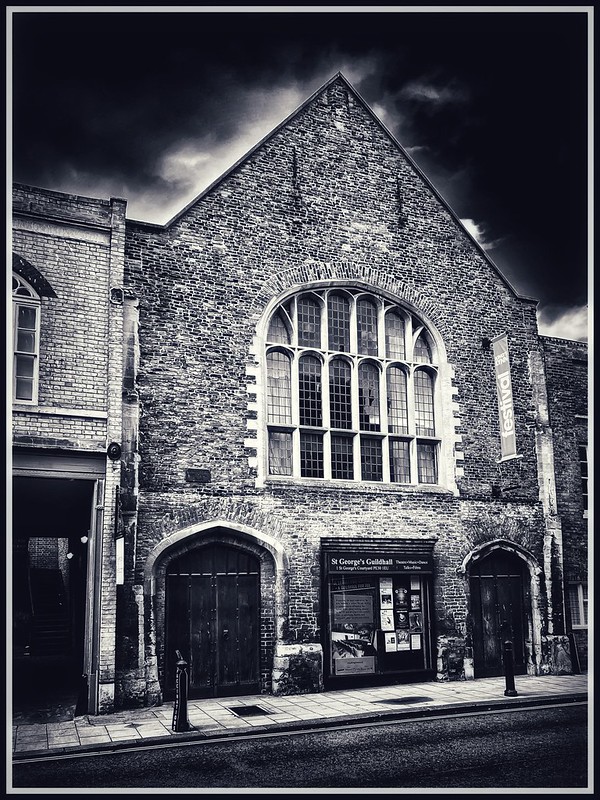
Photo © James Rye 2023
The most remarkable survival is St George’s Guildhall. The religious fraternity dedicated to St George was founded in 1376 and received a royal charter in 1406. Its early fifteenth-century hall is regarded as the largest substantially complete medieval guildhall in England. [Historic England]
The guild provided religious services, companionship and assistance for its members. It arranged prayers and commemorations for the dead, but its King Street premises also formed part of the commercial waterfront. The site extended westwards towards the river and included warehouses, working buildings and access to a quay.
Performances took place in the guildhall from at least the fifteenth century. After the suppression of religious guilds under Edward VI in 1547, the corporation retained the building and allowed travelling companies of actors to use it.
In 1766 the hall was converted into a formal theatre, complete with stage, galleries, boxes and a pit. It remained Lynn’s principal playhouse until a new theatre opened elsewhere in 1814.
The guildhall has frequently been linked with William Shakespeare. The Earl of Pembroke’s Men, a company with which Shakespeare was associated, performed in Lynn in 1593 while London’s theatres were closed during an outbreak of plague. Shakespeare may have travelled with the players, but no surviving Lynn document names him. The visit of the company is recorded; Shakespeare’s personal appearance remains possible rather than proven.
By the twentieth century the guildhall had deteriorated and parts were being used as warehouses. Alexander Penrose purchased it in 1945, after which a trust was created to secure its restoration. Its rescue preserved a building linking Lynn’s medieval guilds with more than five centuries of theatrical performance.
Bagge’s brewery
Brewing became one of King Street’s leading industries. W. and T. Bagge operated a brewery there before 1767, although a later company tradition placed its foundation as early as 1688. The Bagges combined brewing with shipping, banking, property ownership and civic office. They became one of the town’s most influential commercial families.
The brewery stood on the east side of upper King Street, opposite the Globe Hotel. Its frontage occupied the area represented today by approximately Nos. 40–48 King Street, although the brewery grounds extended behind the street and cannot safely be reduced to one modern house number.
The surviving buildings in this group help explain the character of the site. Nos. 40–42 contain a late medieval timber-framed house and shop with a carriage entrance. Nos. 46 and 48 are nineteenth-century houses and offices, also incorporating broad entrances into the yards behind. These passages would have allowed carts carrying grain, malt, barrels and coal to enter the brewery complex.
The frontage directly opposite the Globe reportedly contained an iron gate bearing the emblem of Steward & Patteson. That Norwich company purchased W. and T. Bagge in 1929, acquiring about seventy-five tied public houses with the brewery business. Brewing in King Street then ceased. [Brewery History Society; KL Magazine]
The Bagge interests were not confined to the brewery itself. In 1768 Thomas Bagge bought land nearby that later contained warehouses, granaries, maltings and offices. The family’s bank occupied No. 27 King Street, almost opposite the brewery. King Street thus became the centre of a closely connected network of brewing, grain storage, property and finance.
The brewery’s position was particularly convenient. It stood close to the Tuesday Market Place, where agricultural produce was traded, and within easy reach of the river. Grain and coal could be received and beer distributed from a site connected to both road and water transport.
Inns, foundries and working yards
Brewing was only one of the trades carried on behind King Street’s façades. At 23–25 King Street, a seventeenth-century house gave access to a much larger site containing malthouses, brewhouses, warehouses and stables. The property became seriously derelict before restoration by the King’s Lynn Preservation Trust during the 1980s.
Aickman’s Yard was associated with iron founding and ship repair. An iron plate bearing the words “John Aickman’s Foundery 1827” survived as evidence of this activity. The riverside location allowed ironwork and other heavy goods to be moved without being carried far through the town.
Numerous inns and public houses also served the street. The surviving Globe Hotel occupies a prominent position at the northern end, overlooking the Tuesday Market Place. Inns provided accommodation for merchants and travellers, but they also supplied food, meeting rooms and places where business could be conducted.
The restored street can therefore give a misleading impression of quiet respectability. King Street was once filled with carts, horses and labourers. Barrels were rolled through gateways, grain was carried into maltings and smoke rose from brewhouses and workshops. The smells of fish, beer, coal and the tidal river would have been difficult to escape.
Sir John Turner and the Custom House
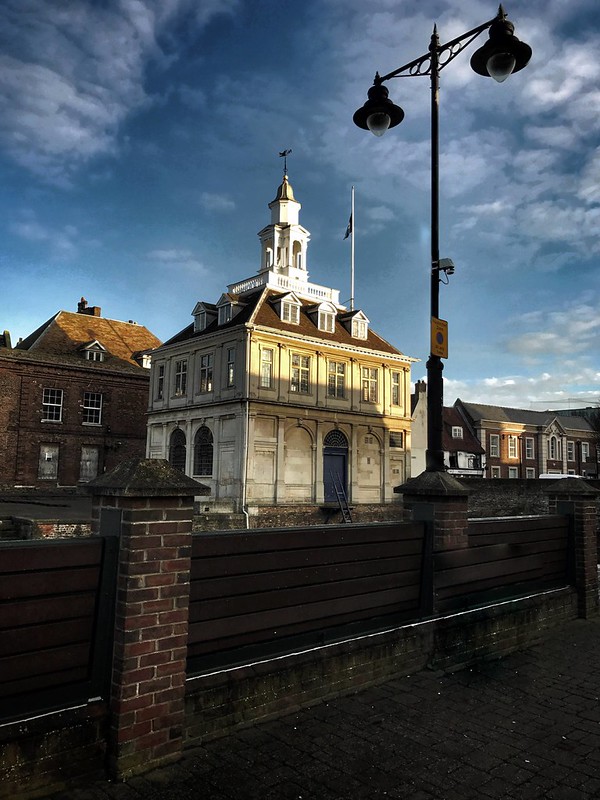
Photo © James Rye 2016
At the southern end of the street stands Purfleet House, built around 1670 for Sir John Turner. Turner was a wealthy merchant and one of Lynn’s leading civic figures. His home beside the Purfleet placed him at the centre of the port’s commercial activity.
In 1683 Turner paid for the construction of a merchants’ exchange nearby. Designed by Henry Bell, the building later became the Custom House. Its graceful classical appearance projected an image of commercial confidence and order.
The closeness of Turner’s private house and the merchants’ exchange reveals something fundamental about the government of Lynn. Leading merchants were also aldermen, magistrates and members of the corporation. They administered the port while trading through it, and civic decisions could affect property in which they held a personal interest.
King Street was one of the places where private wealth and public authority became almost impossible to separate.
Decline and conservation
During the nineteenth century the economic position of King Street slowly changed. The arrival of the railway in Lynn in 1847 encouraged the movement of passengers and goods away from some traditional river and coastal routes. Prosperous residents increasingly preferred newer houses outside the crowded waterfront district.
Former merchants’ houses were divided into smaller premises or converted into offices and stores. As the river retreated behind reclaimed land and later buildings, King Street’s original connection with the water became harder to recognise.
By the middle of the twentieth century several of its most important structures were threatened. St George’s Guildhall required major repairs, while houses such as Nos. 23–25 had fallen into serious decay. The age of other properties remained concealed behind later façades.
Restoration after the Second World War helped to reverse this decline. St George’s Guildhall was rescued, Nos. 28–32 were restored between 1978 and 1982, and the King’s Lynn Preservation Trust saved several endangered properties.
The work preserved more than a collection of distinguished buildings. It retained the outlines of the medieval port.
A history of Lynn in one street
King Street records the growth of Lynn from a medieval trading settlement into an international port. Its street line follows the former riverbank, while its elongated plots show how merchants combined homes, warehouses and quays within the same properties.
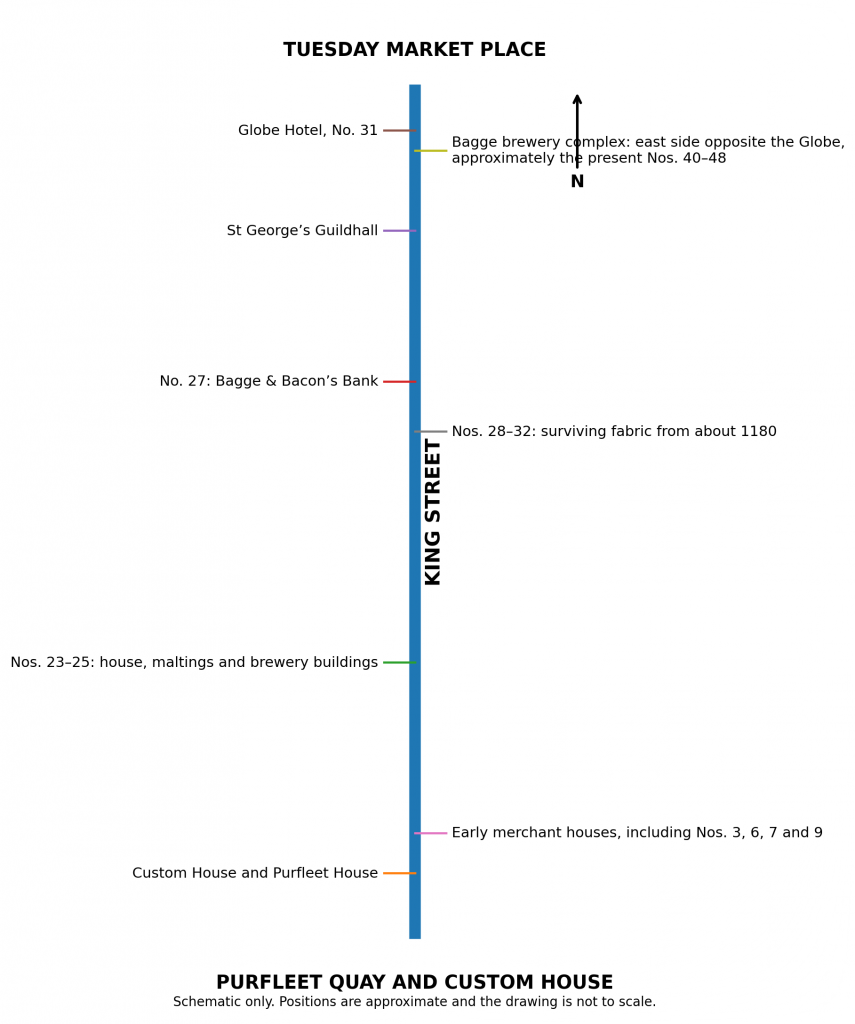
Stockfish merchants, guild members, brewers and foundry workers all used the street. The Bagges conducted brewing and banking within sight of one another, while Sir John Turner lived beside the exchange he had commissioned. At St George’s Guildhall, religious fraternity gave way to travelling players, a Georgian theatre and a modern arts centre.
King Street’s buildings are handsome, but their appearance is only part of their value. Behind the façades lies the working history of King’s Lynn: goods arriving from abroad, labourers waiting to be hired, carts entering brewery yards and merchants moving between their counting houses and the corporation chamber.
The river is now less visible, but King Street still follows its former edge. That relationship with the Ouse explains why the street developed, why wealthy merchants chose to live there and why it became one of the most important places in the town.
King Street: selected historic events
| Date | Event |
|---|---|
| Mid-twelfth century | Lynn’s northern “Newland” was laid out around the Tuesday Market Place. King Street developed along its western edge, close to the River Great Ouse. |
| About 1180 | The earliest surviving fabric at 28–32 King Street was constructed. It is among the oldest secular buildings in King’s Lynn. |
| 1325 | Part of the street was recorded as Le Stocfisrowe, or Stockfish Row, probably reflecting the sale or storage of dried cod imported from northern Europe. |
| 1376 | The religious fraternity known as the Guild of St George was founded. |
| 1406 | The Guild of St George received a royal charter. Its property was described as being in “le Cheker”, showing that the street was then known as Chequer Street. |
| Early fifteenth century | The surviving St George’s Guildhall was built. Tree-ring dating places some of its principal timbers in the first years of the century. |
| 1445 | A dramatic performance is recorded at St George’s Guildhall, providing early evidence of the building’s theatrical use. |
| 1520 | The corporation ordered unemployed labourers seeking work to assemble near the junction of Chequer Street and the Common Staith, where employers could hire them. |
| 1547 | The religious guilds were suppressed during the reign of Edward VI. St George’s Guildhall passed into secular and civic use. |
| 1593 | The Earl of Pembroke’s Men, a theatrical company associated with William Shakespeare, visited Lynn. Shakespeare may have been among them, but this is not proven. |
| About 1670 | Purfleet House, at No. 1 King Street, was built for the merchant and civic leader Sir John Turner. |
| 1683 | Henry Bell’s Custom House was erected near the southern end of King Street. It was initially used as a merchants’ exchange and was financed by Sir John Turner. |
| 1717 | The merchants’ exchange became Lynn’s official Custom House. |
| Before 1767 | The Bagge family’s brewery was operating on the east side of upper King Street, opposite the Globe Hotel. A later company tradition claimed a foundation date of 1688, but this has not been firmly verified. |
| 1766 | St George’s Guildhall was converted into a formal theatre with a stage, galleries, boxes and a pit. |
| 1809 | Chequer Street was renamed King Street during a period when several Lynn streets received patriotic names. |
| 1814 | St George’s Guildhall ceased to be Lynn’s principal theatre after a new theatre opened elsewhere in the town. |
| 1827 | An iron plate recorded the operation of John Aickman’s foundry, associated with ship repair and industrial work in a yard reached from King Street. |
| 1847 | The railway reached King’s Lynn. Over time it reduced the importance of some traditional river and coastal trading routes connected with King Street. |
| 1929 | W. & T. Bagge was purchased by Steward & Patteson. The sale included about seventy-five public houses, and brewing in King Street ended. |
| 1945 | Alexander Penrose purchased St George’s Guildhall, beginning the post-war campaign to rescue and restore the building. |
| 1949 | The St George’s Art Trust was established to secure the guildhall’s future as a cultural venue. |
| 1978–1982 | The medieval range at 28–32 King Street was extensively restored. |
| 1980s | Several endangered King Street buildings were rescued, including 23–25 King Street, with assistance from the King’s Lynn Preservation Trust. |
| Present day | King Street remains one of Lynn’s richest historic streets, preserving evidence of medieval commerce, merchant government, brewing, theatre and the town’s former waterfront. |
© James Rye 2026
Book a Walk with a Trained and Qualified King’s Lynn Guide
References
- Brewery History Society. “W. & T. Bagge.” Brewery History Wiki. Accessed 24 June 2026.
https://breweryhistory.com/wiki/index.php/W._%26_T._Bagge - Hillen, Henry J. History of the Borough of King’s Lynn. Vol. 1. Norwich: East of England Newspaper Company, 1907.
https://archive.org/details/historyofborough01hill - Historic England. “28, 30 and 32 King Street, King’s Lynn.” National Heritage List for England, list entry 1195291.
https://historicengland.org.uk/listing/the-list/list-entry/1195291 - Historic England. “40 and 42 King Street, King’s Lynn.” National Heritage List for England.
https://historicengland.org.uk/listing/the-list/ - Historic England. “46 King Street, King’s Lynn.” National Heritage List for England.
https://historicengland.org.uk/listing/the-list/ - Historic England. “48 King Street, King’s Lynn.” National Heritage List for England.
https://historicengland.org.uk/listing/the-list/ - Historic England. “The Globe Hotel, 31 King Street, King’s Lynn.” National Heritage List for England.
https://historicengland.org.uk/listing/the-list/ - Historic England. “Guildhall of St George, King Street, King’s Lynn.” National Heritage List for England, list entry 1290960.
https://historicengland.org.uk/listing/the-list/list-entry/1290960 - Historic England. “Sommerfeld and Thomas Warehouse, King’s Lynn.” National Heritage List for England.
https://historicengland.org.uk/listing/the-list/ - King’s Lynn Civic Society. Every Street Name Tells a Story: The Origins of Street Names in King’s Lynn. King’s Lynn: King’s Lynn Civic Society.
https://www.kingslynncivicsociety.co.uk/wp-content/uploads/Every-street-name-tells-a-story_web.pdf - King’s Lynn Preservation Trust. “23–25 King Street.”
https://www.klprestrust.org.uk/project/23-25-king-street/ - KL Magazine. “The History of King’s Lynn in a Single Street.”
https://www.klmagazine.co.uk/articles/king-street - Norfolk Record Office. “Research Your Home in King’s Lynn.” Norfolk County Council.
https://www.archives.norfolk.gov.uk/article/31156/Research-your-home-in-Kings-Lynn