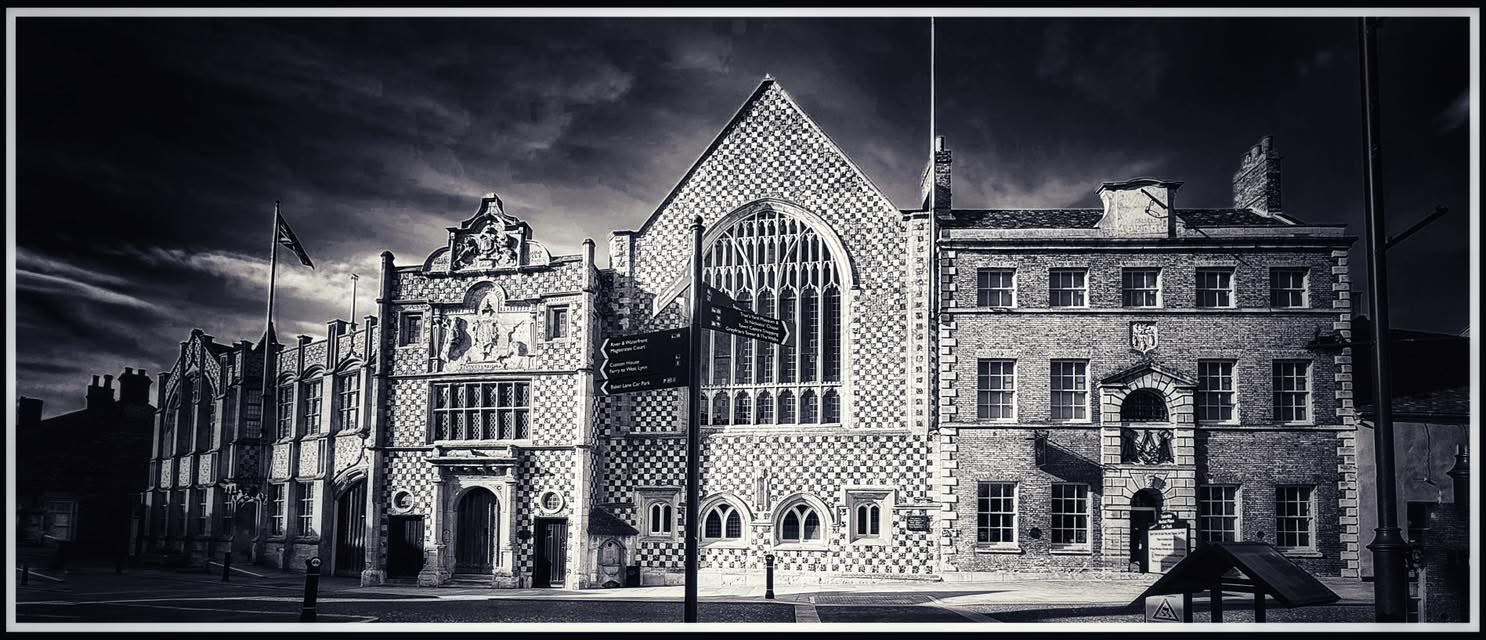
A royal puzzle above the doorway
Stand in Saturday Market Place and look up at the entrance porch of King’s Lynn Town Hall. High on the chequered flint-and-stone façade is a royal carving often described as Elizabeth I. Strictly speaking, it is not a portrait of the queen, but the royal coat of arms associated with her reign.
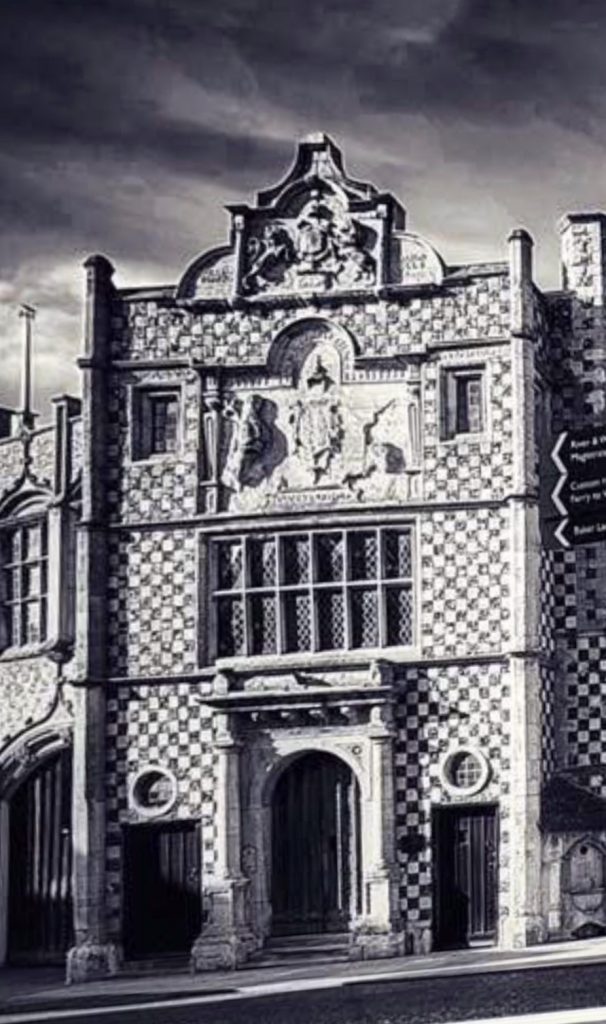
Photo © James Rye 2024
That distinction matters. A portrait commemorates a person. Royal arms make a public claim about authority. On a civic building, they announce loyalty, legitimacy, and government under the Crown.
The oddity is the date. The porch was built in 1624, during the reign of James I, more than twenty years after Elizabeth’s death. So why was an Elizabethan royal emblem placed there?
The old guildhall and the new porch
The building behind the carving is much older than the porch. The Guildhall of the Holy and Undivided Trinity was built in the fourteenth century as the hall of Lynn’s powerful religious merchant guild. Its chequered flushwork, made from alternating dark flint and pale stone, still gives the Town Hall complex one of the most distinctive frontages in East Anglia.
By the seventeenth century, the old guildhall had long since ceased to be simply a medieval guild building. After the Reformation, the religious guild was suppressed, and the building became increasingly part of Lynn’s civic life. It served the town’s government, courts, ceremonies, and administration.
In 1624, a new porch was added to protect a staircase leading up to the Stone Hall. It was Jacobean in date, but designed to harmonise with the medieval building beside it. The builders used the same striking chequerwork, making the new entrance look as though it belonged to the older civic fabric.
A carving brought from St James’s
The Elizabethan arms were not made for the 1624 porch. They were reused. Norfolk Heritage Explorer records that the coat of arms of Queen Elizabeth I over the door was brought from St James’s Chapel in 1624. Other local accounts give the same basic story: the royal arms came from St James’s and were reset above the new Town Hall entrance.
That movement gives the carving its interest. It passed from a religious setting to a civic one. In its earlier position at St James’s, the arms would have carried the post-Reformation message of royal authority over the Church of England. Once moved to the Guildhall porch, they spoke more directly of borough authority under the Crown.
The mayor named in connection with the 1624 work was Edward Hargae. Historic England records the Elizabethan arms as being inscribed with “Edward Hargae, Mayor, 1624”. His name fixes the act of reuse firmly within the civic life of the town.
Why reuse Elizabeth’s arms?
The sources do not tell us exactly what Hargae and the corporation intended, so we should be careful not to invent a private motive. But the choice made good practical and symbolic sense.
The corporation had a new public entrance to embellish. It also had a large royal carving available from St James’s. Reusing it saved material, preserved an impressive piece of carved stone, and gave the porch a strong statement of lawful authority.
Elizabeth’s arms still had meaning in 1624. They recalled the Protestant settlement and the authority of the Crown after the Reformation. Placing them on the Guildhall porch helped present the old religious guildhall as a modern civic building, loyal to the monarchy and central to the government of Lynn.
There is a neat irony here. A symbol that had once helped proclaim royal authority in a church setting was now used to proclaim civic authority on a town building. The stone had not changed, but its setting had.
A second royal layer
The porch gained another royal emblem in 1664, after the Restoration of Charles II. Historic England records that a new achievement relating to Charles II was added on the parapet, inscribed with the name of William Wharton, Mayor, 1664.
This gave the entrance a second political layer. The lower arms recalled Elizabeth and the Tudor Protestant settlement. The later arms proclaimed loyalty to the restored Stuart monarchy after the Civil War, Commonwealth, and Protectorate.
Together, they make the porch a small stone record of changing monarchy and continuing civic loyalty. It is not just decorative. It is historical argument in architecture.
What the carving tells us
Elizabeth I is not there because she built the porch, visited the Town Hall, or gave Lynn this entrance. The porch dates from 1624, in the reign of James I. The reason she appears there is that her royal arms were brought from St James’s Chapel and reused above the new civic doorway.
Edward Hargae’s name belongs to the 1624 porch and the resetting of the Elizabethan arms. William Wharton’s belongs to the Restoration addition of 1664. Between them, the two mayoral inscriptions show how Lynn’s civic leaders used the front of the Guildhall to make public statements about authority, continuity, and loyalty.
It is a small detail, easily missed by anyone walking through Saturday Market Place. Yet it tells a very Lynn story: a medieval guildhall adapted for civic government, a church carving given a second life, and a town using old stone to say something new.
© James Rye 2026
Book a Walk with a Trained and Qualified King’s Lynn Guide
References
- Historic England. “Town Hall and Trinity Guildhall, King’s Lynn.” National Heritage List for England. https://historicengland.org.uk/listing/the-list/list-entry/1211953
- Norfolk Heritage Explorer. “Guildhall, Saturday Market Place, King’s Lynn.” https://www.heritage.norfolk.gov.uk/
- Britain Express. “Trinity Guildhall, King’s Lynn.” https://www.britainexpress.com/counties/norfolk/properties/trinity-guildhall.htm
- The Royal Household. “Coats of Arms.” https://www.royal.uk/coats-arms