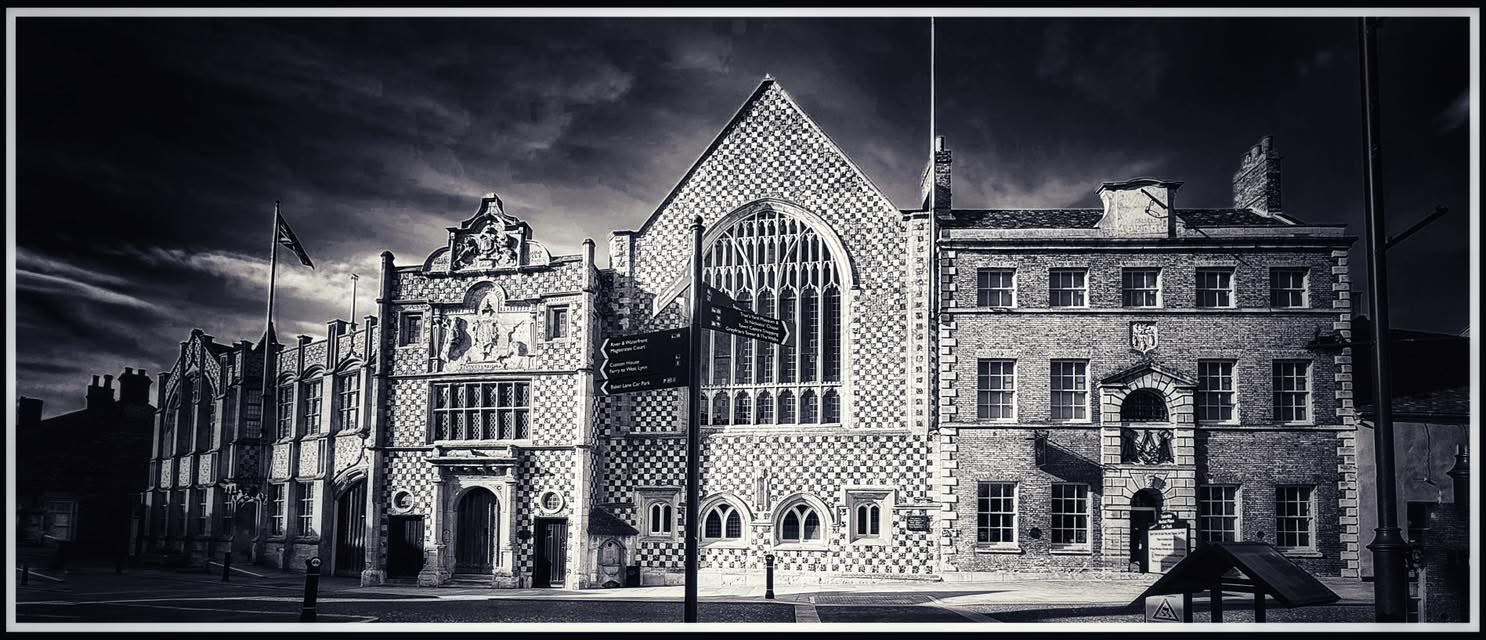
Photo © James Rye 2023
For centuries, one of England’s most powerful aristocratic families is said to have owned half of Lynn.
It is a memorable claim. The bishop of Norwich supposedly possessed one half of the medieval town, while the d’Aubigny family, builders of nearby Castle Rising, possessed the other.
The truth is more complicated.
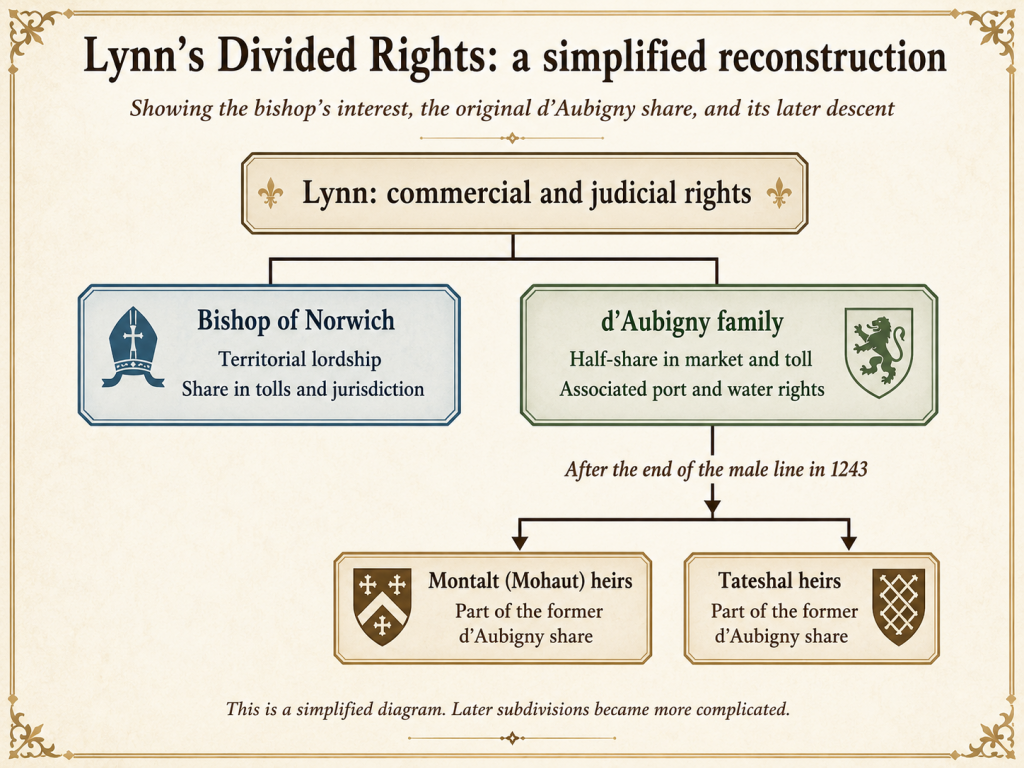
The d’Aubignys never owned half of Lynn’s streets, houses, land, or population. The bishop of Norwich remained the town’s principal territorial lord. What the family possessed was an unusually valuable collection of commercial and legal rights. These included an explicit half-share in Lynn’s market and toll, together with privileges connected with the port, arriving ships, passage by water, and certain judicial proceedings.
Their officials could demand payments from merchants and take part in disputes arising from the town’s trade. King John considered these privileges important enough to protect them when he granted Lynn its borough charter in 1204. The rights also survived the family. After the last male d’Aubigny died in 1243, the inheritance was divided among aristocratic descendants. One of them later obtained a judgment of £4,000 against Lynn.
The d’Aubignys did not own half the town. They held something less visible, but potentially just as powerful: a permanent claim upon the business that made Lynn wealthy.
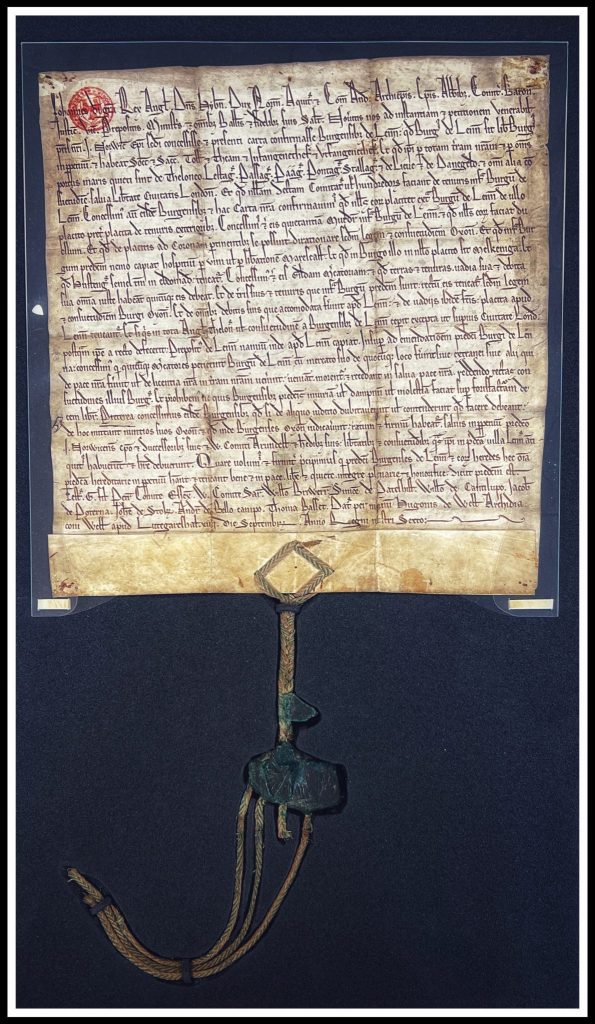
Photo © James Rye 2023
A family easily confused
The family name appears in several forms, including d’Aubigny, de Albini, d’Albini, and, later, Daubeney. Medieval scribes did not expect surnames to be spelt consistently.
There were also two important Anglo-Norman families with very similar names. The family connected with Lynn and Castle Rising must not be confused with the d’Aubignys of Belvoir. Older genealogies sometimes merged the two lines, while the repeated use of the name William created further confusion. The founder of the Lynn connection was William d’Aubigny Pincerna, who died in 1139.
The Latin word pincerna means butler or cupbearer. This was not a minor domestic position. The royal butler was an important household officer, close to the king and well placed to receive land, offices, and profitable privileges.
William was also the founder of Wymondham Priory, which he endowed from his Norfolk estates, including property at Snettisham.
From Snettisham to Lynn
Before the Norman Conquest, the great estate at Snettisham had belonged to Archbishop Stigand. By 1086, Domesday Book recorded it among the lands of Odo of Bayeux, half-brother of William the Conqueror.
Snettisham was exceptionally valuable. It was worth £85 annually and included extensive farmland, fisheries, mills, and salt houses. Land at Rising and several neighbouring places formed part of the same broad estate.
Odo rebelled against William II, better known as William Rufus, in 1088. After his defeat, his English lands were confiscated.
At some point afterwards, William Rufus granted Snettisham and associated rights to William d’Aubigny. The original charter has not survived. Our evidence comes from a later confirmation issued by Henry I, which stated that the property and privileges had previously been given by “King William, my brother”. The d’Aubignys therefore entered the Lynn area through a royal grant centred upon Snettisham. They did not receive Lynn from the bishop of Norwich, nor did they replace him as lord of the town.
Instead, two forms of power existed beside one another. The bishop held territorial lordship over Lynn. The d’Aubignys possessed particular revenues and jurisdictions within it.
Henry I’s remarkable charter
The most important evidence is Henry I’s charter confirming William d’Aubigny’s rights. The document has no date in its text. Modern editors place it between 1107 and 1109, largely from its witnesses and the known movements of the royal court. The original parchment has disappeared. In 1327, Robert de Montalt, a later inheritor of the d’Aubigny interest, asked the Crown to inspect and confirm it. The document was then copied into the Patent Roll.
Henry I confirmed William in possession of Snettisham, Freebridge Hundred-and-a-Half, and Smithdon Hundred. A hundred was an administrative and judicial district, so these grants gave the family considerable authority across north-west Norfolk. The charter then turned to Lynn.
William received the town’s misteria, half of its market and toll, other customs, the port, the landing or mooring of ships, a privilege called lofcop, passage by water, and the legal pleas connected with these rights. The document also granted “sake and soke, toll and team, and infangthief”. These phrases represented substantial judicial powers, including the right to hold courts, receive legal profits, and deal with certain disputes involving goods and theft.
The grant placed the d’Aubignys inside Lynn’s commercial machinery. It did not give them half the town.
What did “half” mean?
The misunderstanding begins with the phrase “half of the market and toll”. A medieval market was not simply an open space filled with stalls. It was a regulated institution. Traders might pay to enter, occupy a selling place, or use official weights and measures. Officers collected money, enforced customary rules, and dealt with offences. A half-share in the market and toll therefore brought income and authority.
It did not mean possession of half of Lynn’s houses, streets, or inhabitants. The charter does not divide the town’s land between the bishop and William d’Aubigny.
There is also a difficulty in the grammar. The word “half” is attached directly to the market and toll. The charter then continues with the port, ship-landing, lofcop, and water passage, but does not repeat the fraction. Later evidence shows that the bishop and the d’Aubigny heirs shared rights in the tollbooth and water jurisdiction. It is therefore reasonable to speak of a divided commercial franchise. It is less safe to claim that the charter plainly awarded the family exactly half of every right exercised in Lynn’s harbour.
Lynn’s mysterious misteria
The phrase misteria de Lenna has sometimes been translated as “the guilds of Lynn”. That may convey part of the meaning, but it risks making early twelfth-century Lynn look more organised than the evidence allows. In later medieval towns, a “mystery” could mean a trade, craft, or occupational body. Lynn eventually possessed numerous craft and religious guilds. It does not follow that this fully developed system already existed in about 1108.
The charter may refer to recognised trades, groups of merchants, commercial customs, or payments connected with particular occupations.
It shows that Lynn’s economic life was already organised enough to produce valuable rights. It does not prove that its later guild structure was already complete.
The puzzle of lofcop
The word lofcop is even more difficult. By the nineteenth century, lofcop at King’s Lynn was understood as a duty charged on grain and seeds shipped through the port. Its original meaning may have been different. One interpretation is that it began as a right of pre-emption, allowing the holder to claim priority when goods were offered for sale or to participate in a commercial purchase. The privilege may have changed over time. A lord’s right to intervene in a sale could gradually have become a standard port payment.
The evidence does not settle the question. What is clear is that lofcop was valuable enough to be named separately in a royal charter.
Castle Rising on Lynn’s doorstep
William d’Aubigny Pincerna died in 1139. His son, another William, carried the family into the highest ranks of Anglo-Norman society. In 1138, the younger William married Adeliza of Louvain, widow of Henry I. The marriage connected him directly with royalty and greatly increased his standing.
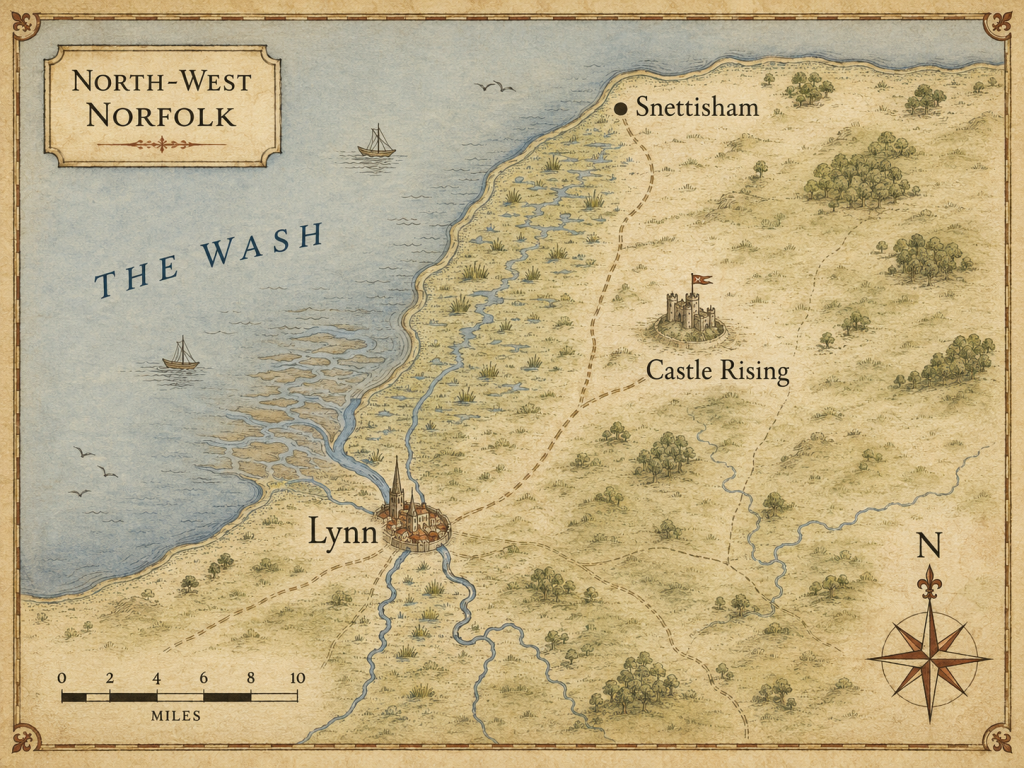
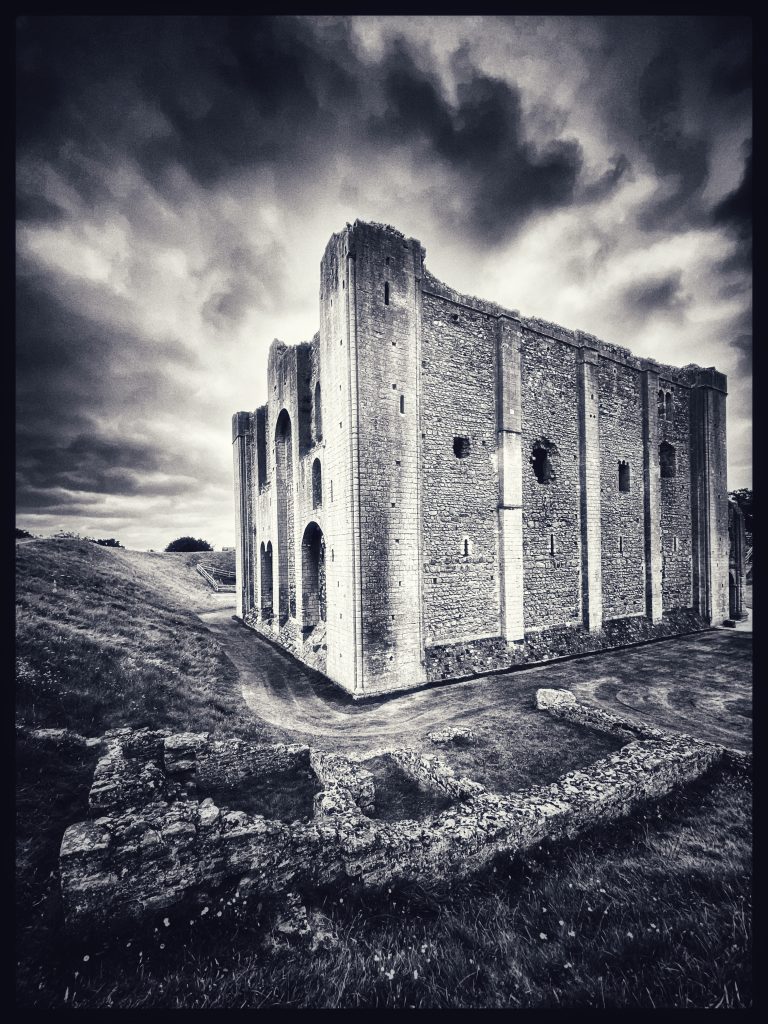
At about the same time, he began building the great stone keep at Castle Rising. The castle was both residence and display. Its decorated entrance, impressive rooms, and elaborate stonework announced the family’s wealth and status. It remains one of the finest surviving twelfth-century keeps in England. Castle Rising stood only a few miles from Lynn. Its household required food, wine, cloth, fuel, horses, metalwork, timber, and skilled labour. Lynn’s merchants and craftsmen were well placed to supply them. The castle also provided a nearby administrative centre from which the family could supervise estates and collect revenues.
It is tempting to say that Castle Rising was built to control Lynn. Its position certainly helped the d’Aubignys oversee their interests, but there is no evidence that control of the port was the castle’s principal purpose. Nor is there firm evidence that the family planned Lynn’s streets, built its earliest quays, or founded its principal churches.
The d’Aubignys were powerful neighbours. They were not the creators of the town.
A town with several masters
King John’s charter to Lynn, issued on 14 September 1204, reveals how authority within the town was divided. The charter recognised Lynn as a free borough. It confirmed important liberties for the burgesses, protected their trading rights, and recognised their merchant guild. The original survives in the King’s Lynn Borough Archives as KL/C 2/1. But John did not make Lynn independent. The charter expressly preserved the existing liberties and customs of the bishop of Norwich and William, earl of Arundel. The earl was the current head of the d’Aubigny family.
Three sources of authority therefore operated within the town. The bishop remained the territorial lord. The d’Aubigny earl possessed inherited commercial and judicial privileges. The burgesses formed an increasingly organised community with liberties of their own. A merchant might occupy property held under the bishop, trade under borough privileges, and pay a toll partly belonging to the d’Aubigny family. If a dispute followed, the parties might then argue over which court should hear it, which official could demand payment, and whose customs took priority. This overlap was not unusual in medieval England. In a wealthy port such as Lynn, however, the boundaries were especially worth fighting over.
The tollbooth and the quayside
Later medieval evidence shows how the divided franchise worked in practice. Lynn’s tollbooth stood where trade, administration, and justice met. Charges could be collected for mooring ships, transferring cargoes, using official measures, and passing by water. Payments were associated with grain, salt, wine casks, and other goods.
The bishop possessed a share in these revenues. The d’Aubigny heirs possessed others. Each lord could appoint a bailiff. These officials collected dues, received fines, and participated in commercial disputes. Some rights were leased, so merchants might deal with men who had paid for the privilege of collecting the tolls and were determined to recover their money. For a trader, the d’Aubigny franchise was not an obscure piece of Norman law. It appeared as a demand for payment, a disputed measure, or a summons to a court. It also gave the franchise holders information. Their officers could observe which ships entered Lynn, what they carried, and which merchants were using the port.
The family dies out, but the rights remain
The principal male line ended when Hugh d’Aubigny died without children in May 1243. His sisters and their descendants became coheirs. The family’s estates and franchises were divided among several aristocratic houses.
Part of the Norfolk inheritance passed to the Montalt family, whose name also appears as Mohaut. Castle Rising, Snettisham, and an interest in Lynn’s tollbooth became associated with this line. Another part passed through the Tateshal family. The Montalt and Tateshal interests together seem to have represented the former d’Aubigny share, although the later divisions became increasingly complicated.
The disappearance of the family did not remove its privileges. It multiplied the number of people entitled to claim them. A right once held by one great baronial house could now be divided into quarters and smaller fractions. Its owners might live far from Lynn and care little about the town beyond the income it produced. Their bailiffs could still collect money.
The £4,000 disaster
The most serious clash came in the early fourteenth century, when Robert de Montalt held Castle Rising and claimed authority connected with Lynn’s river and port. Lynn’s records accuse Montalt and his officers of interfering with merchants, forcing townspeople to attend an outside court, and imposing excessive demands.
The account must be treated carefully. It was written from the borough’s side of the dispute. Montalt would probably have argued that he was exercising ancient rights inherited through the d’Aubignys. He may have believed that Lynn’s mayor and burgesses were trying to escape lawful obligations and keep the profits of the port for themselves.
The quarrel eventually reached the royal Court of Common Pleas. In 1314, Robert de Montalt and his wife, Emma, obtained a judgment of £4,000 against Lynn’s mayor and community.
The sum was enormous. Lynn could not pay immediately and had to negotiate instalments over several years.
Later accounts have sometimes connected the judgment with an alleged assault upon, or imprisonment of, Montalt’s officials in 1317. That cannot be correct. A judgment made in 1314 cannot have been caused by an event three years later. There may have been further violence in 1317, but it belonged to the continuing quarrel.
The exact legal action behind the £4,000 award still needs to be checked in the original Common Pleas roll. Even so, the episode shows the extraordinary durability of the d’Aubigny inheritance. Nearly two centuries after Henry I’s charter, those rights could still place Lynn in serious financial danger.
What the d’Aubignys did not control
The evidence does not support the claim that the d’Aubignys owned half of Lynn. They did not possess half its urban land or rule half its inhabitants. There is no secure evidence that they appointed Lynn’s mayors, directed the ordinary business of the borough, or controlled its principal religious institutions. Their wealth and nearby estates undoubtedly affected the local economy. Castle Rising created demand for goods and services, while the family’s lands formed part of the productive countryside upon which Lynn depended.
That does not prove that the d’Aubignys planned the town, built the first quays, or created its churches. Lynn grew through a combination of episcopal lordship, merchant enterprise, royal privilege, river traffic, religious institutions, and borough organisation. The d’Aubignys were an important part of that story, but not the whole of it.
Who controlled medieval Lynn?
The question assumes that control had to belong to one person or institution. Medieval government was rarely so tidy.
The bishop of Norwich was Lynn’s principal territorial lord. The burgesses acquired liberties and developed institutions of their own. The d’Aubignys possessed a hereditary stake in the market, tolls, port, and associated jurisdiction. These rights overlapped.
The bishop might hold the land, the borough might regulate its merchants, and the earl’s bailiff might claim a payment arising from their trade. Each could possess a valid right while disagreeing fiercely about where it ended. This is the reality concealed by the phrase “half of Lynn”.
The d’Aubignys did possess half of something important. Their share in the market and toll placed them inside the machinery of Lynn’s commerce. Their other privileges strengthened that position. They did not own half of medieval Lynn. They held a hereditary interest in the business that made Lynn rich.
That distinction gives us a more accurate picture of the town. Bishop’s Lynn was not divided neatly between two landlords. It was a thriving port in which episcopal lordship, aristocratic privilege, and borough liberty crossed one another repeatedly, sometimes cooperating, sometimes competing, and never fitting comfortably together.
© James Rye 2026
Book a Walk with a Trained and Qualified King’s Lynn Guide
References
- Ballard, Adolphus. British Borough Charters, 1042–1216. Cambridge: Cambridge University Press, 1913.
- Cohn, Samuel K., Jr., with Douglas Aiton. Popular Protest in Late Medieval English Towns. Cambridge: Cambridge University Press, 2012.
- Cokayne, George Edward. The Complete Peerage of England, Scotland, Ireland, Great Britain and the United Kingdom. Vol. 1. London: St Catherine Press, 1910.
- Cronne, H. A., and Charles Johnson, eds. Regesta Regum Anglo-Normannorum, 1066–1154. Vol. 2. Oxford: Clarendon Press, 1956. https://archive.org/details/regestaregumangl02grea
- English Heritage. “Castle Rising Castle.” https://www.english-heritage.org.uk/visit/places/castle-rising-castle/
- Historical Manuscripts Commission. Eleventh Report, Appendix, Part III: The Manuscripts of the Corporations of Southampton and King’s Lynn. London: Her Majesty’s Stationery Office, 1887. https://www.british-history.ac.uk/hist-mss-comm/vol11/pt3/pp235-247
- Norfolk Record Office. “One of King’s Lynn Borough Archives’ Earliest Documents: The Charter of King John to the Burgesses of Lynn, 14 September 1204.” https://norfolkrecordofficeblog.org/2016/10/21/one-of-kings-lynn-borough-archives-earliest-documents-the-charter-of-king-john-to-the-burgesses-of-lynn-14-september-1204/
- Open Domesday. “Snettisham.” https://opendomesday.org/place/TF6934/snettisham/
- Page, William, ed. “The Abbey of Wymondham.” In A History of the County of Norfolk. Vol. 2. London: Victoria County History, 1906. https://www.british-history.ac.uk/vch/norf/vol2/pp336-343