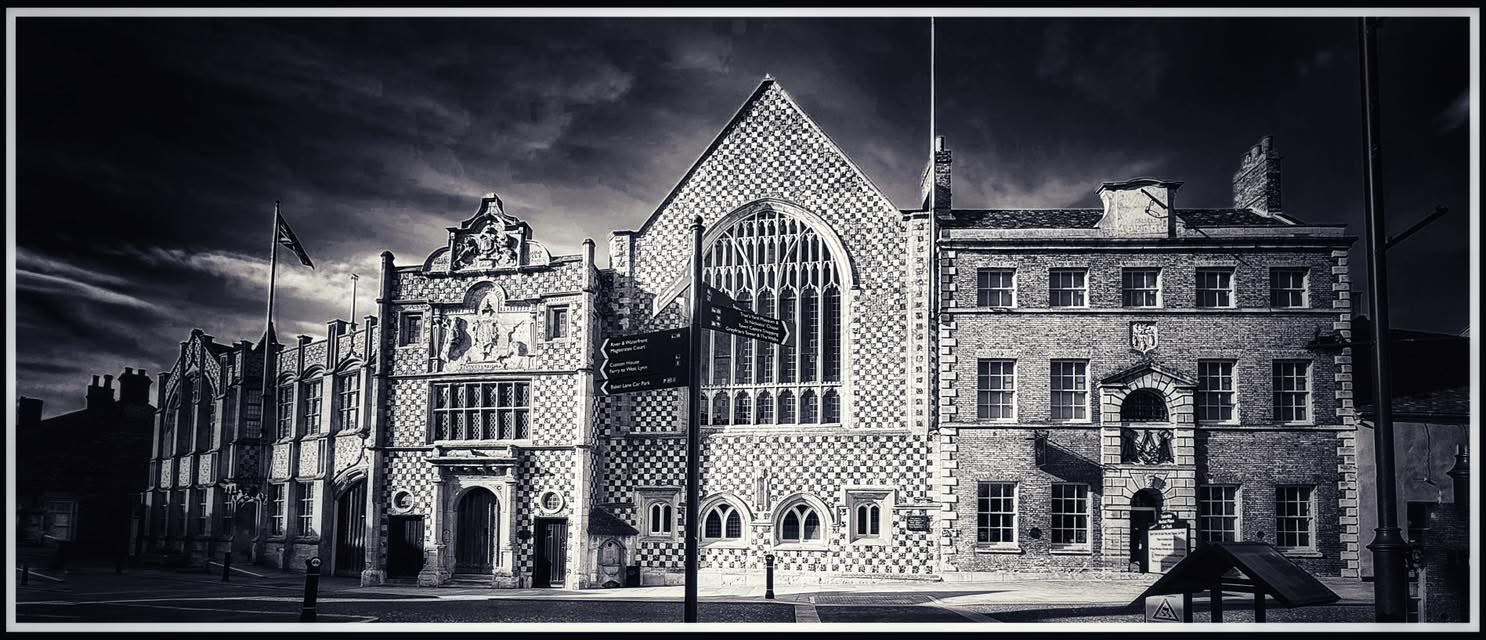
Aickman’s Yard in King’s Lynn was once the entrance to an important nineteenth-century iron foundry established by John Aickman and David Menzies.
Aickman’s Yard in one glance
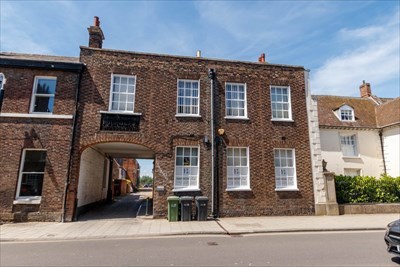
Aickman’s Yard sits off King Street behind the carriage entrance at No. 19, and its story is announced in iron. Historic England’s list description notes that the segmental-arched carriage entrance leads into Aickman’s Yard, “which formerly contained John Aickman’s Foundry”, and that a cast-iron plaque over the arch reads “John Aickman’s Foundry, MDCCCXXVII”.
A local maritime trail aimed at visitors makes the same point in plain language, adding two useful details: the yard “led to a ship repair business by the river”, and the 1827 plaque is something to look for as you pass.
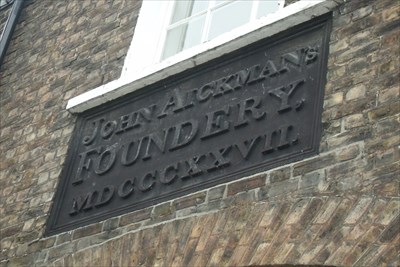
Those two statements, taken together, tell you why the site mattered. This was not an inland workshop tucked away for convenience. It was a river-facing business embedded in one of Lynn’s most commercial streets.
John Aickman and David Menzies: why they came, and what they brought
John Aikman was born in Scotland on 25 March 1779, into a family wealthy enough to send him and his brother James to school in Edinburgh. He and his friend David Menzies left Scotland in the context of post-1746 upheavals and the Highland clearances, aiming to make their fortunes elsewhere.
Their key preparatory stage was Yorkshire. They travelled to Birstall, south-west of Leeds, to connect with William Spurr, an established iron worker who ran an iron foundry there. Aickman and Menzies stayed with the Spurr family, learning iron smelting, production and engineering before moving on to King’s Lynn.
That Birstall link mattered later, because it became the backbone of a long-running Aickman–Spurr dynasty in Lynn, with marriage and inheritance repeatedly tying the King Street foundry to the Spurr family network.
Why King’s Lynn made sense
King’s Lynn offered a particular blend of advantages in this period. It remained a port and market centre of real weight, with strong inland navigation and a large, well-served agricultural hinterland, at a time when poor roads still made water transport highly competitive.
The site they chose was perfectly adapted to that economy. Before it took Aickman’s name, the plot was known as Linnock’s Yard. It fronted King Street with a medieval timber-framed house, and behind it ran warehouses and a yard down to the river, including a private quay. For a foundry and shipsmith business, that layout was ideal: bulky raw materials in, heavy products out, and the river doing the hardest part of the transport work.
By 1810, Aickman was already rising rapidly in Lynn, established as a merchant and active in Freemasonry. In 1835 he was installed as Master of the Lodge. This is a useful reminder that early industrial enterprise in Lynn depended as much on networks and reputation as on technical skill.
The “Foundery” takes shape, 1822 to 1827
Aickman and Menzies were trading by 1822, with advertisements appearing in Pigot’s London & Provincial Directory and White’s Directory of Norfolk. Sometime before 1827 they had arrived in Lynn, established their foundry at Linnock’s Yard, and then took the decisive step: they purchased the entire yard, pulled down the medieval street-front house, and rebuilt two brick town houses on King Street (now 17 and 19).
The 1827 rebuild is the moment the yard becomes legible to us today. It is also why the plaque matters so much. It is a dated claim of presence on the town’s premier commercial street, saying, in effect: this business belongs here.
What the foundry did, and who it served
The foundry’s core work was practical and local in the best sense. It produced boat parts and farm implements and carried out repairs, with demand strengthened as iron and steel were used more widely in shipbuilding and as mechanical farming spread. These were not luxury products. They were the fittings and fixes that kept a working port town, and a heavily farmed region, moving.
This is also where the yard’s river connection becomes more than an attractive idea. The Maritime Trail’s note that the yard led to ship repair by the river fits neatly with the foundry’s output and with the earlier existence of a private quay on the site.
1843: death, succession, and a remarkable inheritance
In 1842 Aickman drafted his will with assistance from David Menzies and the local solicitor Lewis Weston Jarvis; he died on 23 April 1843, aged 64.
Immediately afterwards, the trades of iron founder and blacksmith continued “on the Premises, in King Street”, under the firm of Aickman, Menzies, and Co.
The most consequential decision, though, was in the property settlement. Aickman left all land and real estate to Elizabeth Spurr and her heirs, rather than to his nephew William. That transfer became the legal and financial anchor for the next phase of the business.
The dynasty: nephews, Spurrs, and the long middle century
Aickman had no children. He therefore brought his nephew William (his brother James’s son) from Scotland to learn the foundry trade, and William, like John, had been educated in Edinburgh. On his way to Lynn, William stayed at Birstall with the Spurrs and learned the technical and managerial side of running a foundry there.
In October 1843 William married Elizabeth Spurr in Lynn, and in 1845 a formal partnership was arranged between William and David Menzies, recorded in White’s Directory as “Aickman and Menzies, Iron Founders”. Menzies moved out of King Street by 1843 and, by 1850, left Lynn and relinquished his partnership, leaving the business to the Aickmans.
As William’s health declined, he invited his brother George to Lynn. George travelled via Birstall, met Marianne Spurr, and married her on 30 August 1855. By 1864 William and George were partners in what had become known as the “Lynn Foundry”.
After William’s death in 1866, Thomas Spurr (William Spurr’s son) joined the Lynn business, taking on duties and becoming a partner; later that same year he married Jean Aickman, William’s daughter. By the 1870s, as pressures on the business grew, property arrangements continued to favour women in the family, explicitly protecting interests from husbands’ control.
In 1872 the business became a limited company under the title William Aickman and Company, Lynn Foundry, King Street. Directory evidence from 1877 still shows “Aickmans” as ship and agricultural instrument makers, though by then the concern was no longer owned by the Aickmans or Spurrs, and the foundry ultimately closed in 1896.
This arc fits the wider shift in Lynn’s economy as the railways and new transport networks altered the town’s older advantages. A local history summary notes that Lynn’s population fell from about 20,000 to about 17,000 between 1851 and 1871, before later recovery linked to docks and rail-connected industry.
Owners
| Date(s) | Owner or property-rights holder (as stated) | Who is described as running/controlling the foundry from the yard | Notes |
|---|---|---|---|
| Before c.1827 | Not stated (the plot is described as “Linnock’s Yard”) | Not stated | Linnock’s Yard with a medieval house fronting King Street and a yard/warehouses running to the river, but does not name the owner. |
| Sometime before 1827 (and trading by 1822) to 23 Apr 1843 | John Aickman and David Menzies (they “purchased Linnock’s Yard”) | John Aickman and David Menzies | They are said to have bought the plot, demolished the medieval street-front house and rebuilt two brick houses. |
| 23 Apr 1843 onward (after John Aickman’s death) | Elizabeth Spurr (later Elizabeth Aickman), by bequest of “all land and real estate” | “Aickman, Menzies, and Co.” continues trading (announcement dated 10 May 1843) | The property transfer is explicit, and the continuation of the firm is announced separately. |
| 18 Oct 1843 onward | Elizabeth Spurr (two properties fronting the yard, now 17 and 19 King Street, “bequeathed to her”) | Day-to-day management passes to William Aickman upon his marriage (24 Oct 1843) | A trust dated 18 Oct 1843 is said to govern her disposal of 17 and 19. |
| 1845 to 1850 | Elizabeth Aickman (property rights implied to remain with her) | William Aickman and David Menzies (formal partnership) | Partnership for the foundry is stated for 1845. |
| By 1850 | “Solely rests with the Aikmans” (ownership of the business, as phrased) | William Aickman (with the family business continuing) | Menzies leaves Lynn and relinquishes his partnership. |
| 30 Aug 1855 to 1864 (and after) | Not separately stated | William and George Aickman (partners by 1864) | George joins and marries Marianne Spurr; by 1864 the brothers are partners in the “Lynn Foundry”. |
| 1866 to 1867 | Elizabeth (wife of William) and Jean (daughter) hold key interests (via will/codicils) | Thomas Spurr becomes partner after William’s death; George continues | After William’s death (1866), Thomas Spurr becomes a partner; William’s will is said to leave properties to his wife Elizabeth and a controlling interest in the foundry to his daughter Jean. |
| By 1867 | Elizabeth and Jean have “controlling interests” (as stated) | George Aickman and William Spurr are described as “running the foundry” | This is framed as operational control versus controlling interests. |
| 1872 | William Aickman and Company (limited company) | Trading continues under the company title | The foundry is said to become a limited company in 1872; Thomas Spurr’s name disappears from the company name. |
| 1870s to 1880 | Elizabeth Aickman (still has “property rights” until her death in 1880) | Thomas Spurr and Jean (née Aickman) are “in sole charge” after 1878 | Some yard properties are said to be sold off or let out during the 1870s; on Elizabeth’s death in 1880 she bequeaths her interest in the foundry properties to Jean Spurr. |
| 1877 (statement about ownership) | “Not owned by the Aickmans or Spurrs” (unclear whether this refers to business, premises, or both) | Directory entry still lists “Aickmans” as ship and agricultural instrument makers | The document makes this claim specifically for 1877. |
| 1893 | Sold off (remaining properties and foundry) | Not stated | Thomas Spurr dies in 1893 and the remaining properties and foundry are sold off, ending about 70 years of use by the Aickmans. |
| After 1893 | Not stated | “Used by several different trades” (owners not named) | Later owners/occupiers are not identified in the document. |
© James Rye 2026 (The author also wishes to acknowledge a debt to Paul Allford, King’s Lynn Town Guides.)
Book a Walk with a Trained and Qualified King’s Lynn Guide
References
- Allford, P. (2021) A Brief History of John Ai(c)kman and the “Lynn Foundery”, Unpublished paper for King’s Lynn Town Guides
- King’s Lynn town guides course document on John Aickman, David Menzies, and the Lynn foundry (2021). (Private document supplied by user.)
- Historic England. “19, King Street” (NHLE 1298220).
https://historicengland.org.uk/listing/the-list/list-entry/1298220 - Historic England. “3, 4, Aickman’s Yard” (NHLE 1195333).
https://historicengland.org.uk/listing/the-list/list-entry/1195333 - Historic England. “Wall 12 metres east of river bank, Aickman’s Yard” (NHLE 1298203).
https://historicengland.org.uk/listing/the-list/list-entry/1298203 - King’s Lynn Maritime Trail (PDF).
https://www.hansehouse.co.uk/wp-content/uploads/2014/06/Maritime_Trail_web-version.pdf - Borough Council of King’s Lynn and West Norfolk. “St Nicholas Conservation Area Character Statement” (PDF).
https://www.west-norfolk.gov.uk/download/downloads/id/1909/kings_lynn_st_nicholas_con_area_leafletpdf.pdf - Visit West Norfolk. “Hanseatic King’s Lynn” (background on nineteenth-century change).
https://www.visitwestnorfolk.com/destinations/kings-lynn/history/hanseatic/