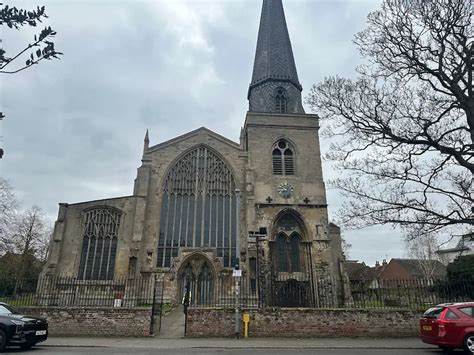
St Nicholas Chapel is one of the finest medieval buildings in King’s Lynn, but it is also one of the most revealing. It tells us how the town expanded in the 12th century, how the merchants of the northern quarter displayed their money and confidence in the late Middle Ages, how bitter church politics could become inside a single town, and how one huge building could move from chapel of ease, to fishermen’s chapel, to concert venue, and still remain part of local life. Founded in 1146, rebuilt several times, enlarged on a grand scale between the later 14th and early 15th centuries, and given its present spire in 1869 to the designs of Sir George Gilbert Scott, it is now generally described as the largest chapel of ease in England.
A chapel for the “new land”
St Nicholas was born from urban growth. As Lynn expanded northwards beyond the Purfleet in the mid 12th century, Bishop William Turbe laid out a “new land” with its own market at what became the Tuesday Market Place. In that setting he established a chapel dedicated to St Nicholas, the saint of sailors, a dedication that made perfect sense in a port town. The early charter quoted in the chapel guide is unusually vivid: the bishop speaks of “our new land” and of a chapel newly erected there. The building was therefore not an afterthought. It was part of a deliberate reshaping of the town’s northern quarter. Yet it was not allowed full independence. From the start it remained subordinate to St Margaret’s, and that subordinate status would shape much of its later history.
The earliest chapel was modest. The guide suggests that its nave was roughly the width of the present south aisle. Around 1200 it was rebuilt, and part of that rebuilding still survives in the old west gable wall, with its three lancets and central doorway, now embedded in the later tower. Soon afterwards, around 1220 to 1225, the great south-west tower was added. The site was difficult. The ground was soft, the tower foundations had to be widely splayed, and the partial use of the older wall helped produce settlement problems which were corrected when the upper stage was added later. These are not small antiquarian details. They show that the chapel still carries, in its own masonry, the story of how Lynn grew on marshy riverside ground.
The great rebuilding and the ambition behind it
The chapel we know today is mainly the result of a vast rebuilding campaign between the later 14th century and the early 15th. Historic England gives the broad range as 1371 to 1419, while the CCT guide argues more cautiously that the main rebuilding probably took place between the 1380s and 1413, warning against treating 1419 as a neat completion date. What matters most is scale. The enlargement left only the older tower and earlier gable wall in place and created an immense rectangular hall, about 59 metres long, 22 metres wide, and 28 metres high to the ridge. For a chapel of ease, this was an astonishing statement. It was the architecture of a prosperous mercantile quarter that did not intend to look secondary.
That statement becomes clearer when set against the history of the “New Land” itself. The guide notes that by the 14th century this was the desirable part of town, where merchants held valuable properties. One striking clue is the now-lost brass of the merchant William de Bittering, who died in 1369. Eighteenth-century observers still saw it largely intact and thought it comparable to the great Flemish brasses in St Margaret’s. The chapel was therefore already attracting wealthy patrons before the grand rebuilding took shape. The surviving west front, with the crest of Richard II, suggests that at least part of the new work was already up before 1399. The guide also names Hugh Rose as master mason in the 1400s.
The long fight over rights and status
One of the most revealing parts of St Nicholas’s history is the repeated attempt to break free, at least in part, from St Margaret’s control. In 1378 the chapel’s chaplain, John Peye, acting at the request and expense of some of Lynn’s townsmen, obtained from Pope Urban VI a bull allowing St Nicholas to perform baptisms, marriages, and the churching of women. For a chapel of ease, this was a major challenge to the existing order. The response from St Margaret’s was fierce. A meeting in the prior’s chapel declared that the bull had been fraudulently obtained, and arbitration in 1381 confirmed that judgement. Historic England reads this dispute, and the rebuilding that followed, as evidence of the wealth and ambition of the merchants who wanted St Nicholas to rival the great parish churches of East Anglia. That seems right. The architecture looks a good deal like an argument in stone.
The issue did not end there. Another attempt followed in the later 1420s and early 1430s. The CCT guide preserves one of the most memorable local echoes of the dispute in The Book of Margery Kempe. Margery reassured the priest of St Margaret’s that the supporters of a font at St Nicholas would not succeed, and on this occasion they did not. Only in 1627 did the chapel finally gain the right to administer marriage and baptism, when a font was commissioned at a cost of £13. That long delay says much about ecclesiastical politics in Lynn. St Nicholas was a very large and splendid building, but grandeur did not automatically bring independence.
Medieval worship inside the chapel
The medieval interior would have looked very different from the open space visitors see today. Historic England notes that the aisles once contained small chapels formed by screens for guild altars, while the rood screen marked off nave from chancel. The guide supplies some of the people and institutions behind that world. Side chapels of St Edmund and St Peter are recorded in 1371. The Trinity Guild paid hermits there in the 1370s and again in the early 15th century. Other links included the Guild of the Annunciation, St Antony, St Thomas of Canterbury, and by 1490 the Guild of St Etheldreda. This was not an empty architectural shell. It was busy, partitioned, devotional, and socially entangled with the fraternities of the town. [Historic England; Churches Conservation Trust guide]
The chapel was also richly furnished. The guide records costly vestments and plate, and notes that in 1551 St Nicholas possessed 24 copes, even more than St Margaret’s. Yet much of that richness vanished in the upheavals of the 16th century and later. Historic England records that no medieval glass now remains, the little that survived the Reformation and Commonwealth having been removed in 1805. The same pattern of loss affected screens, fittings and imagery. What survives is impressive, but it is only a part of what late medieval worshippers would have known.

Photo © James Rye 2023
The building itself
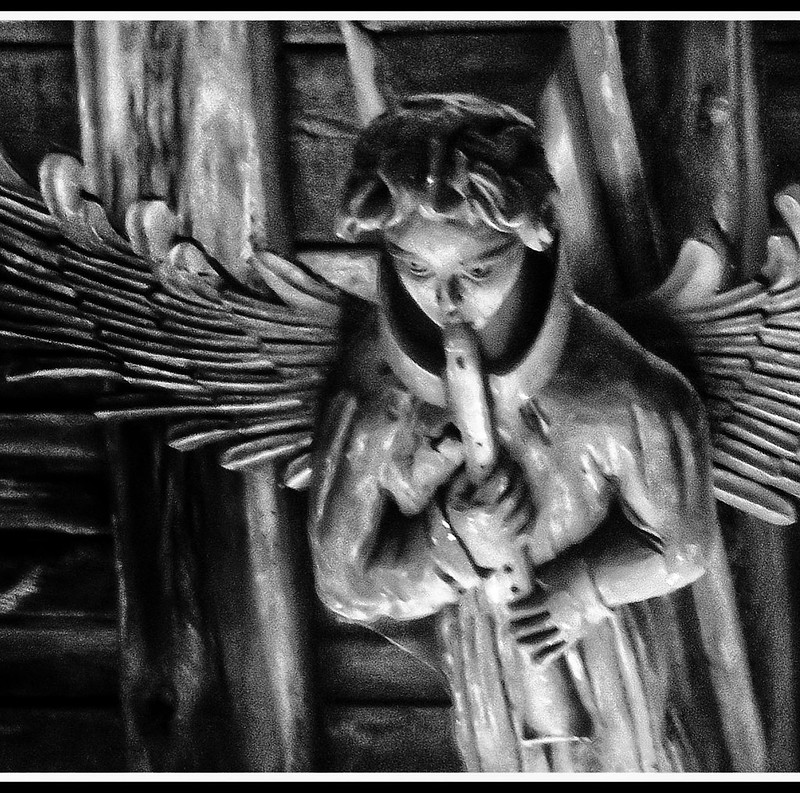
Architecturally, St Nicholas is extraordinary. The south porch is one of the showpieces of King’s Lynn, two-storeyed and heavily ornamented, with an interior lierne vault whose bosses include God the Father, angels, heads, foliage, demons and dragons. Inside, the chapel opens into an enormous eleven-bay hall with a roof of alternating tie-beam and hammer-beam trusses. The carved angels above the clerestory are among the building’s most famous features. Historic England notes that only the sanctuary bay still preserves some original paint, and the guide points out a particularly attractive detail: the recorder played by one angel on the south side is the earliest known illustration of that instrument in church carving.
Other survivals are just as interesting, though less often noticed. The consistory court in the north-west corner, built in 1617, is a rare survival of the place where the archdeacon dealt with offences against church law, including sexual misconduct and other cases of “immorality”, meeting twice yearly at Easter and Michaelmas. There is also a fine pre-Reformation brass lectern, one of only about 45 such lecterns surviving in England and Wales according to Historic England. Across the floor lie 187 ledger slabs, said to be second in number only to Bath Abbey. The monuments, too, are remarkable, among them the Robert Adam memorial to Sir Benjamin Keene with its carved Lisbon shipping scene.
Reformation losses, storm damage, and Victorian “improvement”
St Nicholas did not pass into the modern age untouched. The chapel lost plate and textiles after the Reformation, and later changes altered both its appearance and its atmosphere. In 1704 Henry Bell designed a fine altarpiece for the chapel, but both Historic England and the guide note that it was destroyed in the 19th century during restoration carried out in the name of better church taste. Earlier galleries and seating had already blocked arches and obscured views, and William Taylor complained about these conditions in the 1840s.
The most dramatic physical blow came with the great gale of 1741, which brought down the spires of both St Nicholas and St Margaret. At St Nicholas the damage was less ruinous than at St Margaret’s, but it was serious enough to require repairs funded in part through long leases on chapel property. The replacement was later mocked as a sort of wooden extinguisher. At last, in 1869 to 1870, the present spire was erected to the designs of George Gilbert Scott, who also oversaw restoration of the tower and recasting of the bells.
Victorian restoration was both rescue and damage. Between 1852 and 1853 the galleries and old pewing were stripped out, the present seating was installed, and the chapel reopened. Yet that campaign also destroyed Bell’s altarpiece and dispersed medieval woodwork. Historic England notes that some misericords and bench ends ended up in the Victoria and Albert Museum, with others now on loan at Lynn Museum. This mixture of preservation and loss is very familiar in 19th-century church history, but at St Nicholas it is especially poignant because so much of the medieval richness had already gone.
The Fishermen’s Chapel
The popular identity of St Nicholas as the “Fishermen’s Chapel” is real, but it is not simply a medieval survival. The guide suggests that this image took shape particularly in the later 19th century. In 1850 the North End population was still in many ways excluded by pew rents, but reforms to Sunday evening worship helped change that, and by 1868 the chapel was being described as having the largest congregation in town, with fishermen prominent among those attending. A mission in 1897 seems to have deepened the bond, and the guide suggests that the familiar nickname may date from that period.
That North End connection also gave the chapel an unexpected place in English musical history. In 1905 Ralph Vaughan Williams, staying in Lynn, was introduced to elderly fishermen connected with the chapel and collected more than seventy folk songs from them. The guide identifies James Carter and Joe Anderson among the singers, and notes that tunes from Lynn entered the Norfolk Rhapsody and The English Hymnal, where “Van Diemen’s Land” became the tune “King’s Lynn”. This is one of the most appealing episodes in the chapel’s later story: a great medieval building, a fishing community, and one of the leading composers of the age meeting by chance in the same orbit.
Closure, rescue, and the chapel now
For much of the 20th century the chapel remained active, with a large choir and a strong role in the King’s Lynn Festival. The guide states that it was the festival’s main concert venue from the 1950s until 1996, and that audiences of around 900 once packed the building. At the same time, ordinary parish use became harder to sustain. By the 1970s St Nicholas was little used for worship, and in 1989 the parish decided to retain St Margaret’s and allow St Nicholas to become redundant. It passed into the care of the Churches Conservation Trust in 1992.
That was not the end of the story. Official CCT and local tourism sources record a £2.7 million conservation project completed in 2015, with major works to improve access, interpretation and year-round use. Historic England notes new toilet and kitchen facilities, restoration of the bells, and other interventions in the tower, while project accounts also mention re-roofing, heating, lighting and solar panels. Today the chapel remains consecrated and is used for concerts, exhibitions, community events, occasional services and North End funerals. In that sense it has kept faith with its long past. It is no longer a crowded medieval chapel of ease, but it is still a place where the town gathers.
St Nicholas Chapel matters because it brings together so many layers of King’s Lynn’s history in a single building. It is about urban growth, merchant wealth, rivalry with St Margaret’s, guild religion, Reformation loss, Victorian restoration, North End memory and modern conservation. St Margaret’s may be the mother church of Lynn, but St Nicholas often feels closer to the grain of the town itself: proud, practical, deeply local, and shaped at every stage by the people who used it.
© James Rye 2026
Book a Walk with a Trained and Qualified King’s Lynn Guide
References
- Churches Conservation Trust. St Nicholas’ Chapel, King’s Lynn. Accessed 10 March 2026. https://www.visitchurches.org.uk/visit/our-churches/kingslynn
- James, Elizabeth, and Michael Begley. St Nicholas’ Chapel, King’s Lynn, Norfolk. London: Churches Conservation Trust, n.d. Accessed 10 March 2026. https://cdn.visitchurches.org.uk/uploads/images/Churches/Kings-Lynn-St-Nicholas/St-Nicholas-Chapel-Kings-Lynn-Guide.pdf?v=1733235411
- History Timeline. Friends of St Nicholas’ Chapel, King’s Lynn. Accessed 10 March 2026. https://www.stnicholaskingslynn.org.uk/history-timeline/
- Historic England. Chapel of St Nicholas, List Entry Number 1210545. Accessed 10 March 2026. https://historicengland.org.uk/listing/the-list/list-entry/1210545
- rg+p. St Nicholas Chapel, King’s Lynn. Accessed 10 March 2026. https://www.rgarchitects.com/st-nicholas-church
- Visit West Norfolk. St Nicholas’ Chapel. Accessed 10 March 2026. https://www.visitwestnorfolk.com/attraction/church/st-nicholas-chapel-1477031/