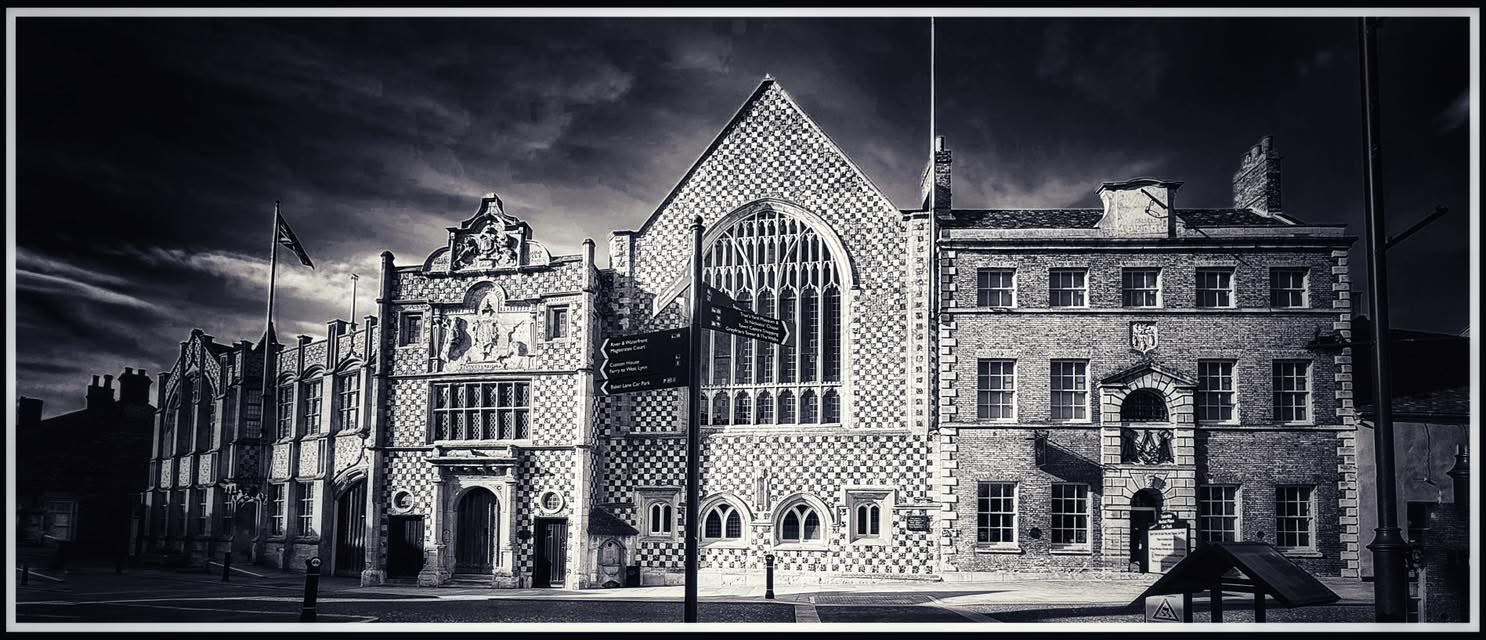
The castle itself probably was not stormed. Its lord was.
Early in the fourteenth century, Robert de Montalt left his great stone residence at Castle Rising and came to Bishop’s Lynn. There, one of the most powerful men in Norfolk was assaulted, pursued through the town, deprived of his freedom and apparently forced to concede the demands of an angry crowd.
Montalt eventually escaped their control. He then exacted a punishment that Lynn would be paying for years.
The lord who claimed Lynn’s river
Robert de Montalt was lord of Castle Rising and hereditary steward of Chester. Through the d’Aubigny family, he had also inherited a share in the tolls and legal rights associated with Lynn’s port.
This produced an awkward arrangement. The bishop of Norwich was lord of Bishop’s Lynn (John Salmon, who held the see from 1299 until his death on 6 July 1325), while the mayor and burgesses claimed extensive liberties within the town. Montalt nevertheless regarded himself as one of the lords of Lynn’s water, entitled to a share of its customs and some authority over its merchants.

Photo © James Rye 2020
In about 1310, he established a court at St German’s Bridge in Wiggenhall, on the river route linking Lynn with the Fenland waterways. Boats carrying goods towards the port could be stopped before reaching the town.
Lynn’s records accuse Montalt’s bailiff, Walter Payn, of summoning traders before the court, seizing their goods and extracting heavy fines. Boatmen who refused to land were allegedly threatened with stones and lumps of earth. Some merchants, the town later claimed, became so impoverished that they sold their vessels.
This was Lynn’s version of events, written by men with every reason to portray Montalt as an oppressor. Montalt presumably believed that he was exercising legitimate inherited rights. Yet the threat to Lynn was real. If his officials controlled the river at St German’s, they could obstruct trade and weaken the authority of the town’s own government.
Violence in the streets of Lynn
The dispute became personal when Montalt came to Lynn.
Henry Hillen’s later history describes a confrontation between Montalt and John de Bromholm, prior of Lynn’s Benedictine community beside St Margaret’s Church. According to Hillen, the prior publicly attacked the baron. The watching townspeople then joined in.
Montalt’s attendants were wounded and the house in which he was staying was damaged. The crowd captured Montalt and carried him away to imprisonment.
While in their hands, he apparently agreed that Lynn could appoint its own bailiff to collect the disputed customs and divide the proceeds among those entitled to them. He may also have promised not to prosecute his attackers.
These details come through partisan and much later accounts, so the precise sequence cannot be treated as certain. The scale of the disturbance is harder to doubt. In his complaint to the king, Montalt individually named 223 men and one woman.
That does not prove that every person named struck Montalt or entered his lodging. Medieval plaintiffs often accused as many people as possible. It does, however, suggest something much larger than a private quarrel. A considerable part of Lynn’s community had apparently united against the man they believed was damaging the port.
Did the crowd march on Castle Rising?
The episode has sometimes been described as an attack upon Castle Rising. It makes an irresistible story: hundreds of angry townspeople marching five miles northwards and forcing their way into one of England’s most imposing Norman castles.
Unfortunately, the evidence examined so far does not support it.
Hillen places the violence in Lynn, where Montalt was lodging. The surviving summaries of the corporation’s documents refer to trespasses committed against Montalt, but not to an assault upon the castle. No source yet found mentions a siege, a broken castle gate or damage to the keep.
The safer conclusion is that Lynn attacked the lord of Castle Rising, not Castle Rising itself.
The distinction hardly diminishes the event. A medieval baron had been beaten, detained and compelled to negotiate with his captors. His massive castle remained untouched, but the authority it represented had suffered a humiliating challenge.
Montalt’s revenge
Promises made under pressure did not restrain Robert for long.
He and his wife Emma took the case to the royal court at Westminster. In Easter term 1314, they recovered £4,000 from Lynn’s mayor and community.
It was an astonishing sum, imposed upon the town collectively rather than upon a handful of convicted rioters. Lynn could not pay it at once. An agreement divided the debt into instalments, followed by years of receipts for payments made at Lynn, Snettisham, London, Kenninghall, and Castle Rising.
The crowd had briefly defeated Montalt in the streets. In the king’s courts, Montalt defeated the entire town.
“Dear friends, send my money”
The first payment was due at All Saints, 1 November 1315. Lynn failed to raise it, blaming the “grievances and disturbances” within the town.
Four days later, Montalt wrote from Shouldham to Mayor John de Thornech and the burgesses. His language was exquisitely polite. He repeatedly called them his “dear friends” and expressed sorrow at their difficulties.
He then demanded his money without further delay.
Montalt also rejected the town’s suggestion that a settlement with his bailiff had ended the dispute. The injury done to the servant might have been settled, he explained, but the insult offered to the lord remained unanswered.
The letter is remarkable for its mixture of courtesy and menace. Montalt never threatens violence or abandons the language expected between nobleman and corporation. He does not need to. Behind every friendly phrase stood a judgment for £4,000.
Lynn continued making payments for years. Surviving receipts record sums ranging from a few pounds to more than £170. Money raised from the port and its inhabitants flowed towards the very lord whose financial demands had helped provoke the rising.
Lynn’s people had seized Robert de Montalt and forced him to listen. They could not make the royal courts listen in the same way.
Appendix: Robert de Montalt’s letter to Lynn, 5 November 1315
The letter was written in Anglo-Norman French. Part of the parchment was already damaged when it was published by the Historical Manuscripts Commission. The following is a modern-English translation; the missing words are marked by an ellipsis. The Anglo-Norman text of the letter is preserved in the Historical Manuscripts Commission report. Its heading and original closing date it to 5 November 1315. The Victorian English translation accidentally gives 6 November, apparently a transcription or printing error.
To the wise men and our dear friends, John de Thornech, mayor of Lynn, and the burgesses of the same town, Robert de Montalt, steward of Chester, sends greetings and every kind of friendship.
Dear friends, you have sent word that the money due to be paid to me at the feast of All Saints just past has not yet been raised because of the grievances and disturbances you have suffered.
Know, dear friends, that I am greatly sorry for your trouble. If I could ease or lessen it, I would do so most willingly. But certainly, dear friends, I am now in such need of money that I must […].
I therefore ask you, dear friends, to arrange for me to receive my money as quickly as you can, for certainly I can wait for it no longer, which troubles me greatly.
Concerning the injury done to my bailiff, you have sent word that the parties have reached agreement. Know that, although peace has been made between them, the contempt shown to me has not been put right.
I therefore ask you, dear sirs, to arrange among yourselves that amends be made to me for the aforesaid contempt.
Farewell, dear friends. May God grant you a good and long life.
Written at Shouldham on the fifth day of November.
© James Rye 2026
Book a Walk with a Trained and Qualified King’s Lynn Guide
References
Cohn, Samuel K., Jr, with Douglas Aiton. Popular Protest in Late Medieval English Towns. Cambridge: Cambridge University Press, 2012.
Historic England. “Castle Rising Castle and Eleventh-Century Church.” National Heritage List for England, list entry 1008356. https://historicengland.org.uk/listing/the-list/list-entry/1008356
Historical Manuscripts Commission. The Manuscripts of the Corporations of Southampton and King’s Lynn. London: Her Majesty’s Stationery Office, 1887. https://archive.org/details/manuscriptsofcor00grea
Hillen, Henry J. History of the Borough of King’s Lynn. Vol. 1. Norwich: East of England Newspaper Company, 1907. https://archive.org/details/historyofborough01hill
Page, William, ed. “Bishops of Norwich.” In Fasti Ecclesiae Anglicanae 1300–1541, vol. 4, Monastic Cathedrals (Southern Province), 23–25. London: Institute of Historical Research, 1963. https://www.british-history.ac.uk/fasti-ecclesiae/1300-1541/vol4/pp23-25
Phillips, Matthew. “Urban Conflict and Legal Strategy in Medieval England: The Case of Bishop’s Lynn, 1346–1350.” Urban History. https://www.cambridge.org/core/journals/urban-history/article/urban-conflict-and-legal-strategy-in-medieval-england-the-case-of-bishops-lynn-13461350/B41F466FDF229A9ECDD8E713F79F2898
Rye, Walter, ed. The Norfolk Antiquarian Miscellany. Norwich, 1873–87.
Saltman, Avrom. Theobald, Archbishop of Canterbury. London: Athlone Press, 1956.
The National Archives. Patent Rolls, Close Rolls and Inquisitions Post Mortem of the Reign of Edward II.