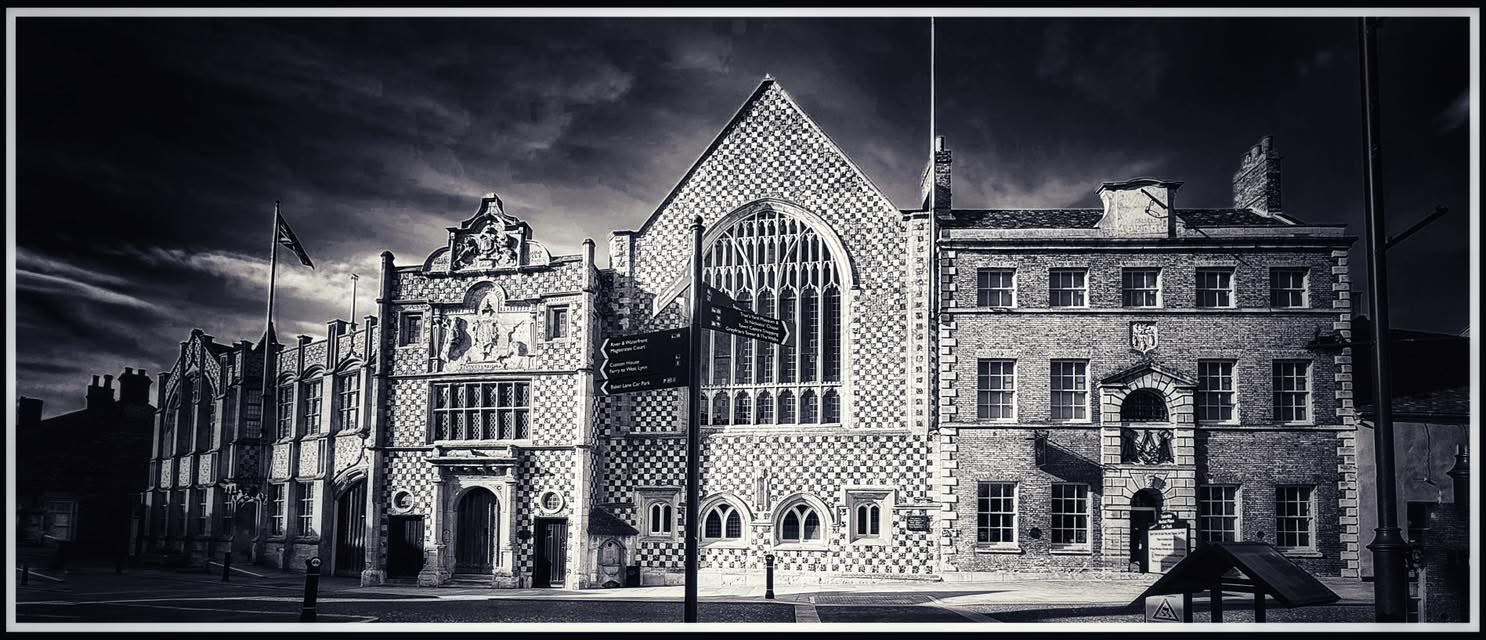
What sort of man acquired the name Richard Skin-the-Cat? Why was another Lynn resident known as William the Mellow? Was Agnes the Candlewife a candle seller, a candle maker, or the widow of a man in the trade? And what had Simon Sit-beside-the-Earl done to deserve such a grandiose name?
The earliest inhabitants of Bishop’s Lynn rarely left behind diaries, letters, or personal accounts. Most survive only as names entered in administrative records. Yet those names can sometimes carry unexpected fragments of personality. They preserve occupations, physical characteristics, jokes, insults, remembered sayings, and evidence of Lynn’s connections with continental Europe.
In 1978, the distinguished name scholar Cecily Clark and the archivist Dorothy Owen published a study of some of the most puzzling names found in documents from twelfth- and thirteenth-century Lynn. Their work showed that a medieval byname was more than a convenient label. It might describe where someone came from, the work they performed, an object associated with them, or a characteristic that their neighbours found memorable.
Some were straightforward. Others remain mysteries.
Before surnames became settled
Hereditary surnames did not suddenly appear throughout England after the Norman Conquest. They developed gradually and unevenly. In twelfth-century Lynn, a person might be distinguished from others with the same Christian name by adding a descriptive second name, usually called a byname.
A man named William might be identified as William of Norwich, William the Cook, William son of Robert, or William the Red. Such names were not necessarily inherited by his children. They could change during a person’s lifetime, especially if he moved, entered a new occupation, or acquired a more memorable nickname.
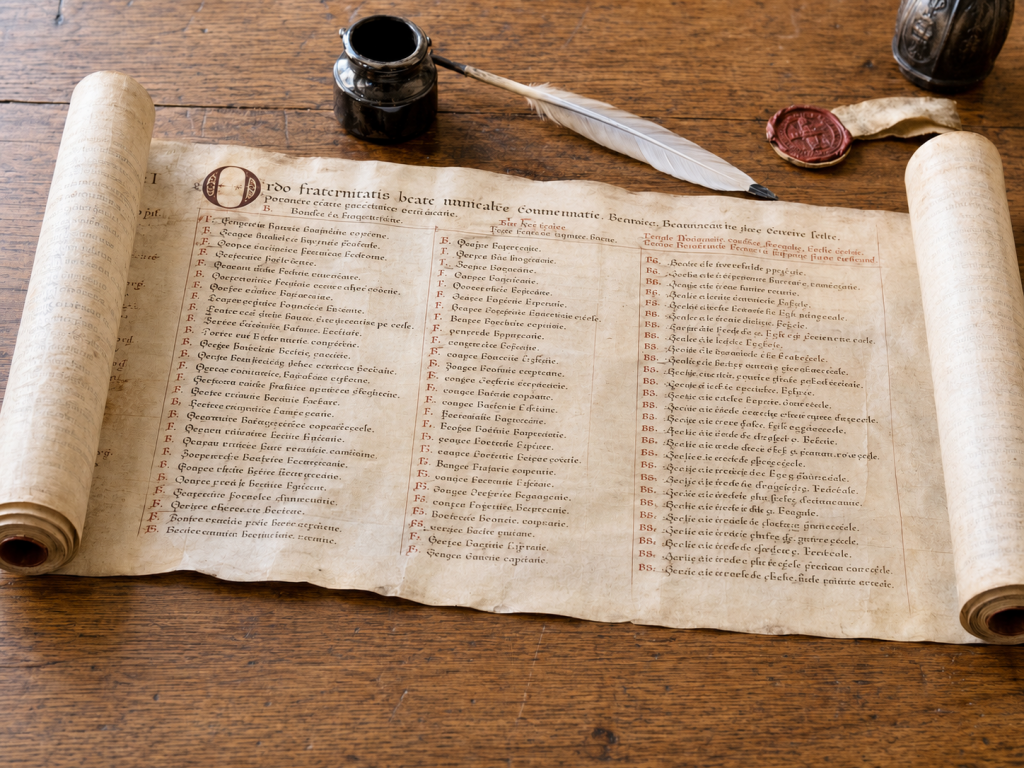
The surviving Lynn material comes principally from three sources. The earliest is a list of burgesses in the royal Pipe Roll of 1166. The others are two medieval bede rolls, or lists of people entitled to the prayers of a religious fraternity.
One belonged to Lynn’s powerful Trinity Guild. Compiled in the later thirteenth century from earlier material, it mainly recorded merchants and other inhabitants of the borough. The second belonged to the Hospital of St Mary Magdalene at Gaywood. Dating from around 1300, although incorporating older entries, it included families from Lynn and the surrounding villages.
The Gaywood roll is especially rich in nicknames. It also presents problems. It was copied from earlier records, sometimes carelessly, and several names may have passed through both spoken and written forms before reaching the surviving manuscript. A clerk could mishear a word, misunderstand an unfamiliar name, or mistake one letter for another.
Clark and Owen therefore treated many of their interpretations as possibilities rather than certainties. That caution is worth retaining. Medieval nicknames were often playful, local, and dependent upon circumstances that no written record explains.
Agnes the Candlewife
One of the most striking names in the Gaywood roll is Agnes le Candilwif, or Agnes the Candlewife.
The name probably identifies a woman who was personally involved in selling or making candles. The ending -wife did not necessarily mean that she was merely the wife of a male candle maker. In Middle English, it could form an occupational description for a woman engaged in a particular trade.
Candles were indispensable in medieval households, workshops, churches, and religious houses. The poorest were commonly made from tallow, usually rendered animal fat. Wax candles were cleaner, brighter, and more expensive, and were particularly valued for religious use.
Agnes’s name is important because medieval records frequently conceal women’s economic activity. A woman might be entered simply as somebody’s wife or widow even when she ran a business herself. “Candlewife” suggests that Agnes was sufficiently identified with the trade for it to become her public name.
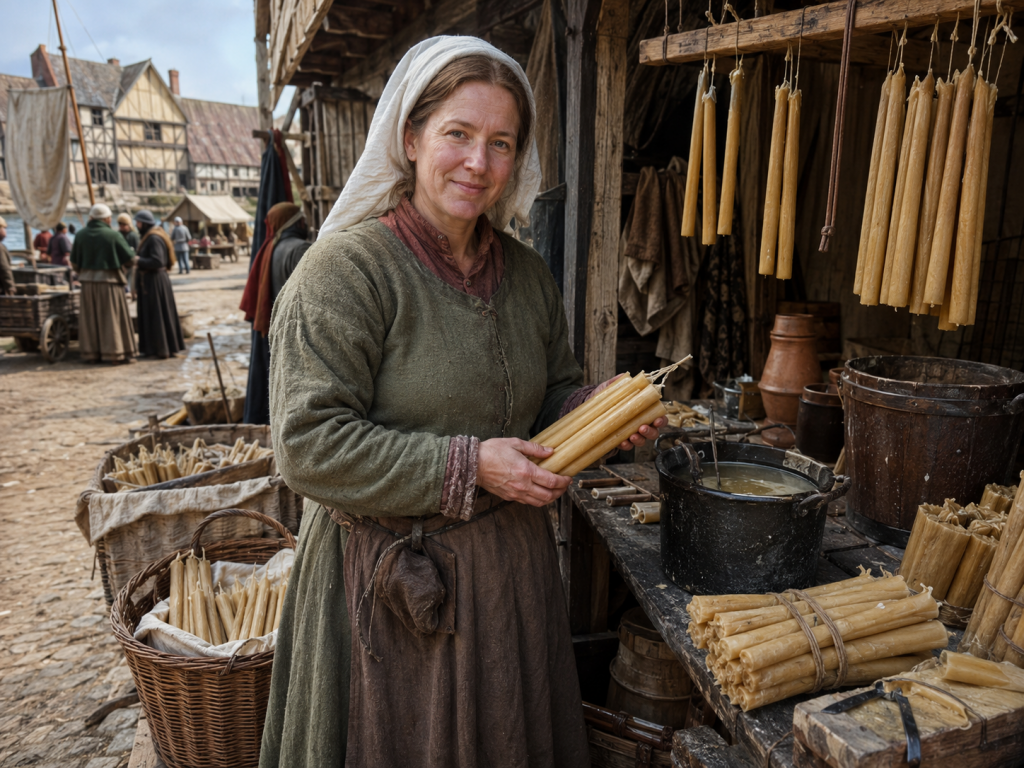
An AI generated image of a thirteenth-century woman selling or making tallow candles.
Another woman, Alicia Cloker, may also have carried an occupational name. Clark and Owen considered several explanations. She might have made clocks, although that seems unlikely at such an early date. She may instead have made or sold cloaks. Alternatively, she could have lived near a bell tower. The surviving spelling does not allow a firm decision.
The workers behind the names
Many Lynn bynames arose from occupations, including jobs that are barely visible in other records.
Bartholomew le Calwere was probably a calf herder. Another entry, Richard Hymeyn Calwere, appears to combine a personal nickname with the same occupational description. The unusual form of the word provides evidence that calver, meaning a keeper or herder of calves, was in use in East Anglia earlier than surviving dictionaries once suggested.
Ralph Cokeman may have been a cook’s assistant rather than the principal cook. A medieval kitchen serving a great household, hospital, guild feast, or religious community required a hierarchy of workers. The cokeman probably occupied one of its lower but necessary positions.
Roger le Coliur appears to have been a collector, perhaps someone responsible for gathering money, rents, tolls, or other payments. He must be distinguished from Thomas Coliere, whose name probably meant charcoal burner.
A collector, however, is only as precise a description as the lost circumstances behind it. Roger might have collected dues for a landlord, payments for a guild, or customs associated with the port.
Lynn’s maritime character may be reflected in William Kranhus de Lenne. His byname can be translated as “Crane House of Lynn”. This was probably not a reference to the long-legged bird. In a port, a crane was lifting equipment used for moving heavy cargo. William may have lived or worked in a building beside one of these machines.
The name is a small reminder that medieval Lynn’s waterfront was equipped for the handling of bulky goods. Timber, barrels, millstones, sacks, and other cargoes could not always be shifted by human strength alone.
Roger Slingge may have been associated with another form of lifting tackle. The word sling could also mean a catapult or projectile weapon, so his occupation remains uncertain. Nevertheless, Lynn’s working quays provide a convincing setting for a man whose name referred to ropes or lifting gear.
Cecilia Broth and John Cooking-Pot
Not every name described a trade. Some people were identified with foods, household objects, or other familiar items.
Cecilia Joute carried a name meaning “broth” or “pottage”. Pottage was a basic medieval dish, varying from a thin vegetable broth to a thick mixture containing grain, herbs, meat, or fish. Why Cecilia became known by it is unknowable. Perhaps she made particularly good broth. Perhaps she sold it. The name might equally have referred to an accident, a joke, or some personal characteristic understood by her neighbours.
Other medieval European towns produced similar food-based names. Clark and Owen found parallels involving cabbage-and-bacon broth and other dishes in Canterbury, Arras, Calais, and Beauvais. Medieval townspeople evidently found food a fruitful source of nicknames.
John Gingil of Lynn was apparently named after a type of cooking pot. The modern surname Gingell may preserve the same word. Adam Skillet, or a closely related form of that name, was likewise associated with a cooking pan.
The presence of such names does not necessarily prove that John and Adam manufactured pots. Objects could acquire human associations in many ways. A man might carry a particular vessel, habitually use it, resemble it in shape, or feature in a well-known local incident involving it.
Medieval nickname creation was not a tidy system. It belonged to conversation rather than administration. Clerks merely wrote down names already circulating among the population.
William the Mellow and the overdressed man
Some bynames describe appearance or temperament more directly.
William le Mellow bore a word that could mean ripe, mature, pleasant, or jovial. The same term later appeared in the Promptorium Parvulorum, the English-to-Latin dictionary compiled in fifteenth-century Lynn. William’s name demonstrates that it had been used locally much earlier.
Whether he was called Mellow because he was genial, elderly, well fed, or habitually cheerful cannot be known. It is at least one of the more flattering names in the rolls.
William Queymerel probably carried a form of the French-derived word quaintrelle, meaning an excessively fashionable or overdressed person. The modern word “quaint” gives the wrong impression. In medieval usage, the associated term could suggest someone clever, elaborate, affected, or overly concerned with appearance.
William may have dressed above his station or taken conspicuous care over his clothes. His neighbours evidently thought it worth commemorating.
At the less complimentary end of the scale was Godfrey Struyere, whose name probably meant destroyer, vandal, or wastrel. It may have described someone who squandered his possessions or damaged those of other people. Once again, it is impossible to tell whether the description was fair. Nicknames record reputation, not objective character.
Alicia Cakardes may have belonged to a family whose name meant “simpleton” or “fool”. The French equivalent was already used as a surname. Whether Alicia herself was being insulted is doubtful because the grammatical form suggests a family name: she may have been Alicia of the Cakard family.
Simon Sit-beside-the-Earl
Among the most entertaining entries in the 1166 list of Lynn burgesses is Simon Sitebidecunte.
Clark and Owen interpreted this as something like “Simon Sit-beside-the-Earl”. It appears to be a phrase-name, a nickname constructed from a short statement or command. Such names could preserve jokes, boasts, habitual remarks, or lines associated with a particular person.
Perhaps Simon insisted upon sitting beside someone of high rank. Perhaps he claimed privileged status or behaved with comic self-importance. His name may have mocked a man who tried to place himself socially above his proper position.
The exact incident has vanished, but the joke survived because a royal clerk entered it into an official record.
Phrase-names were not peculiar to Lynn. Medieval records contain names resembling miniature sentences, including commands, accusations, and fragments of familiar expressions. They show how much early naming depended upon the spoken language of streets, workshops, taverns, and marketplaces.
The mouse in the mill
Two Norfolk men appear with the remarkable byname Milnemus, meaning “mill mouse” or “mouse in a mill”.
This was not necessarily an image of poverty. A church mouse was poor because a church contained little food. A mouse living in a grain mill occupied much happier circumstances.
Clark and Owen connected the name with sayings such as “as safe as a mouse in a mill” and the idea of living comfortably while somebody else ground the meal. A mill mouse was surrounded by grain and flour. The nickname could therefore have described a comfortable, fortunate, or well-provided person.
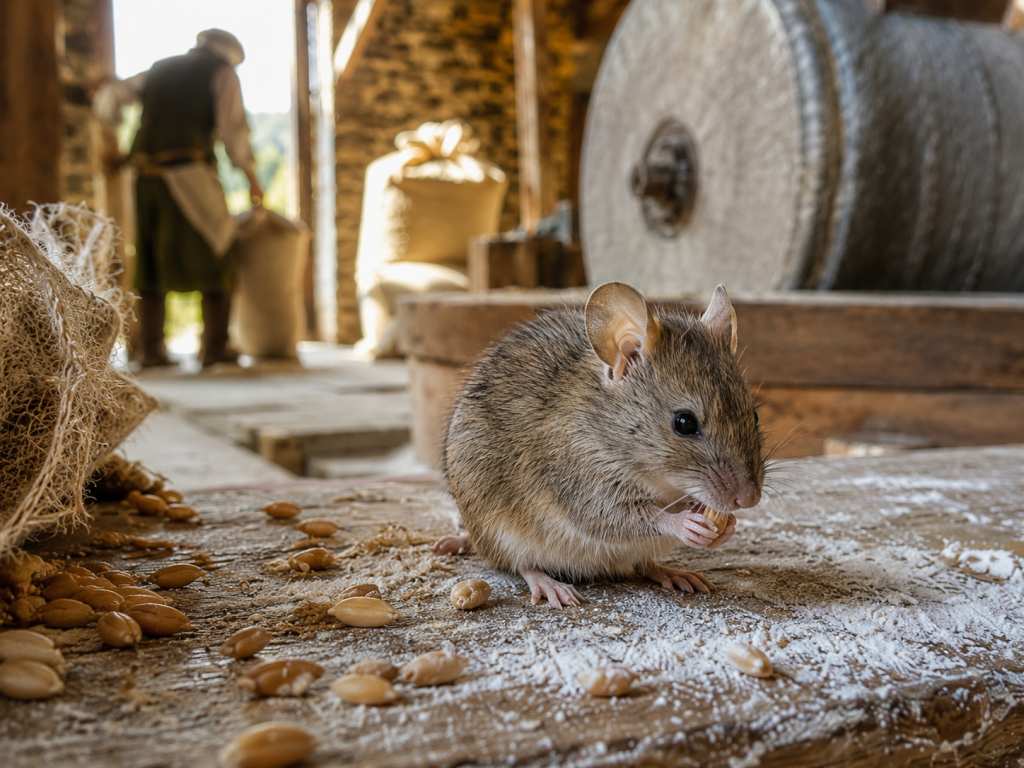
It might also have contained an accusation. Someone who prospered from other people’s labour, took small portions of their goods, or lived comfortably at another’s expense could resemble the mouse stealing grain inside the mill.
The name demonstrates how proverbs entered everyday speech. A medieval nickname might be incomprehensible when separated from a saying that everybody at the time understood.
Richard Skin-the-Cat
A still more vivid phrase-name appears in the 1166 Pipe Roll: Richard Pilecat.
The first part probably comes from a verb meaning to strip, peel, or skin. The whole can therefore be read as “Skin-the-Cat” or “Cat-Skinner”.
Richard may have worked with animal skins. Even relatively poor furs had a commercial value, and cat skins could be used in clothing and linings. Yet Clark and Owen thought the name was more likely to have arisen from proverbial language.
Medieval sayings frequently referred to removing a cat’s skin, sometimes in the context of extracting the last possible advantage from something of little value. Richard’s nickname may have suggested a man alert to small profits or willing to take whatever could be obtained.
It is tempting to imagine an exceptionally grasping trader, although the evidence does not justify turning that possibility into fact. All that survives is the name and the group of sayings that may help to explain it.
A port open to Europe
Lynn’s names also reveal the town’s international connections. Its merchants traded regularly with Flanders, the Low Countries, and northern France. Foreign merchants visited the port, while some settled in or near the borough.
A large number of Lynn bynames have close parallels in French-speaking regions, especially Picardy and north-eastern France. Some may simply show the adoption of French vocabulary into English after the Norman Conquest. Others probably belonged to immigrants who brought their names with them.
The records include people identified with Beauvais, Saint-Omer, and other continental places. Gilbert Lussebune and Ralph Lussebune may have borne a name connected with Luxembourg, although the same word could also be associated with foreign or counterfeit coinage.
Folcard Estrich appears to have been described as a man from the Baltic or Norway. The term was sometimes used for imported timber or wool, but in this case it seems to identify geographical origin.
Such names place Lynn within the trading world of the North Sea rather than at the edge of England. The town’s population heard foreign accents, encountered continental fashions, and absorbed words arriving with merchants and sailors.
Some unusual names may have been imported ready-made. A French or Flemish settler could retain a nickname coined before he reached Lynn. Others arose locally from the mixture of English, French, Scandinavian, and Latin forms heard around the port.
Names that defeated the experts
Clark and Owen were unable to explain every name, and they published the most difficult examples in the hope that other scholars might solve them.
Eustace Corpekil remains unexplained. Edith T’ger presents another mystery. Hubert Cossenan might represent a French phrase meaning something like “a kiss at once”, but that suggestion is highly speculative. Sibald Kicker could have been a man who kicked, a fighter, or somebody whose name came from a completely different word.
William Doggedrove might have been connected with a fishing expedition or a type of fish. Alternatively, his name may refer to Dog Drove, a road in Holbeach in Lincolnshire.
A man whose byname was recorded as Horn-grey may have had grey hair resembling the colour of horn. The surviving form could, however, be a copying error for the more familiar “iron-grey”.
Even apparently simple names could be ambiguous. A person called Fork might have lived near a fork in a road, a forked piece of land, a supporting post, or the town gallows.
These uncertainties are not failures. They reveal the distance between a living medieval community and the fragmentary evidence that survives. The people who used the names knew exactly what they meant. It is the context, rather than necessarily the word itself, that has been lost.
A town talking to itself
The names preserved in Lynn’s rolls give us something rare: faint traces of the town’s informal speech.
Administrative documents generally tell us about property, taxation, obligations, and disputes. Bynames introduce another world. They suggest neighbours commenting upon one another’s clothes, tempers, occupations, habits, origins, and pretensions.
We meet a jovial William, an overdressed William, a possible wastrel, a candle-trading woman, a comfortable mill mouse, and a man who may have tried to sit beside an earl. We also encounter cooks, calf herders, collectors, port workers, immigrants, and women whose livelihoods would otherwise be almost invisible.
The names must not be treated as miniature biographies. Simon Sit-beside-the-Earl may never have sat beside an earl. Richard Skin-the-Cat may never have harmed a cat. A nickname could exaggerate, ridicule, or preserve a joke whose literal meaning was never intended.
Yet these names bring medieval Lynn’s population closer to us. Behind the formal Latin of the rolls, the town was talking about its inhabitants in a vigorous mixture of English, French, Scandinavian forms, local dialect, proverbial expressions, and private humour.
Eight centuries later, much of the joke has been lost. Enough remains, however, to remind us that the people of medieval Lynn did not experience one another as anonymous names in a document. They knew who dressed too finely, who complained, who prospered like a mouse in a mill, and who was always trying to sit in a better place than his neighbours thought he deserved.
© James Rye 2026
Book a Walk with a Trained and Qualified King’s Lynn Guide
References
Clark, Cecily, and Dorothy Owen. “Lexicographical Notes from King’s Lynn.” Norfolk Archaeology 37 (1978): 56–69.
Clark, Cecily. “The Early Personal Names of King’s Lynn: An Essay in Socio-Cultural History, Part I: Baptismal Names.” Nomina 6 (1982): 51–71.
Clark, Cecily. “The Early Personal Names of King’s Lynn: An Essay in Socio-Cultural History, Part 2: By-Names.” Nomina 7 (1983): 65–89.
Owen, Dorothy M., ed. The Making of King’s Lynn: A Documentary Survey. Records of Social and Economic History, new series 9. London: British Academy, 1984.