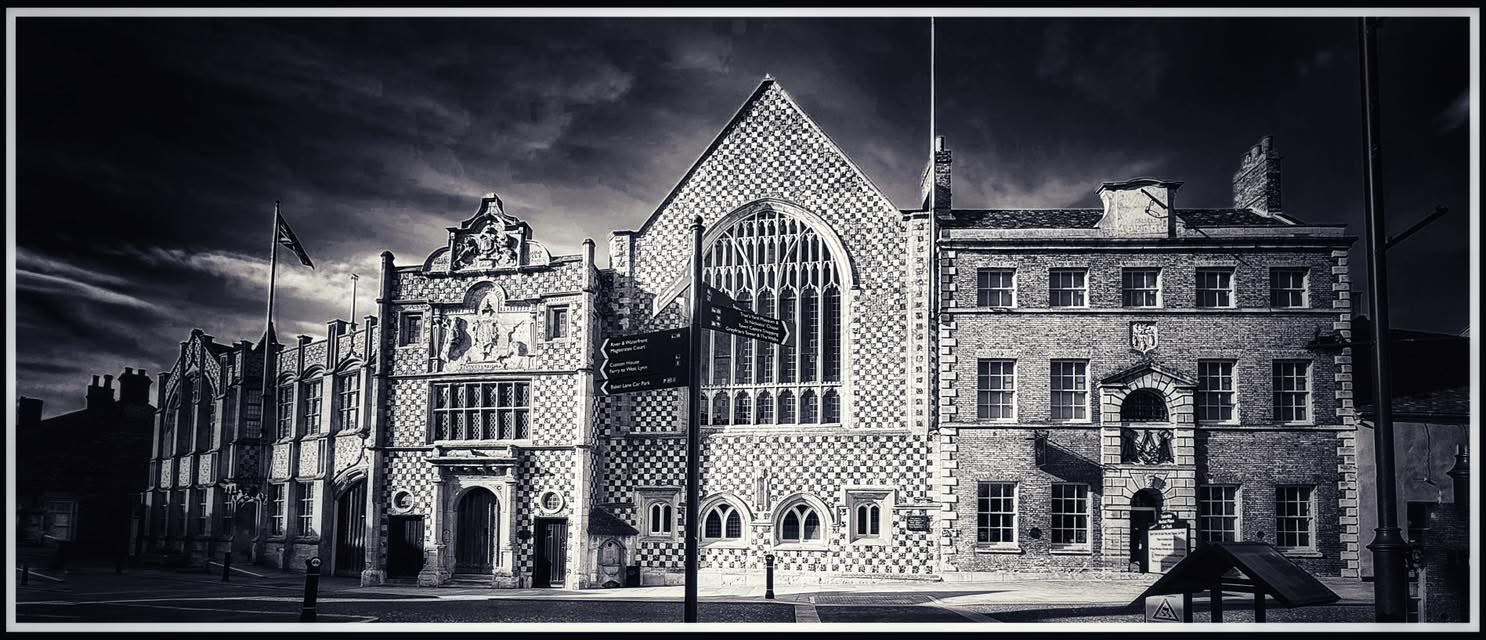
A short-lived friary
King’s Lynn had several medieval friaries, but one of the least visible was the house of the Friars of the Sack. Their proper name was the Friars of the Penitence of Jesus Christ, in Latin Fratres de Penitentia Jesu Christi. Their English nickname came from their coarse sackcloth habit.
They were a mendicant order, part of the same thirteenth-century religious world as the Franciscans, Dominicans, Carmelites, and Austin friars. Unlike those larger orders, the Friars of the Sack had a short life. The Second Council of Lyons in 1274 restricted many of the smaller mendicant orders, and the Sack Friars soon disappeared.
That matters for Lynn. Their house was not dissolved under Henry VIII. It had gone by the early fourteenth century. Historic England records the Lynn friary as founded by 1266 and suppressed by 1307, although the precise dates should be treated with care.
The Lynn house
The strongest evidence for the friary comes from a vellum roll once kept among Lynn’s municipal records. It listed messuages, lands, and tenements held of the Bishop of Norwich. One entry stated that the brethren of the Sack held land on which their church and habitation had been built.
That proves a real foundation in Lynn: a church, domestic buildings, and a recognised plot of land. It does not prove the exact layout or the survival of any fabric.
The same record links the site with gifts from local or regional patrons. The names include Lord John de Vaux, a reference connected with Westacre, Richard son of Adam de Wigenhale, and the heirs of Alexander Fitz-Parson or Fitz-Person. These names place the friary within the landholding networks of west Norfolk.
Roger de Flegg
The best-known friar associated with the Lynn house is Roger de Flegg. A deed dated at Lynn on the Sunday before All Saints in 1307 describes him as vicar-general of the Order of the Friars of the Penitence of Jesus Christ in England and as prior of the friars of that order living in Lynn.
The deed concerned the order’s former property in Cambridge. Roger and the other English friars formally gave up any remaining claim to it, passing their rights to the master and scholars of the house of St Peter in Cambridge.
This shows that the prior of Lynn was not merely a local figure. In 1307 he was acting for the English order as its affairs were being settled. Some later summaries give his name as Robert Flegg, but the stronger antiquarian notices give Roger.
The probable site
The friary’s site is not securely fixed. Historic England says it was probably near the Greenland Fishery in Bridge Street. The record is careful: the evidence is documentary, and the exact site was not definitely known. Hillen wrote that the friary stood at the twelfth tenement north of St Nicholas’ Chapel on the east side of the way.
The safest conclusion is that the Friars of the Sack probably stood near Bridge Street, close to the later Greenland Fishery, but the site is not firmly identified.
The seal of the prior
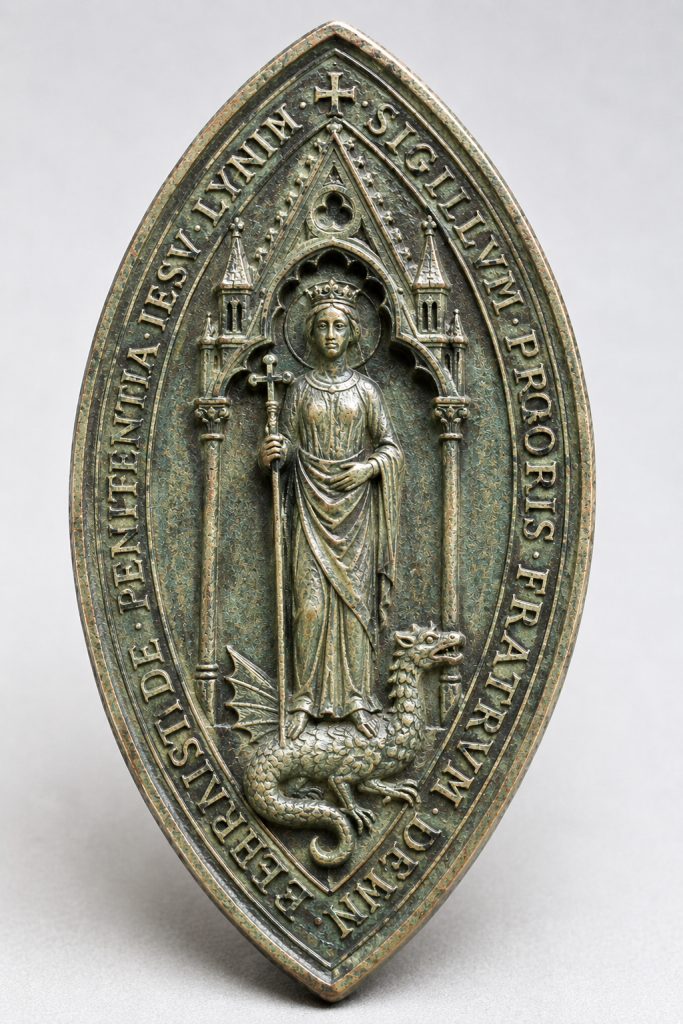
The clearest physical survival is a copper-alloy seal matrix. It is pointed oval, 39 by 24 millimetres, and shows St Margaret of Antioch beneath a church-like canopy. She holds a cross-staff and stands on a dragon. The inscription identifies it as the seal of the prior of the Brothers of the Penitence of Jesus Christ of Lynn.
St Margaret was the patron saint of Lynn’s great parish church. Her appearance on the seal does not prove that the friars’ own church was dedicated to her. Hillen says the friars’ patron was St Anthony, but that claim needs further checking.
The seal proves something more limited but valuable: the Lynn Friars of the Sack had a prior, property, legal identity, and a place in the religious life of the town.
What remains
The Friars of the Sack left no known standing building in Lynn. Their history rests on a small group of records: the municipal roll, the 1307 deed involving Roger de Flegg, the probable site near Bridge Street, and the seal matrix with St Margaret and the dragon.
They were a brief presence in medieval Lynn, not a Reformation casualty. By the time Henry VIII’s commissioners reached the town’s friaries in the sixteenth century, the Sack Friars had already been gone for more than two hundred years.
© James Rye 2026
Book a Guided Tour with a Trained and Qualified King’s Lynn Guide Through Historic Lynn
References
Andrews, Frances. The Other Friars: The Carmelite, Augustinian, Sack and Pied Friars in the Middle Ages. Woodbridge: Boydell Press, 2006. https://boydellandbrewer.com/book/the-other-friars-9781783270040/
Cooper, C. H. “Fratres de Penitentia Jesu Christi.” Notes and Queries, 2nd ser., 10, 18 August 1860. https://archive.org/stream/B-001-003-211/Notes_and_Queries_djvu.txt
Emery, R. W. “Sack, Friars of the.” New Catholic Encyclopedia. Encyclopedia.com. https://www.encyclopedia.com/religion/encyclopedias-almanacs-transcripts-and-maps/sack-friars
Hillen, Henry J. History of the Borough of King’s Lynn. Vol. 1. Norwich: East of England Newspaper Co., 1907. https://archive.org/stream/historyofborough01hill/historyofborough01hill_djvu.txt
Historic England Research Records. “Kings Lynn Friary Of Friars Of The Sack.” Hob Uid 356303. Heritage Gateway. https://www.heritagegateway.org.uk/Gateway/Results_Single.aspx?resourceID=19191&uid=356303
King’s Lynn Preservation Trust. “The Greenland Fishery.” https://www.klprestrust.org.uk/project/greenland-fishery/
Portable Antiquities Scheme. “Medieval Seal Matrix.” FindID 197412. Image and description reproduced via Wikimedia Commons. https://commons.wikimedia.org/wiki/File:Medieval_seal_matrix_(FindID_197412).jpg
Swatman, Alan Henry. “Fratres de Penitentia Jesu Christi.” Notes and Queries, 2nd ser., 10, 4 August 1860. https://archive.org/stream/B-001-003-211/Notes_and_Queries_djvu.txt