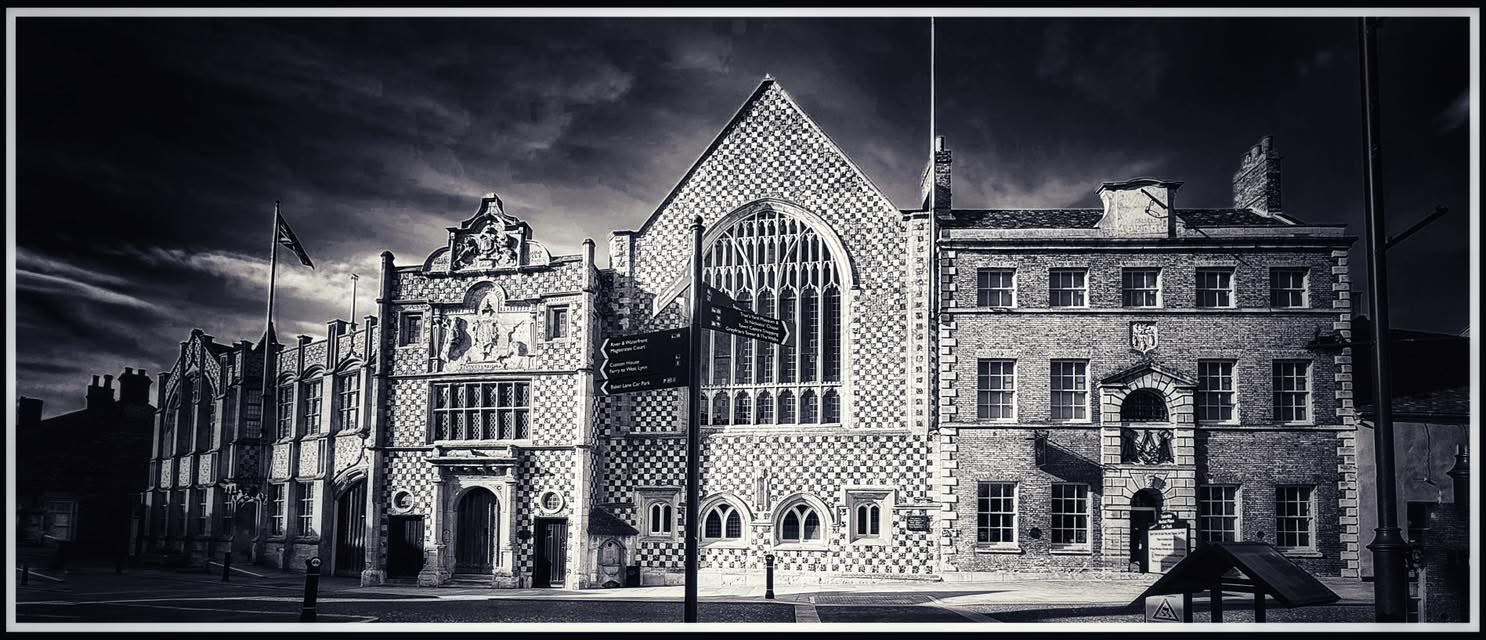
King’s Lynn is usually remembered as a port: quays, merchants, warehouses, grain, wine, timber, salt, coal, fishing boats, and foreign trade. That is true, but it is not the whole story. Lynn was also a place where ships were built, repaired, supplied, strengthened, launched, registered, and sent into dangerous waters.
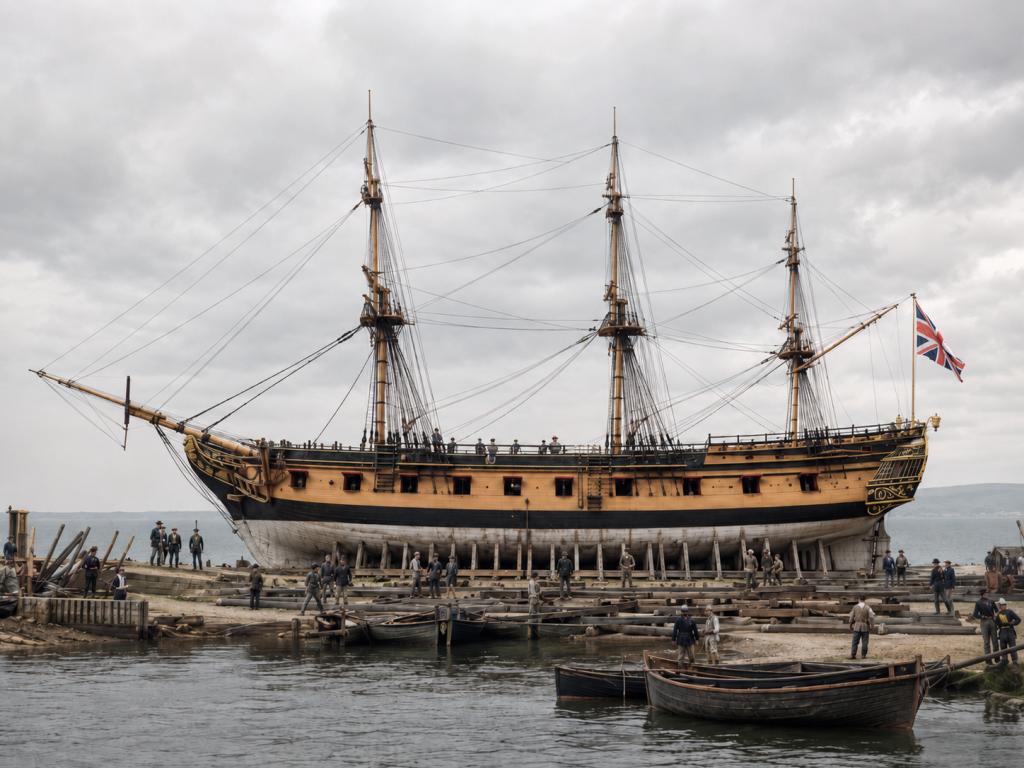
The evidence is uneven. For the medieval period, we can show strong maritime organisation and specialist supply, but not a clearly documented shipyard. For the late eighteenth and early nineteenth centuries, the evidence becomes much firmer. By then, Lynn yards were launching whalers, merchant vessels, East Indiamen, naval brigs, and a Royal Navy post ship.
The key is not to overstate the case. A ship “registered at Lynn” was not necessarily built there. A ship “launched at Lynn,” especially from a named yard, is much stronger evidence. That distinction changes the story.
Medieval Lynn: ships, ropes, anchors, and royal service
Bishop’s Lynn was one of medieval England’s great ports. The Friars Conservation Area statement summarises its rise from a small settlement by salt-water lagoons into a leading trading town, noting its links with wool exports, Gascon wine, coal, Baltic timber, luxury goods, and the Hanseatic trade. It describes Lynn, within two centuries of Bishop Herbert de Losinga’s foundation, as England’s third greatest port.
That was the world in which Lynn’s maritime skills developed. In 1337, during Edward III’s war preparations, Thomas de Melchbourne of Lynn was ordered to provide four anchors, three cables, and other ropes for the king’s ship la Grauntecogg, to be carried from Bishop’s Lynn to London.
The same Gascon Roll shows the crown relying on Lynn men for more than equipment. John de Swardeston, mayor of Lynn, and Thomas de Melchbourne were involved in selecting men and mariners for seven of the “greatest and strongest” ships of the town, which were to be double-manned, armed, victualled, and sent to London for royal service. They were advising for the king’s galley la Phelippe, and for double-manning la Magdaleyne and la Seintemaricogge
That is excellent evidence for a town rich in maritime labour, ship supply, and naval administration. It is not, by itself, proof that large ships were being built at Lynn in the fourteenth century. The safest wording is that medieval Lynn almost certainly had boat repair, fitting-out, rope, sail, timber, and equipment work, while the evidence for named medieval shipyards remains thin.
From port work to shipbuilding
By the early modern period, the evidence becomes more suggestive, and by the late eighteenth century it becomes much clearer. Lynn had the necessary ingredients: imported timber, access to English oak by inland waterways, skilled carpenters, sail-makers, rope-makers, merchants with capital, and a waterfront broken by fleets, quays, yards, slips, and muddy working spaces.
The most useful local source is Henry J. Hillen’s History of the Borough of King’s Lynn. He identifies t Bottomley’s shipyard near the South Gates. He also records a dry dock on the Friars, near F. W. Lane’s steam saw mills, used for repairs.
This fits the wider geography. Friars Fleet, in South Lynn, is repeatedly associated with shipbuilding and whaling. A modern summary of Paul Richards’s work on lost Lynn says that Friars Fleet was the location of shipbuilding yards and the whaling fleet, both gone by 1870.
Bottomley’s Yard and HMS Larne
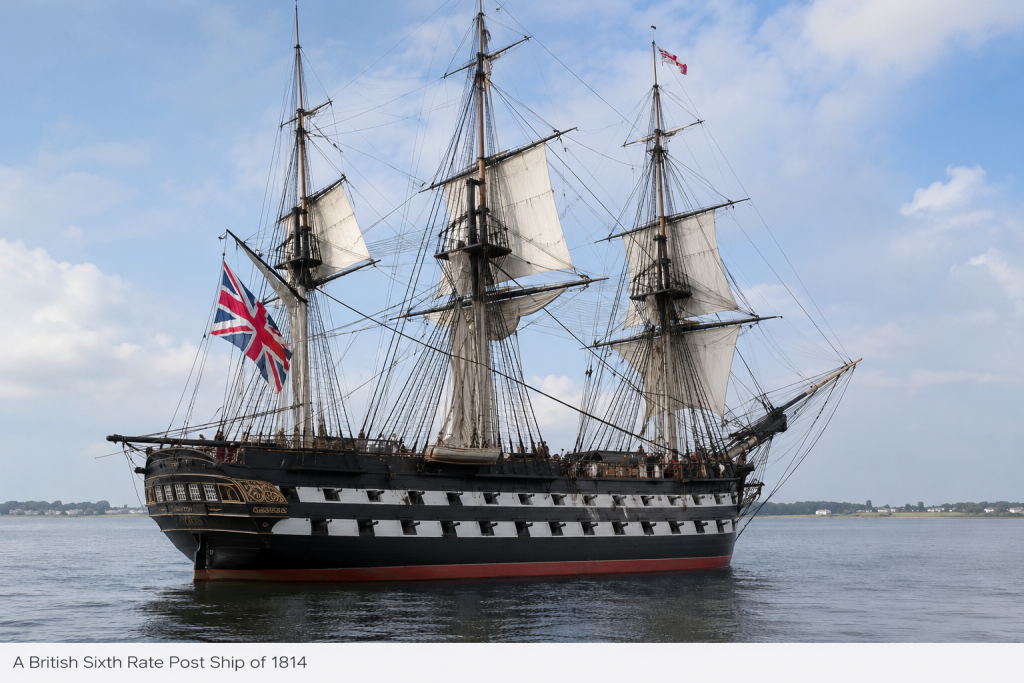
The strongest single proof of Lynn shipbuilding is HMS Larne. Three Decks records her as a 20-gun Royal Navy sixth-rate post ship, ordered on 18 November 1812, laid down in July 1813, and launched on 8 March 1814. Her shipyard is given as Bottomley’s Yard, King’s Lynn, and she was “built by contract.”
This is much stronger than saying a ship was merely owned or registered at Lynn. A launch from a named yard is shipbuilding evidence. In Larne’s case, the source gives the yard, the builder, the class, the date, the dimensions, the armament, and the subsequent fitting-out history. She measured 115 feet 6 inches on the gun deck, carried 18 32-pounder carronades and two 9-pounders, and was sold in 1828.
A post ship was not a great ship of the line. It was smaller, more flexible, and useful for patrol, convoy, dispatch work, and overseas service. But it was still a commissioned naval vessel. When Larne slid into the water in March 1814, Lynn was taking part in the naval economy of the Napoleonic Wars.
Bottomley was not a one-vessel shipbuilder. The King’s Lynn registers for 1824 to 1835 record vessels built by William Bottomley at Lynn, including Hawk in 1824, Martha and Syren in 1827, Royal Admiral and Lucy in 1828, and William the Fourth in 1830.
Brindley, Larking, Spong, and wartime yards
Bottomley was part of a wider trade. Mackie’s Norfolk Annals, compiled from the Norfolk Chronicle, records that the 18-gun sloop of war Sapphire was launched from Messrs Brindley’s yard at King’s Lynn in November 1806.
Three Decks also points to other Lynn naval builders. The Cruizer-class list includes vessels ordered from Edward Larking and William Spong at King’s Lynn, and from William Bottomley. Hillen’s local list adds launches from the shipyard near St Ann’s Fort, including Auspicious, described by the Bury and Norwich Post as pierced for 20 guns, and later vessels such as Haughty, Victor, Ida, Nelson, and Duke of Kent.
The broad pattern is clear. Around the years of war with France, Lynn’s yards were not simply repairing coasters. They were building substantial wooden vessels for private owners and the state.
Whalers and the Arctic trade
The whaling story gives the shipbuilding trade a different atmosphere. Lynn’s whaling was small compared with Hull, but it was real. Lynn Museum records that nine ships are believed to have sailed from King’s Lynn to Greenland and the Davis Strait between 1774 and 1821: Jango, Enterprise, Experiment, Balaena, Eclipse, Fountain, Bedford, Archangel, and Form. Whaling ships were often converted merchant vessels, reinforced with extra planking, beams, ironwork, and timber to survive the pressure of ice.
The distinction between “built” and “registered” is useful here. Lynn Museum says the Bedford was built and registered at King’s Lynn in 1750. That is good evidence for local construction. The Fountain, by contrast, was built at Whitby and registered at Lynn. That proves a Lynn connection, not Lynn construction.
So the whaling evidence shows both sides of Lynn’s maritime economy. Some vessels were locally built. Others were bought, owned, registered, strengthened, or sailed from Lynn.
Decline
Hillen gives a final impressive list from the South Gates yard, including Hebe in 1845, Lady Jocelyn in 1847, Calypso in 1848, Undine in 1849, Emily in 1850, Galatea in 1852, Young England in 1853, Macedonian in 1854, Arethusa, Royal Arthur, and Marie Josephine in 1855, and Harcourt in 1856.
After that, the old wooden shipbuilding world faded. The reasons were practical rather than dramatic. Larger vessels needed better dock facilities. The channel could be troublesome. Railways damaged coastal carrying trades. The Alexandra Dock opened in 1869 north of the Fisher Fleet, followed by Bentinck Dock in 1883, shifting the port’s centre of gravity towards larger deep-draught vessels and away from the older fleets and slips.
The town did not stop being maritime. It remained a working port, and engineering continued. But the old yards of South Lynn, Friars Fleet, St Ann’s Fort, Chapel Street, St Nicholas Street, and the South Gates gradually slipped out of everyday memory.
A brief note on Fisher Fleet
Fisher Fleet belongs mainly to the story of Lynn’s fishing community. It may well have seen boat maintenance, beaching, mending, and small craft work, but I have not found strong evidence that it was a major shipbuilding centre. The clearer shipbuilding evidence points south, especially to Friars Fleet and the South Gates area.
What the evidence now supports
King’s Lynn did have a shipbuilding industry. It was not continuous in the same way as the great dockyard towns, and it should not be exaggerated for the medieval period. But from at least the eighteenth century, and especially during the Napoleonic Wars and the decades after, Lynn built substantial wooden ships.
The most secure story runs from medieval maritime supply and royal service, through whaling and merchant construction, to the naval contracts of Bottomley, Brindley, Larking, and Spong. HMS Larne, launched from Bottomley’s Yard in 1814, is the best single symbol of that lost industry: a Royal Navy warship built not in one of the famous dockyard towns, but in King’s Lynn.
© James Rye 2026
Book a Guided Tour with a Trained and Qualified King’s Lynn Guide Through Historic Lynn
References
- Borough Council of King’s Lynn and West Norfolk. The Friars Conservation Area Character Statement. King’s Lynn: Borough Council of King’s Lynn and West Norfolk, 2008. https://www.west-norfolk.gov.uk/download/downloads/id/1913/kings_lynn_the_friars_con_area_leafletpdf.pdf
- Gascon Rolls Project. C 61/49: Gascon Roll for the 11th Year of the Reign of Edward III, 1337–1338. https://www.gasconrolls.org/fr/edition/calendars/C61_49/document.html
- Hillen, Henry J. History of the Borough of King’s Lynn. Vol. 2. Norwich: East of England Newspaper Co., 1907. https://archive.org/stream/historyofborough02hill/historyofborough02hill_djvu.txt
- KL Magazine. “Looking Back at Lost King’s Lynn.” https://www.klmagazine.co.uk/articles/lost-kings-lynn
- Lynn Museum. “Blubber, Bone and Baleen: Lynn’s Whaling Industry.” Google Arts & Culture. https://artsandculture.google.com/story/blubber-bone-and-baleen-lynn-s-whaling-industry-lynn-museum/DQUBsJVYcI20IA?hl=en
- Mackie, Charles. Norfolk Annals: A Chronological Record of Remarkable Events in the Nineteenth Century. Vol. 1. Norwich: Norfolk Chronicle, 1901. https://www.gutenberg.org/files/34439/34439-h/34439-h.htm
- Maritime Heritage East. “Ships Registered at King’s Lynn, 1824 to 1835.” https://www.maritimeheritageeast.org.uk/ux/file/ref%3D41%26ty%3DDOCS
- Three Decks. “British Sixth Rate Post Ship Larne (1814).” https://threedecks.org/index.php?display_type=show_ship&id=5037
- Three Decks. “William Bottomley.” https://threedecks.org/index.php?display_type=show_crewman&id=23310
- Three Decks. “Josiah and Thomas Brindley.” https://threedecks.org/index.php?display_type=show_crewman&id=23590
- Three Decks. “British Brig Sloop Zenobia (1807).” https://threedecks.org/index.php?display_type=show_ship&id=2832
- Wikipedia contributors. “Cruizer-Class Brig-Sloop.” Wikipedia. https://en.wikipedia.org/wiki/Cruizer-class_brig-sloop