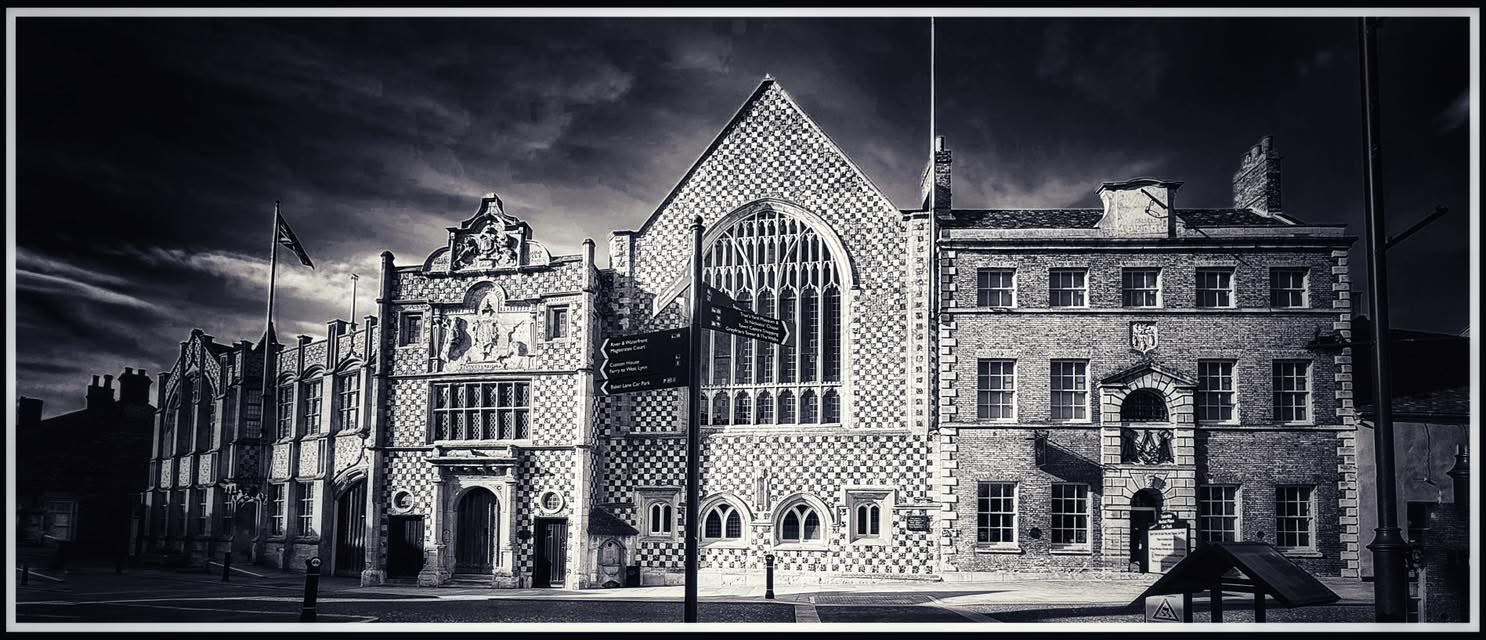
The building in the market place
The Trinity Guildhall stands in one of the most telling positions in King’s Lynn. It faces Saturday Market Place, beside St Margaret’s, now King’s Lynn Minster, in the old heart of medieval Bishop’s Lynn. That setting is not accidental. This was not a tucked-away religious house or a minor meeting room for a small fraternity. It was the home of the Guild Merchant of the Holy Trinity, usually known as the Great Guild, one of the most powerful institutions in the town.

Photo © James Rye 2025
The frontage that survives today belongs to a long and altered civic complex, but behind it was once a body that joined together many of the things we now tend to keep separate. The guild was religious, but it was not merely devotional. It was commercial, but it was not simply a trading company. It was social and ceremonial, but it was much more than a dining club for prosperous men. It held property, kept accounts, handled valuable goods, remembered the dead, admitted members for substantial fees, maintained records and treasure, and, most strikingly, helped shape the election of Lynn’s mayor.
That combination is what makes the Great Guild so important. It shows us a medieval town in which worship, money, status, and power were bound together. A wealthy merchant did not have to choose between piety and profit, or between prayer and politics. In Bishop’s Lynn, all those things could meet in the same institution, under the name of the Holy Trinity.
What survives in the records
The guild’s history does not rest on pretty legend. It rests on unusually strong evidence. King’s Lynn Borough Archives hold the minutes of the Guild Merchant of the Holy Trinity, catalogued as KL/C 5/1–4, dating from the thirteenth to the sixteenth centuries. They also hold the Holy Trinity Guild account rolls, KL/C 38/1–31, covering the years from 1373 to 1509. Around these records sit the wider archives of the borough: Hall Books, Hall Rolls, the Red Register, deeds, rentals, chamberlains’ accounts, letters patent, and other civic records.
That survival is crucial to understanding the guild properly. Many medieval guilds come down to us as little more than names, fragments, or later traditions. Lynn’s Great Guild can be studied as a documented institution. By the early fourteenth century, and probably earlier, Lynn had a large, wealthy, and politically significant merchant guild dedicated to the Holy Trinity.
One of the most evocative surviving references is to an undated bede-roll assigned by the Historical Manuscripts Commission to the reign of Edward II. Its Latin heading reads, “Hii sunt fratres Gilde Mercatorie de Lenn”, meaning “These are the brothers of the merchant guild of Lynn”. The roll was said to contain 867 names. A bede-roll was not an ordinary membership list in the modern sense. It belonged to a culture of prayer and remembrance, in which names were preserved so that the living and the dead could be remembered before God.
A port town and its merchant elite
Medieval King’s Lynn was Bishop’s Lynn. The bishop of Norwich was lord of the town, but the town’s wealth flowed through the port. Lynn traded inland with East Anglia and outward across the North Sea and Baltic worlds. It was a place of ships, quays, warehouses, river passages, merchants, craftsmen, servants, strangers, and officials. Its leading men were not simply businessmen. They were burgesses, office-holders, negotiators, benefactors, litigants, and governors.
The Great Guild gave this merchant world a corporate shape. Membership was expensive: the entrance fee was 100 shillings. That was a serious barrier, and it tells us at once that this was not a broad popular association open to anyone with a little spare money. It was a fraternity of the upper levels of Lynn society, especially the men who dominated trade and civic office.
Yet the guild was not closed in a narrow local or family sense. Lynn’s prosperity depended on movement, and its institutions could absorb successful incomers. In 1306, Siglaf Susse of Gotland joined the great guild and was admitted as a burgess at about the same time. His presence is a useful reminder that medieval Lynn’s elite was shaped by commerce across distance. The town’s ruling society was rooted in Lynn, but it was not cut off from the wider world.
The families and individuals associated with the guild confirm its importance. John de Brunham, father of Margery Kempe, was one of Lynn’s leading burgesses. He served several times as mayor, represented the town in Parliament, and was alderman of the Great Guild in the 1390s. Thomas Thoresby, John Wesynham, and Walter Coney also appear in the history of the guild and the government of the town. These were not marginal names. They belonged to the civic world of property, mayoral office, parliamentary representation, and commercial influence.
Prayer, memory, and corporate display
The guild’s dedication to the Holy Trinity must be taken seriously. It was a religious fraternity, and its members expected spiritual benefit from belonging to it. They were remembered in prayer. They were part of a brotherhood whose obligations extended beyond business and civic manoeuvring. In medieval terms, this was not a decorative extra. Salvation, reputation, death, and memory were central concerns.
The surviving descriptions of the guild’s goods give us a vivid glimpse of its inner world. In the custody of its officers were the guild register, account rolls, chests containing treasure and muniments (documents giving rights and privileges), a cloth of gold used for funerals, a silver wand for the dean’s office, and silver vessels. These objects tell us almost as much as formal statements of purpose. The books and rolls preserved the guild’s memory. The chests protected title deeds and privileges. The funeral cloth dignified the dead. The silver wand and vessels made office and ceremony visible.
Medieval corporations expressed themselves through things as well as words. They had seals, chests, cloths, cups, books, and places of assembly. Such objects gave authority a visible form. They reminded members that they belonged to something older and larger than themselves. They also announced status to everyone else.
Women appear in this religious side of the guild’s history, though the evidence must be handled carefully. The Historical Manuscripts Commission noted that women could be admitted to the spiritual benefits of the guild for a substantial payment. An earlier mistranslation had rendered the Latin “spiritualibus” as “special”, but the corrected reading points specifically to spiritual benefits. This seems to place women within the guild’s devotional and commemorative life, not necessarily within its full political privileges. A woman could share in prayer and remembrance without holding the civic authority exercised by male merchant members.
That distinction matters in Lynn because of Margery Kempe. Her father, John de Brunham, stood near the centre of the world described here, and Margery’s own devotional life unfolded in a town where trade, piety, social standing, and family reputation were tightly interwoven. Her book is not a guild record, but her background helps us imagine the social atmosphere in which such a guild made sense.
The business of stone
The Great Guild prayed for its members, but it also counted money. Its account rolls show income from admission payments, rents, property, and a trade that deserves more attention than it usually receives: the sale of millstones, gravestones, paving stones, and marble. The Historical Manuscripts Commission suggested that the guild had something close to a monopoly in this stone business.
This is one of the most revealing details in the whole story. Stone was heavy, practical, valuable, and symbolically rich. Millstones belonged to the working economy of grain and flour. Gravestones belonged to burial, memory, parish churches, and family status. Paving stones and marble belonged to building, display, and improvement. Through stone, the guild touched the mill, the street, the church, and the grave.
The account rolls were kept from one Feast of the Holy Trinity to the next. Even the rhythm of financial record-keeping followed the guild’s religious dedication. That small fact captures the medieval character of the institution beautifully. The sacred calendar and the commercial ledger were not enemies. They belonged to the same corporate life.
A full reading of the account rolls would probably reveal far more. It might show where the stone came from, who bought it, how far it travelled, whether the buyers were local people, parishes, mills, religious houses, or other towns, and how the trade changed over time. At present, the published summaries give us the outline: the Great Guild was not merely wealthy because men paid to belong to it. It also handled a valuable commodity.
Property, quays, and passage rights
The guild’s wealth was also rooted in property. One of the most specific surviving records is a royal licence dated 3 September in the sixteenth year of Richard II. It allowed John de Brunham and Thomas de Conteshale of Lynn to grant to the alderman and brethren of the Guild Merchant of the Holy Trinity five messuages, a quay, £10 6s. 8d. in rent, and the profit of the passage of a boat beyond the port of Bishop’s Lynn. The grant was to be held for religious uses, notwithstanding the Statute of Mortmain.
This is dense language, but it is worth pausing over. A messuage was a dwelling house with its associated buildings and land. The grant also included a quay, rent, and income from a boat passage. In other words, it gave the guild urban property, waterfront interest, regular income, and a stake in movement through the port. This was pious endowment, but it was also hard-headed economic infrastructure.
The reference to mortmain also tells us something. Land held by a religious or corporate body could be locked away from ordinary inheritance and feudal claims. For that reason, such grants often required royal licence. The Great Guild’s property was therefore not a casual accumulation of gifts. It sat within law, privilege, permission, and royal authority.
Further confirmations and licences followed. Under Henry VI, earlier concessions were inspected and confirmed. Another licence concerned Scalesmylle, two messuages, and six acres of land in South Lynn, to be held by Henry Thoresby, then alderman, the wardens or scabins, and the brethren of the guild. The details are technical, but the pattern is plain. The guild was a corporate landholder with a recognised legal identity and valuable assets in and around Lynn.
The alderman and the mayor
The Great Guild’s most startling power lay in its connection with civic government. Its alderman was not simply a chairman of dinners or a ceremonial figure. He had a formal place in the process by which Lynn chose its mayor.
The procedure was carefully staged. The alderman of the Great Guild named the first four members of a twelve-man committee for electing the mayor. Those four selected four more, and the eight then selected the final four. A fifteenth-century civic record calendared by the Historical Manuscripts Commission preserves the procedure in action: the common clerk charged John Wesynham, alderman of the Guild of the Holy Trinity, on his oath, to name four suitable persons for the mayoral election.
That is a remarkable moment. The first move in choosing the town’s mayor passed through the head of the merchant guild. The guild was not the whole borough government, and it should not be confused with the corporation itself, but its alderman stood inside the machinery of civic power.
This helps explain why the Great Guild mattered so much. It was not merely a reflection of wealth already held elsewhere. It helped organise and reproduce that wealth’s authority. Lynn’s governing society included mayor, jurats, burgesses, clerks, assemblies, and courts, but the Great Guild gave the leading merchants a powerful institutional focus.
Medieval Lynn’s records sometimes describe civic society in terms of the potentiores, the more powerful men; the mediocres, the middling sort; and the inferiores non burgenses, the lower inhabitants who were not burgesses. These are not neat modern class labels, but they show a town alert to rank and access. The Great Guild belonged above all to the potentiores. Its fee, offices, property, and electoral role placed it firmly in the world of the governing merchants.
It would be too simple to make these men villains in a story of oligarchy. They traded, prayed, endowed, administered, defended local privileges, and carried the responsibilities of office. Yet the concentration of influence is undeniable. A guild whose alderman opened the mayoral election process was part of the way Lynn was ruled.
Fire, rebuilding, and the hall’s long life
The physical history of the Trinity Guildhall contains one dramatic date. On 23 January 1421, a fire destroyed the tenement next to the building and did some damage to the hall. The guild accounts for 1421 to 1423 record substantial expenditure connected with repairing the hall.
The hall’s setting remained central to its meaning. It stood by the town’s great church and market place, where religion, trade, law, and public ceremony met. Anyone entering Saturday Market Place could see that the guild had a house worthy of its status.
After the Reformation, the building’s story continued. In 1571, the eastern half of the undercroft was converted into a prison. In 1618, the western section became a Bridewell House of Correction. The old guild building moved from the world of fraternity and prayer into the world of municipal administration and discipline. That afterlife is a useful reminder that medieval buildings often survived because they were made useful. The Trinity Guildhall did not remain frozen in the age of the Great Guild. It was absorbed, adapted, and reworked by the civic town that inherited it.
The end of the medieval guild
The Great Guild’s medieval life ended in the Reformation. Under Edward VI, religious guilds and fraternities were suppressed, and their property was taken into royal control before being redistributed. For Lynn, the decisive grant was dated 21 May in the second year of Edward VI. It transferred to the mayor and burgesses of King’s Lynn, in fee farm, various lands, tenements, and rents formerly belonging to the Guild Merchant of the Holy Trinity, together with lands formerly belonging to the Guild of St George the Martyr, at a yearly rent of £13 10s.
The same grant included the stock and store of millstones worth £40, formerly part of the goods and chattels of the Holy Trinity guild, and £30 from the goods, chattels, and money of St George’s Guild.
That reference to millstones is wonderfully blunt. At the moment when the guild’s religious identity was being extinguished, its commercial stock was still being counted. The prayers, offices, ceremonies, and spiritual brotherhood of the medieval guild were swept away, but its lands, buildings, and goods remained valuable. Much of that value passed into civic hands.
This transfer also helps explain why the evidence survived. The guild did not continue as a medieval religious corporation, but its records were preserved among the borough muniments. The town that inherited its property also inherited its paperwork.
The institution behind the frontage
The Guild Merchant of the Holy Trinity was one of the central institutions of medieval Bishop’s Lynn. It gathered the town’s leading merchants into a fraternity of worship and remembrance, but it also handled property, money, stone, records, ceremonial objects, and civic influence. Its alderman helped begin the process of choosing the mayor. Its accounts recorded the heavy, profitable trade in millstones, gravestones, paving stones, and marble. Its property grants tied it to houses, quays, rents, and passage rights. Its bede-roll preserved names for prayer.
The Great Guild shows us a town in which the sacred and the commercial were not separate worlds. A merchant could seek salvation, status, influence, fraternity, and profit through the same institution. Modern categories struggle with that mixture, but medieval Lynn did not.
© James Rye 2026
Book a Guided Tour with a Trained and Qualified King’s Lynn Guide
References
- Gross, Charles. The Gild Merchant: A Contribution to British Municipal History. 2 vols. Oxford: Clarendon Press, 1890.
- Hill, Henry J. History of the Borough of King’s Lynn. King’s Lynn: Thew & Son, 1891. https://archive.org/stream/historyofborough01hill/historyofborough01hill_djvu.txt.
- Historical Manuscripts Commission. “The Borough of King’s Lynn: Charters, Letters Patent, etc.” In The Manuscripts of the Corporations of Southampton and King’s Lynn, Eleventh Report, Appendix, Part III, 185–209. London: HMSO, 1887. https://www.british-history.ac.uk/hist-mss-comm/vol11/pt3/pp185-209.
- Historical Manuscripts Commission. “Extracts from the Chamberlains’ Accounts.” In The Manuscripts of the Corporations of Southampton and King’s Lynn, Eleventh Report, Appendix, Part III, 213–31. London: HMSO, 1887. https://www.british-history.ac.uk/hist-mss-comm/vol11/pt3/pp213-231.
- Ingleby, Holcombe, ed. The Red Register of King’s Lynn. Transcribed by R. F. Isaacson. 2 vols. King’s Lynn: Thew & Son, 1919–22. https://catalog.hathitrust.org/Record/008887230.
- King’s Lynn Borough Archives. King’s Lynn Borough Archives Fonds KL. Norfolk Record Office online catalogue. https://nrocatalogue.norfolk.gov.uk/index.php/kings-lynn-borough-archives.
- King’s Lynn Town Hall. “History.” https://www.kingslynntownhall.com/townhall/history/.
- Maddock, Susan. “Encountering the ‘Duche’ in Margery Kempe’s Lynn.” In The Fifteenth Century XIX: Enmity and Amity, edited by Linda Clark. Woodbridge: Boydell, 2022. https://www.cambridge.org/core/books/abs/fifteenth-century-xix/encountering-the-duche-in-margery-kempes-lynn/ACDECBF6FD890BE7D466F3F7BAB777DE.
- Maddock, Susan. “Livelihoods and Liberties of Low Countries Immigrants in Late Medieval Lynn.” History 110, no. 388 (2025). https://ueaeprints.uea.ac.uk/id/eprint/98142/1/Maddock_2025_History.pdf.
- Myers, M. D. “A Fictional-True Self: Margery Kempe and the Social Reality of the Merchant Elite of King’s Lynn.” Albion 31, no. 3 (1999): 377–97. https://www.cambridge.org/core/journals/albion/article/fictionaltrue-self-margery-kempe-and-the-social-reality-of-the-merchant-elite-of-kings-lynn/1CC86BA03FCE7586CAE36638F1C4E882.
- Norfolk Record Office. “King’s Lynn Borough Archives.” https://www.archives.norfolk.gov.uk/article/31098/Kings-Lynn-Borough-Archives.
- Owen, Dorothy M., ed. The Making of King’s Lynn: A Documentary Survey. Records of Social and Economic History, New Series 9. London: British Academy, 1984.
- Richards, William. The History of Lynn. 2 vols. King’s Lynn: W. G. Whittingham, 1812. https://readingroo.ms/6/2/3/6/62365/62365-h/62365-h.htm.