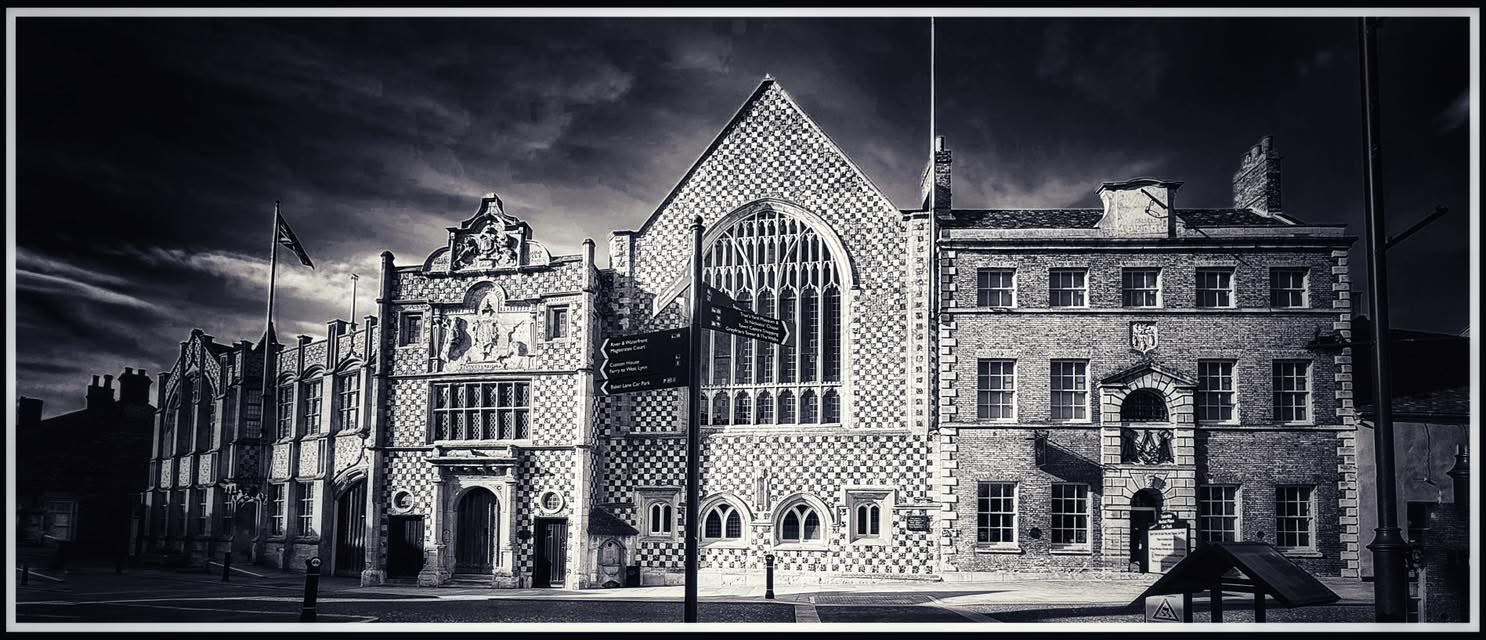
A medieval king’s war could arrive in a town in several ways. It might arrive as a royal command, a tax demand, a requisitioned cargo, or the tramp of soldiers on the road. In Bishop’s Lynn, in the early years of the fourteenth century, Edward I’s Scottish war also arrived as a piece of local accounting.
The entry is small, but beautifully revealing. A Lynn burgess called John de Welle had a ship called the Nicholas. The ship had been in the king’s service. The town owed John money for its expenses. John, awkwardly, also owed money to the town. So the borough set one debt against the other.
No battle is described. No voyage is narrated. No heroic captain stands on deck beneath a snapping banner. Instead, we get something more useful: a glimpse of how a great national campaign pushed its costs into the ledgers of a working medieval port.
A bill, not a battle story
The evidence comes from Henry Hillen’s History of the Borough of King’s Lynn, where he summarised entries from the old Lynn tallage accounts. Under the heading “King Edward I, towards the war in Scotland”, Hillen gives several local allowances or abatements. One concerns Simon de Lincoln, who in 1300 received an allowance “to furnish ships for an expedition to Scotland”. Another concerns John de Welle in 1302.
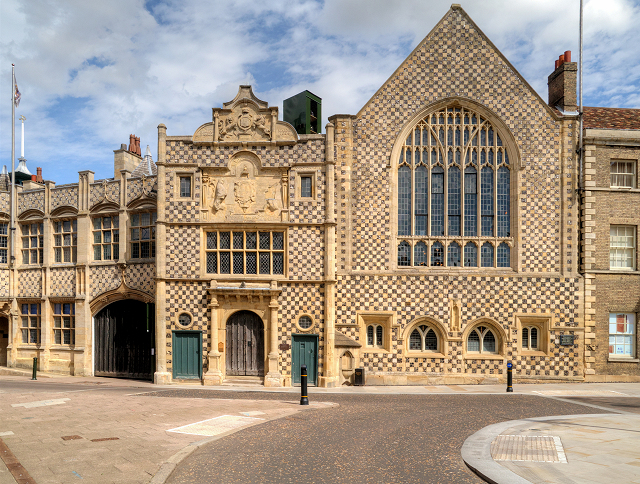
David Dixon / King’s Lynn Guild Hall / CC BY-SA 2.0.
John’s entry says that the town owed him £5 for the expenses of his ship, the Nicholas, while it was in the king’s service. But John also owed the community the current tallage and two earlier tallages. A tallage was a tax or levy, here handled through the borough community. Instead of paying John the whole £5 and then separately collecting his overdue tallages, the town balanced the two accounts.
The arithmetic is straightforward. Five pounds equalled 100 shillings. John’s three unpaid tallages came to 45 shillings. Deduct 45 from 100 and 55 shillings remained. The tally-cutter therefore issued John a new tally showing that the town still owed him 55 shillings. In modern money-of-account terms, that was £2 15s.
That is the story in its plainest form. John had a claim against the town. The town had a claim against John. The war made the debt necessary, but the borough’s own accounting machinery settled the balance.
What was the Nicholas?
We should be careful. The entry does not tell us what kind of ship the Nicholas was. It does not give her size, crew, route, cargo, or destination. It does not say that she sailed to Scotland. It says only that she was John de Welle’s ship and that her expenses arose from being in the king’s service.
The name itself is perfectly plausible. St Nicholas was widely associated with sailors and seafarers, so a medieval ship called the Nicholas is no surprise. But that attractive detail should not tempt us into invention. We do not know whether the vessel carried supplies, timber, soldiers, equipment, messages, or something else.
John de Welle, however, was not a stray name. A deed calendared by the Historical Manuscripts Commission records that, in April 1301, John Ode, burgess of Lynn, conveyed his ferry-boat at Lynn Ferry to John de Welle, also described as a burgess of Lynn. This does not prove that the ferry-boat was the Nicholas. It probably was not. But it does show John de Welle as a Lynn townsman involved in waterborne property at almost exactly the right date.
So the safest description is this: John de Welle was a Lynn burgess with maritime interests, and by 1302 the borough was settling with him for expenses connected with his ship, the Nicholas, in royal service.
What did the £5 pay for?
This is the tempting question, and the one where we must stop short. Hillen’s summary does not itemise the £5. It simply says “expenses”. That word could cover several things: hire of the ship, wages, victuals, gear, repairs, compensation for lost trading time, or a mixture of these. We cannot choose one without more evidence.
Later Lynn accounts from the reign of Edward III show the kind of maritime costs a borough might record. They include freight, mariners’ wages, oars, passage costs, ale, wheat for mariners, and payments connected with ships used by the king. Those later examples are useful for imagination, but not for proof. They show the sort of expenses that could arise when a town’s shipping was drawn into royal service. They do not prove what was included in the Nicholas account of 1302.
The honest answer is therefore modest: Lynn owed John de Welle £5 for the expenses of the Nicholas in the king’s service. The record, as printed by Hillen, does not tell us exactly what those expenses were.
Why Lynn?
Lynn was a natural place for the Crown to look when it needed maritime help. The town’s archives preserve records from the thirteenth century onwards, including accounts from the late thirteenth century, chamberlains’ and treasurers’ accounts, court records, and other material from a borough whose life was closely tied to river, sea, tolls, trade, and administration.
Edward I’s Scottish campaigns needed ships as well as soldiers. The surviving documentation for his maritime logistics shows fleets being assembled on the east and west coasts around 1299–1301 to support English armies fighting in Scotland. Ports, shipmasters, and coastal communities were part of the war machine, even when they were far from the battlefield.
Seen in that setting, the Lynn entry no longer looks odd. Simon de Lincoln’s allowance in 1300 for furnishing ships and John de Welle’s settlement in 1302 for the Nicholas both belong to the same practical world. The king needed transport and supply. Ports supplied ships and men. Local accounts then had to catch up with the cost.
Do not confuse the Nicholas with the bridge fleet
See also: Bridges at Lynn: The Carpenters behind Edward I’s Scottish Campaign
There is another Lynn-and-Scotland story from these same years, and it is much better documented. In 1302–3, Lynn was used for a remarkable royal engineering project: wooden bridges were made there for Edward I’s army to cross “beyond the Scottish sea”. The account, printed in Joseph Bain’s Calendar of Documents Relating to Scotland, names engineers, carpenters, smiths, ships, seamen, cables, anchors, canvas, timber, iron, nails, sea-coal, streamers, and other supplies. The total cost came to £938 9s. 6d., a large sum.
That bridge account names several vessels. John Cok was master of la Haukine of Wiggenhall, Thomas le Blower was master of la Pelerine of Wiggenhall, and Adam le Long was master of la Godeyere of Burnham. There were also twenty-seven other vessels from eastern ports, with many seamen, and further ships assigned to pilotage and protection.
The Nicholas is not named in that bridge account. So it would be unsafe to say that John de Welle’s ship carried the bridges north. The Nicholas and the bridge fleet belong to the same broad background of Edward I’s Scottish war, but they are not the same piece of evidence.
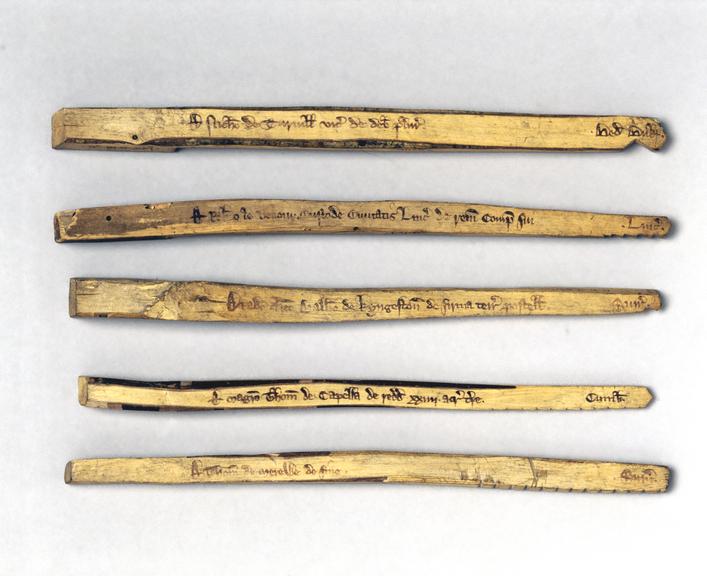
Science Museum Group Collection, Medieval Exchequer Tally Sticks, object no. 1952-431.
The tally-cutter’s moment
One of the most vivid details is the tally-cutter. A tally was a notched wooden accounting record. In medieval financial practice, a stick could be marked and split so that the two halves matched. One party held one half, the other party held the other. The matching notches and the unique split in the wood helped prove the transaction.
In John de Welle’s case, the tally-cutter gave him a new tally after the debts had been set against each other. This is a small detail, but it makes the whole transaction feel immediate. Somewhere in Bishop’s Lynn, an official did not merely write down an abstract sum. He physically recorded the balance between a burgess and the town. The king’s Scottish war had become a notch in a piece of wood.
That is the fascination of the entry. It gives us war without trumpets. Edward I’s campaigns in Scotland were grand, expensive, and politically explosive. But in Lynn we see the quieter aftermath: a ship used, a cost recognised, a tax debt deducted, and 55 shillings still due.
A small entry with a long reach
The Nicholas account does not let us reconstruct a voyage. It does not tell us the shape of John de Welle’s ship, nor the names of her crew, nor the cargo she carried. It does not even say whether John himself went to sea.
What it does show is that Bishop’s Lynn was not merely watching events in Scotland from a distance. The town’s maritime community was being drawn into royal service. Its burgesses supplied or furnished ships. Its officials balanced the costs. Its local taxes and royal war obligations met in the same account.
That makes the entry valuable. A great campaign is often remembered through kings, battles, treaties, and sieges. Lynn’s Nicholas reminds us that war also depended on smaller arrangements: a shipmaster’s claim, a borough’s debt, and a tally showing what remained to be paid.
In 1302, Edward I’s Scottish war passed through Bishop’s Lynn not as a chronicle flourish, but as a bill. And that bill, carefully balanced against John de Welle’s unpaid tallages, tells us something wonderfully concrete about how medieval war worked.
© James Rye 2026
Book a Guided Tour with a Trained and Qualified King’s Lynn Guide Through Historic Lynn
References
- Bain, Joseph, ed. Calendar of Documents Relating to Scotland, vol. 2. Edinburgh: H. M. General Register House, 1884. https://www.electricscotland.com/history/records/bain/028bainvolumetwocalendarpart04.pdf
- Great Britain Royal Commission on Historical Manuscripts. The Manuscripts of the Corporations of Southampton and King’s Lynn. London: HMSO, 1887. https://archive.org/stream/manuscriptsofcor00grea/manuscriptsofcor00grea_djvu.txt
- Hillen, Henry J. History of the Borough of King’s Lynn, vol. 1. Norwich: East of England Newspaper Co., 1907. https://archive.org/stream/historyofborough01hill/historyofborough01hill_djvu.txt
- Norfolk Record Office. “King’s Lynn Borough Archives.” https://www.archives.norfolk.gov.uk/article/31098/Kings-Lynn-Borough-Archives
- Science Museum Group. “Medieval Exchequer Tally Sticks.” https://collection.sciencemuseumgroup.org.uk/objects/co60506/medieval-exchequer-tally-sticks
- The National Archives. “King’s Lynn Borough Archives: Tallage Rolls, 1292–1357, KL/C37/1–7.” https://www.nationalarchives.gov.uk/a2a/records.aspx?cat=153-klmain_1-2&cid=8-5
- Rose, Susan. “Maritime Logistics and Edward I’s Military Campaigns: What Can Be Learnt from the Surviving Documentation?” The Mariner’s Mirror 99, no. 4 (2013): 414–429. Summary available at https://snr.org.uk/maritime-logistics-and-edward-is-military-campaigns-what-can-be-learnt-from-the-surviving-documentation/