In April 1337, Thomas de Melchebourn of Bishop’s Lynn supplied four anchors, three cables, and rope for one of Edward III’s great ships. Two months later, Thomas and William de Melchebourn were recruiting armed men for a royal galley and two Lynn vessels, la Magdaleyne and la Seintemaricogge.
The mayor and bailiffs of Lynn were ordered to assist. Ships had to be prepared and crews found for overseas service.
Edward was moving towards the conflict now known as the Hundred Years War. He claimed the French throne, was seeking allies in the Low Countries, and needed money on a scale that his ordinary income could not provide.
The Melchebourns’ contribution did not end with ships and sailors. Within a few years, they and other Lynn merchants were helping to finance Edward’s campaigns through a remarkable system involving wool, royal debts, and future customs revenue.
Some of their support was willing and potentially profitable. Some of it was forced upon them.
Paying for war with wool
English wool was highly valued by cloth makers in the Low Countries and Italy. Every sack exported through ports such as Lynn, Boston, and London paid customs duties to the Crown.
Customs produced money gradually, but soldiers, ships, and foreign allies had to be paid immediately. Edward therefore needed merchants prepared to advance money now and recover it later from taxes that had not yet been collected.
In August 1336, the king prohibited wool exports. The following year, a company of English merchants was authorised to assemble an enormous stock, with a nominal target of 30,000 sacks.
Much of the wool was obtained compulsorily on credit at prices fixed by the government. Producers surrendered their wool but did not necessarily receive immediate payment. The merchants would sell it abroad, settle with the producers, and divide the expected profits with the king.
Edward also expected the merchants to provide him with a huge advance, possibly as much as £200,000, without interest.
The scheme depended upon one layer of credit resting on another. Growers waited for merchants to pay them. The merchants waited for overseas sales. Edward wanted money before those sales had been completed.
Only the first main shipment appears to have left England before the plan began to fail.
The king takes the wool
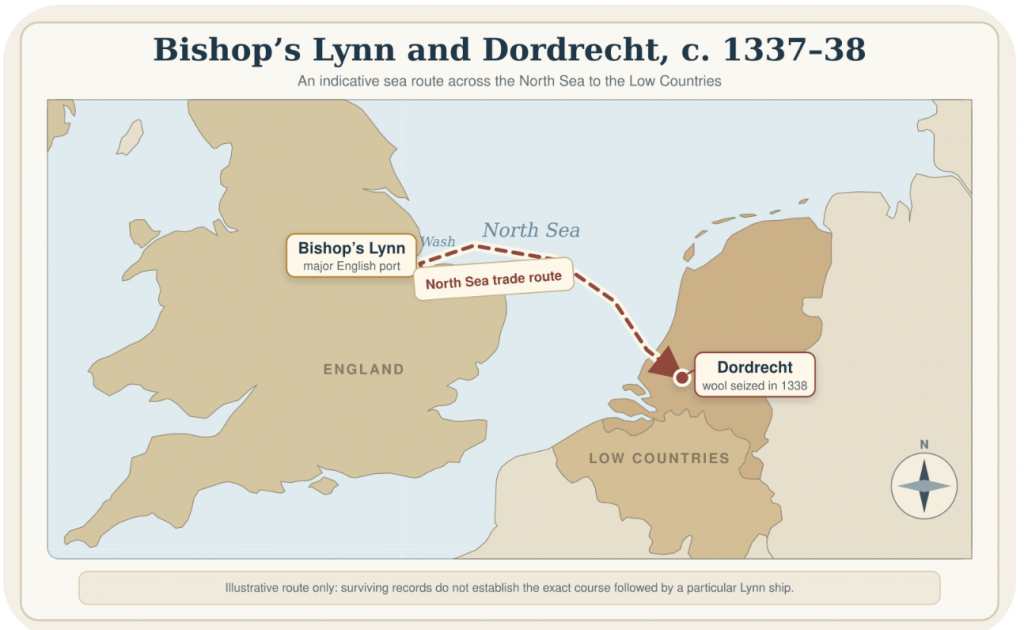
Early in 1338, a large quantity of wool was at Dordrecht in Holland. Edward demanded a further advance from the merchants. According to the surviving Exchequer evidence, they replied that they could not raise the money.
The king’s representatives then took the wool and sold it. Historian Matt Raven estimates that the sale produced about £68,000 for the Crown.
The money supported Edward’s policies in the Low Countries, but the merchants lost the wool from which they had expected to recover their costs. Some still owed money to the English producers who had supplied it.
The official Close Rolls later described the wool as having been:
“taken at Durdraght for the king’s use”
The chronicler Adam Murimuth was more outspoken. He described wool being taken at low prices from unwilling owners.
Murimuth gave the quantity as 30,000 sacks, but this was probably the target for the entire monopoly rather than a reliable count of what was sold at Dordrecht. Only part of the intended stock appears to have reached the Low Countries.
Edward gained ready money for war. The merchants received written promises that the Crown would repay them.
Historians later called these promises the “Dordrecht bonds”.
Three Lynn merchants wait for their money
The Dordrecht bonds were not issued by the Dutch town. They were English royal IOUs acknowledging debts created when the king took merchants’ wool there.
In July 1343, five years after the seizure, royal clerks recorded the remaining claims of three merchants connected with Lynn.
Robert de Wotton of Lynn had originally been owed £29 3s. After receiving allowances of £2 7s 8½d, he was still waiting for £26 15s 3½d.
Peter Wake of Lynn had lost wool valued at £41 4s. His unpaid balance was £34 16s 3½d.
Thomas de Melchebourn’s claim was much larger. The Crown had originally owed him £104 19s 5¾d. By 1343, he had recovered £17 13s 10½d, but £87 5s 7¼d remained outstanding.
Together, the three men were still owed £148 17s 2¼d. The record does not reveal how many sacks they owned or through which English port their wool travelled. Robert and Peter are explicitly described as being “of Lenn”. Thomas’s connection with Bishop’s Lynn is confirmed by the earlier orders concerning royal ships.
These merchants had helped finance Edward’s war in a direct but involuntary way. The king had taken their property and left them holding royal promises of later payment.
How the repayment system worked
Edward did not have enough cash to settle all the Dordrecht debts. His government therefore tied repayment to the tax on future wool exports.
In 1343, the additional tax was 40 shillings, or £2, on each sack exported. During the first year, a recognised Dordrecht creditor could deduct 20 shillings from the tax on every sack of his own wool. In each of the following two years, he could deduct one mark, equal to 13s 4d.
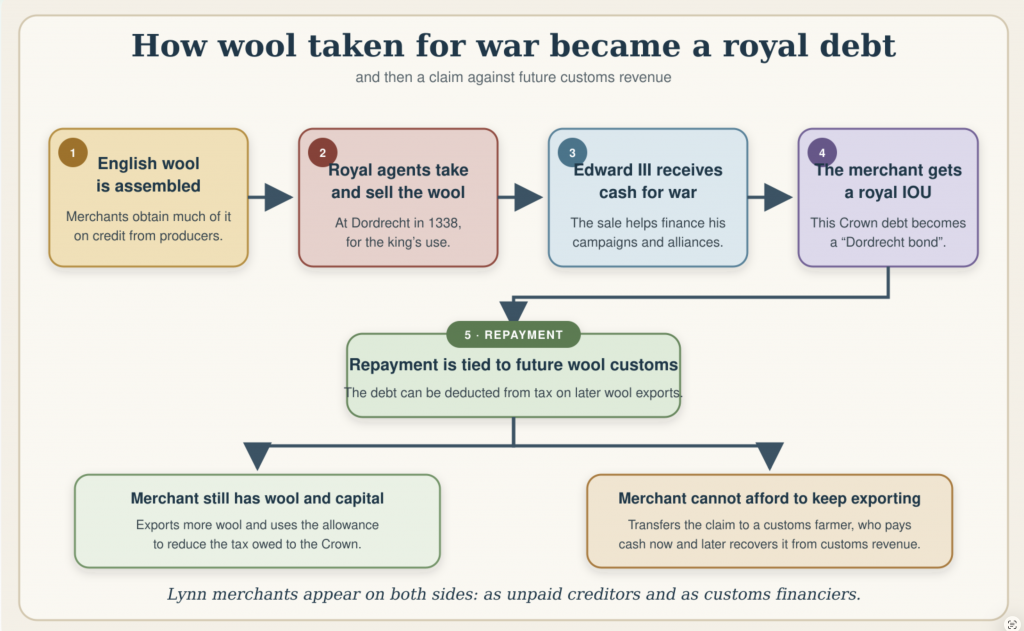
Suppose the king owed a merchant £100. The Exchequer did not hand him £100. Instead, the merchant continued exporting wool. If he exported one hundred sacks during the first year, he could deduct £1 from the tax on every sack and gradually recover the debt.
Rather than receiving money from the Crown, he retained money that he would otherwise have paid to the Crown.
This worked for a rich merchant who possessed enough capital to buy and export more wool. It was far less useful to someone whose trading money had disappeared with the Dordrecht cargo.
A merchant might hold a royal promise for £100 but be unable to buy the wool needed to claim it. To recover payment for his lost wool, he first had to acquire more wool.
The customs farmers
This is where the customs farmers entered the story.
A customs farm had nothing to do with farming land. A company of merchants agreed to provide the king with fixed payments, advances, or loans. In return, it obtained the right to manage customs revenues for an agreed period.
Port officials still examined cargoes and recorded exports. The farming company stood behind them, controlling the revenue and accounting with the Crown.
Edward received money sooner and with greater certainty. The customs farmers gained access to a dependable stream of tax revenue from which their advances and other royal debts could be recovered. They acted, in effect, as the king’s bankers.
They were also well placed to acquire Dordrecht claims.
A creditor who could not afford to continue exporting could transfer his royal IOU to a customs farmer. The farmer provided immediate cash, probably less than the claim’s recorded value. He could then recover the full amount through the customs accounts.
The creditor received less money but received it sooner. The customs farmer waited and expected to make a profit.
Thomas de Melchebourn becomes a royal financier
On 8 July 1343, only days before the remaining Lynn claims were entered in the Close Rolls, Thomas de Melchebourn appeared at the head of a large company farming the English customs.
Historian E. B. Fryde believed that William de la Pole was the real financial power behind the company. Thomas was nevertheless its formal leader in the enrolled agreement.
Thomas now occupied two positions. He was still owed more than £87 because the king had taken his wool. At the same time, he headed a company managing the customs revenues through which such debts could be repaid.
This might appear contradictory, but a merchant could be harmed by Edward’s failure to pay and still decide that continued cooperation offered the best chance of recovering his losses. Remaining close to the Crown also brought access to royal business and customs revenue.
Thomas had supplied equipment and recruited sailors. His wool had then provided Edward with an involuntary loan. By 1343, he was helping to convert future tax income into money that the king could use immediately.
William buys other merchants’ debts
The customs agreement allowed creditors who could not use their Dordrecht allowances to transfer them to the customs farmers.
On 2 June 1344, Lynn’s customs collectors received an order concerning John de Wylton of Beverley and Robert de Shirebourne. Their wool had been taken at Dordrecht, leaving the Crown owing them £236.
The record says that they could not use the export allowances “on account of their poverty”. They transferred their claim to William de Melchebourn and his associates. The Lynn collectors were instructed to allow William’s group the £236.
“Poverty” need not mean destitution. The men may have owned property but lacked enough available money to buy another stock of wool and wait for an overseas sale. Their problem was circular: to recover the money owed for their lost wool, they had to possess more wool.
William and his partners had the necessary capital.
In February 1345, William received another Dordrecht claim. Robert de Denton was owed £81 3s 8d but was also said to be unable to use the allowance because of poverty.
The records give the face value of these debts but not the price William’s group paid for them. A parliamentary complaint in 1348 alleged that wealthy merchants could buy poorer merchants’ claims and dictate the price. Yet the exact profits made by William and his associates cannot be calculated.
John de Wesenham continues the Lynn connection
Another Lynn merchant, John de Wesenham, later joined the customs system. His name also appears as Wesynham and under other medieval spellings.
A record of March 1345 calls him “John de Wesenham of Lenne, merchant”. By 1346, Wesenham and his associates had become grantees of the customs.
On 11 May, they were ordered to allow £72 11s ½d to two London customs collectors who had already credited money to merchants for wool taken at Dordrecht.
This does not prove that Wesenham personally lost wool in 1338. It shows that he was involved in the national machinery used to repay the resulting debts.
The date is suggestive. In 1346, Edward launched the campaign that culminated in the Battle of Crécy. The evidence does not link Wesenham’s particular customs allowance directly to that campaign, but it shows that Lynn merchants remained involved in royal finance as the war entered one of its most famous phases.
Lynn helps finance a king
Lynn’s contribution to the opening years of the Hundred Years War extended well beyond ships and fighting men.
Robert de Wotton and Peter Wake helped finance the king unwillingly when their wool was taken. Thomas de Melchebourn moved from royal supplier and unpaid creditor to formal leader of a customs company. William acquired the debts of merchants who could not afford to wait. John de Wesenham later helped administer the customs revenue through which such debts were settled.
There is no evidence that Lynn’s borough corporation issued Dordrecht bonds. The obligations were English Crown debts, not securities created by Lynn or Dordrecht. The local connection was with individual merchants.
Edward turned wool into ready money. When he could not repay its owners, he gave them claims against future taxes. Wealthier financiers bought some of those claims and recovered them through the customs farms.
Behind the campaigns and royal ambitions of the Hundred Years War stood this machinery of wool, credit, and taxation. Part of it ran through Bishop’s Lynn.
© James Rye 2026
Book a Walk with a Trained and Qualified King’s Lynn Guide
References
- Calendar of Close Rolls, Edward III. Volume VII, 1343–1346. London: His Majesty’s Stationery Office, 1904.
https://archive.org/details/calendarofcloser07grea - Calendar of Close Rolls, Edward III. “Dordrecht Creditors under the Port of Lynn,” 1343.
https://archive.org/details/calendarofcloser07grea/page/n157/mode/2up - Calendar of Close Rolls, Edward III. “Order for Repayment of the Dordrecht Debts,” July 16, 1343.
https://archive.org/details/calendarofcloser07grea/page/n151/mode/2up - Calendar of Close Rolls, Edward III. “Customs-Farming Indenture and Assignment of Dordrecht Debts,” 1343.
https://archive.org/details/calendarofcloser07grea/page/n279/mode/2up
https://archive.org/details/calendarofcloser07grea/page/n280/mode/2up - Calendar of Close Rolls, Edward III. “Order to the Customs Collectors at Lynn,” June 2, 1344.
https://archive.org/details/calendarofcloser07grea/page/n414/mode/2up - Calendar of Close Rolls, Edward III. “Assignment from Robert de Denton to William de Melchebourn,” February 16, 1345.
https://archive.org/details/calendarofcloser07grea/page/n606/mode/2up - Calendar of Close Rolls, Edward III. Volume VIII, 1346–1349. London: His Majesty’s Stationery Office, 1896.
https://archive.org/details/calendarofcloser08grea - Calendar of Close Rolls, Edward III. “Order to John de Wesenham and His Fellows,” May 11, 1346.
https://archive.org/details/calendarofcloser08grea/page/n39/mode/2up - Fryde, E. B. “Edward III’s Wool Monopoly of 1337: A Fourteenth-Century Royal Trading Venture.” History 37, no. 129 (1952): 8–24.
https://www.jstor.org/stable/24402100 - Fryde, E. B. “The English Farmers of the Customs, 1343–51.” Transactions of the Royal Historical Society 9 (1959): 1–17.
https://www.cambridge.org/core/journals/transactions-of-the-royal-historical-society/article/english-farmers-of-the-customs-134351/A30B2D4CCA5CB8442883FC316F1AE18F - Gascon Rolls Project. “C 61/49: Royal Orders and Correspondence, 1337.”
https://www.gasconrolls.org/fr/edition/calendars/C61_49/document.html - Murimuth, Adam. Continuatio Chronicarum. Edited by E. Maunde Thompson. London: Rolls Series, 1889.
https://archive.org/details/admurimuthconti00robegoog - Raven, Matt. “Wool Smuggling and the Royal Government in England, c.1337–63: Law Enforcement and the Moral Economy in the Late Middle Ages.” Law and History Review 40, no. 4 (2022): 747–788.
https://www.cambridge.org/core/journals/law-and-history-review/article/wool-smuggling-and-the-royal-government-in-england-c133763-law-enforcement-and-the-moral-economy-in-the-late-middle-ages/FFA1B0757290B2C00E34FD3013066ECA - Unwin, George. “Estate of Merchants, 1336–65 II.” In Finance and Trade under Edward III.
https://www.british-history.ac.uk/manchester-uni/london-lay-subsidy/1332/pp205-221