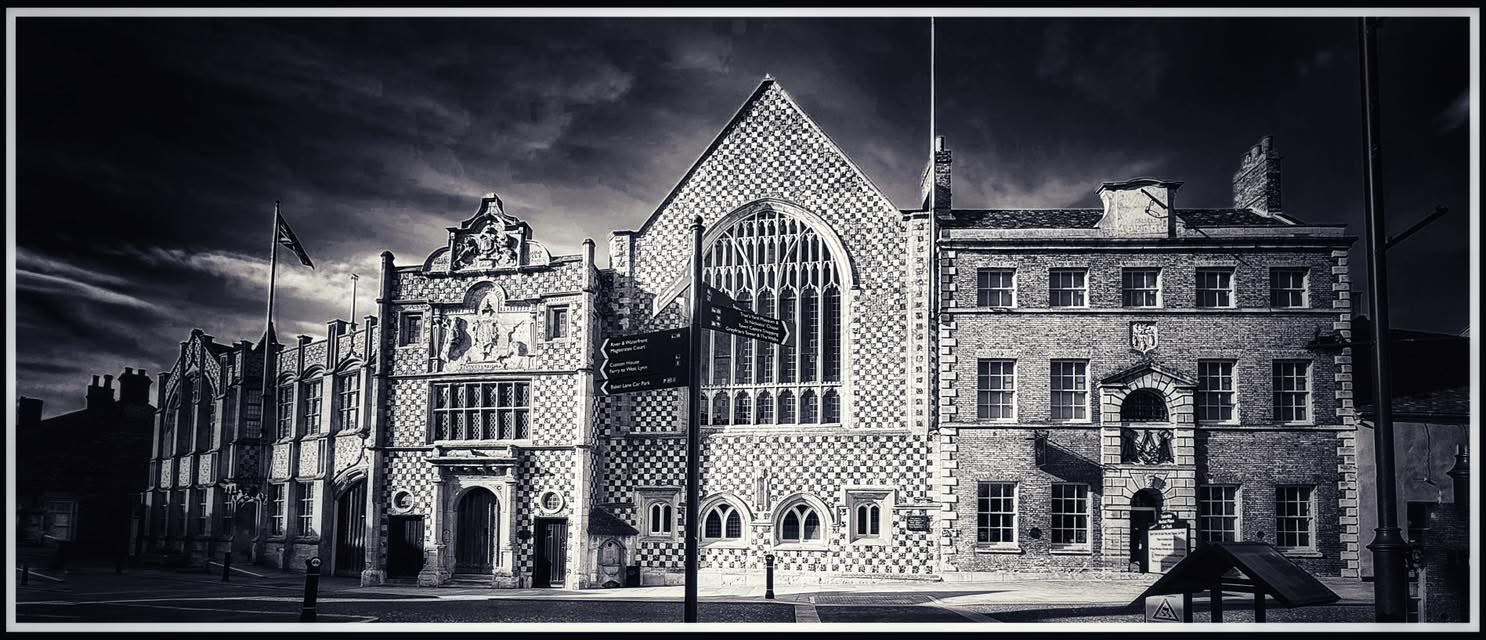
King’s Lynn did not begin with a public library. It began with books in churches, records in counting houses, papers in civic chests, and learned volumes kept where only a small part of the town could reach them.
A medieval port could not run without writing. Lynn’s merchants, clergy, guild officers, lawyers, customs men, and borough officials all depended on documents. St Margaret’s Church, St Nicholas’s Chapel, the friaries, and the town’s governing institutions all used books or records of one sort or another. But this was not yet a library culture in the modern sense. Books were tools of worship, trade, law, office, and status.
The story of King’s Lynn’s libraries is therefore a story of access. At first, books belonged to institutions. Later, they served clergy, educated townsmen, subscribers, society members, and improvers. Then, in the early twentieth century, they became part of free public provision. Today, in New Conduit Street, the town’s library mixes lending, learning, digital access, local heritage, public rooms, and rare books. The route from chapel vestry to town-centre library is longer, stranger, and more revealing than it first appears.
Before the Public Shelf
Medieval Bishop’s Lynn was one of the great ports of eastern England. Its commercial life faced the Wash, the North Sea, and the trading world beyond. Its religious and civic life was rooted in St Margaret’s, St Nicholas’s, the guildhall, the Saturday Market Place, the riverfront, and the borough’s institutions.
Books certainly existed in that world. Service books were needed for worship. Administrative records were needed for government. Merchants and lawyers needed written instruments. Schools required texts. Yet none of this proves the existence of a public library. The safest conclusion is more precise: Lynn had a literate institutional culture before it had a library open to readers as a civic service.
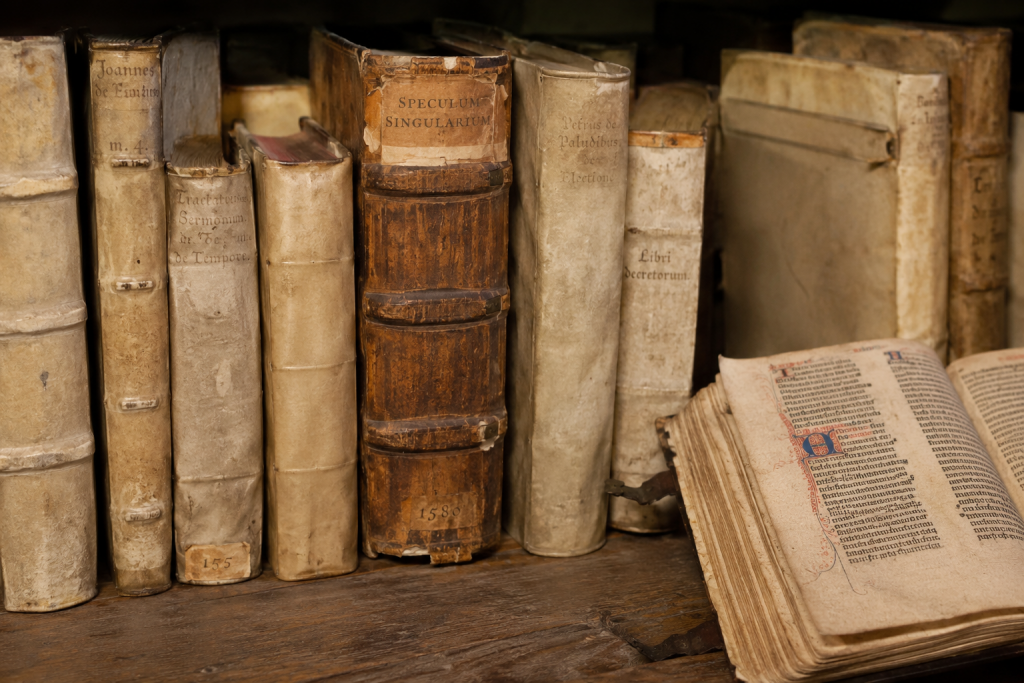
That older culture left traces. The town’s later rare-book collections are associated with St Margaret’s and St Nicholas’s, and public material describes about 2,000 historic volumes, including a copy of the Nuremberg Chronicle. Such survivals are not decorative extras. They are evidence that Lynn’s book history began in the parish, the chapel, and the learned life of the town’s churches.
The Chapel Vestry and the Church Porch
The first firm dates in Lynn’s library history fall in the early seventeenth century. In 1617, a library was established in the vestry of St Nicholas’s Chapel. In 1631, another was opened above the north porch of St Margaret’s Church, now King’s Lynn Minster.
These were not free lending libraries. They were learned church libraries, formed in a town where divinity, civic office, preaching, scholarship, and local status overlapped. Their first strength lay in theology, with books in Latin, Greek, and Hebrew. Later, the collections widened to include subjects such as science, medicine, history, and literature.
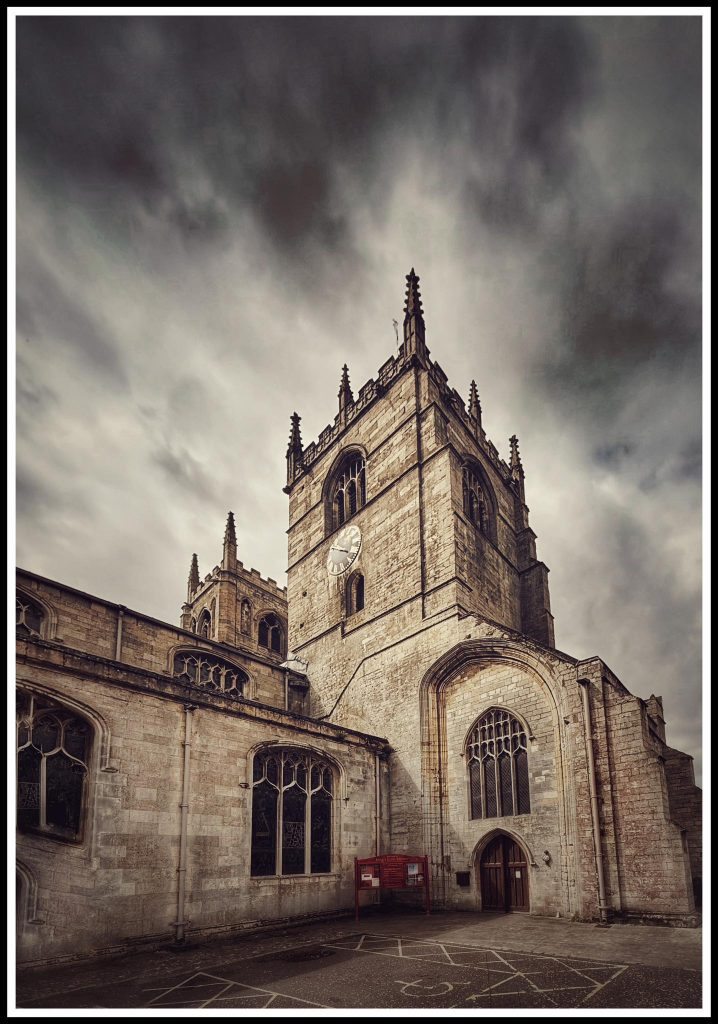
Photo © James Rye 202
The locations are worth holding in mind. St Nicholas’s served the northern part of the town. St Margaret’s stood at the older civic and religious centre, close to the Saturday Market Place and the borough’s core. Books were not hidden in random corners. They were kept in places of authority.
The phrase “books above the porch” catches something of the period. Knowledge was present, but raised, guarded, and mediated. It belonged to a learned community rather than to the whole town. Lynn’s later public library movement would not erase that older inheritance. It would build over it.
The Athenaeum: Improvement with a Reading Room
By the nineteenth century, library history in Lynn had moved out from the church and into the civic culture of improvement. The key setting was the Athenaeum in Baxter’s Plain.
Lynn Museum was founded in 1844 by members of the Lynn Conversazione and Society of Arts. In 1854, it moved from Welwick House in Union Street to the Athenaeum, a purpose-built museum and library on the site of the old Post Office. The Athenaeum housed literary, artistic, and scientific societies, as well as libraries and museum collections.
This was the Victorian town improving itself in public. The Athenaeum gathered lectures, collections, reading, display, science, art, and antiquarian interest under one roof. It was not simply a library, and that is the point. In mid-nineteenth-century Lynn, books belonged to a wider world of respectable instruction and organised curiosity.
The building also marks a change in audience. The seventeenth-century church libraries had served a learned religious and civic elite. The Athenaeum served society members, subscribers, lecturers, collectors, and the town’s educated public. It widened the circle, but not without limits.
The Stanley Library: Abundance, But by Subscription
In 1884, the Stanley Library opened in the Athenaeum. It reportedly held more than 8,000 volumes and had more than 600 subscribers. Those figures suggest real appetite for books in late Victorian Lynn. A town does not sustain that kind of library without readers.
Yet the Stanley Library was still a subscription institution. That is its strength and its limitation. It put a substantial collection within reach of many more people than the old church libraries had done, but the word “subscribers” tells us where the boundary lay. Access still depended on membership.
The Stanley Library is therefore best understood as the last major stage before the free public library. It proved the demand. It also exposed the gap. Lynn had books, readers, and organisational energy. What it did not yet have was a public library founded on the principle that books should be available without subscription.
Carnegie’s Tower
The answer came on London Road.
King’s Lynn’s Carnegie Library was built in 1904 to designs by H. J. Green. Andrew Carnegie made a large contribution to the cost and attended the opening on 18 May 1905. The building is now Grade II listed.
It was designed to declare itself. Historic England describes a large fan-shaped island block in Gothic style, with Arts and Crafts influence, built of cut carstone, red brick, and terracotta dressings. Its three-storey tower forms the entrance porch. Above the doorway sits the inscription “Public Library”. There are crenellations, buttresses, a canted oriel, and terracotta tablets bearing the names of authors.
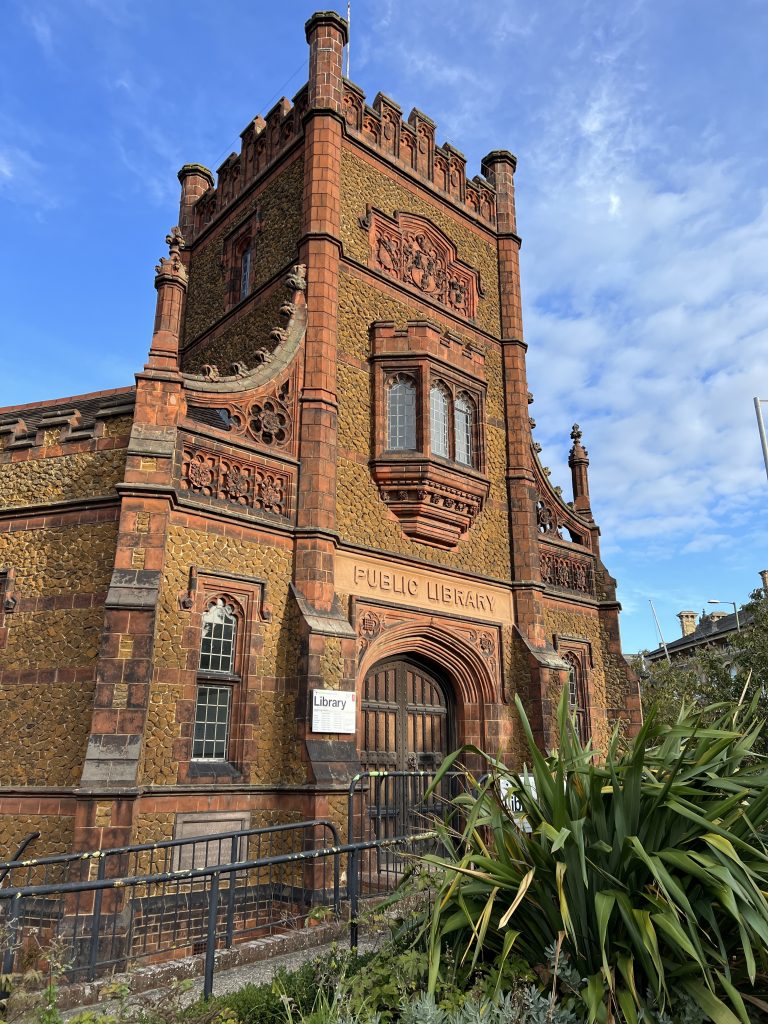
Photo © James Rye 2022
The architecture did a job. It gave free reading a public face. Earlier collections had been placed in vestries, above porches, and inside subscription rooms. The Carnegie Library stood as a civic monument. It announced that books were no longer merely the property of churchmen, societies, or paying members. They were part of public life.
Those author tablets are more than ornament. They are a reading list turned into masonry. The building preached confidence in literature, education, and civic progress. Lynn had made a library that could be seen from the street and understood at a glance.
What Free Reading Changed
A public library did not make Lynn classless, nor did it abolish the rules and assumptions of respectable Edwardian reading. Public libraries had catalogues, regulations, opening hours, silent rooms, and moral expectations. They guided as well as supplied.
Still, the shift was real. The Carnegie Library changed the town’s relationship with books. It brought the principle of free access into a port town of clerks, shopkeepers, teachers, artisans, apprentices, labourers, seafarers, professionals, and children. A library could offer fiction, reference works, newspapers, technical knowledge, children’s books, and quiet space.
The old inscription said only “Public Library”. That was enough. After nearly three centuries of documented library provision in Lynn, those two words marked a new social settlement.
A Watchtower in Wartime
In 1915, the library tower took on a different meaning. After a Zeppelin raid over King’s Lynn, members of the Berkshire Yeomanry, stationed in the town, are said to have used the tower as an observation point to watch for enemy aircraft. Some soldiers are also said to have left their names cut into the stone.
It is a small episode, but a sharp one. A building made for reading became a lookout. The library tower, built as a proud entrance and architectural marker, was briefly folded into the town’s wartime defences.
Libraries often gather uses their founders never foresaw. They become landmarks, meeting places, shelters, shortcuts, memory stores, and, in this case, a place from which soldiers watched the sky.
Rare Books, Public Memory
The rare books associated with St Margaret’s and St Nicholas’s are among the most valuable threads in the whole story. They carry Lynn’s library history back to the seventeenth century, and possibly into older habits of ecclesiastical collecting. They also complicate the usual story of public libraries as purely modern institutions.
The Nuremberg Chronicle, named in local public material, is especially striking. Printed in 1493, it belongs to the great age of early European printing. Its presence in a King’s Lynn historic collection links a Norfolk port town with continental book production, urban history, humanist learning, and the circulation of printed knowledge.
Rare books can easily become invisible. They are too fragile for ordinary handling and too specialised for casual display. The new library’s provision for curated sessions gives them a better public future. That matters, because a town’s book history is not only about borrowing. It is also about survival: what was kept, where it was kept, who used it, and how it came down to us.
New Conduit Street
In March 2026, King’s Lynn Library opened at 46 New Conduit Street, in the former Argos building. The move was more than a change of address.
The Carnegie building belonged to the Edwardian world of philanthropy and municipal confidence. The New Conduit Street library belongs to a different public language: accessibility, digital access, adult learning, children’s provision, study space, business support, meeting rooms, sustainability, and heritage access. It includes public computers, free Wi-Fi, learning facilities, event spaces, lifts, accessible toilets, and a Changing Places facility.
At first sight, this looks like a break with the past. In fact, it also brings the story round. The Athenaeum was never only a library. It combined books with lectures, collections, science, societies, and public instruction. The new library does something similar for a different century.
The public library is no longer just a building where books are borrowed. It is one of the town’s working rooms.
The Town That Kept Its Books
King’s Lynn’s library history is layered rather than linear. It begins with church collections in St Nicholas and St Margaret. It passes through the Athenaeum, the Stanley Library, and the world of Victorian improvement. It takes monumental form in the Carnegie Library. It now continues in New Conduit Street, where public lending sits beside learning, digital access, community use, and rare-book interpretation.
The sharpest way to read the story is through access. Who could use the books? Clergy. Educated townsmen. Society members. Subscribers. Ratepayers. Children. Students. Anyone needing a computer, a quiet desk, a local source, or a room.
The town’s libraries have changed because the town’s idea of a reader has changed. Once, the reader was expected to climb to a porch room or belong to a society. Then the reader entered beneath a tower labelled “Public Library”. Now the reader may be a child, a jobseeker, a family historian, a student, a business owner, a rare-book researcher, or someone simply needing warmth, quiet, and a table.
A compact chronology
Medieval period: books certainly existed in Lynn’s churches, friaries, civic administration, and mercantile culture.
1617: a library is said to have been established in the vestry of St Nicholas’s Chapel.
1631: a similar library is said to have opened above the north porch of St Margaret’s Church.
1844: Lynn Museum was founded by members of the Lynn Conversazione and Society of Arts.
1854: the museum moved to the Athenaeum in Baxter’s Plain, a purpose-built museum and library.
1884: the Stanley Library opened in the Athenaeum, with more than 8,000 volumes and more than 600 subscribers, according to a local account.
1904: H. J. Green designed the new public library building on London Road.
18 May 1905: Andrew Carnegie attended the opening of the London Road public library.
1915: after a Zeppelin raid, the Berkshire Yeomanry are said to have used the library tower as an aircraft observation point.
2025: Norfolk County Council announced The Garage Trust as the future custodian of the Carnegie Library building.
March 2026: the new King’s Lynn Library opened at 46 New Conduit Street, in the former Argos building.
© James Rye 2026
Book a Guided Tour with a Trained and Qualified King’s Lynn Guide Through Historic Lynn
References
Historic England. “Chapel of St Nicholas, Non Civil Parish: List Entry Number 1210545.” National Heritage List for England. https://historicengland.org.uk/listing/the-list/list-entry/1210545
Historic England. “Kings Lynn Library, Non Civil Parish: List Entry Number 1195423.” National Heritage List for England. https://historicengland.org.uk/listing/the-list/list-entry/1195423
Lynn Museum, Norfolk Museums Service. “History of Lynn Museum.” https://www.lynnmuseum.norfolk.gov.uk/article/30494/History-of-Lynn-Museum
Norfolk County Council. “King’s Lynn Library.” https://www.norfolk.gov.uk/article/40205/Kings-Lynn-Library
Norfolk Heritage Explorer. “Site of Athenaeum, Baxter’s Plain.” https://www.heritage.norfolk.gov.uk/record-details?Index=60243&MNF71291-Site-of-Athenaeum-Baxter%27s-Plain=
The National Archives. “Parish Records of St Margaret with St Nicholas, King’s Lynn.” Discovery catalogue entry. https://discovery.nationalarchives.gov.uk/details/r/004ebccb-871a-4e59-8537-313658a61387
Rye, James. “The Man Who Opened Books in Lynn.” Circato. 17 December 2022. https://circato.co.uk/the-man-who-opened-books-in-lynn
Visit West Norfolk. “A Pilgrimage Trail of King’s Lynn.” PDF. https://www.visitwestnorfolk.com/wp-content/uploads/2023/01/1390-109-2-Pilgrimage-Trail-A5-booklet-WEB-1.pdf
West Norfolk, Borough Council of King’s Lynn and West Norfolk. “New King’s Lynn Library Opens Its Doors.” 16 March 2026. https://www.west-norfolk.gov.uk/news/article/2024/new_kings_lynn_library_opens_its_doors