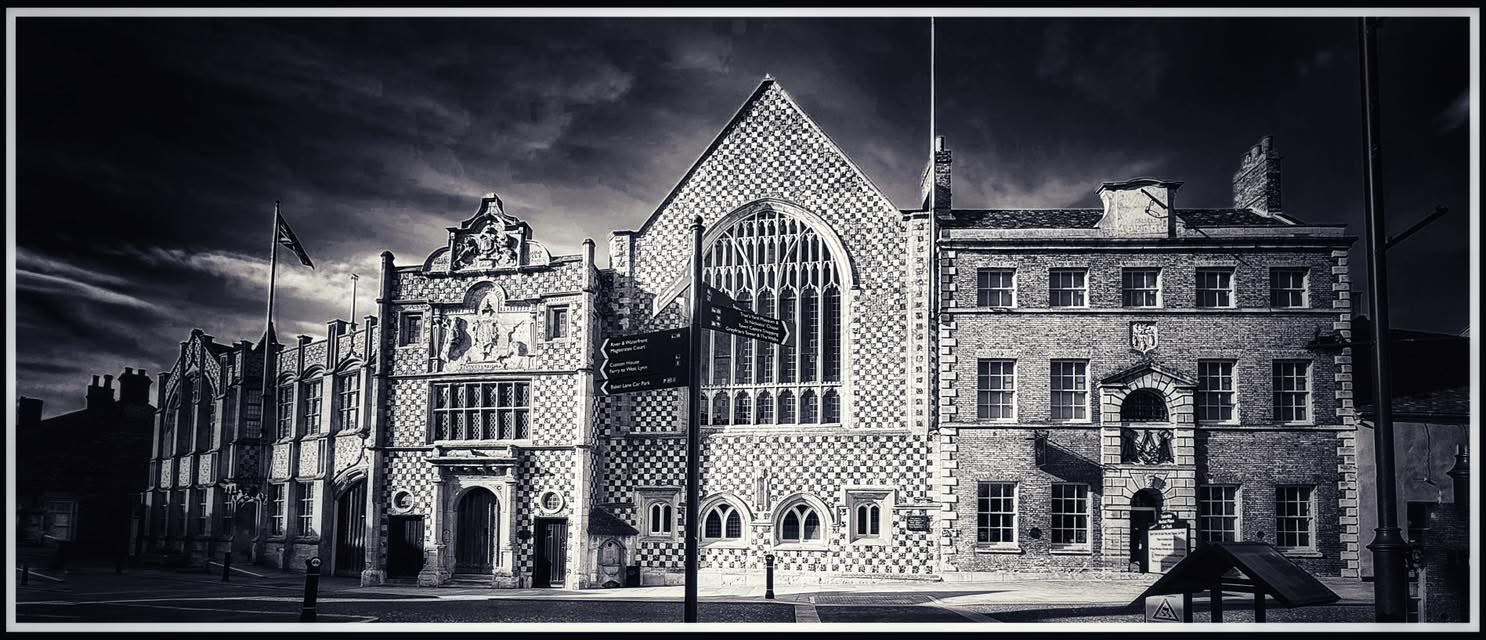
The Pool Beneath the Pilot Office
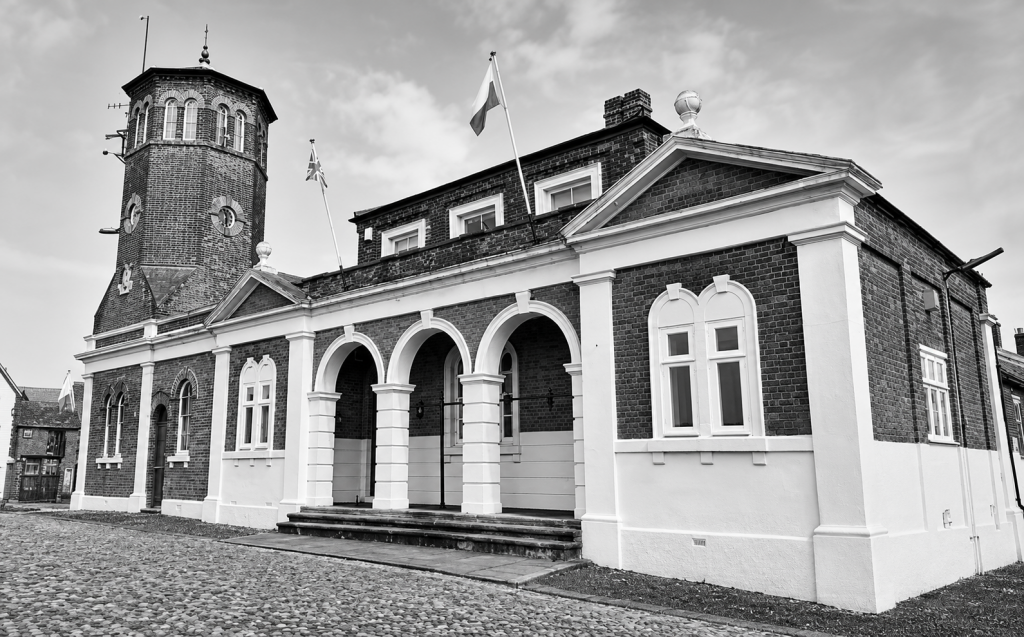
King’s Lynn has always had a gift for hiding excellent stories in perfectly ordinary places. On Common Staithe Quay, the Conservancy Board and Pilots’ Office looks exactly as a harbour building ought to look: brisk, practical, official, and faintly allergic to nonsense. It has a tower, port lettering, workshops, and the air of a place where someone once knew precisely which rope belonged where.
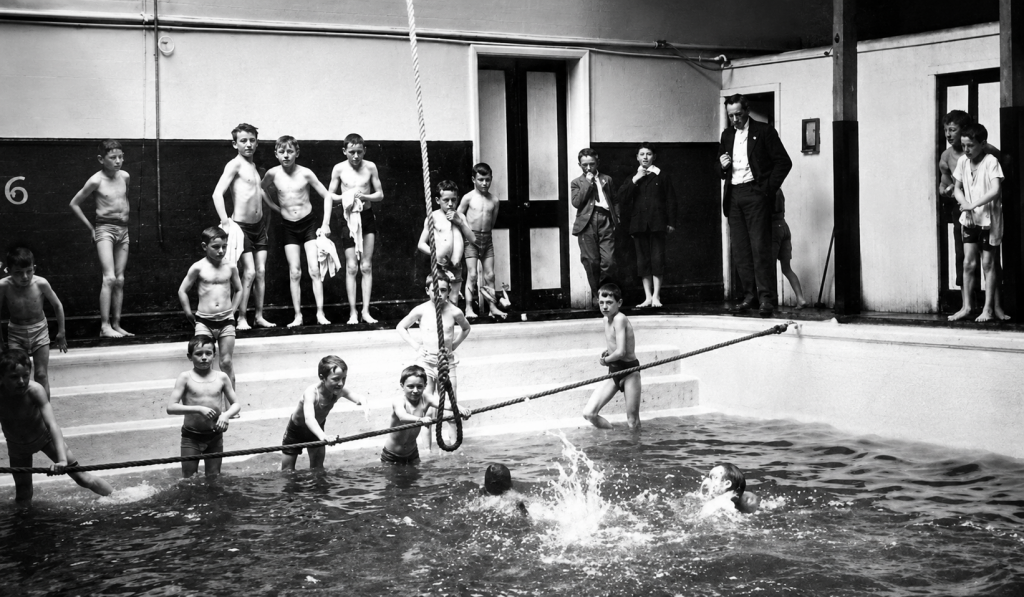
Yet inside this Grade II listed building, beneath a later floor, survives one of Lynn’s quieter surprises: the swimming bath of the town’s Victorian Public Baths, opened in 1856.
This is not, sadly, a private pool installed for off-duty harbourmasters. It is better than that. It is a public-health building that changed occupation, changed appearance, and somehow kept its old bones.
Before the pilots came the bathers
The Common Staithe was never a decorative backdrop. It was part of the working waterfront, close to Tuesday Market Place and the River Great Ouse, where trade, warehouses, vessels, dues, and cargo shaped daily life. The word staithemeans a quay, and this one belonged to Lynn’s long mercantile geography.
In 1856, the Public Baths opened there. They were part of a wider Victorian movement that treated washing, health, discipline, and civic improvement as matters fit for public provision. The Baths and Washhouses Act of 1846 had encouraged towns to provide facilities for bathing and washing, and Lynn’s baths followed within a decade.
The establishment was not simply a swimming pool in the modern leisure-centre sense. Contemporary descriptions refer to hot and cold baths, salt and fresh water baths, shower baths, and swimming baths. It offered cleanliness, exercise, and respectability under one roof, with the River Great Ouse just beyond the quay.
Then the tower arrived
The port soon pressed itself into the story. In the 1860s, the Pilots’ Office was added to the north end of the baths complex, bringing with it the observation tower that still gives the building much of its character.
It is a wonderfully Lynn arrangement. One part of the building belonged to bathing, another to pilotage, another to river dues, and later use brought in offices, workshops, storage, and the Conservancy Board. The west front still preserves traces of the original public baths, including the arched entrance arcade. The tower, meanwhile, announces “PILOTS’ OFFICE” and “MOORING DUES” in raised lettering, just in case anyone was tempted to mistake the place for a spa.
The swimming bath that stayed put
The best part is also the plainest. The pool survives.
Historic England’s list entry records that the swimming bath, with a stepped north end, remains beneath an inserted floor. Above it are surviving parts of the old bath hall, including a curved east end wall and a shallow-pitched roof with scissor-braced principal rafters, slender purlins, and short king posts.
So the phrase “hidden swimming pool” is true, but only if said carefully. This is not a secret chamber or a municipal Atlantis. The pool is hidden because the building was adapted. The bath was floored over, the spaces changed use, and the old structure was folded into a busy port building.
That is often how towns keep their past. Not under glass, but under boards.
Boiler rooms, flares, and other useful things
The survival is larger than the basin alone. The former baths complex also contains the remains of a boiler room, a stepped square chimney, and a settling tank. Oxford Archaeology has noted that a reservoir connected with flushing the baths may survive buried beneath the car park.
The building’s later life adds its own fine absurdity. Historic England records that the former baths were partly used until recent times as a sports gymnasium, with the swimming bath already floored over. The complex also contains a small vaulted room known as the Magazine Room, thought to have been used for explosive flares.
Pool below, gym above, harbour offices nearby, flares in a vaulted room. Lynn’s buildings rarely waste a wall.
Why this odd survival matters
The Common Staithe baths are not just a charming local curiosity. Historic England describes them as one of the earliest surviving examples of Victorian public swimming baths in the country. Oxford Archaeology has called the Italianate public baths at Common Staithe the sixth oldest baths to survive in England.
That places the hidden pool in a much larger story. Early public baths are not common survivals. Many were rebuilt, demolished, modernised beyond recognition, or replaced by twentieth-century municipal pools. Lynn’s example survived partly because it was absorbed, reused, and obscured.
Its setting also matters. This was not a grand civic bath standing proudly in a broad street. It was tucked into the working waterfront of a port town. It belonged to the same urban world as ships, warehouses, pilots, dues, chandlers, cargo, mud, smoke, and river traffic. That makes it especially revealing. Public health in Victorian Lynn was not abstract reform. It was built in brick, beside the quay, among the practical machinery of the town.
The Conservancy Board chapter
The Conservancy Board itself belongs to a later period. The Board traces its creation to the aftermath of the wreck of the Wick Bay in December 1889, which helped lead to the King’s Lynn Conservancy Act of 1897. Its duties included safeguarding the river, marking the channel, collecting dues, and removing wrecks.
The present building therefore contains several histories at once. It remembers the age of civic bathing. It records the needs of pilotage and harbour management. It stands on one of Lynn’s old mercantile spaces. It shows how a town repeatedly adapts its buildings instead of starting again.
© James Rye 2026
Book a Walk with a Trained and Qualified King’s Lynn Guide
References
Historic England. “Interior View of the Swimming Pool Hall in the Former Public Baths, Now Part of the Pilot Office Building, from the East.” Historic England Archive, reference DP217329, 2 August 2017. https://historicengland.org.uk/images-books/photos/item/DP217329
Historic England. “Revealing the Past of the Common Staithe.” Historic England. https://historicengland.org.uk/whats-new/in-your-area/east-of-england/kings-lynn-research/common-staithe/
Historic England. “The Common Staithe, King’s Lynn, Norfolk: An Architectural and Archaeological Assessment.” Historic England Research Report 8/2018. https://historicengland.org.uk/research/results/reports/8-2018
Historic England. “The Conservancy Board and Pilots’ Office, Common Staithe Quay, King’s Lynn.” National Heritage List for England, List Entry Number 1195305. https://historicengland.org.uk/listing/the-list/list-entry/1195305
King’s Lynn Conservancy Board. “History.” King’s Lynn Conservancy Board: Port and Pilotage Authority. https://www.kingslynnport.co.uk/about/history/
King’s Lynn Conservancy Board. “About Us.” King’s Lynn Conservancy Board: Port and Pilotage Authority. https://www.kingslynnport.co.uk/about/about-us/
Oxford Archaeology East. King’s Lynn Heritage Action Zone: Common Staithe and Purfleet Area Historic Area Assessment. Oxford Archaeology East Report 2576, July 2022. https://eprints.oxfordarchaeology.com/7238/1/OAE_Report_2576_ENF145566_Kings_Lynn_HAZ_LR_Final_July_2022.pdf
UK Parliament. “Baths and Washhouses Act.” Living Heritage: Transforming Society. https://www.parliament.uk/about/living-heritage/transformingsociety/towncountry/towns/tyne-and-wear-case-study/about-the-group/baths-and-washhouses/baths-and-washhouses-act/