A Market-Place Made by Water
Tuesday Market Place is one of King’s Lynn’s great urban spaces, but it was never just a handsome square. Its history belongs to water, trade, episcopal planning, market law, and the crowded working life of a medieval port.
The square formed part of the northern expansion of Bishop’s Lynn, the town that later became King’s Lynn. This development is associated with Bishop William Turbe of Norwich in the mid-twelfth century. North of the Purfleet, a new planned settlement took shape, with its market at what became Tuesday Market Place and St Nicholas’s nearby as a chapel of ease to St Margaret’s.
The physical setting mattered. The west side of the Tuesday Market area was once close to the river. King Street marked the line of the old bank, and the plots behind it were extended westward as the river frontage changed. The square was therefore not an inland market accidentally placed near water. It was part of a port landscape: Purfleet, Common Staithe, King Street, Chapel Street, St Nicholas Street, quays, yards, warehouses, shops, inns, and merchants’ houses all belonged to the same working system.
Archaeology around Chapel Street has shown how dense this northern quarter once was. The route between Tuesday Market Place and St Nicholas’s Chapel was not an empty approach, but a busy urban area of houses, shops, and yards. By the fifteenth and sixteenth centuries, Chapel Street and St Nicholas Street were probably lined with timber-framed buildings, some with shops below and accommodation above.
The Tuesday Market and Its Charters
There is a useful distinction to make between the square and the formal Tuesday market. The market-place itself belongs to the medieval northern town. The Tuesday market as a legally recognised weekly market seems to have been strengthened, or perhaps regularised, by Henry VIII’s charter of 7 July 1529, which allowed Lynn to hold two weekly markets.
That later charter should not be taken as the birth of the space itself. Lynn’s market history reaches much further back. King John’s charter of 1205 refers to a charter market, and the town’s two great market-places, Saturday Market Place to the south and Tuesday Market Place to the north, reflected the structure of medieval Lynn.
Medieval markets were not simply open ground. They were managed, marked, rented, and regulated. Both Lynn market-places had rails, semi-permanent stalls, and shops. Tuesday Market Place had a market cross, with shambles and shops around it. “Shambles” meant butchers’ stalls or meat-market structures, not general disorder. The earlier square would have been busier, smellier, more enclosed, and more architecturally cluttered than the broad open space seen today.
The Lost Market Cross
The lost market cross is one of the most important vanished features of Tuesday Market Place. A succession of structures stood in the centre of the market. The last was an ornate cross designed by Henry Bell and built in the early eighteenth century, probably between 1707 and 1710.
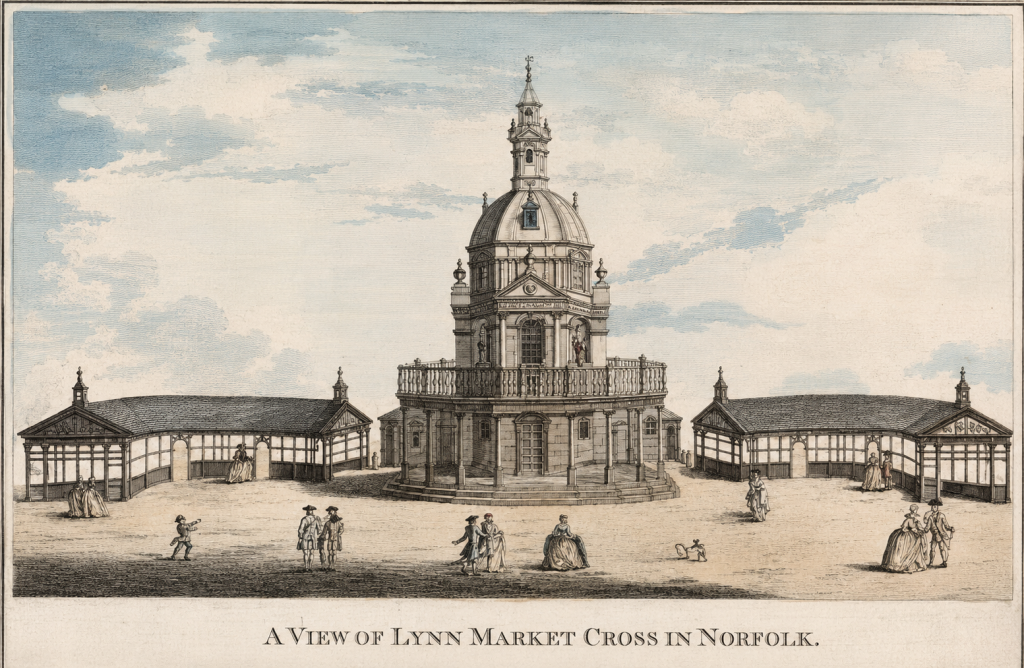
Bell was one of the most significant architectural figures in late seventeenth-century Lynn. He designed the Custom House in 1683 for Sir John Turner and was also active in civic life, serving as alderman and mayor. His market cross belonged to the same world as the Custom House and the Duke’s Head: a confident mercantile Lynn adopting classical architectural language.
By the 1820s, however, the old market arrangements were under review. Corporation discussions considered rebuilding the cross and erecting new shambles. In 1829, the Tuesday Market Committee was authorised to take down the cross, with care taken to preserve the pool or well beneath it. The Angel Inn was also ordered to be demolished.
A new Market House followed. Its foundation stone was laid by Mayor William Bagge on 17 April 1830, and it was transferred to the Corporation in 1832. It stood on the site now occupied by the Corn Exchange and included a fish market, butchers’ stalls, and a concert room above. It lasted barely a generation.
The Corn Exchange and the Age of Grain
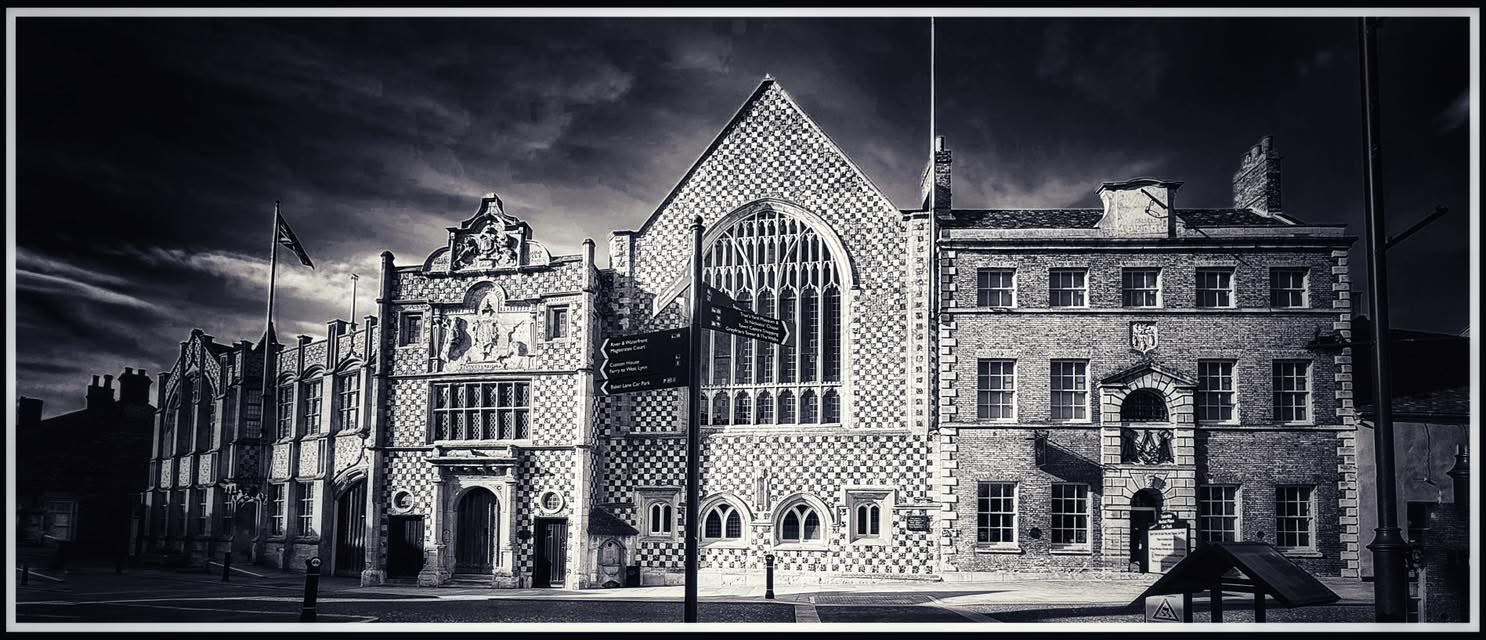
The present Corn Exchange replaced the Market House in 1854. It was designed by the King’s Lynn architects Cruso and Maberley, received a replacement roof in 1877, and was remodelled in 1995 to 1996 as a concert and community hall.
Its name tells an important story. From the sixteenth century, and especially in the eighteenth, Lynn’s economy became heavily associated with the grain trade. Corn moved through the port, while coal, wine, and other goods came inland by water. The Corn Exchange gave architectural form to that commercial world.
The building also changed the cultural role of the square. It began as a place for trade in grain, but later became one of the town’s main public venues. Since the late twentieth-century remodelling, it has served as a concert and community space, taking on a role once strongly associated with St Nicholas’s Chapel during the King’s Lynn Festival.
Punishment and Public Order
Like many English market-places, Tuesday Market Place was also a stage for authority. The pillory stood near the lane beside the Duke’s Head, formerly known as Pillory Lane. In 1325, a man who had allowed salt water into the Common Ditch, damaging the town’s fresh-water supply, was sentenced to stand in the pillory on the Tuesday Market and then abjure the town.
In 1605, Henry Wayte was sentenced at Norwich Assizes to stand in the Lynn market pillory for words spoken against Elizabeth I. The punishment was public by design. The market-place made law visible to townspeople, traders, and visitors.
The square also appears in accounts of political unrest. During the Civil War siege of Lynn in 1643, shot and grenades were said to have fallen into Tuesday Market Place and other parts of the town. After a royalist rising in 1650, rebels were reportedly hanged there. These details come from older local historical writing and should be handled with due caution, but they fit the broader pattern of market-places as sites of public force, proclamation, and punishment.
Fairs, Disease, and the Mart
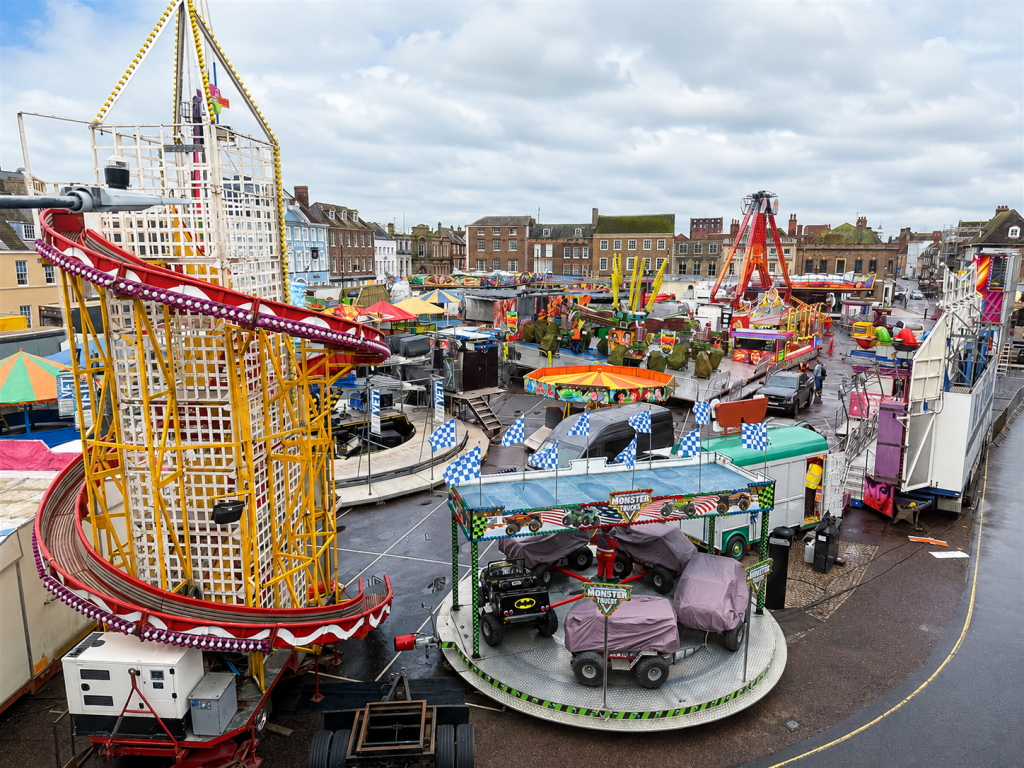
Tuesday Market Place has long been associated with fairs. During plague conditions in 1584, the February fair was moved from Damgate to Tuesday Market Place because the old area was affected by disease. Later Lynn tradition made the square the recognised home of the Mart.
One should be careful about claiming a simple unbroken line from medieval fair rights to the modern funfair. The legal, commercial, and recreational history of fairs is rarely that tidy. Still, it is safe to say that by the late sixteenth century Tuesday Market Place was being used as a fairground space, and that the Mart became one of the strongest surviving public traditions attached to the square.
Henry Bell, the Duke’s Head, and Late Stuart Lynn
The late seventeenth century left a powerful mark on Tuesday Market Place. The Duke’s Head Hotel was built between 1683 and 1689, probably to designs by Henry Bell. It was commissioned by Sir John Turner MP as a coaching inn for visitors to Turner’s Merchants’ Exchange, now the Custom House.
The Duke’s Head gave the square a new architectural presence. Its classical façade, central pediment, staircase, and interior fittings reflected the taste and ambition of Restoration Lynn. It later served as a Whig Party headquarters and as a meeting place for Norfolk masonic lodges.
In 1686, a statue of James II was unveiled in Tuesday Market Place on the anniversary of his coronation. The statue has gone, but its presence reminds us that the square was also a ceremonial and political space. Market stalls, meat trades, punishment, fairs, monarchy, and civic display all occupied the same ground.
Houses with Older Bones
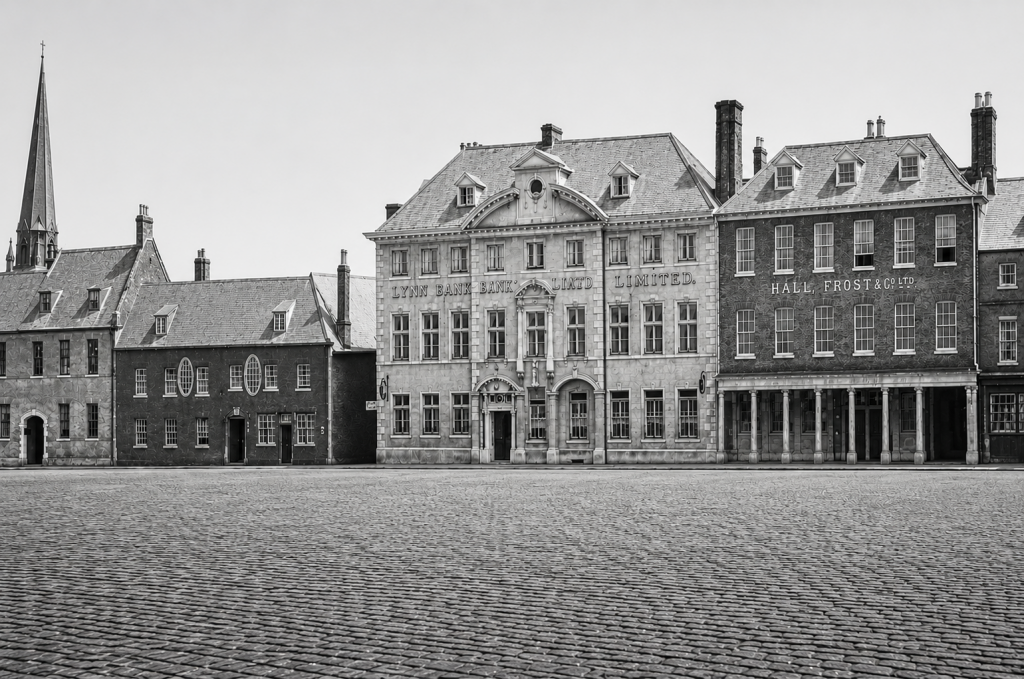
Several buildings around Tuesday Market Place preserve much earlier fabric behind later fronts. This is one of the square’s most important characteristics. It cannot be read only from its façades.
No. 18, Bishop’s Lynn House, is one of the richest examples. Its cellars are late fourteenth- or fifteenth-century in origin. The original house was divided into two properties in the late sixteenth century, bought by the merchant William Bagge in 1725, partly refronted, reunited around 1760, and partly rebuilt for Thomas Bagge in 1803 to 1804. Behind the polite later exterior is a long history of mercantile occupation, alteration, and survival.
Nos. 15 and 16 also preserve early fabric. They began as a range of early sixteenth-century houses, later unified by an early eighteenth-century façade and altered many times. Inside are features that point to the older building: timber framing, mullioned windows, bridging beams, and a brick fireplace.
Other buildings tell similar stories. Nos. 14 and 14A have late sixteenth-century origins, though their present appearance is mainly mid-eighteenth century. Nos. 11 and 12, with 17 St Nicholas Street, have sixteenth-century origins and were rebuilt around 1830 as a range including a public house and domestic quarters. No. 23, Bank Chambers, began as a late seventeenth-century town house and was remodelled in the eighteenth century. The square’s edges are not a single-period architectural display, but a sequence of medieval, early modern, Georgian, Victorian, and modern adaptation.
St Nicholas’s and the Northern Town
St Nicholas’s Chapel stands just off the square, but it belongs to the same history. Founded in 1146 as a chapel of ease to St Margaret’s, it was rebuilt around 1200, given its south-west tower around 1220, and substantially rebuilt between 1371 and 1419. Its steeple was added around 1500 and rebuilt by Sir George Gilbert Scott in 1869.
The chapel’s scale is striking. It is unusually large for a chapel of ease and reflects the wealth of Lynn’s merchant community from the late fourteenth century. Tuesday Market Place, St Nicholas’s, Chapel Street, and the river routes should be read together. They formed one of the most important commercial and religious landscapes of medieval Lynn.
The Witch’s Heart, Carefully Told
The best-known legend attached to Tuesday Market Place is the “witch’s heart” story, usually linked with Margaret Read and a heart-shaped mark on the north side of the square. The familiar version says that Margaret Read was burned in 1590 and that her heart burst from her body, struck a wall, and left a mark before travelling towards the river.
It is a memorable tale, but not secure history. Parish registers provide possible women of that name or family connection, including a Margaret Read baptised in 1568 and a Margaret Hammond who married Thomas Read in 1562. That does not prove the execution story. There is also a legal problem with the common version: in England, people convicted of witchcraft were ordinarily hanged, not burned.
The story should not be discarded, because folklore has its own history. It tells us how people have imagined, marked, and retold the square. But it should be presented as a Lynn tradition, not as a documented account of an execution.
What the Open Space Hides
Tuesday Market Place now impresses by its scale and openness. Pevsner famously called it one of the most splendid open spaces in provincial England. Yet the modern openness hides much of its earlier life.
The medieval and early modern market-place had rails, stalls, shambles, a market cross, inns, shops, punishment sites, yards, and dense approach streets. The nineteenth century removed much of the older market furniture and replaced it with more specialised commercial architecture, first the Market House and then the Corn Exchange. Later traffic patterns, banking, office use, conservation, and cultural reuse added further layers.
The square is not a preserved scene from one age. It is a working urban space repeatedly remade: a medieval market, a port-side trading place, a site of punishment and ceremony, a fairground, a late Stuart architectural showpiece, a centre of the corn trade, and a modern civic venue. Its splendour lies not in being untouched, but in the amount of Lynn’s history still legible around its edges.
© James Rye 2026
Book a Walk with a Trained and Qualified King’s Lynn Guide
References
Borough Council of King’s Lynn and West Norfolk. “History of Markets.” Accessed June 3, 2026. https://www.west-norfolk.gov.uk/info/20186/markets/407/history_of_markets
English Heritage. “Witchcraft: Eight Myths and Misconceptions.” Accessed June 3, 2026. https://www.english-heritage.org.uk/learn/histories/eight-witchcraft-myths/
Hillen, Henry J. History of the Borough of King’s Lynn. Vol. 1. Norwich: East of England Newspaper Co., 1907. Internet Archive. Accessed June 3, 2026. https://archive.org/details/historyofborough01hill
Hillen, Henry J. History of the Borough of King’s Lynn. Vol. 2. Norwich: East of England Newspaper Co., 1907. Internet Archive. Accessed June 3, 2026. https://archive.org/details/historyofborough02hill
Historic England. “11,12, Tuesday Market Place, 17, St Nicholas Street.” National Heritage List for England, list entry 1212284. Accessed June 3, 2026. https://historicengland.org.uk/listing/the-list/list-entry/1212284
Historic England. “14,14A, Tuesday Market Place.” National Heritage List for England, list entry 1195406. Accessed June 3, 2026. https://historicengland.org.uk/listing/the-list/list-entry/1195406
Historic England. “15,16, Tuesday Market Place.” National Heritage List for England, list entry 1212298. Accessed June 3, 2026. https://historicengland.org.uk/listing/the-list/list-entry/1212298
Historic England. “Bishop’s Lynn House.” National Heritage List for England, list entry 1289527. Accessed June 3, 2026. https://historicengland.org.uk/listing/the-list/list-entry/1289527
Historic England. “Chapel of St Nicholas.” National Heritage List for England, list entry 1210545. Accessed June 3, 2026. https://historicengland.org.uk/listing/the-list/list-entry/1210545
Historic England. “Corn Exchange.” National Heritage List for England, list entry 1212488. Accessed June 3, 2026. https://historicengland.org.uk/listing/the-list/list-entry/1212488
Historic England. “Duke’s Head Hotel.” National Heritage List for England, list entry 1212229. Accessed June 3, 2026. https://historicengland.org.uk/listing/the-list/list-entry/1212229
Historic England. “Revealing the Past of Chapel Street Car Park.” Accessed June 3, 2026. https://historicengland.org.uk/whats-new/in-your-area/east-of-england/kings-lynn-research/chapel-street-car-park/
Newsome, Sarah. Chapel Street, King’s Lynn, Norfolk: The History and Archaeology of the Chapel Street Car Park. Historic England Research Report 2/2018. Published April 12, 2018. Accessed June 3, 2026. https://historicengland.org.uk/research/results/reports/2-2018
Norfolk Record Office. “The Witches of Lynn.” October 31, 2018. Accessed June 3, 2026. https://norfolkrecordofficeblog.org/2018/10/31/the-witches-of-lynn/
Society for the Protection of Ancient Buildings. “Casework: Bishop Lynn’s House, 18 Tuesday Market Place, King’s Lynn, Norfolk.” April 8, 2022. Accessed June 3, 2026. https://www.spab.org.uk/news/casework-bishop-lynns-house-18-tuesday-market-place-kings-lynn-norfolk