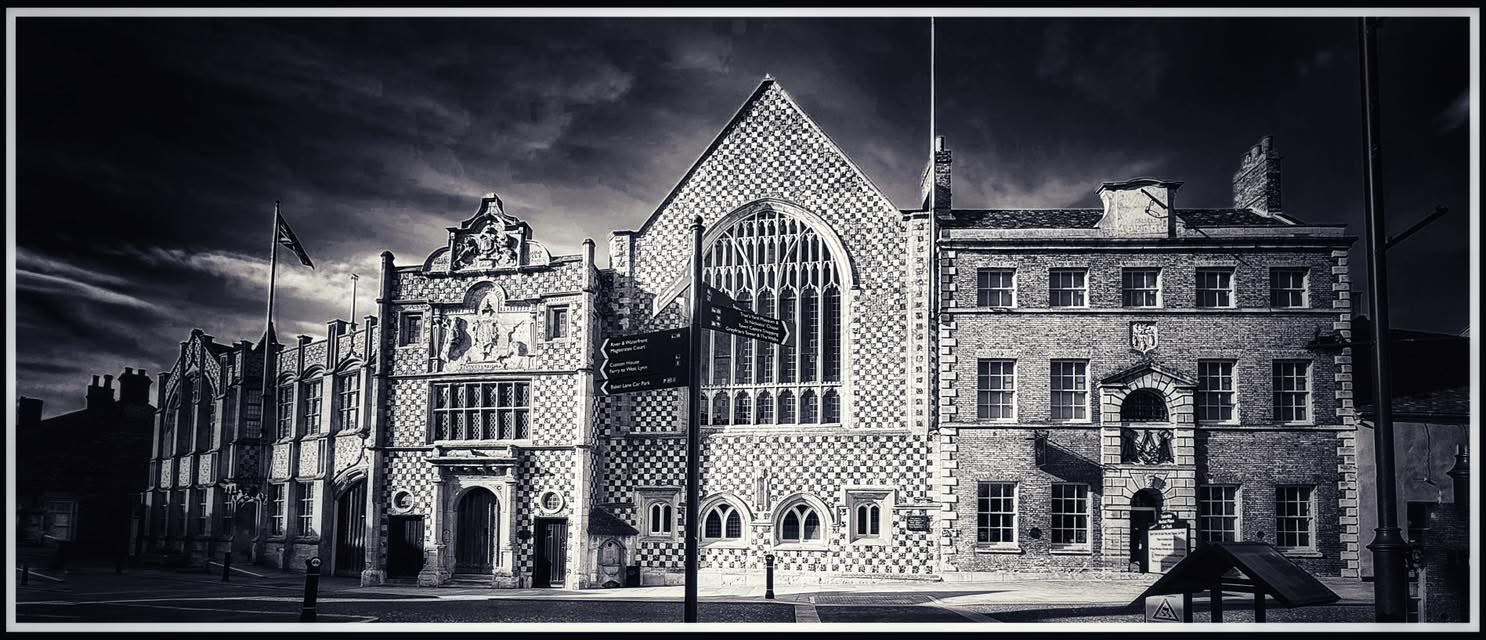
Margery Kempe’s Book did not simply appear. It was argued into being, postponed, mistrusted, rewritten, and copied. Behind its survival stands a small cast of men who handled her words at different stages: a first writer, probably her son; a Lynn priest, very probably Master Robert Spryngolde; and a later monastic scribe known as Salthows.
The tempting story is that Lynn’s clergy neatly wrote the first English autobiography for her. The evidence is more interesting than that. What we have is a tense local collaboration between a controversial laywoman and cautious clerics who knew that putting her visions on parchment was not a harmless favour.
A Book That Nearly Failed at the First Attempt
The Book tells us that Margery had been urged for years to have her spiritual experiences written down. She delayed for more than twenty years. When the first attempt was finally made, the writer was not a priest. He was an Englishman who had lived overseas in “Dewchland”, meaning Germany, and who returned to England with his wife and goods.
Modern scholarship has made a strong case that this man was Margery’s son, John Kempe, living in Danzig, now Gdańsk. He wrote down what Margery told him, but he died before the work could be properly shaped. The text he left behind was, by the Book’s own account, extremely hard to use. It was not good English, not good German, and not written in forms familiar to the next reader.
So the first written version existed, but only just. It was a difficult draft, made from Margery’s own telling, and it needed someone with patience, learning, and nerve.
The Lynn Priest Who Took the Risk
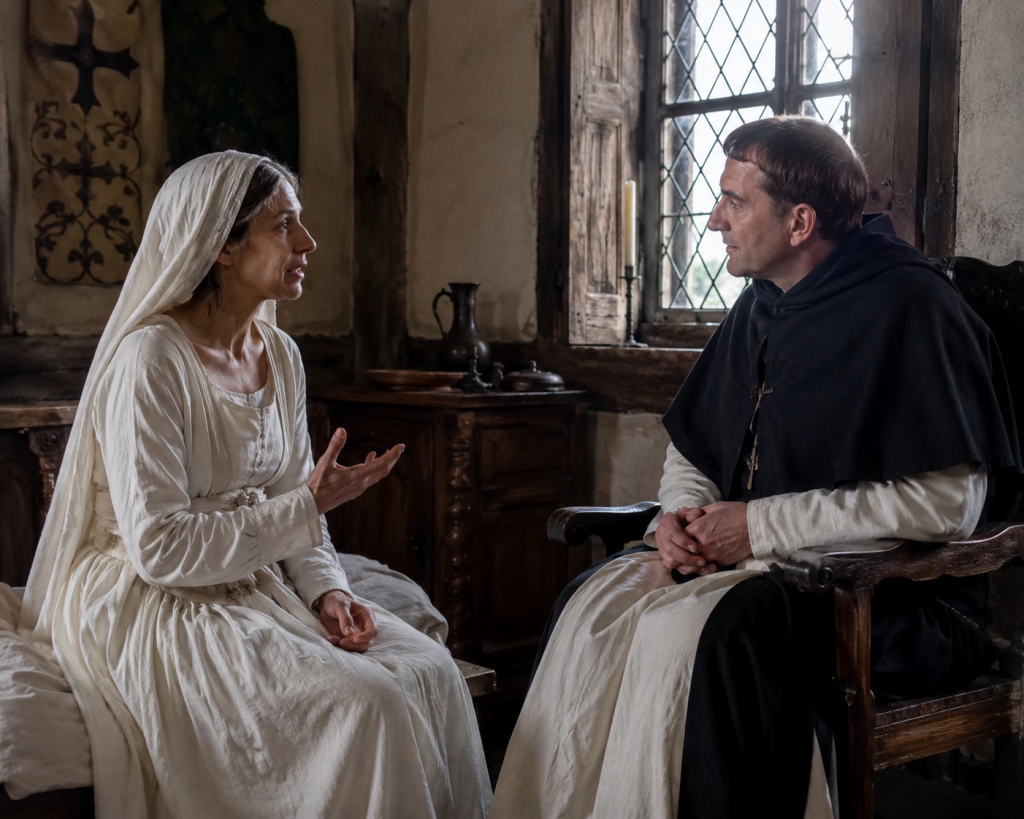
The next figure is the key one for Lynn. The Book says Margery took the difficult manuscript to a priest whom she greatly trusted. He promised to copy it if he could read it, but he hesitated for more than four years. The reason given is striking. There was so much hostile talk about Margery and her weeping that he feared danger to himself.
That fear was not fanciful. Margery had been suspected, criticised, and examined. Her public crying, her white clothing, her pilgrimages, and her bold speech before clergy made her a disputed figure. For a priest to put her story into writing was to lend her a measure of clerical authority.
After one failed attempt by another man to copy the awkward first version, the priest returned to the task. He read the text aloud before Margery, with her helping where the writing was obscure. He then rewrote it. The Book admits that the result was not arranged in strict chronological order. It followed the order in which the material came back to Margery’s mind.
That admission is one of the most human details in the whole story. This was not a tidy archive. It was memory, devotion, argument, and scribal labour, brought together long after many of the events had happened.
Was This Priest Robert Spryngolde?
The best candidate is Master Robert Spryngolde, parish priest of St Margaret’s, Lynn, and Margery’s principal confessor.
The case is strong, but it should be stated carefully. The Book does not give us a plain colophon saying, “Robert Spryngolde wrote this.” What it does give us is a convergence of clues. Spryngolde appears in the Book as a named Lynn cleric close to Margery. He was her confessor, and he was involved in the fraught matter of her access to confession and communion at St Margaret’s.
In one episode, Robert Spryngolde appears with Thomas Hevyngham, prior of Lynn, when Margery’s sacramental rights are defended under authority from the Archbishop of Canterbury. Elsewhere, the Book refers to a priest who later wrote the treatise, a man who had first drawn back from Margery after public criticism of her but was later persuaded of her spiritual credibility.
That profile fits Spryngolde very well. He had the standing, the local position, the pastoral relationship, and the motive. Recent documentary work has also strengthened the connection between Spryngolde and Margery’s family circle.
So the fair verdict is this: Robert Spryngolde was very probably the Lynn priest who rewrote much of the Book. Certainty is just out of reach, but the historical finger points firmly in his direction.
The Reading Behind the Writing
The Lynn priest did not simply take dictation. The Book presents him as a reader, tester, and organiser. He compared Margery’s experiences with recognised devotional works, including The Pricke of Love and Richard Rolle’s Incendium Amoris. This mattered because Margery’s claims needed to be judged against accepted spiritual writing.
Another unnamed bachelor of divinity also helped to change the priest’s mind. He encouraged him to look more seriously at the written material about Margery. This man may not have written the Book himself, but he helped create the conditions in which the Lynn priest could proceed.
The result was not a lone act of authorship. It was a collaboration. Margery supplied the life, the memory, and the spiritual authority she believed came from God. The priest supplied literacy, clerical testing, structure, and a written form that could survive.
The White Friar Who Offered, But Probably Did Not Write
The Book also mentions a White Friar, that is, a Carmelite, who offered to write Margery’s tribulations and feelings. Margery refused because she believed the time was not yet right.
This friar cannot be securely identified. It is tempting to connect him with Master Alan of Lynn, a Carmelite doctor of divinity who appears elsewhere in the Book and who took Margery seriously. It is also tempting to think of other Carmelite supporters, such as William Southfield of Norwich. But temptation is not evidence.
Alan of Lynn and William Southfield belong to Margery’s wider clerical world. They helped test, support, or interpret her claims. They cannot be shown to have written the Book.
Thomas Hevyngham and the Clerical World of St Margaret’s
Thomas Hevyngham, prior of Lynn, was not one of the known writers. His importance lies elsewhere. He appears in the institutional setting of St Margaret’s, the great church at the centre of Margery’s town.
That setting matters. Margery’s Book was not created in a private spiritual bubble. It was shaped amid the parish, priory, friaries, confession, communion, rumour, and local judgement. St Margaret’s was not merely a backdrop. It was one of the places where Margery’s reputation was fought over.
Salthows: The Man Who Preserved the Book We Have
The manuscript that survives today is British Library Additional MS 61823, the only known manuscript of The Book of Margery Kempe. It is not Margery’s original, nor Spryngolde’s own working copy. It is a later copy, probably made in the mid-fifteenth century.
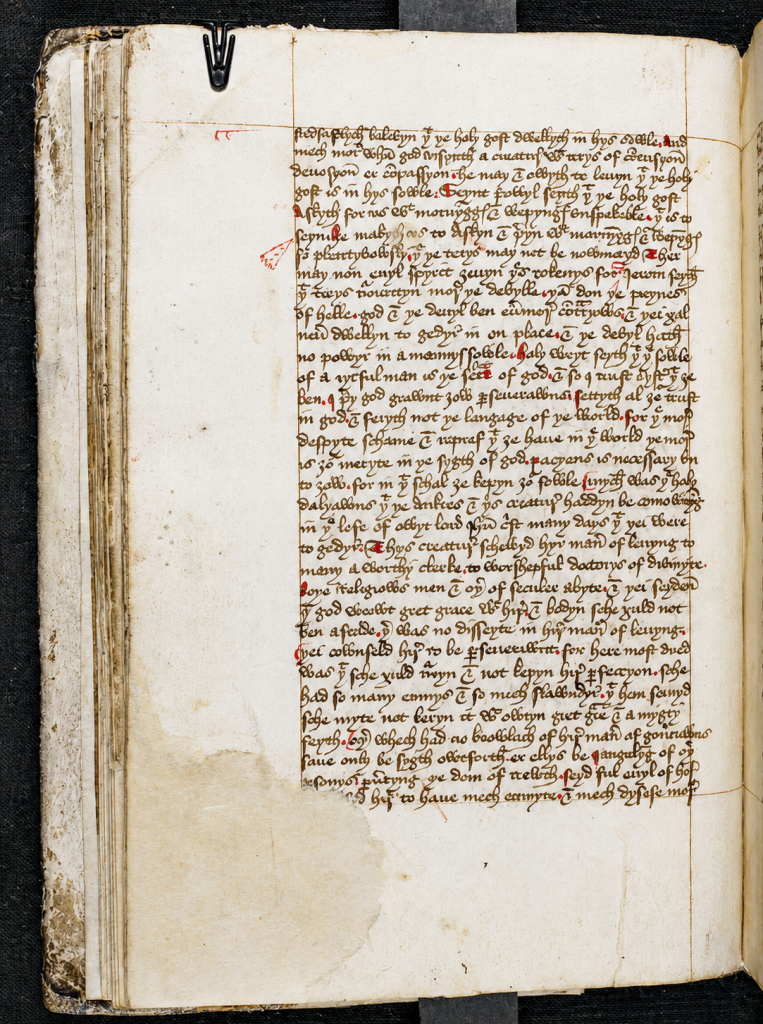
At the end stands the phrase “Jhesu mercy quod Salthows.” Salthows has long been recognised as the scribe of the surviving manuscript. Anthony Bale has argued that he was probably Richard Salthouse, a monk of Norwich Cathedral Priory.
Salthouse was not the Lynn priest who worked with Margery in 1436. His role came later. Yet without him, the Book as we know it might not exist at all. He is the bridge between the Lynn making of the text and its later monastic survival.
What We Can Say Plainly
Margery Kempe’s Book was not written by one hand in one sitting. Its making began with Margery’s own oral account. A first written version was probably made by her son, John Kempe, after his return from Danzig. That version was defective. A Lynn priest then rewrote it, very probably Robert Spryngolde of St Margaret’s. Other clerics helped by testing, encouraging, or defending Margery. Later still, Salthows, probably Richard Salthouse of Norwich, copied the only manuscript now known to survive.
The Lynn clergy did not create Margery’s experience for her. Nor did they simply record it as neutral secretaries. They mediated it. They made it legible, safer, and more acceptable to readers who might otherwise have dismissed her as noisy, suspect, or dangerous.
That is why the clerics matter. Margery gave the Book its fire. The Lynn priest gave it form. Salthows gave it survival.
The Book That Almost Disappeared
It is remarkable that The Book of Margery Kempe survives at all. After being copied in the mid-fifteenth century, the manuscript belonged to the Carthusian monks of Mount Grace Priory. Following the Dissolution of the Monasteries, it disappeared into private hands and was thought lost for nearly 400 years.
Then, in 1934, medieval scholar Hope Emily Allen identified the long-forgotten manuscript in the library of the Butler-Bowdon family at Southgate House, Wigan. It proved to be the only known complete copy of Margery’s Book. The manuscript was later acquired by the British Library, where it is preserved today as Additional MS 61823.
Without that chance discovery, one of the most extraordinary voices of medieval England, and one of King’s Lynn’s greatest literary treasures, might have been lost forever.
© James Rye 2026
Book a Walk with a Trained and Qualified King’s Lynn Guide
References
Bale, Anthony. “Richard Salthouse of Norwich and the Scribe of The Book of Margery Kempe.” The Chaucer Review 52, no. 2 (2017): 173–187. https://web.english.upenn.edu/~cavitch/pdf-library/Bale_on_scribe_of_Kempe.pdf
British Library. “Add MS 61823: The Book of Margery Kempe.” Archives and Manuscripts Catalogue. https://searcharchives.bl.uk/catalog/032-001962059
Kempe, Margery. The Book of Margery Kempe. Edited by Lynn Staley. Kalamazoo, MI: Medieval Institute Publications, 1996. https://metseditions.org/editions/zY0MDpwC644aFmAQ7HvV73C41mbVAZeK
Sobecki, Sebastian. “‘The Writyng of This Tretys’: Margery Kempe’s Son and the Authorship of Her Book.” Studies in the Age of Chaucer 37 (2015): 257–283. https://doi.org/10.1353/sac.2015.0015