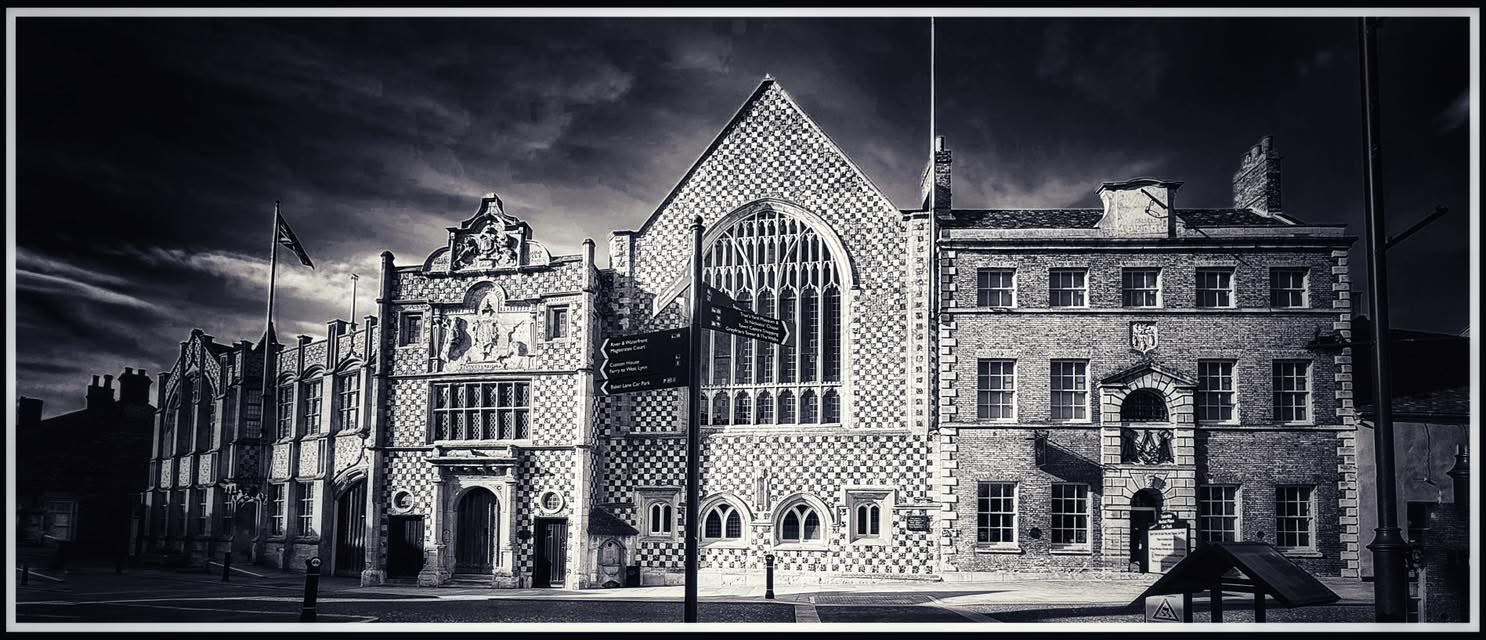
A town that loved liberty, until liberty became dangerous
In February 1771, John Wilkes came to King’s Lynn as one of the most famous political names in Britain. He was a London politician, journalist, and troublemaker whose battles with the government had turned him into a popular hero. To his supporters, Wilkes stood for the rights of voters, the freedom of the press, and the old liberties of Englishmen. Lynn’s Corporation entertained him handsomely, and conferred upon him the freedom of the borough.
A generation later, another radical speaker came to Lynn. His name was John Thelwall. Like Wilkes, he believed that ordinary people should have a greater voice in politics. Unlike Wilkes, he arrived after the French Revolution had frightened much of Britain’s governing class. Thelwall had been tried for treason in 1794 and acquitted, but suspicion still clung to him. In Lynn, according to William Richards’s History of Lynn, he “could get no hearing” and was glad to escape “with a whole skin and unbroken bones”.
Richards drew attention to the stark differences between the town’s treatment of the two men. By the 1790s, he wrote, “the politicks of William Pitt had now completely superseded those of John Wilkes.” Pitt was William Pitt the Younger, prime minister during the anxious years of war with Revolutionary France. His government became closely associated with the suppression of radical reformers, the restriction of public meetings, and the defence of king, church, property, and order. In plain terms, Richards meant that Lynn had once cheered a man who challenged government power, but later turned against another man who spoke the language of political reform.
That contrast is clear but in danger of being understood too simplistically. Lynn did not simply move from radicalism to reaction as though the whole town changed its mind overnight. Wilkes and Thelwall arrived in different decades, under different pressures, and with very different public reputations. Wilkes came wrapped in the language of English constitutional liberty. Thelwall came under the shadow of the French Revolution, war with France, treason trials, government surveillance, loyalist intimidation, and anti-Jacobin fear.
John Wilkes: scandal, liberty, and a useful patriot
John Wilkes was born in London in 1725. He became one of the most famous political agitators of the reign of George III: a journalist, MP, wit, libertine, debtor, and opportunist, but also a powerful symbol of civil liberty.
His fame rested above all on The North Briton, especially issue no. 45, published in April 1763, which criticised the King’s Speech following the Peace of Paris. The government treated the issue as seditious libel. Wilkes was arrested under a general warrant. He challenged the legality of that warrant, and became a national cause. The number 45 became a political emblem, appearing in print, in speech, in popular celebration, and in street culture.
The crisis deepened when Wilkes returned from exile and was elected for Middlesex in 1768. The House of Commons expelled him in 1769. His constituents re-elected him, repeatedly, but the Commons rejected their choice. To Wilkes’s supporters, this was not merely a dispute about one scandalous man. It raised a question with broad appeal: did electors have the right to choose their own representative, or could Parliament override them when it disliked the result?
That question mattered in a borough such as Lynn, where civic identity, freemen, parliamentary elections, corporation politics, and the prestige of local independence were all closely entangled. Wilkes could be admired not as a social revolutionary, but as a defender of the old liberties of Englishmen. That made him radical enough to excite the streets, but respectable enough for a corporation dinner.
King’s Lynn receives Wilkes
The local sequence is reasonably clear. On 30 October 1770, Lynn’s Corporation conferred the freedom of the borough on Wilkes “for his Constitutional Spirited and uniform Conduct in support of the Liberties of This Country”. He was not sworn until 14 February 1771, when, at the Corporation’s express invitation, he visited Lynn and was “magnificently entertained”. Henry J. Hillen, in his later history of the borough, adds that Wilkes was also received with “tokens of respect and adulation” at Downham and elsewhere.
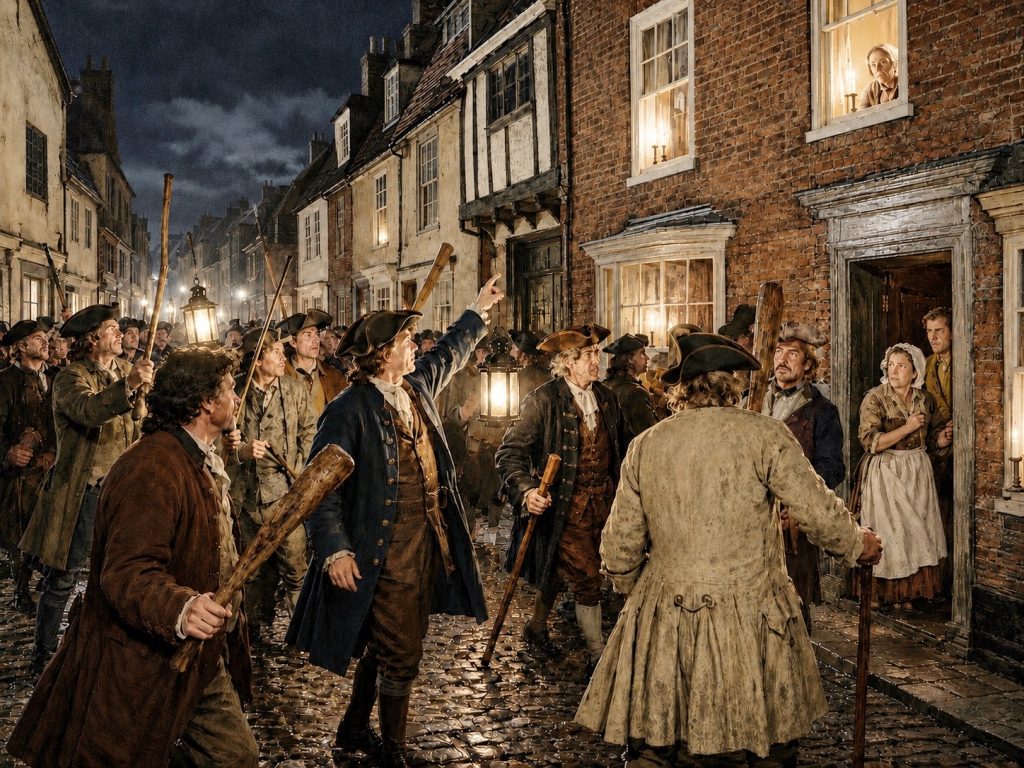
This was civic theatre. The freedom of the borough was not a casual compliment. It placed Lynn publicly within the national Wilkite movement. It allowed the town’s rulers to present themselves as patriotic guardians of constitutional liberty.
The most vivid details come from Hillen’s account. He quotes a paragraph from the Salisbury Journal of 27 February 1770 reporting that a subscription had opened at Lynn and in other parts of Norfolk for 137 gold medals, each to weigh five guineas, with an agreed device and inscription. (The 137 number celebrates the 137 MPs who had voted against Wilkes being expelled from the Commons after his election.) The same report stated that, when news arrived of a “certain late event”, the bells in all the churches were immediately muffled and a “dumb peal” rung, expressing the concern of “all ranks of people” in that “loyal and patriotic borough”. Hillen interprets this as referring to Wilkes’s second expulsion from the House of Commons.
It is a wonderfully theatrical image: Lynn’s church bells made to sound grief for a London radical. A muffled or dumb peal belonged to the language of mourning. Here it was used for political protest.
Hillen also records that, to celebrate the rescinding of Wilkes’s outlawry, the mob at Lynn insisted on an illumination of the town. Every householder was ordered to place lights in the windows. Those who failed to comply risked “the smashing of glass”. Hillen’s phrasing is sharp and hostile: he says Lynn’s patriotic gentry styled “the mad frolics of a drunken mob” as “the love of liberty”. Lynn’s Wilkite liberty had a coercive edge. Those who did not display their patriotism in candlelight might find their windows broken. The cause of liberty was celebrated by compelling householders to join the display.
What Wilkes meant in Lynn
Wilkes’s immediate impact in Lynn was symbolic, civic, and performative rather than institutional. There is no evidence that his visit transformed the borough’s parliamentary structure or created a durable local reform organisation. Yet the episode matters.
First, Wilkes gave Lynn a language of constitutional patriotism. The Corporation’s wording praised him for supporting the “Liberties of This Country”. That was not the language of social equality or universal suffrage. It was the language of inherited English rights, of freeborn subjects, juries, electors, and resistance to arbitrary power.
Second, his visit exposed the relationship between formal and popular politics. The Corporation gave him the freedom of the borough. The wider town, or at least a noisy and active part of it, performed Wilkite enthusiasm through medals, bells, illuminations, and crowd pressure.
Third, the visit entered print. Hillen notes two publications connected with the occasion: Verses addressed to John Wilkes on his arrival at Lynn and A Political Epistle to the Author of Verses. Lynn was not merely receiving politics from London. It was producing its own Wilkite response.
The episode therefore gives us a lively picture of Georgian political culture in a port town. Politics did not remain inside council chambers or parliamentary elections. It rang from church towers, glimmered in windows, appeared on medals, stirred crowds, and produced verses. It was civic, popular, noisy, and theatrical.
It was also selective. Lynn was willing to celebrate liberty when it looked like the defence of the constitution. That willingness would not survive unchanged into the 1790s.
John Thelwall: a different kind of radical
By the time John Thelwall came to Lynn, the political weather had changed completely.
The French Revolution began in 1789. Britain went to war with Revolutionary France in 1793. Reform societies were watched, harried, and prosecuted. The London Corresponding Society, with which Thelwall was closely associated, sought parliamentary reform and wider political participation. To radicals, this was reform. To loyalists, it looked like Jacobinism. (In Britain, calling someone a Jacobin usually meant accusing them of being dangerously revolutionary: anti-monarchy, anti-church, anti-property, and willing to overturn society by force. Reformers such as Thelwall rejected that label, but loyalists used it to discredit demands for parliamentary reform and wider political rights.)
Thelwall was born in 1764, almost forty years after Wilkes. He was a writer, lecturer, orator, political reformer, and later a teacher of elocution. He campaigned for democratic reform, universal suffrage, and freedom of speech. He was arrested and tried for treason in 1794, alongside other radicals including Thomas Hardy and John Horne Tooke. He was acquitted, but acquittal did not remove suspicion. In the political climate of the mid-1790s, a man once tried for treason could be treated as dangerous even after a jury had found him not guilty.
Government pressure intensified. The Treason Act and Seditious Meetings Act of 1795 restricted political speech and public meetings. Thelwall adapted by lecturing on Roman history, using the ancient world as a way of discussing liberty, corruption, tyranny, and citizenship. It was an ingenious method. It was not enough to protect him.
Wilkes had been dangerous because he embarrassed ministers and challenged parliamentary authority. Thelwall was dangerous because he spoke to a broader public about democratic reform at a time when the governing classes feared revolution. Wilkes could be absorbed, with difficulty, into the language of English constitutionalism. Thelwall was much harder to make safe.
Thelwall in Norfolk and Lynn
Thelwall’s East Anglian tour took him into a politically divided Norfolk. Norwich had a strong reform culture, with dissenting, artisan, and intellectual elements. Yarmouth, Lynn, and Wisbech proved much more hostile.
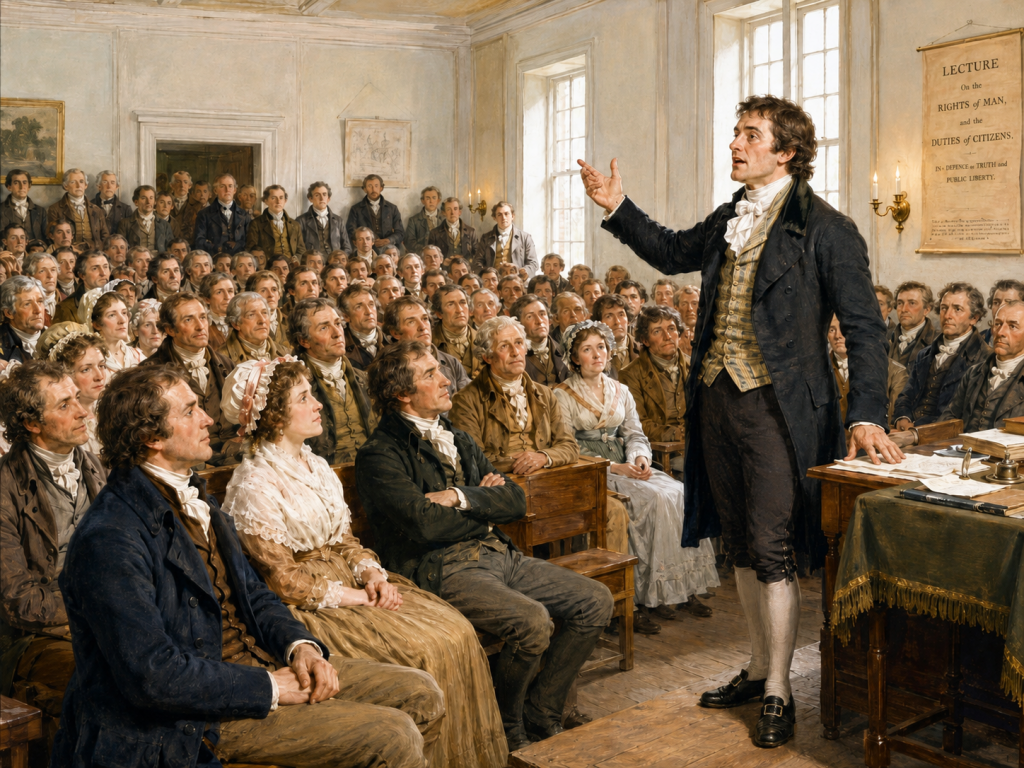
Richards’s account of Lynn is short but powerful. He says Thelwall visited the town to promote “political liberty and genuine patriotism”, but by then those principles had become “unfashionable and disreputable” there. Thelwall’s first Lynn lecture at St Margaret’s was attended by less than 80 people. The later account by Charles Cestre, based on Thelwall manuscripts, says that Thelwall appealed to the mayor of Lynn Regis for protection. He had heard that an attack like the one at Yarmouth was being prepared. According to Cestre, no effective protection followed, and Thelwall and his audience suffered such ill-treatment that he left the town.
Hillen, writing later, places Thelwall’s visit within the Corporation’s changed mood. In his account, after two decades the “Gospel of Politics, according to St. Wilkes” had been eclipsed by the doctrines of William Pitt. Hillen says that at Lynn and Wisbech “mobs were hired to prevent him being heard”.
Why Lynn’s reaction mattered
Thelwall’s immediate impact in Lynn was, on the surface, failure. He was not honoured, not properly heard, and not protected effectively. The point of the disturbance was to prevent communication. If Wilkes’s visit had been a civic performance of welcome, Thelwall’s was an anti-performance: a public demonstration that some political speech would not be allowed to become public.
Yet that failure is historically revealing.
It shows first that the language of liberty had changed. In 1771, liberty could mean the rights of electors, the illegality of general warrants, and the defence of the subject against ministerial overreach. In the 1790s, liberty could mean democratic reform, wider suffrage, political societies, and mass political education. That second version frightened many people who had tolerated, or even celebrated, the first.
It also shows the power of loyalist intimidation. Thelwall’s enemies did not need to defeat him in argument if they could prevent him from speaking. A crowd could do what a censor could not always formally do. It could make speech impossible.
Finally, it reminds us that Lynn was a port. This mattered. Maritime communities were not automatically conservative, but ports in wartime were intensely sensitive places. Lynn’s world included merchants, sailors, customs officers, shipping interests, press gangs, rumours, patriotic display, and fears of invasion. In such a setting, a travelling radical lecturer associated with the London Corresponding Society could easily be represented as a threat to public order and national security.
Thelwall’s visit, then, did not leave behind medals, verses, or civic honours. It left a sharper trace: the memory of a town refusing to hear what it had once claimed to prize.
Wilkes and Thelwall compared
The comparison is tempting because both men were radicals, both challenged government power, both relied on publicity, and both became symbols larger than themselves. Yet their differences explain the very different receptions they received in Lynn.
Wilkes was a gentleman politician and MP. His radicalism grew out of disputes within the political nation: Parliament, elections, libel law, warrants, privilege, and the rights of electors. His supporters could claim that they were defending the old constitution against ministerial corruption. That claim did not make Wilkes harmless, but it made him honourable enough for Lynn’s Corporation to embrace.
Thelwall belonged to a later and more frightening political world. He was associated with extra-parliamentary democratic organisation. His audience was wider. His methods were oral, mobile, and popular. His politics reached towards universal suffrage and systematic reform. He was not asking only whether Middlesex electors could have the MP they had chosen. He was asking who should count politically in the first place.
The settings were different too. Wilkes came to Lynn after imprisonment and outlawry had made him a glamorous victim of government overreach. Thelwall came after the French Revolution had been associated in British loyalist imagination with regicide, terror, invasion, atheism, and social collapse. Wilkes could be imagined as the defender of English liberty. Thelwall could be denounced as the carrier of French infection.
The local choreography was almost perfectly opposed. Wilkes’s Lynn was ceremonial: freedom of the borough, entertainment, medals, bells, verses, and illuminations. Thelwall’s Lynn was coercive in another direction: obstruction, disturbance, refusal of a hearing, and fear of bodily harm. In one case, the town staged honour. In the other, it staged silencing.
Yet there is a darker continuity. Both episodes involved pressure from the crowd. In Wilkes’s case, householders were expected to illuminate their windows, and those who did not might lose the glass. In Thelwall’s case, the lecturer himself was prevented from speaking. Lynn’s streets were not a neutral public sphere. They were places where politics was enforced by noise, bodies, and the threat of damage.
That is what makes the comparison so valuable. It does not show a simple journey from liberty to repression. It shows that “liberty” was always contested. Who owned the word? The Corporation? The crowd? The freemen? The electors? The lecturer? The government? The loyalists? The answer changed according to date, danger, and audience.
In 1771, liberty could be lit in the windows of King’s Lynn. By the mid-1790s, it could get a man shouted down.
A town’s change of heart, or a change of world?
Richards thought Lynn had changed its mind. In one sense he was right. The town that had “eagerly caressed Wilkes” did not extend the same courtesy to Thelwall. The politics of William Pitt had overtaken the politics of Wilkes.
But Lynn had not changed in isolation. The world around it had changed. The French Revolution had made reform politics seem more dangerous. War had made dissent look disloyal. Loyalism had become organised, confident, and sometimes violent. The state had learned to watch, prosecute, restrict, and intimidate. Crowds had learned that they could defend King and Constitution by breaking up a meeting as surely as earlier crowds had defended Wilkes by demanding candles in the windows.
Wilkes allowed Lynn to perform liberty safely, or at least respectably. Thelwall tested whether that liberty extended to democratic reform during wartime. The answer, in Lynn, was no.
For local history, that answer matters. It places King’s Lynn inside the great political argument of late Georgian Britain. This was not a sleepy port watching national events from a distance. Lynn rang its bells for Wilkes, lit its windows for liberty, broke glass in the name of patriotism, and later helped silence a radical lecturer whose politics had become too alarming for the times.
The two visits reveal a town politically alive, but not politically consistent. Perhaps no town was. Liberty was a word everyone wanted to claim. Wilkes and Thelwall showed how quickly its meaning could change.
© James Rye 2026
Book a Guided Tour with a Trained and Qualified King’s Lynn Guide Through Historic Lynn
References
Cash, Arthur H. John Wilkes: The Scandalous Father of Civil Liberty. New Haven: Yale University Press, 2006.
Cestre, Charles. John Thelwall: A Pioneer of Democracy and Social Reform in England during the French Revolution. London: Swan Sonnenschein, 1906. https://archive.org/download/cu31924026425383/cu31924026425383.pdf
Corfield, Penelope J. “John Thelwall: Champion of Democracy.” 2019. https://www.penelopejcorfield.com/PDFs/3.5.3-Corfieldpdf54-John-Thelwall-Champion-of-Democracy.pdf
English Heritage. “John Thelwall.” English Heritage Blue Plaques. https://www.english-heritage.org.uk/visit/blue-plaques/john-thelwall/
Hillen, Henry J. History of the Borough of King’s Lynn. Vol. 2. Norwich: East of England Newspaper Co., 1907. https://archive.org/stream/historyofborough02hill/historyofborough02hill_djvu.txt
Norfolk County Council. “John Thelwall and Radical Norfolk: A Symposium.” 15 October 2024. https://www.norfolk.gov.uk/article/63020/John-Thelwall-and-Radical-Norfolk-A-Symposium
Norfolk Record Office. “Events: Summer/Autumn 2024.” Norfolk Record Office Blog. https://norfolkrecordofficeblog.org/events-summer-autumn-2024/
Parliament UK. “John Wilkes: Liberty and Parliament.” UK Parliament, Living Heritage. https://www.parliament.uk/about/living-heritage/evolutionofparliament/houseofcommons/reformacts/overview/wilkeslib1/
Richards, William. The History of Lynn. Vol. 2. King’s Lynn: W. G. Whittingham, 1812. https://www.gutenberg.org/cache/epub/62372/pg62372-images.html
The National Archives. “Great Yarmouth Borough.” Catalogue entry for Norfolk Record Office D 41.32-40, including 1796 depositions relating to disturbance at John Thelwall lecture. https://discovery.nationalarchives.gov.uk/details/c/F138830
Thelwall, John. The Tribune. 3 vols. London, 1795–96. Online Library of Liberty edition. https://oll.libertyfund.org/titles/thelwall-the-tribune
Thompson, E. P. “Hunting the Jacobin Fox.” Past & Present 142, no. 1 (1994): 94–140. https://academic.oup.com/past/article-pdf/142/1/94/9917565/94.pdf
“Thelwall, John.” Dictionary of National Biography, 1885–1900. Wikisource edition. https://en.wikisource.org/wiki/Dictionary_of_National_Biography,_1885-1900/Thelwall,_John
Wilkes, John. The North Briton. London, 1762–63. Issue no. 45 online at Constitution Society. https://www.constitution.org/1-Constitution/cmt/wilkes/north_briton_45.html