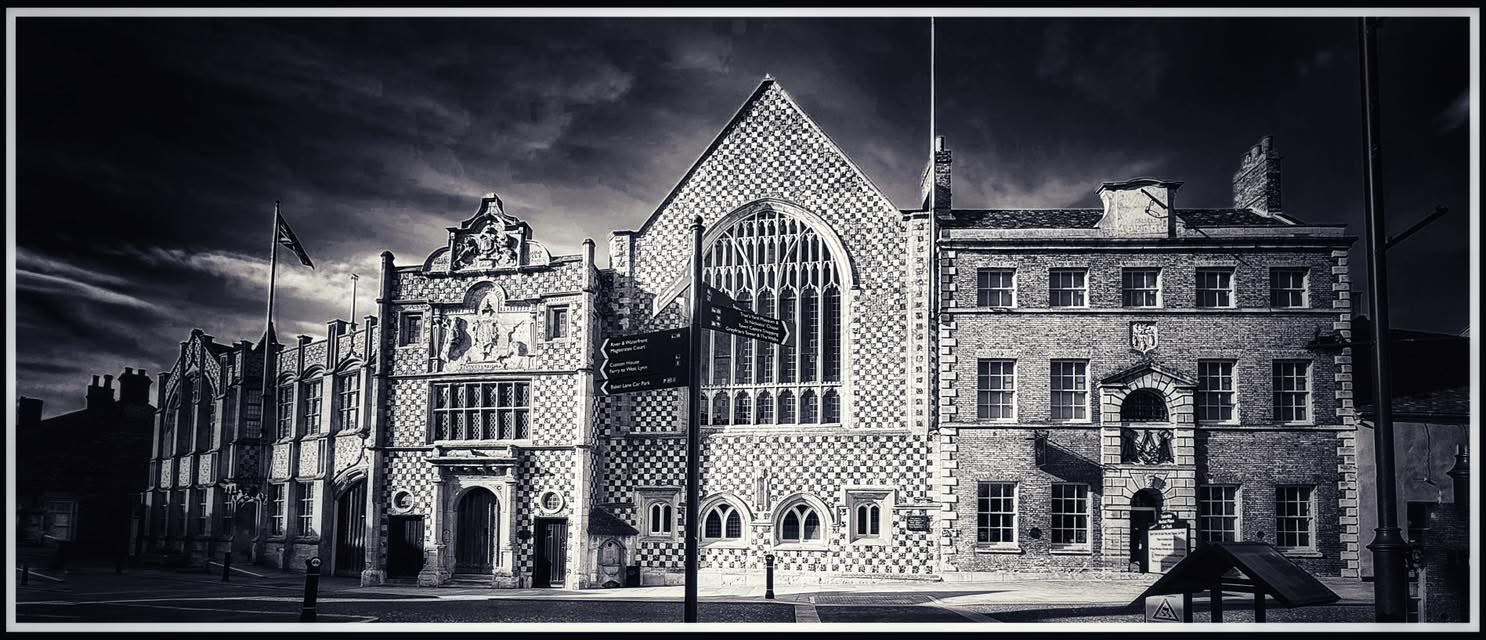
A small courtyard of brick almshouses stands on Gaywood Road on the east side of King’s Lynn. Their low roofs, Dutch gables, and enclosed court suggest a modest seventeenth-century foundation. But the history beneath them is much older.
For perhaps nine centuries this site has been associated with the care of poor, sick, and elderly people. A medieval religious hospital stood here beside this road into Lynn. It was disrupted by the Reformation, attacked during the disturbances of 1549, reconstituted by James I in 1611, and burnt during the Siege of Lynn in 1643. Rebuilt six years later, it survived as an almshouse supported by landed estates and later charitable gifts.
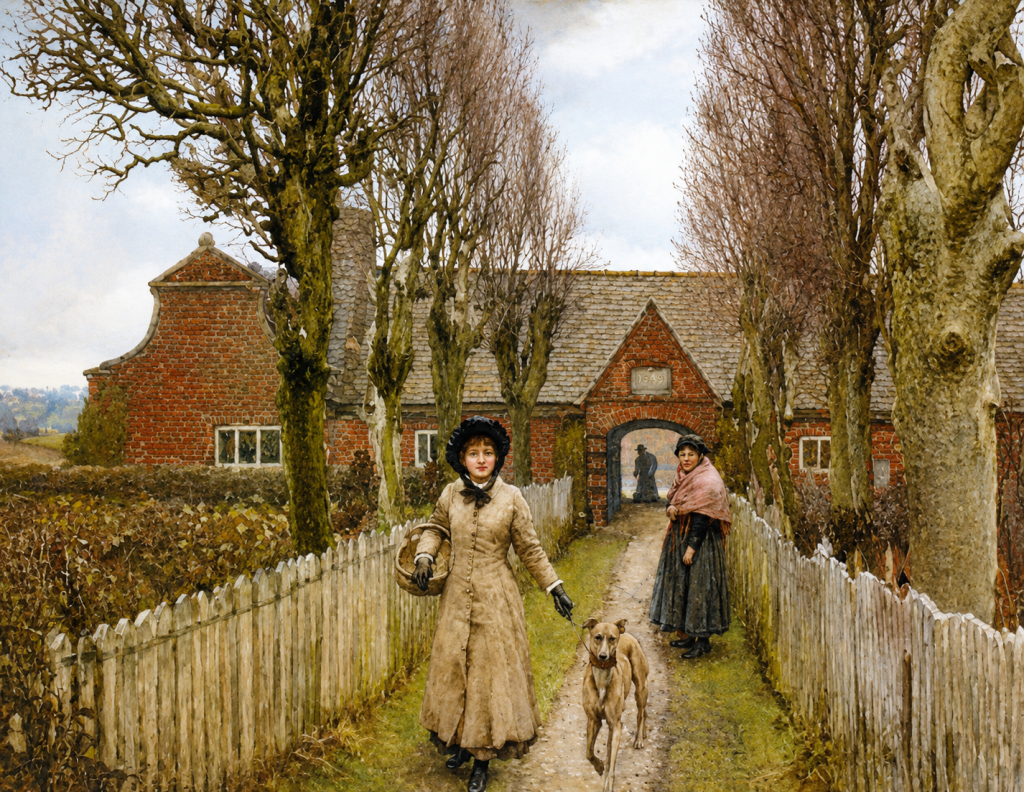
Even its formal name conceals part of the story. The Hospital of St Mary Magdalen “of the Foundation of King James” was not originally founded by James I. He inherited something centuries older.
A hospital on the road to Gaywood
The Hospital of St Mary Magdalen had been established by the twelfth century on the causeway between Lynn and Gaywood. Its foundation is traditionally associated with Peter the Chaplain, or Petrus Capellanus. The exact date is less secure. The Victoria County History gives 1145, a date repeated in later heritage records, while William Richards preserved an older manuscript tradition associated with Peter’s death and hospital regulations in 1174. The safest conclusion is that St Mary Magdalen was a twelfth-century hospital, traditionally linked with Peter the Chaplain.
It was more than an almshouse. An early description records a prior, brethren and sisters, property, religious obligations, and provision for sick inmates. Of thirteen members, including the prior, three were described as diseased or leprous. St Mary Magdalen may therefore be called a hospital which cared for people suffering from leprosy, but describing it simply as a “leper hospital” is too narrow. It was a religious community with charitable, medical, and devotional functions.
Its position outside the main town suited such an institution while keeping it closely connected to Lynn. The hospital also possessed burial rights. Human skeletal remains discovered on the site in 2021 accord with documentary references to a burial ground, although they cannot yet be securely identified as medieval hospital inmates.
Reformation and rebellion
The sixteenth century broke apart the hospital’s medieval organisation. Reformation legislation transformed its legal and financial position, and its estates became entangled with the Crown. Care for poor people appears to have continued in some form.
Then came 1549. A later Lynn account says rebels attacked the hospital during the Norfolk rising, expelled its occupants, removed goods and stock, and demolished its chapel and buildings.
The account deserves caution. It is retrospective rather than a surviving eyewitness description from 1549. The broad tradition of serious damage is plausible, but its details should not be treated as independently verified.
St Mary Magdalen nevertheless survived. That persistence became the defining feature of its history.
James I and the re-foundation of 1611
By the early seventeenth century the Crown still exercised rights over the hospital. In 1608 Thomas Vause, a royal servant, received the office of prior, guide, or governor of St Mary Magdalen at Gaywood. Three years later came the settlement that shaped the institution for centuries.
On 22 April 1611, James I issued letters patent reconstituting St Mary Magdalen.
The distinction matters. The patent did not create a new charity on an empty site. It recognised an existing ancient hospital or almshouse and restored its legal identity and property. The new institution became the Hospital of St Mary Magdalen of the Foundation of King James. James was therefore its founder in a new legal sense, but historically he was refounding a medieval institution.
The Jacobean hospital was to contain a master or warden and between five and ten poor men and women, called brothers and sisters. Peter Tudman became the first master.
Control passed firmly into Lynn’s civic world. The mayor was one of the governors. The master swore his oath before the mayor in the Guildhall. The governors oversaw admissions, discipline, worship, stipends, clothing, and property. A medieval religious hospital had become, in effect, a municipal charity.
Land, rents, and the cost of charity
The residents at Gaywood depended upon land spread across Norfolk. The Jacobean settlement included former hospital property in East and West Lexham, Dunham, Narford, West Winch, Holkham, and elsewhere. These holdings produced income, but also disputes over leases, boundaries, and grazing rights.
In 1618, commissioners were appointed to investigate a disputed foldcourse involving the hospital’s governors. A century later the corporation was still surveying estates and trying to define exactly what belonged to St Mary Magdalen.
This was the practical machinery of charity. The poor people housed beside Gaywood Road relied upon rents from fields miles away. Lynn’s mayor and aldermen were not merely selecting pensioners. They were managing an estate.
Before that system could settle into the eighteenth century, the hospital suffered another destruction.
The hospital burns
In August 1643, Lynn declared for the king and was surrounded by Parliamentarian forces.
St Mary Magdalen stood outside the town, directly in the contested ground around Gaywood. Later summaries often say only that the hospital was destroyed during the siege. Henry Hillen, drawing upon the seventeenth-century historian John Rushworth, gives a more revealing account. The destruction appears to have been carried out by Lynn’s own defenders.
Men from the town made a sortie beyond the East Gates and burnt buildings around Gaywood which might shelter Parliamentarian troops. Two houses and St Mary Magdalen’s Hospital were set alight.
It was a severe piece of military logic. A building created to provide shelter was destroyed because it might shelter an enemy.
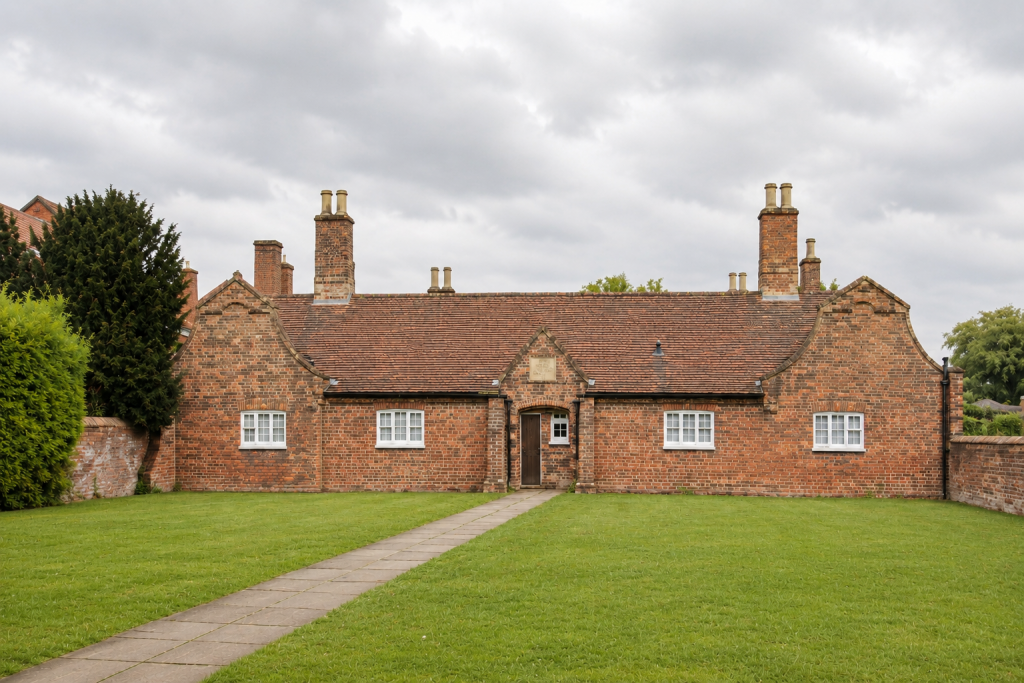
Yet again, the institution survived. The hospital was rebuilt in 1649, six years after the siege. That rebuilding forms the core of the almshouses visible today.
Eight almshouses around a courtyard
Historic England describes the surviving group as eight single-storey almshouses arranged around a courtyard, principally dating from 1649. The buildings are brick with plaintiled roofs and Dutch gables. Later alterations show continued use. A sundial slab bears the date 1738, many windows are eighteenth century, and the courtyard retains a cast-iron pump. Restoration followed in 1904, including structural work still visible inside the buildings, and further modernisation took place in 1965.
The present hospital is therefore not an untouched seventeenth-century survival. It is a building repeatedly repaired and adapted because people continued to live there.
From brothers and sisters to widows
The medieval hospital housed religious and lay brothers and sisters. James I’s patent still envisaged both poor men and poor women. By the eighteenth and nineteenth centuries, however, St Mary Magdalen was increasingly described as an almshouse for poor women or widows. The precise date of that transition remains unclear, but the change reflects the institution’s wider evolution. A medieval religious hospital became a civic almshouse, governed by the borough and supported by rents and charitable bequests.
Among the later benefactors were Robert Awborne, also written Auborne, and Alderman George Hogg, whose names survive in the charity’s later legal title. Awborne’s charity is known to have supported several Lynn charitable purposes, including payments to pensioners at St Mary Magdalen. Hogg’s bequest was also ultimately attached to the institution, although the donor’s precise identity and the original terms of the gift still require firmer documentary proof.
That is enough to show that St Mary Magdalen did not depend on one act of royal patronage. It endured through a succession of endowments, rents, repairs, and civic decisions.
A survivor beside the road
King’s Lynn has more imposing survivals. The Minster, St Nicholas’ Chapel, the Guildhall, warehouses, merchant houses, and towers speak directly of worship, government, and trade. St Mary Magdalen tells another part of the town’s history. Its story concerns the sick, the poor, widows, pensioners, and people dependent upon charitable income. Yet sustaining them required kings, mayors, aldermen, merchants, lawyers, tenants, estate managers, and generations of civic officials.
The hospital was attacked in 1549. James I reconstructed its legal existence in 1611. Lynn’s defenders burnt it in 1643. It rose again in 1649. Its governors managed land, collected rents, admitted pensioners, and absorbed later charitable gifts. Its buildings changed, and so did its residents. The institution endured.
That may be the most remarkable fact about St Mary Magdalen. It refused to disappear.
© James Rye 2026
Book a Guided Walk with a Trained and Qualified King’s Lynn Guide
References
Charity Commission for England and Wales. “Hospital of St Mary Magdalen of the Foundation of King James (Including Robert Awborne and Alderman George Hoggs Bequest) (Almshouse Charities).” Register of Charities. Accessed August 9, 2026. https://register-of-charities.charitycommission.gov.uk/en/charity-search/-/charity-details/15623
Hillen, Henry J. History of the Borough of King’s Lynn. Vol. 1. Norwich: East of England Newspaper Co., 1907. https://archive.org/stream/historyofborough01hill/historyofborough01hill_djvu.txt
Historic England. “Almshouses (Gaywood Hospital), Gaywood Road, King’s Lynn.” National Heritage List for England. List Entry 1219806. Accessed August 9, 2026. https://historicengland.org.uk/listing/the-list/list-entry/1219806
Norfolk Historic Environment Service. “Site of Hospital of St Mary Magdalen, Gaywood Road.” Norfolk Heritage Explorer. NHER 11963. Accessed August 9, 2026. https://www.heritage.norfolk.gov.uk/record-details?uid=MNF11963
Page, William, ed. “Hospitals in Lynn.” In A History of the County of Norfolk. Vol. 2, 441–42. London: Victoria County History, 1906. British History Online. https://www.british-history.ac.uk/vch/norf/vol2/pp441-442
Richards, William. The History of Lynn, Civil, Ecclesiastical, Political, Commercial, Biographical, Municipal, and Military, from the Earliest Accounts to the Present Time. Vol. 1. King’s Lynn, 1812. https://readingroo.ms/6/2/3/6/62365/62365-h/62365-h.htm
Richards, William. The History of Lynn, Civil, Ecclesiastical, Political, Commercial, Biographical, Municipal, and Military, from the Earliest Accounts to the Present Time. Vol. 2. King’s Lynn, 1812. https://www.gutenberg.org/cache/epub/62372/pg62372-images.html
The National Archives. “King’s Lynn Borough Archives”, including Gaywood Hospital deeds and estate papers, KL/C56/1–42. Discovery. https://discovery.nationalarchives.gov.uk/redirect/a2a/?cat=153-klmain_1-2&cid=-1