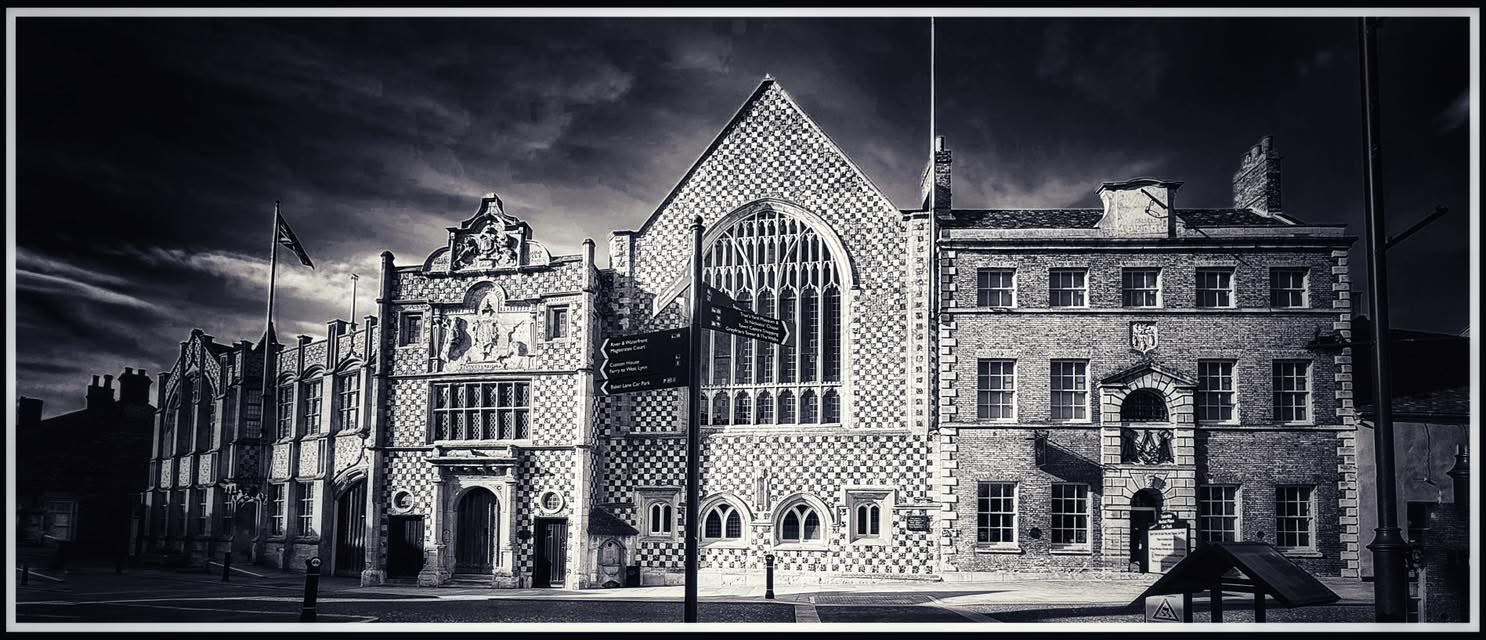
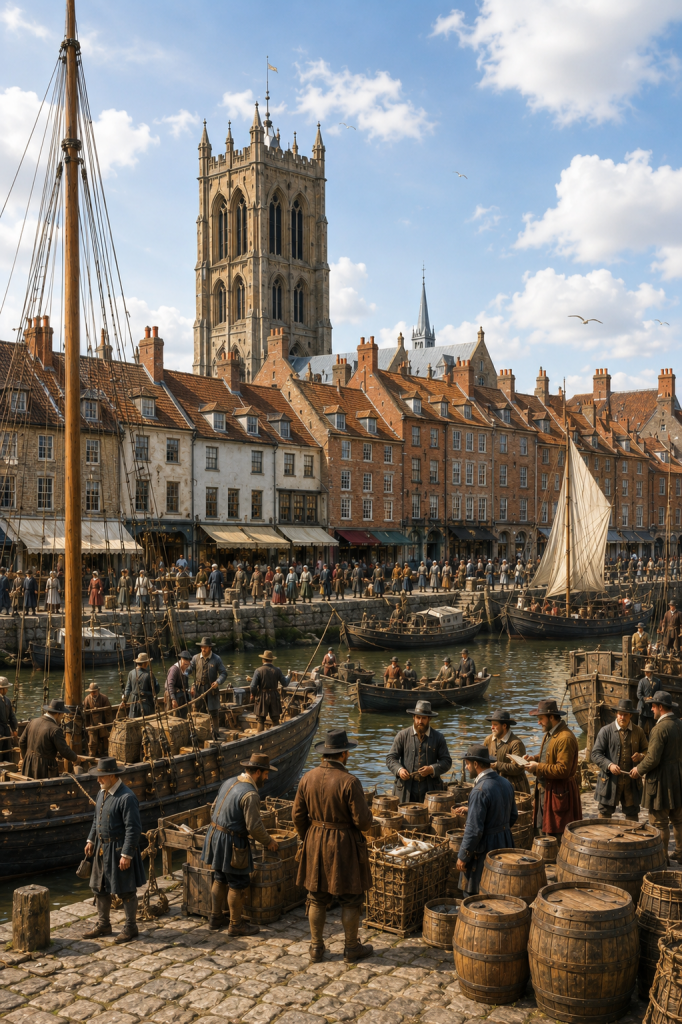
In September 1636, the official musicians of King’s Lynn asked the Corporation for financial help. The waits normally earned money by playing at civic ceremonies, markets and private celebrations. Now those gatherings had stopped. Their petition referred simply to “this Tyme of Sicknes & visitacion”. Each musician received ten shillings.
The entry gives an immediate sense of a town falling silent. Plague had reached Lynn, public life was being suspended and people who remained healthy were already losing their livelihoods [Guild of Town Pipers].
Within weeks, the crisis had spread far beyond the infected households. Markets closed, wooden pesthouses were erected beside the town walls, and thousands of inhabitants depended upon municipal relief.
A threat from Newcastle
The danger had been anticipated. During 1636, plague devastated Newcastle upon Tyne, killing several thousand people. This was particularly alarming for Lynn because ships regularly carried coal from Newcastle into the Great Ouse.
The Corporation ordered arrivals from Newcastle and other infected places to remain aboard their vessels for fourteen days. Council porters were instructed to prevent crews and passengers from landing.
The authorities knew nothing of bacteria or infected fleas, but they understood that plague travelled with people and goods. Lynn had used similar precautions during earlier scares, closing gates, watching river approaches and restricting the entry of strangers.
It is possible that the infection reached Lynn aboard a Newcastle collier, but there is no surviving evidence identifying a particular ship or sailor. The town traded with many ports and was connected to the surrounding region by road and river. Newcastle represented an obvious danger, not a proven source.
Pesthouses beneath the walls
Once plague appeared inside Lynn, the Corporation attempted to separate the sick from the wider population. Temporary wooden buildings were erected “under the town-walk”, probably close to the town walls. These pesthouses were intended particularly for poorer inhabitants who could not be isolated within spacious homes.
They were probably simple cabins rather than hospitals. Patients required food, fuel, bedding and attendants, while watchmen were needed to enforce restrictions. The exact location of the buildings has not been established.
The system placed the heaviest burden upon the poor. Wealthier families might isolate a patient in a separate room or leave Lynn before restrictions tightened. Labourers, sailors’ families and craft workers living in cramped houses had fewer choices. Removal to a pesthouse meant separation from home at the moment when sickness and fear were greatest.
The voices of those patients have disappeared. The surviving records tell us much more about Corporation expenditure than about what happened inside the cabins.

Sixty-nine families infected
By late October 1636, 69 families were officially recorded as infected. Yet the economic effects were far wider. About 2,400 people were receiving daily relief, while another calculation listed 2,426 inhabitants as destitute because of the sickness.
These figures probably describe overlapping groups and should not be added together. Even so, they show that a large part of the population had lost its normal means of support.
Lynn depended upon movement. Ships entered the harbour, country people attended the markets, labourers found casual work and visitors spent money in inns. The measures intended to contain plague interrupted all of these activities.
Markets were discontinued. Customers stayed away. Sailors could not land freely, craftsmen lost orders and public entertainments ceased. The waits were only one small group among many whose incomes vanished.
The Corporation claimed that at least £50 a week was required to feed and house plague victims. A further £140 was reportedly needed each week to support those left without work or income [Smith, 153–54].
At the same time, the tradesmen and householders who normally contributed to poor relief were themselves suffering. The number needing help rose just as the town’s ability to provide it declined.
Norfolk offers £20
Lynn appealed to the surrounding countryside for assistance. Its leaders argued that neighbouring communities benefited from the port and markets in ordinary times and should contribute towards keeping the town alive during an emergency.
A representative appeared before the Norfolk Quarter Sessions, where county magistrates considered taxation and poor relief. After four meetings over six weeks, the three nearest hundreds offered only £20.
The response exposed the weakness of seventeenth-century emergency provision. There was no national disaster fund and no dependable county system capable of rescuing an infected borough. Lynn had to negotiate repeatedly with magistrates who were reluctant to increase the burden upon their own ratepayers.
Plague and ship money
The epidemic struck while Charles I was demanding ship money, a royal levy intended to finance naval defence. Lynn’s assessment was £250.
The Corporation argued that a town spending heavily to feed thousands of distressed inhabitants could not meet the demand as though nothing had happened. In October 1636, it petitioned the Crown, describing Lynn’s “great want”.
On 6 January 1636/7, the Sheriff of Norfolk, William Paston, reported that the sickness had ceased. This suggests that the active outbreak ended around the close of 1636, although its financial consequences continued.
The Privy Council initially ordered that Lynn’s assessment should be reduced and the money raised elsewhere in Norfolk. The sheriff objected because much of the county levy had already been collected. Lynn was eventually required to pay, while continuing to seek credit against a later demand.
The dispute shows the Corporation attempting to turn the scale of the disaster into a political argument. Its members collected figures, sent representatives and repeatedly pressed the government for relief.
Storm and shipwreck
Plague was followed by another blow. William Richards recorded that a storm struck Lynn harbour on 4 November 1636 and that, according to one account, fourteen ships were lost with their crews.
Later petitions referred to 25 ships lost through storms and shipwreck. The higher number may have covered a longer period rather than a single night. Both figures require caution, but maritime losses were plainly included in Lynn’s appeal for financial relief.
Plague had halted trade and drained the town treasury. Shipwreck then destroyed vessels and took away sailors needed for the port’s recovery.
How many people died?
The figure most often repeated is that about 200 people died. It comes from William Richards, who wrote that pesthouses were built beneath the walls, “where about 200 persons are said to have died”.
His wording is uncertain. The figure may refer only to deaths in the pesthouses rather than to all plague deaths in Lynn. Others may have died in their homes, aboard ships or outside the town.
A reliable total would require a detailed comparison of the burial registers for St Margaret’s, St Nicholas’s and All Saints’ during 1635, 1636 and 1637. Until that work is completed, the traditional figure of 200 should be treated as an estimate rather than an established total.
The doctor’s unpaid bill
The Corporation employed Dr Samuel Barron to attend plague patients. More than three years later, he complained to the Privy Council that Lynn had not fully paid him.
In January 1639/40, the Council ordered the Corporation to give Barron a further £70 for his work during the epidemic.
The pesthouses had gone and trade had resumed, but the debts of the plague remained.
A town stopped in its tracks
The most revealing contrast is between the 69 infected families and the thousands who needed relief. The disease struck particular households, but the response to it disrupted the entire town.
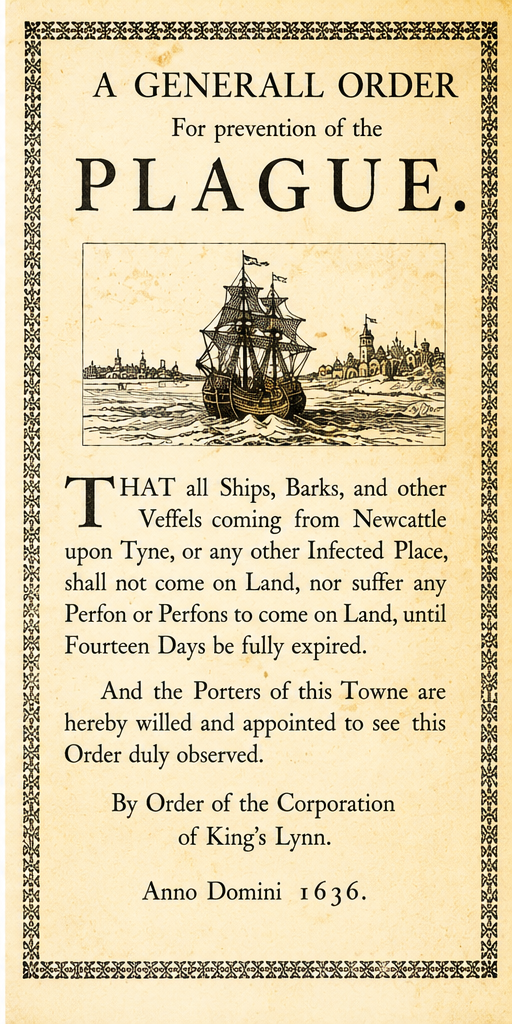
Lynn’s rulers closed markets, restricted shipping, built pesthouses, employed a doctor and distributed relief. Their measures probably limited contact, but they also stopped much of the activity upon which the population depended.
The waits’ petition captures the crisis in miniature. King’s Lynn was normally filled with bells, market cries, ships and civic music. In September 1636, even the musicians could no longer earn their living.
The plague had not only entered the town. It had brought the town to a halt.
Other documented outbreaks
The safest list is not quite the same as the short sequence often repeated in general histories. Lynn experienced both actual outbreaks and years when the Corporation imposed precautions because plague threatened from elsewhere.
1348–1349
The Black Death reached eastern England and almost certainly struck Bishop’s Lynn severely. Precise local mortality figures do not survive, but later estimates suggest that a very large proportion of the population may have died.
1516
Usually listed as one of Lynn’s severe plague years, although readily accessible accounts provide little detail about the course of the outbreak.
1540
The town cancelled both annual fairs because of plague. This strongly indicates either an outbreak in Lynn or an immediate and serious local danger.
1584
A major outbreak is recorded. A special tax was raised for the relief of victims and their families. Some secondary summaries give 1587 instead, so the original borough records should be checked before treating either year as beyond dispute.
1597
A serious epidemic affected the town, and more than 200 burials were reportedly made in the St James area. One modern account claims 6,000 deaths, but that figure cannot be correct as printed: Lynn’s entire population was nowhere near 60,000, which would be required for 6,000 to equal the stated 10 per cent. The figure may be a transcription or typographical error.
1602
Plague was concentrated particularly in the North End. In October the Corporation ordered residents to be isolated and supplied with food.
Shortly after 1602, exact year uncertain
Another outbreak caused the grammar school to be “broken up”, meaning temporarily closed or dispersed to limit infection. The accessible summary does not give a precise year.
1630
Plague was found within Lynn in June, after the town had initially closed its gates because of infection at Cambridge. The Corporation ordered cats and dogs to be killed because they were believed to spread the disease.
1636
The best documented Lynn epidemic. Sixty-nine families were recorded as infected, thousands required relief, pesthouses were erected near the walls, and the outbreak appears to have ended around the close of the year.
1645–1646
A further outbreak occurred during the Civil War period. Armed guards were placed at the gates, incoming ships were quarantined, sheds were built for infected people and traders reportedly avoided the town. A national thanksgiving was held on 14 October 1646, apparently marking the end of the epidemic danger.
1665
Plague returned during the Great Plague epidemic. By the summer, Lynn closed its gates, prevented boats from Cambridge and Peterborough from landing goods, erected isolation booths beside the walls and used armed guards to deter visitors. This is generally regarded as Lynn’s last major plague outbreak.
Years of serious precaution, but not necessarily local plague
1625
Because plague was present in Cambridge, Lynn closed its gates, watched the river and forbade innkeepers to receive travellers. The evidence cited describes preventive action rather than confirmed plague within Lynn.
April 1630
The gates were initially closed because Cambridge was infected. Local cases were then discovered two months later, making 1630 both a precaution year and an outbreak year.
Early 1645
Measures were taken against travellers, “rogues and vagabonds” and ships arriving from Sunderland, where plague had been reported. These precautions developed into the 1645–46 crisis.
September 1743
Ships were still being quarantined at Lynn because of plague fears abroad, although there is no suggestion of a local outbreak.
© James Rye 2026
Book a Walk with a Trained and Qualified King’s Lynn Guide
References
- Guild of Town Pipers. “King’s Lynn 1600–1699.” Accessed 21 June 2026. https://townwaits.org.uk/historical-records/kings-lynn-waits-menu/history_lynn_1600-1699/
- Richards, Paul. “A Look at King’s Lynn during the Plague Years.” KL Magazine. https://www.klmagazine.co.uk/articles/plague
- Richards, William. The History of Lynn, Civil, Ecclesiastical, Political, Commercial, Biographical, Municipal, and Military, from the Earliest Accounts to the Present Time. Vol. 2. Lynn: W. G. Whittingham, 1812. https://www.gutenberg.org/ebooks/62372
- Smith, Peter. “Petitionary Negotiation in a Community in Conflict: King’s Lynn and West Norfolk, c. 1575–1662.” PhD diss., University of East Anglia, 2012. https://ueaeprints.uea.ac.uk/id/eprint/40587/