Who watched the Mayor? Who controlled Lynn’s money? And who had the right to check the men who governed it?
The unrest that shook Lynn in the years around 1411 to 1420 can sound, at first, like a tangle of medieval names and legal phrases. At heart, however, it was about something plain enough: who controlled the town’s money, and who had the right to check the men who governed it?
The town beneath the bishop
Lynn had a mayor, burgesses, officers, charters, and a strong civic identity. A burgess was a recognised member of the borough community, usually with trading and civic privileges. The town also had twenty-four jurats, a word that simply means “sworn men”. In Lynn they were senior burgesses who formed the core governing body, advising and acting with the mayor, and often providing the pool from which mayors were chosen.
Yet Lynn was not fully free. The bishop of Norwich remained lord of the town. This mattered because many of Lynn’s leading men had spent money in earlier struggles against Bishop Henry Despenser, bishop of Norwich from 1370 until 1406. Despenser was a forceful figure, and disputes with him touched the boundaries of Lynn’s civic freedom.
The trouble was not merely that money had been spent. It was that some townsmen believed large sums had been spent, borrowed, or claimed without proper consent from the wider community.
The bill that would not go away
The central dispute came into view in the arbitration of 1412. Several former mayors, or men connected with former mayors, claimed repayment for expenses said to have been incurred while serving the town. The figures were large. Claims included £36 13s. 8d. by John Belleyetere, £70 15s. 10d. by Thomas Watirden, £80 10s. by John Wynteworth, £69 2s. 4½d. by the executors of Robert Botekesham, and £122 1s. 5d. by Thomas Brigge.
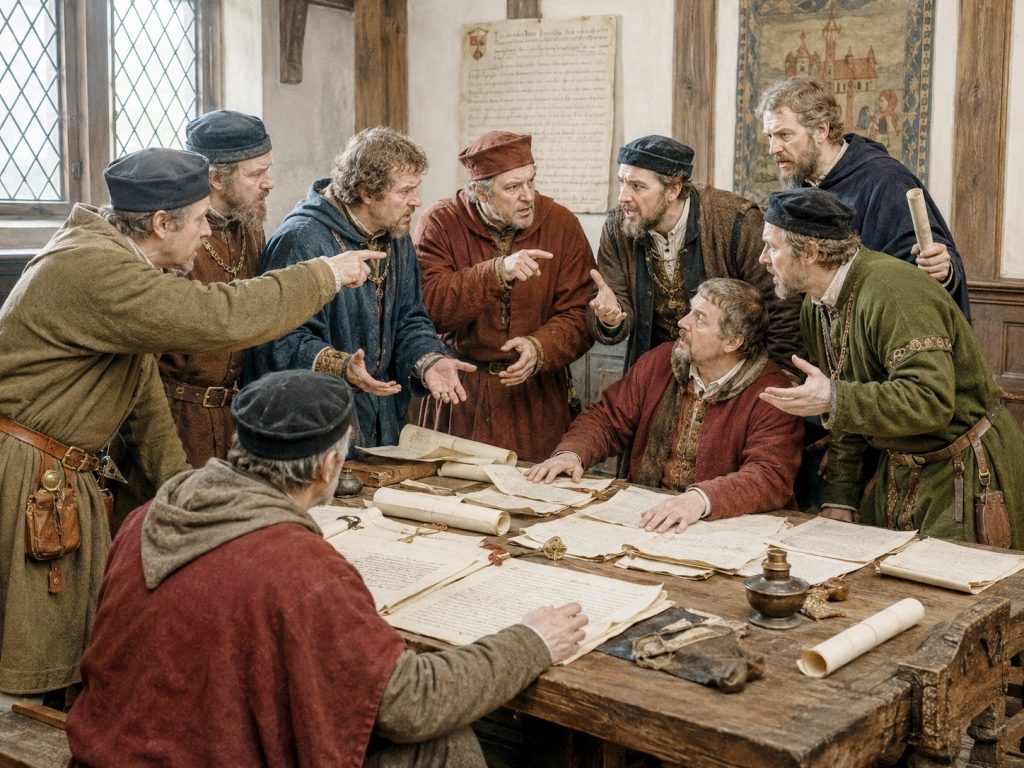
The arbitrators disallowed those claims.
Still larger was the notorious figure of £457 19s. 7d., connected with money spent against Henry Despenser by former mayors including John Brunham, Edmund Belleyetere, Thomas Watirden, Robert Botekesham, and John Wynteworth. The surviving record says this had been disbursed without the consent of the community, to its serious prejudice and impoverishment.
That language comes from the record of settlement, so it should not be treated as a neutral verdict from a modern audit. The former mayors and their supporters may well have thought they had defended Lynn’s interests in a hard struggle against the bishop. Their opponents thought they had acted too freely with public resources.
This was the spark. Once townspeople asked who had authorised the spending, they also asked who chose the mayor, who controlled the records, who could inspect accounts, and who was entitled to be present when town business was done.
Three groups, but not a simple class war
The sources divide the town into three groups: the potentiores, the mediocres, and the inferiores. The potentiores were the more powerful men, many of them associated with the older governing families. The mediocres were middling burgesses who wanted greater accountability and more say in civic affairs. The inferiores were lower-status inhabitants, some of whom were not burgesses at all.
It would be too crude to call this simply rich against poor. Some of the inferiores had useful skills and connections. What mattered politically was that they stood outside the main circle of merchant burgesses who usually dominated Lynn’s formal government.
The quarrel was therefore about access. Who could see the accounts? Who could influence office-holding? Who could compel the governors to answer?
The first answer: arbitration in 1412
The first major attempt at a solution came in 1412. Eighteen arbitrators were appointed, drawn from across the town’s divided groups. Their task was to settle the quarrel and stop it poisoning civic life.
They did three things.
First, they rejected several claims for repayment from former mayors or their representatives. This limited the ability of office-holders to present the town with large bills after the event.
Second, they issued a quitclaim over the £457 19s. 7d. A quitclaim was a legal release. In ordinary terms, it meant that the community gave up, or was made to give up, further claims against the named men over that particular sum. It was not necessarily forgiveness in the moral sense. It was a legal device to close the matter.
Third, the arbitrators created a new financial safeguard. Each mayor was to choose nine men to work with him: three from the potentiores, three from the mediocres, and three from the non-burgess inferiores. These nine, together with the mayor, were to handle the town’s rents and related financial business during that mayoral year.
This was the practical heart of the settlement. The problem had been mistrust over money. The proposed remedy was shared oversight.
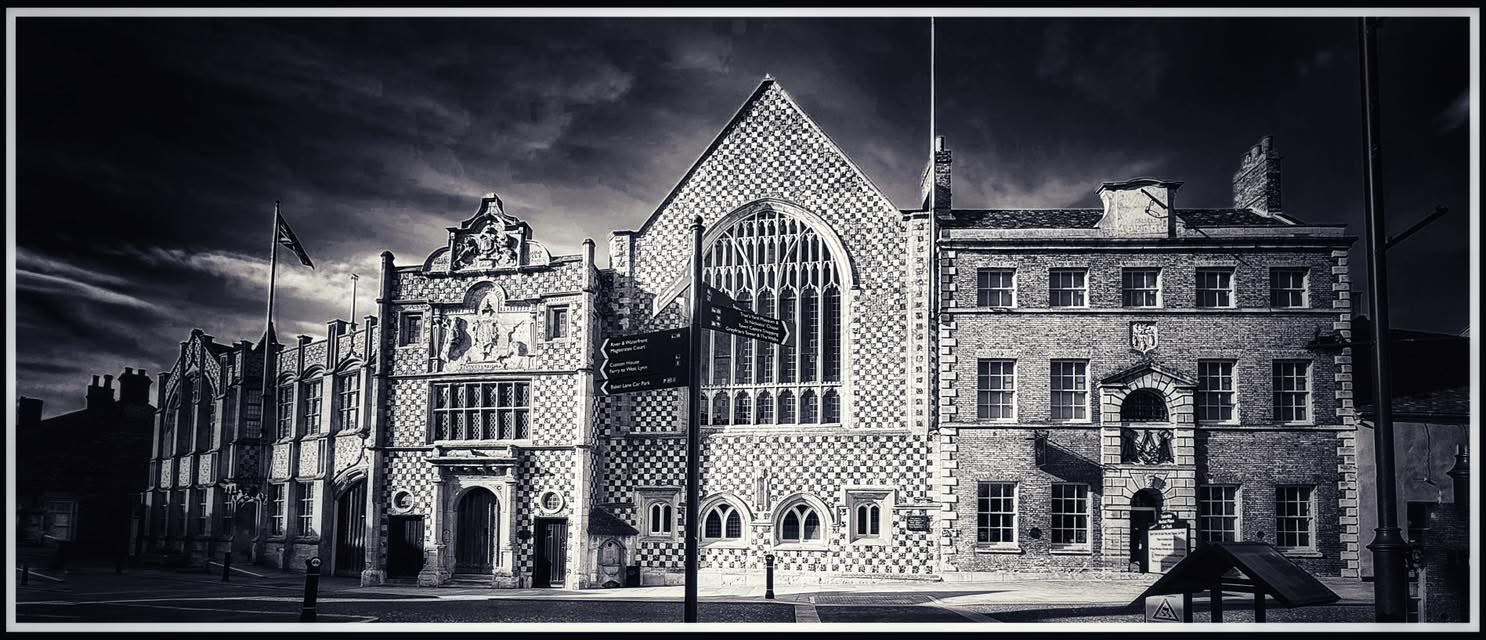
The Guildhall as a public arena
For a time, Lynn’s politics became unusually public. Meetings were held in the Hall of the Holy Trinity Guild, the great civic and mercantile space at the centre of town life. The Holy Trinity Guild was not only a religious brotherhood. It was bound up with trade, wealth, and civic authority.
In 1412 and 1413 the records show large general assemblies, sometimes with at least 100 men present, and on some occasions perhaps 400 to 500. Burgesses and non-burgesses could be present. They watched documents sealed, heard reports, and saw officers answer questions.
This mattered. The quarrel had grown from suspicion that decisions had been made too privately. Public witnessing was a way of making rulers visible. It did not give every man an equal vote, but it did make it harder for office-holders to hide.
Yet open assemblies were not a stable way to run a town. They could expose wrongdoing, but they could also magnify faction. Lynn needed a form of government that allowed scrutiny without turning every matter into a crowded confrontation.
The failed experiment with elections
The next attempt to solve the quarrel dealt with elections. This made sense. If the wrong men had controlled the money, townspeople naturally asked how those men had reached office.
New ordinances tried to alter how the mayor, jurats, chamberlains, and other officers were chosen. They gave burgesses a more visible part in naming candidates, though final power still lay heavily with the mayor and jurats. The reforms did not create democracy. They created a compromise between wider participation and older elite control.
The compromise failed. In 1416 the new ordinances were revoked, and older electoral customs were restored. The official language blamed the reforms for strife, riots, dissensions, expense, and danger to the town. That may be legal rhetoric, but it reflects a real failure. The electoral experiment had not settled the quarrel.
The durable answer: the council of twenty-seven
The lasting settlement came between 1418 and 1420. Bishop John Wakering of Norwich confirmed a new common council of twenty-seven. Lynn’s nine constabularies, which were local districts rather like wards, were each to choose three suitable burgesses.
This was the answer that fitted the problem. The twenty-seven were to take part in the town’s business where accountability mattered most: taxes, tenths and fifteenths, allowances, repairs to houses, walls, bridges, watercourses, and ditches, payments, accounts, and civic charges.
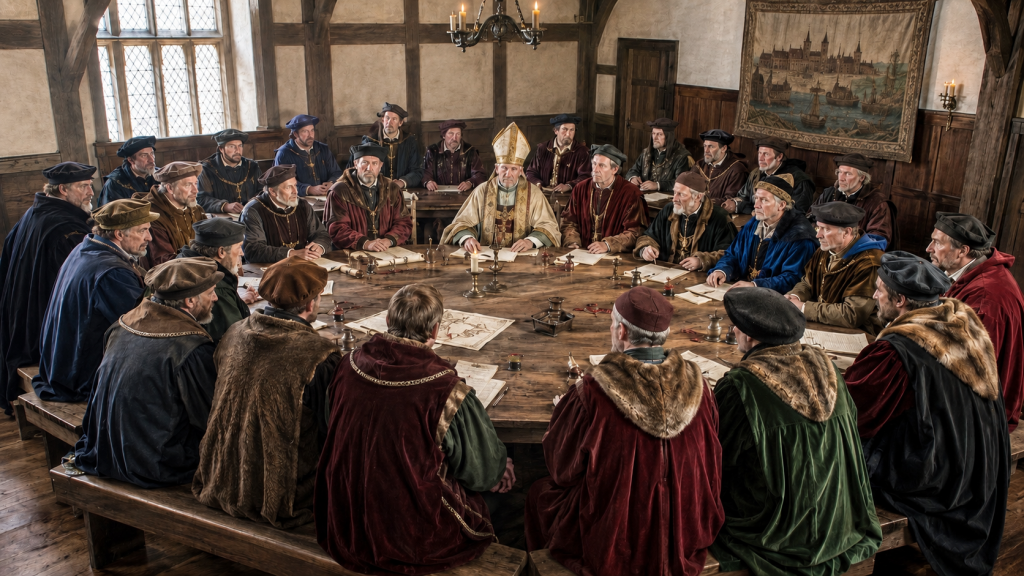
The solution was not open rule by the whole population. Non-burgesses did not gain equality. The mayor and the twenty-four jurats remained central. The bishop’s lordship remained. But a wider body of burgesses now had a recognised place in supervising the work that had caused so much anger: money, repairs, taxation, and accounts.
The price was that large public assemblies became less central. Government moved away from the drama of the open hall and into meetings of the mayor, jurats, and common council. Lynn gained representation, but lost some of the direct public theatre of accountability.
What the quarrel achieved
The unrest in early fifteenth-century Lynn was not a failed revolution. Nor was it just a squabble among ambitious merchants. It was a constitutional crisis in a major medieval port.
The first issue was money spent in the town’s quarrel with Bishop Despenser. The deeper issue was trust. Former mayors had acted, or claimed to have acted, for Lynn. Their critics demanded to know who had authorised the spending, who should pay, and who could inspect the accounts.
The 1412 arbitration tried to settle the old debts and create a temporary financial check. The electoral reforms then tried, unsuccessfully, to change how office-holders were chosen. The common council of twenty-seven gave Lynn the more lasting answer: a regular representative body, drawn from the burgess community, with a defined role in finance and civic administration.
That was the settlement’s strength. It did not promise equality. It did not remove conflict. It did not free Lynn from the bishop. But it gave the town a way to make government more answerable without making government impossible.
For medieval Lynn, that was no small achievement. The town did not solve its problems by becoming calm. It solved them by building machinery strong enough to contain argument.
© James Rye 2026
Book a Guided Tour with a Trained and Qualified King’s Lynn Guide Through Historic Lynn
References
Hartrich, Eliza J. “The Boundaries of Popular Control in Late Medieval English Towns.” Journal of Social History 58, no. 1 (2024): 27–53.
Historical Manuscripts Commission. The Manuscripts of the Corporations of Southampton and Kings Lynn. Eleventh Report, Appendix: Part III. London: HMSO, 1887. (british-history.ac.uk)
Jones, B., ed. “Bishops of Norwich.” In Fasti Ecclesiae Anglicanae 1300–1541: Volume 4, Monastic Cathedrals (Southern Province). London: Institute of Historical Research, 1963. (british-history.ac.uk)
Myers, Michael D. “The Failure of Conflict Resolution and the Limits of Arbitration in King’s Lynn, 1405–1416.” In Traditions and Transformations in Late Medieval England, edited by Douglas Biggs, Sharon D. Michalove, and A. Compton Reeves, 81–107. Leiden: Brill, 2002.
Norfolk Heritage Explorer. “King’s Lynn Parish Summary.” Norfolk County Council. (heritage.norfolk.gov.uk)
Owen, A. E. B., and D. M. Owen, eds. “William Asshebourne’s Book: King’s Lynn Corporation Archives 10/2.” Norfolk Record Society 48 (1981): 55–120.
Parker, Kate. “A Little Local Difficulty: Lynn and the Lancastrian Usurpation.” In Medieval East Anglia, edited by Christopher Harper-Bill, 115–29. Woodbridge: Boydell, 2005.
Parker, Kate. “Politics and Patronage in Lynn, 1399–1416.” In The Reign of Henry IV: Rebellion and Survival, 1403–1413, edited by Gwilym Dodd and Douglas Biggs, 210–27. York: York Medieval Press, 2008. (Cambridge University Press & Assessment)
Phillips, Matthew. “Urban Conflict and Legal Strategy in Medieval England: The Case of Bishop’s Lynn, 1346–1350.” Urban History 42, no. 3 (2015): 365–80.