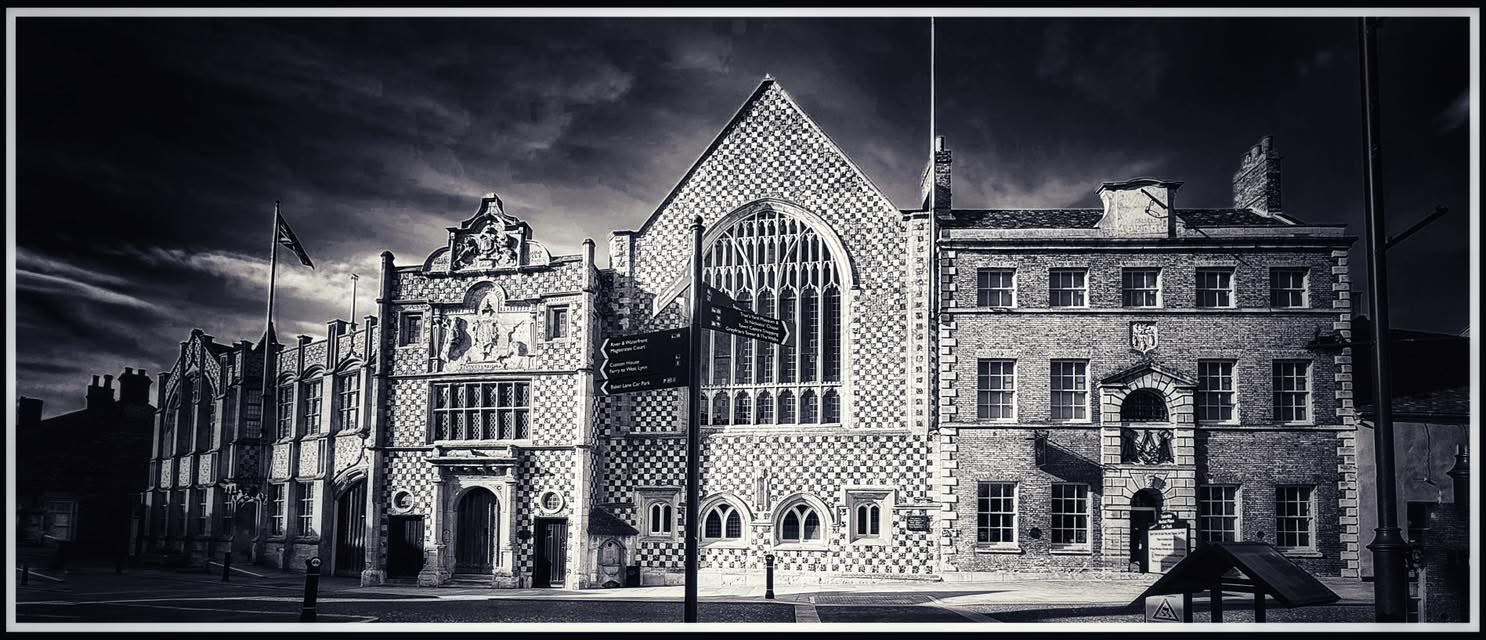
In the summer of 1216, soldiers supporting a French claimant to the English throne descended on Bishop’s Lynn. They captured townspeople, carried prisoners away and forced the town to pay a heavy ransom.
Behind the invasion stood Robert FitzWalter, an English baron who had once served King John. FitzWalter had fought for him in Normandy and benefited from royal favour. By 1215, he commanded the rebel army opposing John. A year later, he helped Prince Louis of France attempt to replace him.
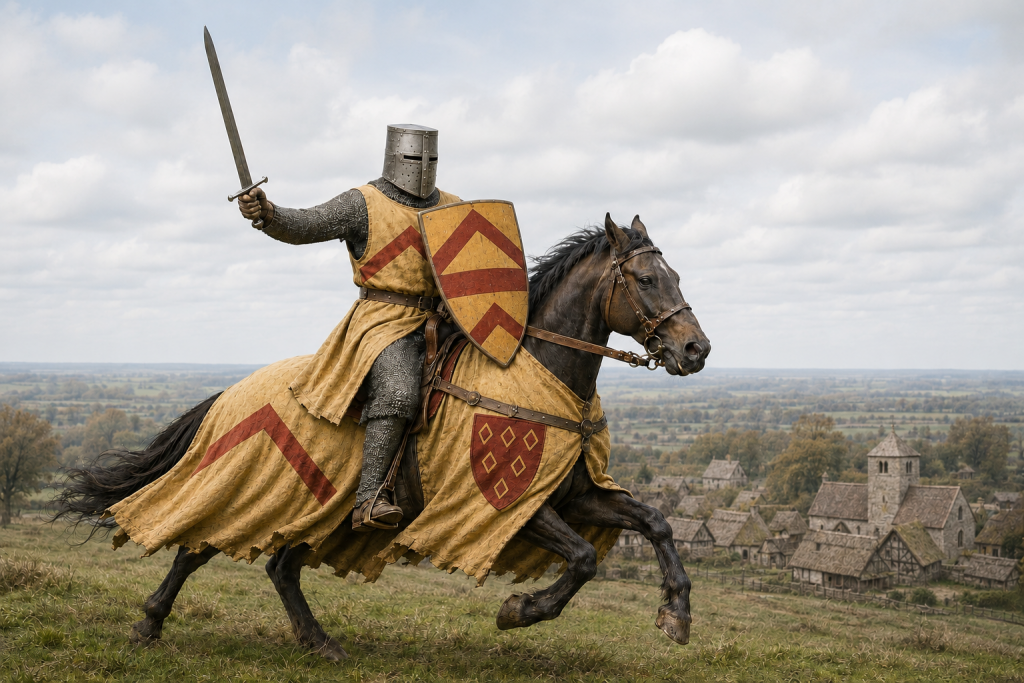
FitzWalter’s story does not divide neatly between a tyrant and a champion of liberty. Personal grievances mixed with disputes over government. A campaign for a charter became a civil war, then an invasion. Bishop’s Lynn was drawn into the struggle.
A Baron with London Influence
Robert FitzWalter inherited his family’s estates in 1198. His principal seat was Little Dunmow in Essex, but his influence reached Hertfordshire and London. His family held Baynard’s Castle beside the Thames and possessed the hereditary right to carry London’s banner in war.
Marriage to Gunnora de Valognes brought him more land, including Benington in Hertfordshire. He ranked among the wealthier English barons and could summon enough knights to make his support valuable to any king.
At first, FitzWalter supported John. In 1203, he and Saer de Quincy commanded the castle of Le Vaudreuil during the defence of Normandy against Philip II of France. They surrendered after only a short siege. The speed of the capitulation caused embarrassment, although John issued a letter excusing their conduct. Philip detained the commanders, and their release required a substantial ransom.
The episode did not immediately destroy FitzWalter’s relationship with John. The king had already rewarded him by pardoning family debts and granting him custody of Hertford Castle. FitzWalter was not an outsider driven naturally towards rebellion. He had served within John’s system and had profited from it.
Outlawed by the King
The relationship broke down in 1212. John believed that a group of barons had plotted to kill or capture him during a proposed expedition to Wales. FitzWalter was among the accused. Rather than submit to judgment before the king, he fled to France.
John retaliated against his property. Baynard’s Castle was demolished in January 1213. Benington Castle was also destroyed, leaving the lower remains of its stone keep that survive today.
Later stories supplied a more personal cause for the quarrel. One account says John attempted to violate FitzWalter’s daughter. Another associates the dispute with the king’s treatment of FitzWalter’s son-in-law. During later centuries the daughter acquired the name Matilda, rejected John’s advances and was poisoned on his orders.
The evidence does not establish that story. A French chronicler writing close to the events reports FitzWalter making an accusation involving his daughter, but his explanation of the quarrel appears to have changed. The poisoning belongs to later legend.
FitzWalter returned in 1213 after John settled his dispute with Pope Innocent III. The king restored his estates, but reconciliation did not remove the mistrust between them.
Marshal of the Army of God
By early 1215, opposition to John had hardened. The rebels demanded that he confirm established liberties and restrict practices they regarded as unlawful. When negotiations failed, they renounced their allegiance and chose FitzWalter as their military leader.
He adopted the title “Marshal of the Army of God and Holy Church”. It presented the rebellion as a lawful defence of the Church and the realm, although the papacy supported John.
The rebels initially achieved little. They failed to take Northampton Castle, while Bedford produced no decisive result. Their fortunes changed on 17 May 1215, when allies inside London admitted the baronial army. FitzWalter’s family connections with the city probably helped to secure its support.
The capture of London deprived John of England’s largest city and gave the rebels money, supplies and a defensible base. It forced the king to negotiate.
At Runnymede in June, John accepted the document later called Magna Carta. FitzWalter became one of twenty-five barons appointed to enforce its terms. If the king broke the agreement, they could seize his property until he corrected the offence.
This was not a peaceful constitutional settlement in the modern sense. Both sides remained armed. FitzWalter and his companions were not disinterested democrats. They wanted protection from arbitrary judgment, excessive financial demands and royal interference with inheritance. Some clauses offered wider safeguards, but the negotiations arose from a struggle among the kingdom’s political elite.
From Magna Carta to a French Invasion
The settlement collapsed within weeks. John appealed to Pope Innocent III, who annulled Magna Carta and condemned the rebels. Fighting resumed.
The rebels could hold London, but they could not defeat John’s mercenaries. Their failure to relieve Rochester Castle exposed their military weakness. FitzWalter and Saer de Quincy therefore sought help from Prince Louis, son of Philip II of France.
They offered Louis the English Crown.
Louis possessed a dynastic claim through his wife, Blanche of Castile, a granddaughter of Henry II. It was not a strong claim while John and his son Henry lived, but it gave the invasion a legal appearance. FitzWalter crossed to France as one of the negotiators and provided assurances that Louis would receive support in England.
Louis landed in Kent on 21 May 1216. He entered London and received the homage of the rebel barons. FitzWalter, who had demanded legal restraints on an English king, now supported a French prince seeking to depose him.
The Ransoming of Bishop’s Lynn
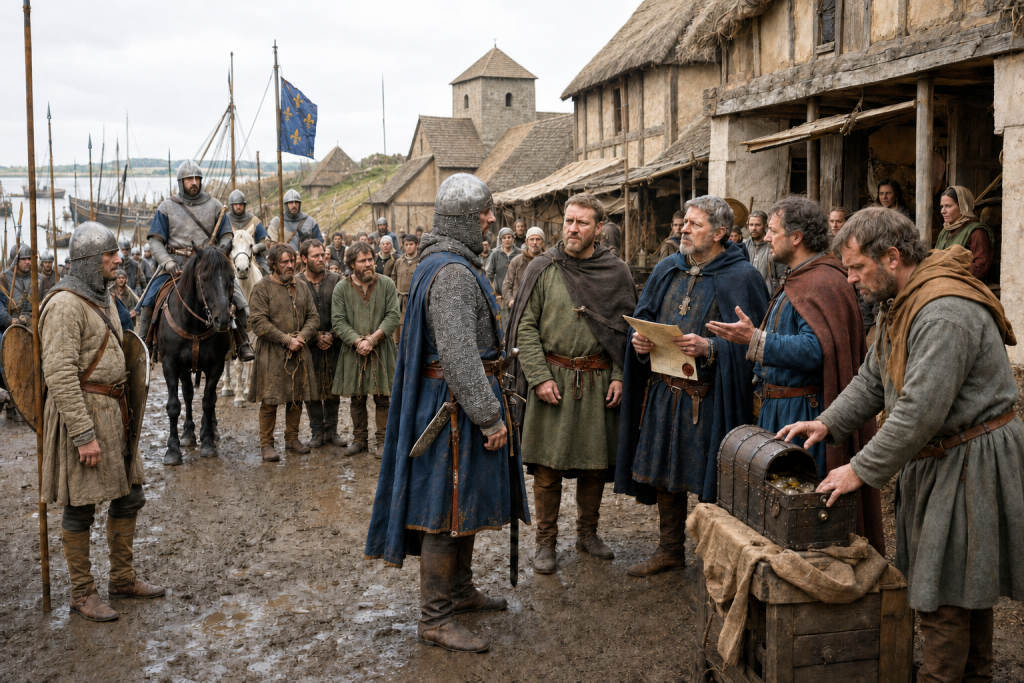
FitzWalter helped carry Louis’s campaign into eastern England. Roger of Wendover records that FitzWalter, William de Mandeville and William de Huntingfield led a powerful force which brought Essex and Suffolk under Louis’s control.
The invasion then reached Bishop’s Lynn.
Wendover says Louis’s forces plundered towns across Essex, Suffolk and Norfolk. They occupied the deserted castle at Norwich and imposed tribute on the surrounding districts. Louis then sent a large army against Lynn. It subdued the town, carried citizens away as prisoners and compelled them to pay what the chronicler called a gravem redemptionem, a heavy ransom. The troops returned to London with plunder.
Wendover does not name the commander of the Lynn force. FitzWalter was one of Louis’s principal commanders and was campaigning in East Anglia at the time. He may have accompanied or directed the expedition, but that cannot be stated as fact. Nor do we know how many people were seized or how much Lynn paid.
The town’s reaction when John arrived in October adds another turn to the story. Wendover says the inhabitants welcomed the king joyfully and gave him substantial presents. Their response may have reflected anger after the summer attack. It may also have been a practical decision made when John’s army controlled the region. No surviving source explains their motives.
John left Lynn on 11 October. His baggage train was lost while attempting a dangerous crossing near the Wash, and the king died at Newark on 19 October.
Defeat at Lincoln
John’s death changed the contest. His heir was nine-year-old Henry III, who carried none of his father’s personal reputation. The royal government reissued Magna Carta in Henry’s name and offered terms to the rebels. Many changed sides.
FitzWalter remained with Louis. On 20 May 1217, he fought at Lincoln, where William Marshal’s royal army defeated the Anglo-French forces. FitzWalter and his son were captured with several rebel leaders.
The defeat ended Louis’s prospect of becoming king. After a further French force was defeated at sea, he accepted a settlement and left England. FitzWalter was released in October.
In 1219 he joined the Fifth Crusade and travelled to the siege of Damietta in Egypt. He later returned to England and made peace with Henry III’s government. In February 1225, he witnessed Henry’s confirmation of Magna Carta. FitzWalter died in 1235 and was buried at Little Dunmow.
The rebel marshal who once tried to replace a king ended his political career as a witness to the royal confirmation of the charter he had enforced with an army.
© James Rye 2026
Book a Guided Tour with a Trained and Qualified King’s Lynn Guide Through Historic Lynn
References
- Anonymous of Béthune. History of the Dukes of Normandy and the Kings of England. Translated by Janet Shirley, with historical notes by Paul Webster. Abingdon: Routledge, 2021. https://www.anglo-norman-texts.net/media/2022/01/Anonyme-de-Bethune.pdf
- Gillingham, John. “The Anonymous of Béthune, King John and Magna Carta.” In Magna Carta and the England of King John, edited by Janet S. Loengard, 27–44. Woodbridge: Boydell Press, 2010. https://doi.org/10.1515/9781846158124-005
- Historic England. “Benington Castle: A Motte and Bailey Castle West of Church Green.” National Heritage List for England, entry 1007844. https://historicengland.org.uk/listing/the-list/list-entry/1007844
- Holt, J. C. Magna Carta. 3rd ed. Cambridge: Cambridge University Press, 2015. https://www.cambridge.org/core/books/magna-carta/711621D1F9EF960F44BB9FC39F51F51C
- Hopkinson, Nick. “Ultra mare in servicio domini regis: English Barons and the Defence of Normandy, 1194–1204.” Historical Research 94, no. 264 (2021): 213–234. https://doi.org/10.1093/hisres/htab010
- Magna Carta Project. “The Rebels Seize London.” King John’s Diary and Itinerary. https://www.magnacartaresearch.org/read/itinerary/The_rebels_seize_London
- Round, J. H. “King John and Robert Fitzwalter.” English Historical Review 19, no. 76 (1904): 707–711. https://doi.org/10.1093/ehr/XIX.LXXVI.707
- Strickland, Matthew. “Fitzwalter, Robert (d. 1235).” Oxford Dictionary of National Biography. Oxford University Press, 2004. https://doi.org/10.1093/ref:odnb/9531
- Wendover, Roger of. Rogeri de Wendover Liber qui dicitur Flores Historiarum. Edited by Henry G. Hewlett. Vol. 3. London: Longman, 1889, 190. https://archive.org/details/rogerdewendover00hewlgoog/page/n196/mode/2up
- Wendover, Roger of. Flowers of History. Translated by J. A. Giles. Vol. 2. London: Henry G. Bohn, 1849. https://www.melocki.org.uk/wendover/Flowers2.html