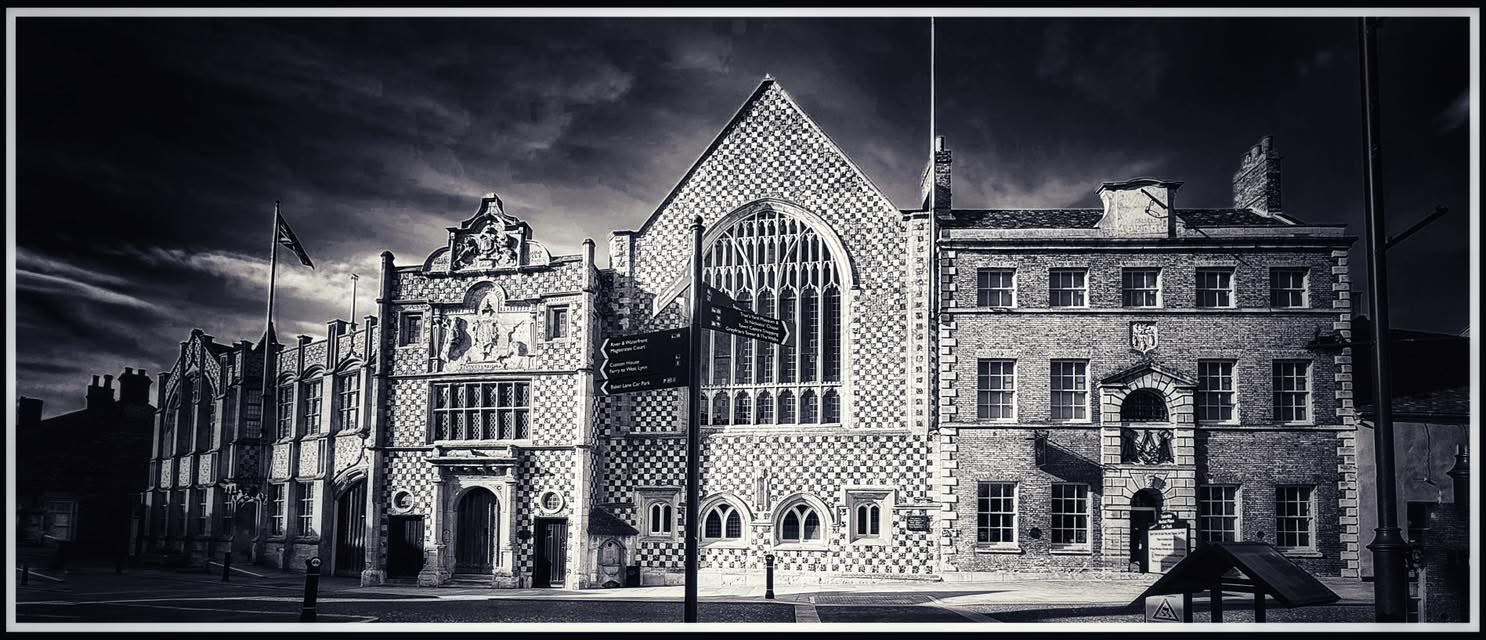
A quiet January night
On Tuesday, 19 January 1915, King’s Lynn became part of a frightening new kind of war. The First World War was only five months old. Local families already knew the conflict through enlistment, casualty lists, letters from soldiers, patriotic meetings, and the strain of waiting. But the town itself was not a battlefield. Then, late that night, people heard a strange droning above them.
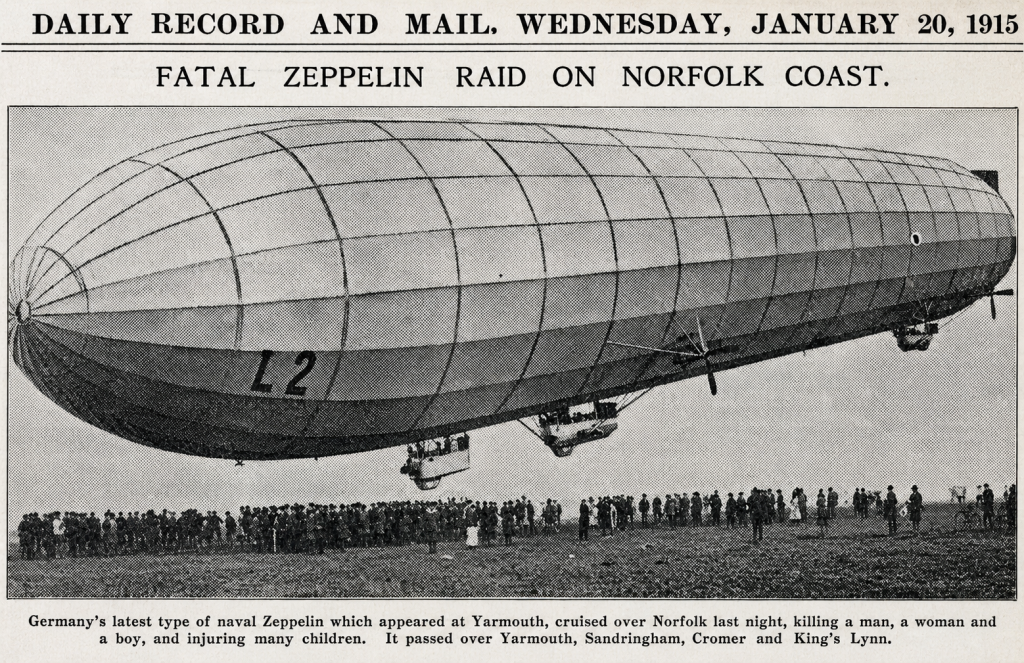
It was not a railway engine or machinery from the docks. It was the German naval Zeppelin L4, commanded by Kapitänleutnant Count Magnus von Platen-Hallermund. It had not set out to attack King’s Lynn. The intended target was probably the Humber, but bad weather and uncertain navigation brought the airship over Norfolk instead. L3 went towards Great Yarmouth. L4 came westwards and then southwards, dropping bombs along the north Norfolk coast before reaching Lynn.
The raid that lost its way
The German raid began with three Zeppelins, L3, L4, and L6. L6 turned back, leaving L3 and L4 to cross the North Sea. The two surviving raiders were meant to strike at Britain’s eastern seaboard, especially military or industrial targets, but the operation quickly became confused. Night flying over the sea was difficult, the weather was poor, and the crews had only limited means of knowing exactly where they were.
L3 attacked Great Yarmouth, where Samuel Smith and Martha Taylor were killed. Smith is often described as the first British civilian to die in an aerial bombardment. L4, meanwhile, passed through or near Sheringham, Brancaster, Heacham, Snettisham, Dersingham, and Grimston before reaching King’s Lynn at about 10.50 p.m.
There was later talk that Sandringham had been the real target. The story is understandable: the Zeppelin passed near the royal estate, and wartime rumour did the rest. But the stronger evidence points to confusion rather than a deliberate attack on the royal family. One detailed modern account states that there is no evidence L4 targeted Sandringham House. The airship seems to have used visible landmarks, including the railway, to find its way towards Gaywood and Lynn.
The bombs fall on Lynn
The town was darkened on the chief constable’s orders, but according to later accounts the streetlights had already been seen from the air. Once over King’s Lynn, L4 dropped bombs across a line of ordinary urban life: fields, allotments, terraced houses, workshops, docks, and streets.
The exact order of every bomb should still be checked against local newspapers and official records, but the broad pattern is clear. One bomb fell behind Tennyson Avenue. Another fell on allotments. The fatal bomb struck Bentinck Street. Further bombs damaged terraced houses and a blacksmith’s premises. One fell near the docks and failed to explode. Another destroyed an engine at Alexandra Dock. The last bombs fell at or near Cresswell Street, where an incendiary hit No. 63 and was put out by neighbours.
This was not a battle in any familiar sense. No fort was stormed. No troops advanced through the streets. A town lying in darkness heard engines overhead and waited for explosions.
Bentinck Street
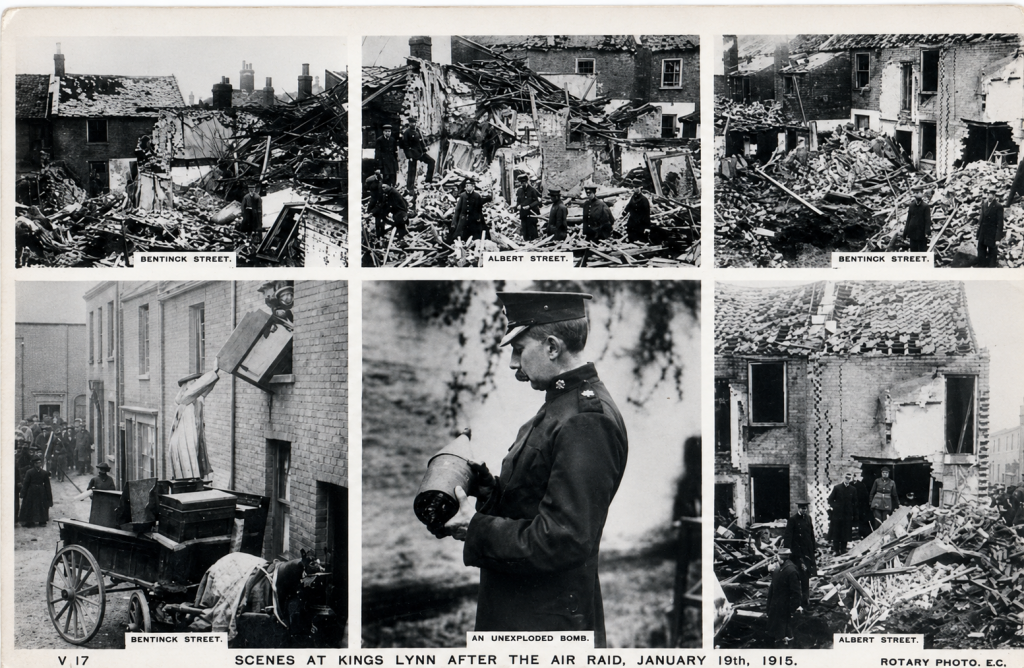
The worst damage was in Bentinck Street. The Imperial War Museum photograph of the scene shows walls torn open, roofs broken, beams splintered, and household space turned into rubble. Its catalogue identifies the destroyed houses as the result of bombs dropped from Zeppelin L4 on 19 January 1915, and records the deaths of fourteen-year-old Percy Goate and twenty-six-year-old Alice Gazley.
Percy Goate was killed at home. His mother’s inquest evidence, quoted by The Gazette, is one of the most painful fragments of the whole story: she saw a bomb come through the skylight and strike the pillow where Percy was lying. She tried to wake him, but he was dead; then the house fell in.
That account has its power because it is so domestic. There is no battlefield scenery, no military language, and no heroic ending. There is a skylight, a pillow, a sleeping boy, and a mother who could not save him.
Alice Gazley
Alice Maud Gazley was the second person killed in King’s Lynn. Her surname appears in some accounts as Gazely or Gazeley, but the Imperial War Museum catalogue uses Gazley. Her story carries another grief. Alice had been widowed only a few months earlier when her husband was killed on the Western Front. The Gazette summarises this sharply: she was twenty-six, and her husband had died in the war overseas before the war came from the air to Norfolk.
In one household story, the distance between Flanders and King’s Lynn almost disappears. The war had taken Alice’s husband abroad, then reached her at home.
Albert Street, Cresswell Street, and the docks
Bentinck Street was the place of death, but not the only place hit. The Imperial War Museum also holds a photograph of damage in Albert Street, caused by the same Zeppelin raid. Another IWM record shows Chief Constable Hunt examining part of one of the bombs dropped on King’s Lynn. These photographs are valuable because they show the raid not as an abstract event, but as a local investigation into shattered buildings and dangerous fragments.
The docks also mattered. Lynn was an old port, and dockside damage naturally gave the raid a military or economic edge. Yet the deaths occurred not at a naval base or factory, but among houses. That is what made the attack so unsettling. Aerial war blurred the old line between the fighting front and the home front.
Why no one stopped it
It is tempting, from a later Second World War perspective, to ask why the Zeppelin was not shot down. The answer is simple: Britain’s air defences were not yet ready for this kind of attack. There was no radar, no mature warning system, and no reliable method of finding a Zeppelin at night over dark countryside.
Aircraft did attempt to respond to the broader threat, but without success. Ian Castle’s reconstruction records that no effective defensive sortie was made against L3 or L4. Information arrived late, positions were uncertain, and aircraft that did take off elsewhere suffered mechanical problems. For King’s Lynn, the practical defence was darkness, luck, and waiting.
The first shock of aerial war
The raid on Great Yarmouth and King’s Lynn did not alter the course of the war. The wider attack killed four people and injured sixteen. In King’s Lynn, Percy Goate and Alice Gazley were killed, and thirteen others were injured. The National Army Museum records the raid as the first Zeppelin raid on Britain, with Great Yarmouth and King’s Lynn bombed on 19 January 1915.
Its importance lies in what it announced. War could now arrive above an English town in darkness. It could reach civilians far from the trenches. It could turn a bedroom, a street, or a dockyard into part of the war zone.
King’s Lynn’s raid has never become as nationally famous as the Blitz, but locally it deserves to be remembered with care. It connects the town to the beginning of aerial bombardment in Britain. It also reminds us that the home front was not only a matter of rationing, recruiting, and patriotic resolve. Sometimes it meant listening to engines overhead and not knowing where the next bomb would fall.
Conclusion: the night Lynn joined the air age
The Zeppelin raid over King’s Lynn lasted only a short time, but it gave the town a place in the history of modern warfare. Lynn was not the intended target. Its people had done nothing more dangerous than live under a route created by poor weather, uncertain navigation, and a new military technology.
That is what makes the story so disturbing.
Percy Goate was fourteen. Alice Maud Gazley was twenty-six. Their deaths show how the First World War entered Norfolk not only through enlistment and bereavement, but through the air, at night, above ordinary streets.
© James Rye 2026
Book a Guided Tour with a Trained and Qualified King’s Lynn Guide Through Historic Lynn
References
- Castle, Ian. “19 Jan 1915.” Ian Castle Zeppelin Raids.
- Imperial War Museums. “The German Bombing Campaign Against England, 1915–1918,” Q 53591 and Q 53585.
- National Army Museum. “The Air Raid on King’s Lynn, 1915.” NAM. 2007-03-8-13.
- The Gazette. “This Month in History: World War 1 Norfolk Zeppelin Raids.”