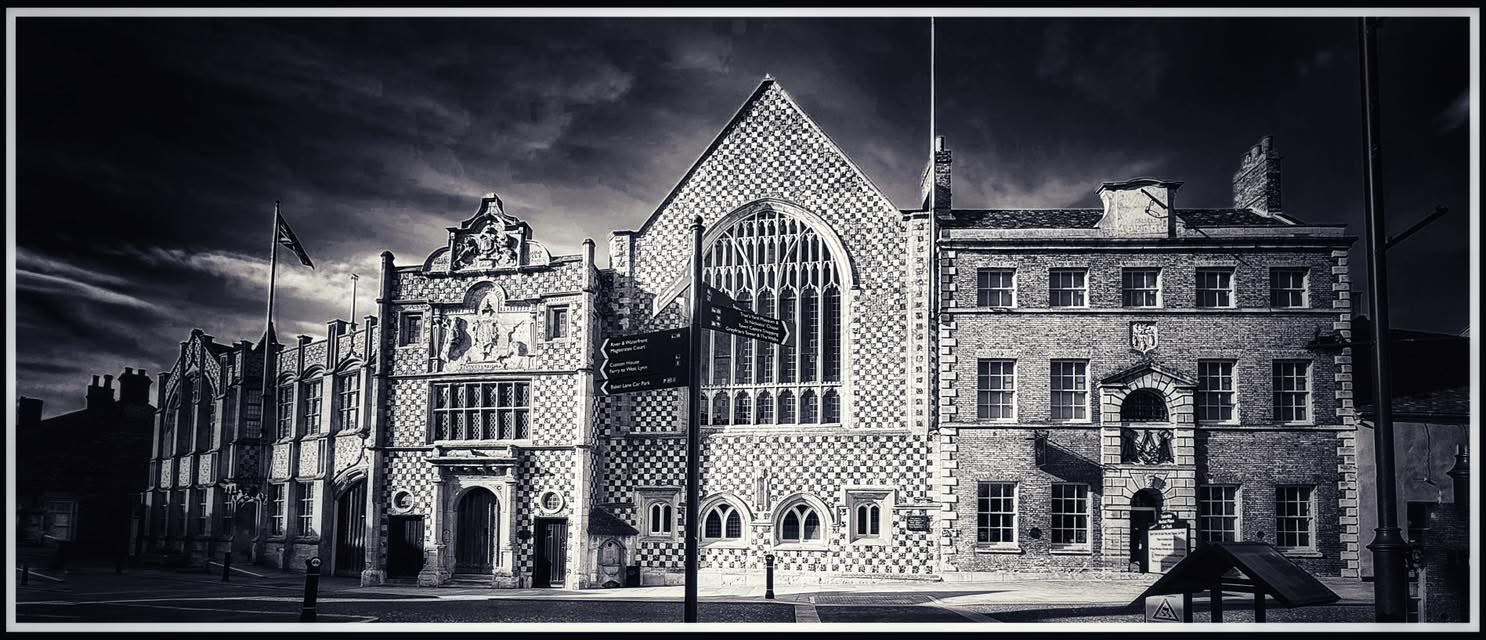
High above the chancel arch in St Margaret’s Church, now King’s Lynn Minster, hangs a large, brightly painted royal coat of arms. At first sight, the inscription seems to date it to 1669 and to associate the Order of the Garter with two churchwardens. Look more closely and a different story emerges. The date is 1660, the churchwardens were not Garter knights, and the shield no longer belongs to the king for whom the carving was made.
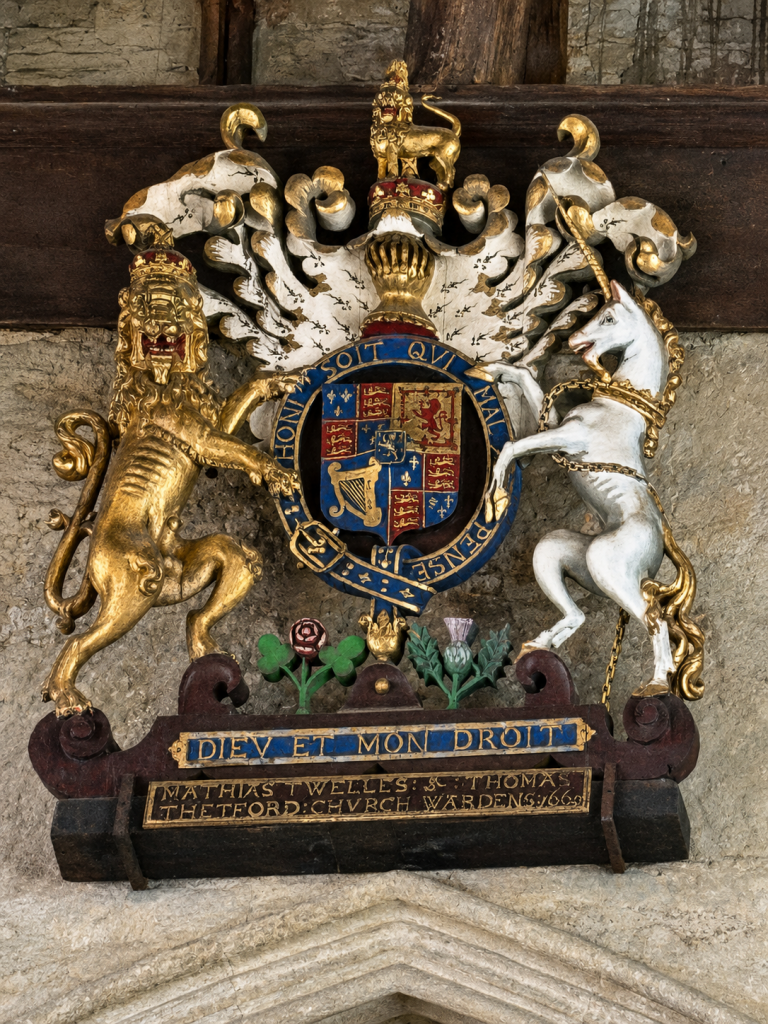
Photo © Simon Bell 2026
This single object records two upheavals in seventeenth-century England. It was commissioned to celebrate the return of Charles II after the Commonwealth. About thirty years later, it was altered to recognise William III and Mary II, the monarchs who replaced Charles’s brother James II.
Not simply a crest
The object is often called a crest, but that term properly describes only the crowned golden lion at the top. The complete display is a royal achievement of arms. It includes the shield, crown and helmet, decorative mantling, supporters, blue Garter, royal motto, and national badges.
At the bottom is the inscription:
MATHIAS TWELLES : & : THOMAS THETFORD : CHVRCH WARDENS : 1660
The final zero can look like a nine when viewed from the church floor. The use of V in place of U, as in CHVRCH and DIEV, was conventional in seventeenth-century inscriptions.
Nothing in the wording says that Mathias Twelles and Thomas Thetford paid for the arms themselves. As churchwardens, they managed parish property, supervised repairs, authorised expenditure, and accounted for work on the building. Their names identify the officials responsible during the year in which it was erected.
The king returns
In 1650 Lynn’s Assembly ordered the removal of royal arms from the town’s churches. Royal emblems were also taken from the mayoral sword scabbard. Four years later, the arms of the Commonwealth were engraved on four borough maces. These changes announced that kingship had ended and that a new government claimed the town’s obedience.
Charles II returned to England in May 1660. Lynn’s Assembly ordered that “the kinges Armes” should be “sett vp as formerly they were”. St Margaret’s did not merely retrieve an old painted board. The churchwardens paid the Lynn craftsman Daniel Shaw £16 for “carving & setting up the King’s Armes & tymber”. Another £10 was charged for painting and gilding.
The £26 cannot be translated honestly into a single modern sum. Comparisons based on wages and purchasing power give different results. The accounts show, however, that this was a substantial parish commission involving specialist carving, new timber, extensive painting, and gilded decoration.
Shaw was already an established local craftsman. He had become a freeman of Lynn in 1628 and undertook other civic work, including carving the town arms and a stone lion. The achievement at St Margaret’s was therefore a locally made proclamation that monarchy had returned.
Royal arms in churches carried a religious meaning as well as a political one. They represented the authority of the Crown and the monarch’s position within the Church of England. Restoring them after the Commonwealth announced the return of the established Church alongside the restored king.
An old carving for new monarchs
The inscription fixes the carving’s origin in the first year of Charles II’s restoration, but the shield now displays the joint arms of William III and Mary II.
It is divided vertically. On the viewer’s left are William’s royal arms, overlaid with a small blue shield for his ancestral House of Nassau. On the viewer’s right are Mary’s arms. The main quarters contain the English lions, Scottish lion, Irish harp, and French fleurs-de-lis. English monarchs retained the old claim to France in their arms until 1801.
William and Mary accepted the Crown jointly in 1689 after James II fled the country. Mary died in December 1694, after which William ruled alone and used a different arrangement. The alteration of the St Margaret’s shield can therefore be dated with reasonable confidence to the joint reign between 1689 and 1694.
The antiquary Edmund Farrer recognised this when he recorded the church’s heraldry in 1893. He described it as “The Royal Arms of William and Mary”, adding that it had been altered because the inscription beneath still carried the wardens’ names and the date 1660.
We do not yet know how the alteration was made. The central shield may have been repainted or fitted with additional pieces. Much of the surrounding carving could remain exactly as Daniel Shaw produced it for Charles II. Later restorations may also account for some of the brilliant colour visible today.
The Garter was not awarded to the churchwardens
The blue band surrounding the shield represents the Order of the Garter. It bears the motto Honi soit qui mal y pense, usually translated as “Shame on him who thinks evil of it”. Edward III founded the Order in 1348, and the monarch is its sovereign.
The Garter appears here because it forms part of the sovereign’s heraldic achievement. It does not indicate that Twelles or Thetford belonged to the Order. Their names appear on a separate panel beneath the royal arms and record their parish office.
Below the shield is a second motto, Dieu et mon droit, meaning “God and my right”. The crowned golden lion supporting the shield represents England. The white unicorn represents Scotland and is shown wearing the chain found in royal heraldry. The chain has no special connection with Lynn.
Two churchwardens who became mayors
Twelles and Thetford belonged to the small group of merchants and aldermen who governed seventeenth-century Lynn. Mathias Twelles later served as mayor in 1666 and died in 1676. A nineteenth-century antiquary recorded his tombstone in St Margaret’s and described his family arms as containing six wells, a visual pun on the name Twelles.
Thomas Thetford became mayor in the civic year 1676–77. He was later associated with the establishment of an organ at St Margaret’s. Their careers show how parish administration and borough government drew upon the same body of prosperous townsmen. The inscription does not commemorate two obscure caretakers. It names future mayors who were answerable for an expensive and politically charged commission.
The carving was not discarded when the Crown changed hands again. Instead, the old royal arms were made to serve the new joint monarchy. Charles II’s date remained beneath William and Mary’s shield, where it can still be read more than three and a half centuries later.
© James Rye 2026
Book a Guided Tour with a Trained and Qualified King’s Lynn Guide Through Historic Lynn
References
- Borough Council of King’s Lynn and West Norfolk. “List of Mayors of King’s Lynn, 1248–2025.” Accessed 18 August 2026. https://www.west-norfolk.gov.uk/download/downloads/id/5646/list_of_mayors_of_kings_lynn_1248_to_2025.pdf.
- Cox, Noel. “Authority for the Use of the Royal Arms in Churches.” Ecclesiastical Law Journal 5, no. 27 (2000): 408–416. https://www.cambridge.org/core/journals/ecclesiastical-law-journal/article/authority-for-the-use-of-the-royal-arms-in-churches/6DAADFD5C65F7FBCACD58422261BEAC6.
- Farrer, Edmund. The Church Heraldry of Norfolk. Vol. 3. Norwich, 1893. https://archive.org/stream/churchheraldryn04farrgoog/churchheraldryn04farrgoog_djvu.txt.
- Hillen, Henry J. History of the Borough of King’s Lynn. Vol. 1. 1907. https://archive.org/stream/historyofborough01hill/historyofborough01hill_djvu.txt.
- Norfolk Record Office. “St Margaret’s Churchwardens’ Accounts with Vestry Minutes, 1605–1674.” PD 39/74. Catalogue description through The National Archives. https://discovery.nationalarchives.gov.uk/details/r/004ebccb-871a-4e59-8537-313658a61387.
- Pardoe, Rosemary A. “Royal Arms in Churches: The Artists and Craftsmen.” 1987. https://www.users.globalnet.co.uk/~pardos/RoyalArms4.html.
- Royal Household. “The Order of the Garter.” Accessed 18 August 2026. https://www.royal.uk/the-order-of-the-garter.
- Royal Collection Trust. “Coat of Arms of William and Mary.” Accessed 18 August 2026. https://www.rct.uk/collection/39249/coat-of-arms-of-william-and-mary.