The history of Elsden’s Almshouses contains a date that refuses to behave. Later directories say that they were founded in 1842. The buildings in Friars Street, however, date from 1866. Their founder had died thirty-four years earlier, leaving money for almshouses that could not be built during his widow’s lifetime.
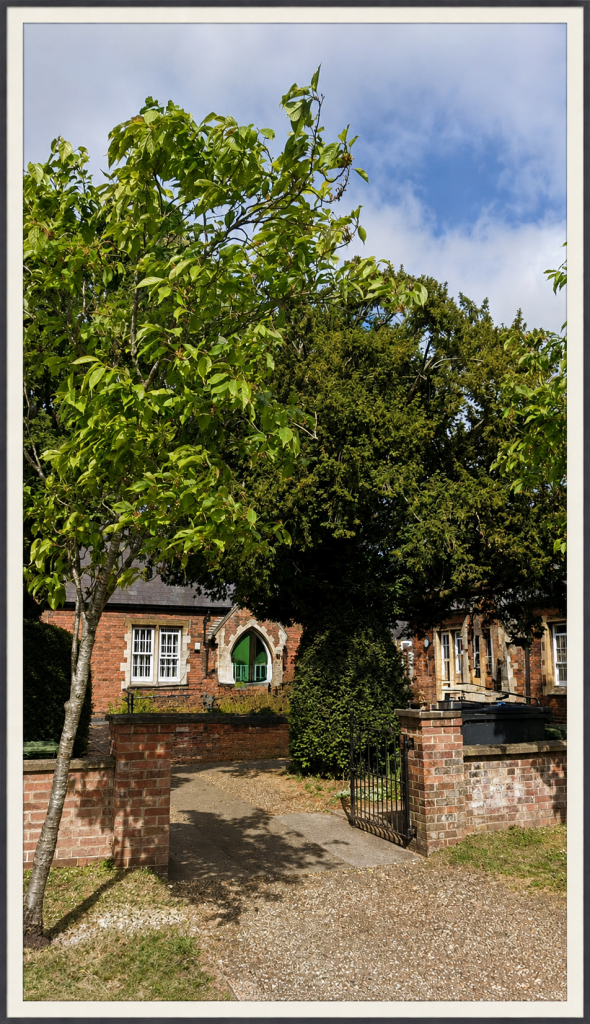
Photo © James Rye 2026
The result was a charitable gift suspended for more than three decades. Edmund Elsden never saw the eight houses bearing his name, and the widow whose life interest delayed their construction also died before the first residents arrived.
A gift delayed for a lifetime
Edmund Elsden was born on 24 February 1789 into an established King’s Lynn mercantile family. Poll books described him as a Lynn merchant in 1822 and again in 1826, although later accounts called him “of Congham”. He married Mabella Baxendale at St Mary’s Church, Lancaster, on 6 October 1814. They had no known children.
Edmund died on 12 January 1832, aged forty-two. According to Henry J. Hillen’s History of the Borough of King’s Lynn, he left £6,000 to trustees, subject to Mabella’s interest during her lifetime. After her death, the money was to pass to the Lynn Charity Trustees so that they could build and endow eight almshouses.
The intended occupants were poor men aged at least sixty who were “lawfully settled” in South Lynn. Legal settlement determined which parish was responsible if someone required poor relief. Edmund’s charity was therefore reserved for a narrowly defined local group rather than for elderly people from Lynn generally.
The £6,000 had to pay for the buildings and provide an invested endowment. It cannot be treated simply as the construction budget. Part of the fund needed to produce income for the residents and meet the continuing cost of repairs.
Mabella survived Edmund by more than thirty-three years. Her memorial at Heacham records her death on 23 April 1865, aged seventy-three. Hillen mistakenly called her father Josiah “Barendale”, but the memorial and Lancaster records agree that the family name was Baxendale. The surviving almshouses were erected in 1866, soon after her death.
Mabella should not be portrayed as obstructing Edmund’s charity. He deliberately gave her a lifetime interest in the fund. The full legal arrangement will remain uncertain until his original will is examined, but the trustees appear to have been unable to use the capital for the almshouses while she lived.
The date that does not fit
The Comprehensive Gazetteer of England and Wales, published in 1894–95, says that Elsden’s Almshouses were founded in 1842 and possessed an annual income of £112. A directory-derived account repeats the date and gives the slightly more precise figure of £112 4s. This is probably the source of many modern references to an 1842 foundation.
Yet 1842 cannot be the construction date of the present range. Mabella was still alive, Hillen says that the houses were erected following her death, and the Borough Council’s conservation study dates them to 1866. Kelly’s directory of 1869 provides near-contemporary confirmation that they were then in use, listing “Elsden’s, Friar street, for 8 persons”.
Something connected with the trust may have happened in 1842, perhaps an enrolment or a change of trustees. No supporting record has yet been identified. It may instead be a printing error copied by later directory compilers. For now, 1832 is the date of Edmund’s bequest and 1866 is the date of the surviving buildings. The meaning of 1842 remains unknown.
Eight homes beside Whitefriars
The almshouses stand on the west side of Friars Street, partly screened by trees. Their stepped gables give the low range a deliberately historic appearance. The Borough Council’s 2008 conservation study called the buildings “picturesque” and judged them to possess considerable architectural merit.
The setting is much older. Friars Street follows the boundary of the medieval Carmelite precinct. The Carmelites, commonly known as the Whitefriars, established their Lynn house around 1260. Their land extended westwards towards the river, while Carmelite Terrace behind the almshouses follows its northern limit. Elsden’s is not a remnant of the friary. It is a Victorian foundation standing within a street pattern shaped by the medieval precinct.
The almshouses also preceded much of the housing behind them. The roads and terraces there, including Whitefriars Road and Carmelite Terrace, were developed during the 1870s. Elsden’s would initially have stood in a more open setting than it does today.
Kelly’s directory still recorded accommodation for eight people in 1912. The original capacity had therefore survived for more than forty years. The reported income of about £112 was the charity’s total annual income, not necessarily a sum divided equally among the residents. Some would have been required for maintenance and other expenses.
One household emerges from the First World War records. William and Susan Stannard lived at No. 4 Elsden’s Houses when their youngest son, Sidney Ernest Stannard, died as a prisoner of war on 30 September 1918. Sidney had worked for a Norfolk Street baker before enlisting in 1915. He was captured during the Second Battle of Gaza and buried in Baghdad North Gate War Cemetery. His parents’ address shows that a married couple occupied one of the houses, although it does not reveal which of them had been formally admitted to the charity.
A Victorian charity in modern use
Elsden’s is now administered within King’s Lynn General Charities. Its governing arrangements rest on Charity Commissioners’ schemes dated 31 August 1966 and 2 June 2005. The registered purpose is to provide almshouses for deserving people of good character resident in the Borough of King’s Lynn. The original restriction to elderly poor men legally settled in South Lynn has disappeared.
The accommodation has changed as well. King’s Lynn General Charities began modernising its five groups of almshouses in 1999. Basic bedsits were converted into homes with one or two bedrooms and modern facilities. A 2021 account says that the other four groups had been completed before the final phase at Framingham’s. This places the work at Elsden’s within that long programme, although its exact date is not given.
Alterations remain sensitive because of the buildings’ architectural character and conservation-area setting. In 2019, the trustees appealed over a proposal to replace windows at Nos. 1–8 Elsden’s Almshouses. The appeal was allowed on 23 August.
© James Rye 2026
Book a Guided Tour with a Trained and Qualified King’s Lynn Guide Through Historic Lynn
References
- Almshouse Association. “King’s Lynn General Charities Mark Completion of Almshouse Conversion.” The Almshouses Gazette, winter 2021–22. https://www.almshouses.org/wp-content/uploads/2022/04/WEB-Gaz-winter-2021-doubles.pdf
- Borough Council of King’s Lynn and West Norfolk. The Friars Conservation Area Character Statement. Approved 2003, revised 2008. https://www.west-norfolk.gov.uk/download/downloads/id/1913/kings_lynn_the_friars_con_area_leafletpdf.pdf
- Charity Commission for England and Wales. “Elsdens Almshouses (Almshouse Charities), Charity 233003-37.” https://register-of-charities.charitycommission.gov.uk/en/charity-search/-/charity-details/15626
- Farrer, Edmund. The Church Heraldry of Norfolk. Norwich: A. H. Goose and Co., 1887. https://archive.org/stream/churchheraldryn00farrgoog/churchheraldryn00farrgoog_djvu.txt
- Hillen, Henry J. History of the Borough of King’s Lynn. Vol. 2. Norwich: East of England Newspaper Company, 1907. https://archive.org/stream/historyofborough02hill/historyofborough02hill_djvu.txt
- Kelly and Co. The Post Office Directory of Cambridge, Norfolk and Suffolk. London: Kelly and Co., 1869. https://leicester.contentdm.oclc.org/digital/api/collection/p16445coll4/id/241154/download
- Kelly’s Directories. Kelly’s Directory of Norfolk. London: Kelly’s Directories, 1912. https://leicester.contentdm.oclc.org/digital/api/collection/p16445coll4/id/248272/download
- Roll of Honour. “South Lynn, All Saints.” https://www.roll-of-honour.com/Norfolk/SouthLynnAllSaints.html
- UK Genealogy Archives. “King’s Lynn, Norfolk.” Transcription from The Comprehensive Gazetteer of England and Wales, 1894–95. https://ukga.org/index.php?pageid=6804
- West Norfolk Borough Council. Appeals Report, Third Quarter 2019. https://democracy.west-norfolk.gov.uk/documents/s36199/Appeals%203rd%20qtr%202019.pdf