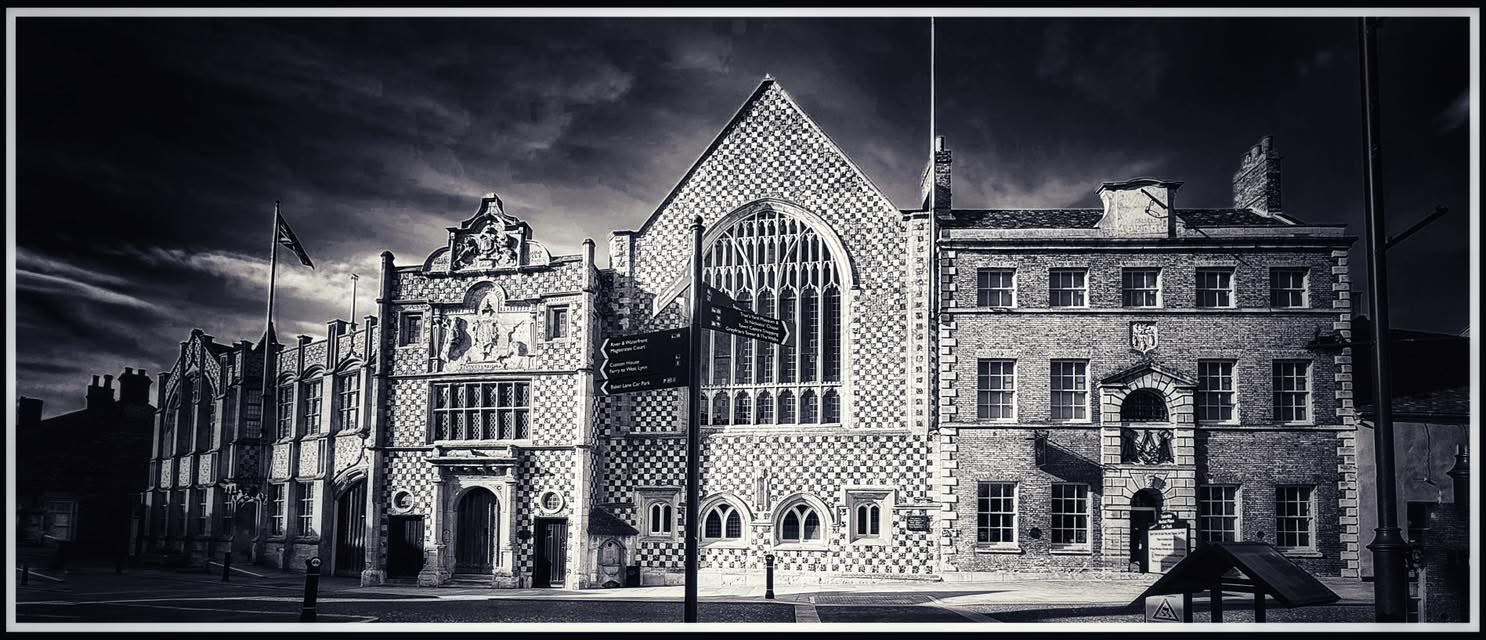
In 1800, King’s Lynn was still recognisably the town it had been for centuries. Ships crowded the river and quays, merchants traded from substantial houses near the waterfront, fishermen lived around the North End, and carts brought agricultural produce in from the surrounding countryside. Yet behind some of the town’s handsome streets lay a very different Lynn: a maze of courts, yards, and narrow alleys where poorer families lived in cramped and often insanitary conditions.
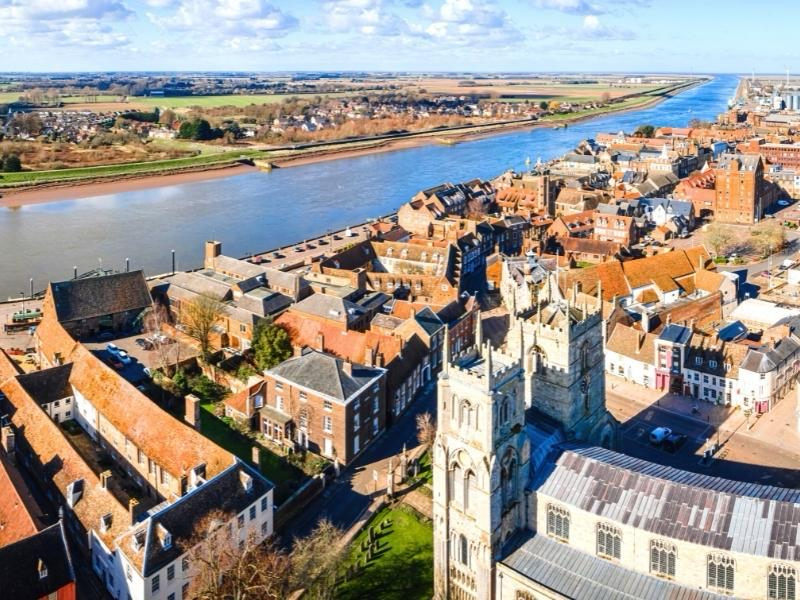
Source Unknown
Over the next two centuries, much of that world disappeared. Railways challenged the old coastal trade. New docks pushed the port northwards. Foundries and engineering works appeared, producing everything from boilers and bearings to locomotives and fairground rides. Lynn was bombed from the air in two world wars and inundated by the catastrophic flood of 1953. Then came perhaps the greatest transformation of all. From the 1960s, London overspill brought thousands of new residents, factories spread across industrial estates, housing expanded over surrounding fields, and bulldozers removed a substantial part of the historic town centre.
The King’s Lynn of 2000 was therefore a very different place from the Lynn of 1800. The remarkable part of the story is how much of the old town survived while another town grew around it.
A town that grew steadily, then changed sharply
King’s Lynn’s population rose during the early nineteenth century and reached 13,370 by 1831. By 1901 the municipal borough had 20,288 people, and by 1911 the figure was 20,201. That near-stability in the early twentieth century shows the kind of town Lynn was. It was growing, but not through the explosive industrial expansion seen in larger manufacturing centres. Its strength lay instead in trade, services, transport, engineering and its role as the urban focus for west Norfolk.
The sharp break came after the Second World War. In 1962 King’s Lynn was chosen for London overspill development. Local authority material records plans to expand the town from roughly 25,000 to 50,000 people in twenty years. In practice the population reached about 38,000 by 1975. New housing, new schools and new industrial jobs changed the town’s scale. Lynn was no longer simply growing by degrees. It was being deliberately reshaped.
The hidden town behind the main streets
Victorian Lynn contained some handsome streets and substantial buildings, but much of its population lived in very different surroundings. Borough conservation material records that around 160 alleys or yards once existed off the main streets and housed nearly a third of the population. That is one of the most revealing facts about nineteenth century Lynn. Much of the town’s working population lived in cramped, unhealthy and overcrowded conditions hidden behind more respectable frontages.
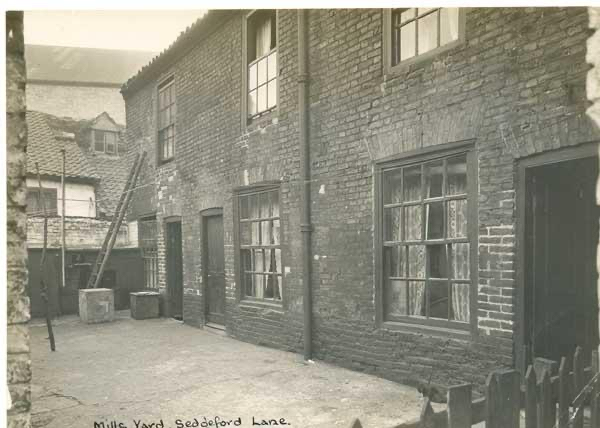
Source King’s Lynn Forums
These conditions shaped everyday life. They affected health, privacy, child-rearing and the experience of poverty. The King’s Lynn Poor Law Union was formed in 1835, and after the collapse of the old St James workhouse in 1854 a new workhouse was built in 1856. That building survives as a reminder that hardship and dependence were woven into the town’s social structure. Lynn’s poorer inhabitants were not peripheral to its history. They were central to it.
Port and trade
Lynn remained a working port throughout the nineteenth century and into the twentieth. It served as the maritime outlet for an agriculturally rich district and handled imports and exports on a meaningful scale. Around 1910, trade directory evidence recorded exports worth £649,000 and imports worth £559,000. That was not the trade of a dead port. Lynn still mattered commercially, even if its age of greatest national prominence lay in the past.
The later nineteenth century dock works were part of the effort to keep it competitive. The King’s Lynn Dock Act 1869 authorised the Alexandra Dock, opened in 1869, and the Bentinck Dock followed in 1883. These improvements show a town investing in its future, though under growing pressure from larger ports and changing patterns of trade. Borough material comments that by the time the Bentinck Dock arrived, the great trading days of the port were already past. That was a hard judgement, but it captures the sense of a place modernising in order to hold ground rather than to dominate.
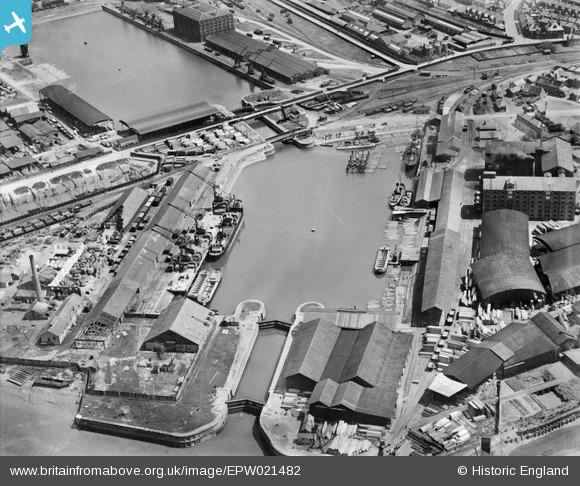
Source Historoic England
Railways changed the balance further. They improved access to inland and metropolitan markets, but they also weakened the old advantages of river and coastal shipping. Lynn could benefit from railway links and lose from them at the same time. That double pressure helps explain why the port endured without recovering its earlier pre-eminence.
Fishing, especially in the North End, remained part of the local economy and way of life. Shrimping and shellfishing never made Lynn into a major fishing port on the pattern of Grimsby or Lowestoft, but they gave the town another working maritime community beyond its merchants and dock interests. That world still survives in local memory and in the preservation of True’s Yard.
Engineering Lynn
One of the strongest threads in Lynn’s modern history is engineering. The town did not become a large industrial centre, but it supported a cluster of firms that gave it a much more substantial manufacturing life than many people now realise.
Aickman’s shows how far back that story runs. Historic England records the plaque above the entrance at 19 King Street reading “John Aickman’s Foundry, MDCCCXXVII”. That puts ironfounding securely into the town by the 1820s. The later workshops in Aickman’s Yard show continued industrial use of the site into the late nineteenth and early twentieth centuries.
Savage’s became the town’s most famous engineering name. Frederick Savage set up in Lynn in 1850, first producing and repairing agricultural machinery. From there the business expanded into traction engines and then into fairground equipment, the field for which it became nationally and internationally known. At its height, the firm employed hundreds of men, and the St Nicholas Ironworks became one of the best-known industrial sites in the town. Savage’s gave Lynn a reputation for ingenuity as well as workmanship.
Dodman’s belonged to the same industrial world. Borough conservation material describes Dodman’s Highgate Ironworks, founded in 1875, as making boilers, locomotives and ships. That brief description says a great deal. Lynn was supporting a firm engaged in substantial iron and engineering work tied to marine, railway and industrial demand. Dodman’s deserves to be remembered alongside Savage’s as part of the serious engineering life of the town.
Cooper took Lynn engineering into the twentieth century. The company was established in King’s Lynn in 1894, and Thomas Cooper’s split roller bearing, patented in 1907, became its great success. Cooper Bearings was important not only as an employer but as proof that Lynn could produce engineering of wider technical significance. It tied the town’s workshop culture to modern industry in a very direct way.
These firms change the way Lynn should be seen. It was not just a port with a historic core. It was also a town of foundries, machine shops, draughtsmen, boilermakers, fitters and skilled hands. Its industrial base was modest by national standards, but it was real and distinctive.
Civic growth and improvement
During the nineteenth century King’s Lynn also developed a stronger municipal structure. The borough archives preserve building-control material from 1883 onward, and by the early twentieth century the town had a mature borough administration of mayor, councillors and civic services. This was the framework within which streets, regulation, markets, public amenities and later housing intervention were managed.
Education formed part of that civic story. Technical and vocational provision grew in the later nineteenth century, reflecting the wider need for trained workers in commerce, engineering and the local economy. In Lynn, education was not simply an abstract social good. It was tied to the town’s effort to equip itself for a changing economic world.
War, flood and danger
The modern town was shaped by more than trade and industry. In January 1915 King’s Lynn became one of the first places in Britain to experience a Zeppelin raid. The National Archives identifies the attack on Great Yarmouth and King’s Lynn as the first Zeppelin raid on Britain. That gave the town an unexpected place in the history of the First World War home front.
During the Second World War Lynn again faced disruption, though on a lesser scale than heavily bombed cities. Norfolk Record Office material on the town’s bomb map shows that bombing still formed part of local wartime experience. The town’s docks, streets and public buildings were part of a landscape under pressure.
Then, in 1953, the east coast flood brought disaster. Government material marking the seventieth anniversary of the flood records fifteen deaths in King’s Lynn. That loss was a stark reminder that the town’s setting, which had long made it commercially valuable, also left it exposed.
Campbell’s, Hardwick, and the remaking of the town
Post-war Lynn took on a new form. The Campbell’s factory opened in 1959 at South Lynn, described by Norfolk Heritage Explorer as the first major Campbell’s factory built outside America. This was a sign that the town was attracting a new kind of industrial investment, one better suited to the age of industrial estates, road transport and large modern plants.
The overspill programme accelerated that shift. New estates expanded the town, and the Hardwick industrial area drew in many new firms. But this was also the era of large-scale redevelopment in the centre. Borough material states that between 1962 and 1971 one fifth of historic King’s Lynn disappeared in the area between London Road and the High Street, replaced by modern shopping developments and pedestrian schemes. That change gave Lynn new commercial space, but it also removed a great deal of older fabric that could never be recovered.
What emerged was a larger, more suburban and more mixed town than the borough of 1900. The old port survived. The engineering tradition survived in part. The historic core survived unevenly. But Lynn after the 1960s was not simply the older town enlarged. It was a town rebalanced around estates, industrial land, new roads and new housing.
Conclusion
King’s Lynn’s nineteenth and twentieth centuries were marked by continuity and change in equal measure. The port remained important, though under pressure. Poverty and overcrowding persisted long after they should have done. Engineering firms such as Aickman, Savages, Dodmans and Coopers gave the town a solid industrial character. War and flood exposed its vulnerability. Post-war planning then changed its scale and appearance more rapidly than anything that had come before.
Modern Lynn was not made by one single force. It was shaped by trade, labour, engineering, municipal ambition, hardship, demolition and planned growth. That is what gives its recent history its particular interest. It is the story of an old town learning, repeatedly, how to remain useful in a new age.
© James Rye 2026
Book a Guided Tour with a Trained and Qualified King’s Lynn Guide Through Historic Lynn
References
- Borough Council of King’s Lynn and West Norfolk. King’s Lynn: St Nicholas Conservation Area Character Statement. Accessed April 6, 2026. https://www.west-norfolk.gov.uk/download/downloads/id/1909/kings_lynn_st_nicholas_con_area_leafletpdf.pdf
- Borough Council of King’s Lynn and West Norfolk. King’s Lynn: The Walks Conservation Area Character Statement. Accessed April 6, 2026. https://www.west-norfolk.gov.uk/download/downloads/id/1911/kings_lynn_the_walks_con_area_leafletpdf.pdf
- Cooper Bearings. “About Us.” Accessed April 6, 2026. https://www.cooperbearings.com/about-us.asp
- Historic England. “19, King Street, King’s Lynn.” National Heritage List for England. Accessed April 6, 2026. https://historicengland.org.uk/listing/the-list/list-entry/1298220
- Legislation.gov.uk. King’s Lynn Dock Act 1869. Accessed April 6, 2026. https://www.legislation.gov.uk/ukla/Vict/32-33/40/contents/enacted
- Lynn Museum. Lorraine Ward. Frederick Savage, Victorian Fairground Manufacturer of King’s Lynn. Accessed April 6, 2026. https://www.lynnmuseum.norfolk.gov.uk/media/14481/A-history-of-savages/pdf/p6a-history-of-savages.pdf
- National Archives. “Zeppelin Raids.” Accessed April 6, 2026. https://www.nationalarchives.gov.uk/education/resources/zeppelin-raids/
- Norfolk Heritage Explorer. “Campbell’s Factory, King’s Lynn.” Accessed April 6, 2026. https://www.heritage.norfolk.gov.uk/record-details?Index=50396&MNF57846-Campbell%27s-Factory-Kings-Lynn=&RecordCount=57338&SessionID=9716759d-2ba8-4fb1-807c-8311ab48a832
- Norfolk Record Office. “King’s Lynn Borough Archives.” Accessed April 6, 2026. https://www.archives.norfolk.gov.uk/article/31098/Kings-Lynn-Borough-Archives
- University of Portsmouth, A Vision of Britain through Time. “Kings Lynn Municipal Borough: Total Population.” Accessed April 6, 2026. https://www.visionofbritain.org.uk/unit/10107684/cube/TOT_POP
- Workhouses.org.uk. “The Workhouse in King’s Lynn, Norfolk.” Accessed April 6, 2026. https://www.workhouses.org.uk/KingsLynn/
I can also make it a little more vivid at the opening if you want something punchier for Circato’s usual style.