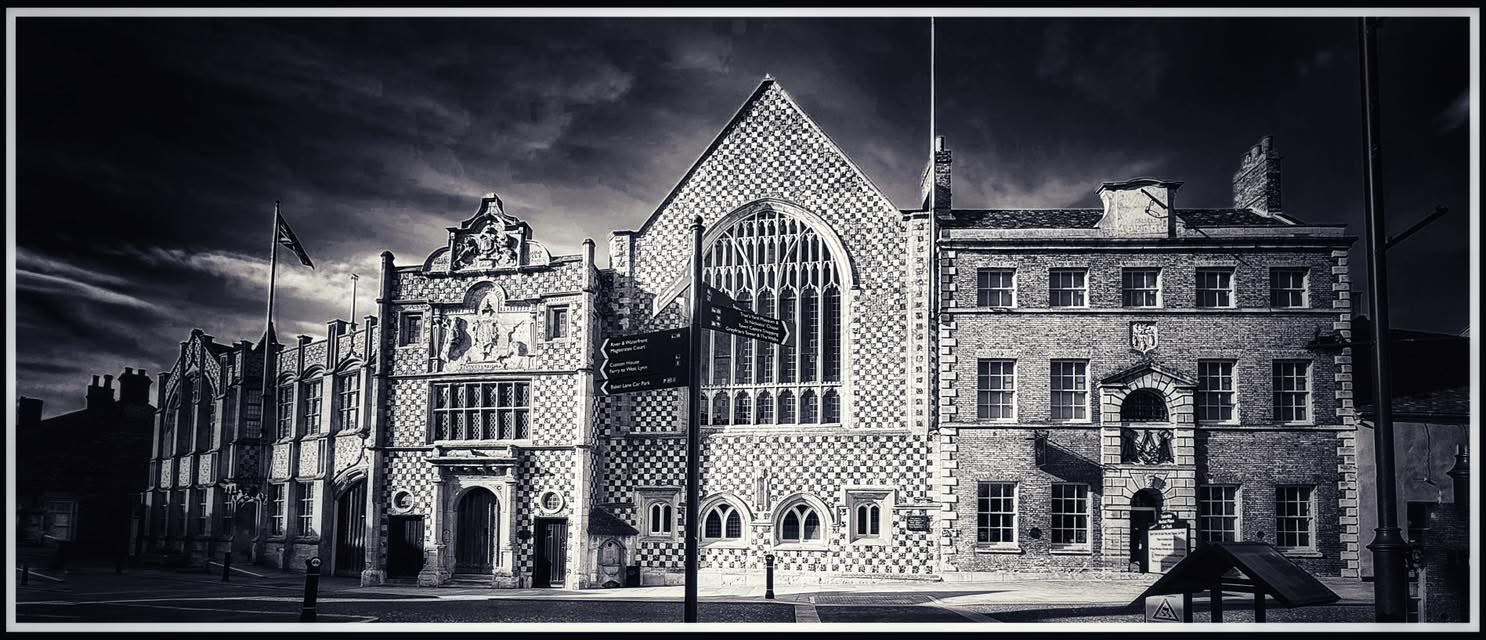
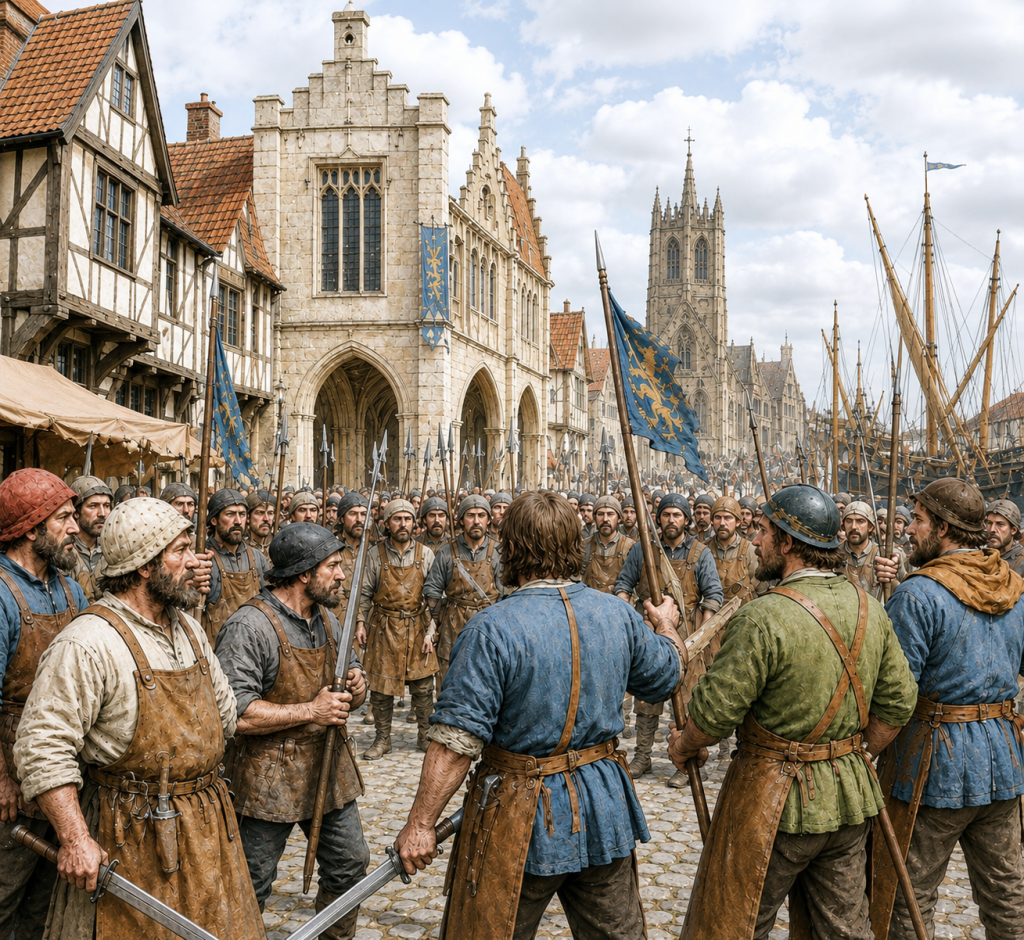
On 18 June 1381, the king’s peace was formally proclaimed in Bishop’s Lynn. It did not work. According to evidence later given to royal justices, rebels promptly seized Richard de Walton and prepared to behead him. He survived only after local people pleaded for his life. Another man was less fortunate. Haukyn Flemmyng was killed on the orders of the rebel leader John Spanye. The rebels then announced that men should prepare to ride out again the following morning.
The events in Lynn have been overshadowed by the better-known story of Wat Tyler, Richard II, and the rebels who marched into London. Even accounts of the rising in Norfolk tend to concentrate upon Norwich and the final confrontation at North Walsham. Yet the surviving records reveal that Bishop’s Lynn was caught up directly in the Great Revolt of 1381. For several extraordinary days, a group of Lynn craftsmen led an armed rising that extended from the streets of the town into Snettisham, Wolferton, East Rudham, Coxford, Barwick, and the woods around Castle Rising.
Why England rebelled
The revolt had been a long time coming. The Black Death of 1348–49 had killed a huge proportion of England’s population and transformed the labour market. With fewer workers available, surviving labourers could demand higher wages and better conditions. Parliament responded with measures intended to restrict wages and labour mobility. At the same time, the continuing war with France placed enormous demands on royal finances.
The immediate trigger in 1381 was taxation. The government of the young Richard II had imposed a succession of poll taxes, culminating in the deeply unpopular tax granted in 1380. The expected contribution was three groats [a groat was a silver coin worth four pence] for each person over the age threshold, although wealthier people were supposed to contribute more so that poorer taxpayers could pay less. Collection proved difficult, evasion was widespread, and commissioners were sent out to investigate why the sums collected fell so far short of expectations.
Behind the tax grievance lay much older disputes. Villagers challenged demands for labour services and manorial dues. Others resented local officials, landlords, lawyers, and royal government. When revolt broke out in Essex at the end of May, it spread with remarkable speed. Rebels entered London on 13 June. The following day the fourteen-year-old Richard II met them at Mile End, while other insurgents entered the Tower of London and killed the chancellor, Simon Sudbury, archbishop of Canterbury, and the treasurer, Robert Hales. On 15 June Wat Tyler was killed during the king’s meeting with the rebels at Smithfield.
But by then revolt had spread far beyond London.
Norfolk rises
Norfolk became one of the principal centres of rebellion. Here the leading figure was Geoffrey Lister, or Litster, a dyer from Felmingham in north-east Norfolk. Rebels gathered at Mousehold Heath outside Norwich, and the city itself was drawn into the disturbance. Sir Robert Salle, a prominent knight, was killed after confronting the rebels. Reginald de Eccles, a justice of the peace, was seized and beheaded.
Elsewhere, rebels attacked Carrow Priory and destroyed documents. At Great Yarmouth they forced the authorities to surrender the town’s charter. Such attacks on written records were highly significant. Medieval charters, court rolls, deeds, and manorial documents established who owed money, labour, rent, and obedience to whom. Destroying them could amount to an attempt to destroy the legal basis of an obligation.
The Norfolk rising eventually encountered an unusually formidable opponent. Henry Despenser, bishop of Norwich, was not content to leave suppression to others. He gathered an armed force and confronted the rebels at North Walsham towards the end of June. Lister was captured and executed, and organised rebellion in Norfolk collapsed.
Yet while Lister’s rising was developing in eastern Norfolk, something separate but closely related was happening in the west.
The revolt reaches Lynn
The first signs appear before the main outbreak in the town. John Coventry, a Lynn bowyer [a maker of bows], became involved in threats directed towards Nicholas de Massingham, a justice of the peace associated with poll-tax collection. By 17 June matters had escalated dramatically.
At the centre of the Lynn rising was John Spanye, sometimes recorded as Spayne. He was not an impoverished agricultural labourer. He was a freeman of Bishop’s Lynn who had been admitted to the freedom of the borough in 1373–74. He worked as a cordwainer [a maker of high-quality leather shoes, traditionally using fine Cordovan leather] and had connections with the Grassmarket area. Later Lynn records describe a tenement there associated with John de Spaigne, leatherdresser.
The occupations of the other men accused alongside him are revealing. Thomas Colyn was a tailor, John Whetewonge a weaver, Henry Cornish and Walter Prat were glovers, and another man, Pynchebeke, was a tailor. There was also a saddler. These were townsmen engaged in Lynn’s crafts and trades, rather than a band of agricultural peasants who had wandered into the borough.
That makes the familiar name “Peasants’ Revolt” particularly misleading when applied to Lynn.
Thirty armed men ride to Snettisham
On Monday 17 June, Spanye rode to Snettisham with about thirty men. According to the subsequent indictment, they were armed. Spanye encouraged the inhabitants to join the rising and began searching for Flemings. The purpose recorded by the jurors was chilling: they were looking for Flemish people in order to kill and behead them.
Spanye also threatened Ralph Panton with death. Panton, fearing for his life, paid ten shillings to one of Spanye’s servants.
The Snettisham expedition was only one part of the day’s activity. Another detailed indictment says that Spanye and his companions went to Wolferton, seized John Sibilye, and brought him back towards Lynn as a supposed traitor who was to be beheaded. He escaped with his life. Other allegations against the Lynn group include the theft of cattle.
The following day, Tuesday 18 June, the authorities attempted to restore order by proclaiming the king’s peace in Lynn.
The rebels ignored it.
A killing in Bishop’s Lynn
After the proclamation, Spanye’s men seized Richard de Walton and threatened to behead him. He escaped only through what the indictment calls the “great supplication” of good men.
Then came the killing of Haukyn Flemmyng.
His surname may itself identify his origins. The record says explicitly that he was killed on Spanye’s order. Another indictment states that the rebels beheaded an unidentified Fleming in Lynn. Whether these records describe the same killing or separate victims requires caution, but there is no doubt that violence against Flemings formed part of the Lynn rising.
This places Lynn within one of the darkest aspects of 1381. Flemings were attacked elsewhere during the revolt, most notoriously in London. England had attracted immigrants from the Low Countries, including skilled textile workers. In a trading and manufacturing town such as Lynn, foreign craftsmen and merchants were conspicuous enough to become targets when economic resentment and xenophobia erupted into violence.
After Haukyn’s killing, a proclamation was made that men should prepare themselves to ride the following day.
This was no longer spontaneous street disorder. Someone was organising the movement.
The rebels take to the road
On Wednesday 19 June, Spanye’s company headed out again. Their route can be followed with unusual detail in the subsequent legal record. They went first to Snettisham intending to seize Simon Wylymot. They then travelled to East Rudham in pursuit of Nicholas Maupas before continuing to Coxford, where they captured Simon de Snytirton.
Snytirton was threatened with beheading unless he paid them 40 shillings and 8 pence.
From there they went to Barwick. Nicholas Maupas was dispossessed of his free tenement and John Coventry, the Lynn bowyer, was put in possession.
The revolt was therefore spreading through the countryside around Lynn, but it retained a recognisably Lynn leadership. Nor were these the only actions attributed to townsmen. On 20 June Walter Prat, a Lynn glover, and Thomas Paynot were accused of confronting Robert, parson of Egmere, and threatening to cut off his head and tear off his limbs unless he paid them 104 shillings.
Threats of beheading recur remarkably often in the evidence. The rebels were adopting the language and methods of the wider revolt, in which those identified as “traitors” to the king and commons could be subjected to summary judgement.
An ambush near Castle Rising
The last major episode associated with Spanye’s group occurred on Saturday 22 June.
Their target was Sir Edmund de Reynham, a knight who had also served as one of the officials concerned with the third poll tax. The rebels ambushed him in a wood at Castle Rising and threatened him until he agreed to pay a ransom.
The indictment puts the demand at 40 shillings. Payment was apparently made not in cash but in grain. The record says that Reynham surrendered fourteen quarters of wheat, although some later accounts describe the payment as oats. The original database transcription gives wheat, so that is the safer reading.
The choice of victim brings the story back to where it began. The unpopular poll tax was not merely a distant cause of the rebellion. A man involved in administering it became personally vulnerable when royal authority temporarily weakened around Lynn.
What happened to John Spanye?
Spanye survived the revolt. His subsequent history also warns us against treating every accusation in the indictments as unquestionable fact.

Source: North Walsham Guide.
The Crown’s judicial machinery moved into action once order had been restored. Rebels were prosecuted, pardons were issued, and accusations were examined. Spanye was initially excluded from the general pardon. He subsequently claimed that accusations of murder and pillage had been made falsely by enemies.
Remarkably, he eventually secured a royal pardon in 1383, with Bishop Despenser reportedly testifying in his favour. Even more strikingly, Lynn’s own records show him still associated with property in the town years later.
This creates an intriguing problem. The indictments portray Spanye as the leader of armed men who threatened victims, hunted Flemings, extorted money, and ordered a killing. Yet he was later pardoned and remained part of Lynn society. Medieval indictments recorded allegations presented by juries, not modern criminal convictions reached after testing every piece of evidence. Personal feuds and attempts to settle old scores could become entangled with genuine prosecutions after a rebellion.
We should therefore resist turning the indictments into a straightforward eyewitness narrative. But their accumulated detail is too substantial to dismiss.
Lynn was not a bystander
For a long time it has been easy to imagine the Great Revolt passing Bishop’s Lynn by. The dramatic Norfolk story appears to belong elsewhere, to Norwich, Mousehold Heath, and North Walsham.
The surviving evidence tells a different story.
For several days in June 1381, royal authority around Lynn became fragile enough for local craftsmen to assemble under their own leaders and ride armed through the surrounding countryside. Men were seized and threatened with execution. Money, property, cattle, and grain were taken. At least one Fleming was killed in Lynn. A poll-tax official was ambushed near Castle Rising. Even after the king’s peace had been proclaimed, the rebels continued their activities.
It was not a revolt on the scale of Norwich, and we should not pretend that the evidence allows us to reconstruct everything that happened inside Lynn. Yet the central fact is now difficult to dispute. The Great Revolt did reach Bishop’s Lynn.
And, for a few dangerous days in June 1381, John Spanye and his fellow craftsmen appear to have been in command of the road out of town.
© James Rye 2026
Book a Guided Tour with a Trained and Qualified King’s Lynn Guide Through Historic Lynn
References
- Barker, Juliet. England, Arise: The People, the King and the Great Revolt of 1381. London: Little, Brown, 2014.
- Lacey, Helen. “‘Grace for the Rebels’: The Role of the Royal Pardon in the Peasants’ Revolt of 1381.” Journal of Medieval History 34, no. 1 (2008): 36–63.
- Pajic, Milan. “Anti-Fleming Sentiment and the Peasants’ Revolt of 1381.” In Flemish Textile Workers in England, 1331–1400: Immigration, Integration and Economic Development. Cambridge: Cambridge University Press, 2023.
- People of 1381. “John Spayne [Spanye, Spaygne, Spaigne], King’s Lynn, Norfolk.” People of 1381 biography of John Spayne
- People of 1381. “John de Spanye: Participant and Incidents.” Based principally on The National Archives, KB 9/166/1, including membranes 68 and 81. People of 1381 database record for John Spanye
- Powell, Edgar. The Rising in East Anglia in 1381. Cambridge: Cambridge University Press, 1896.
- Schoon, Paul. “The Role of News and Rumour during the Peasants’ Revolt, 1381.” Historical Research 97, no. 278 (2024): 458–475.
- Whittle, Jane. “Peasant Politics and Class Consciousness: The Norfolk Rebellions of 1381 and 1549 Compared.” Past & Present 195, supplement 2 (2007): 233–247.