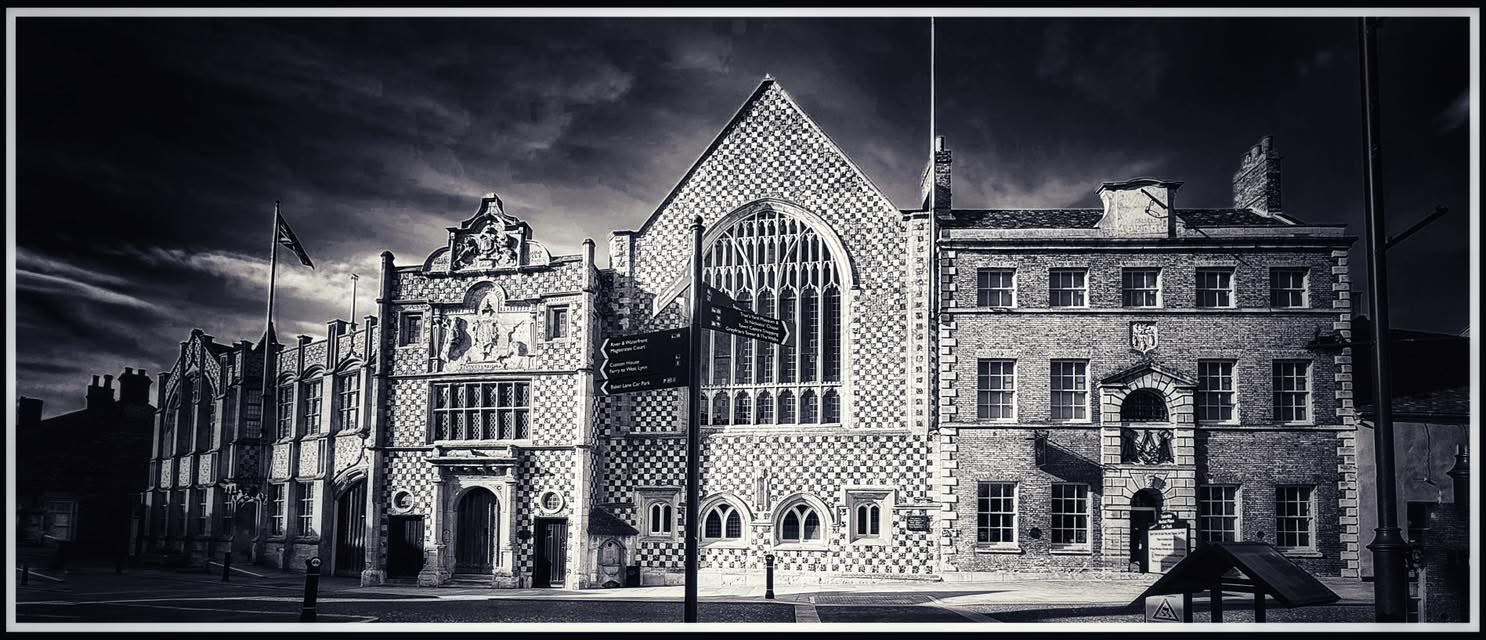
In June 1688, King James II effectively sacked the government of King’s Lynn. Mayor Robert Sparrow was removed from office. So were five other aldermen, eight members of the Common Council, and the Town Clerk. Fifteen Corporation officers disappeared at royal command. James then instructed those who remained whom they were to choose as replacements, including the man who was to become mayor. A few months later, the King intervened again to keep his preferred mayor in office.
For a borough which had guarded its privileges for centuries, this was an extraordinary intrusion. Yet James had not suddenly invented the power to interfere. Four years earlier, King’s Lynn had surrendered important elements of its corporate independence to his brother, Charles II. The events of 1684 and 1688 were therefore two stages of the same story, and Lynn was not alone. Across England, the later Stuart monarchy was attempting to bring troublesome and politically valuable borough corporations under much tighter royal control.
Why Charles II wanted control of the corporations

The struggle began far beyond Lynn. During the later 1670s and early 1680s, Charles II faced a political crisis over the succession of his Roman Catholic brother, James, Duke of York. The attempt to exclude James from the throne helped divide national politics between emerging Whig and Tory groupings. Borough corporations became caught in that struggle because they possessed considerable local power. They appointed officers, administered justice, enforced legislation concerning religion, and, in many towns, could exert considerable influence over parliamentary elections. Control of corporations therefore offered the government one route towards a more dependable political nation.
Charles’s government began to lean more on the charters that allowed towns to run themselves. A common tool was ‘quo warranto’, a legal process that made corporations show how they had the right to use their privileges. In 1683, London lost its charter. Elsewhere, the idea of costly and risky legal battles made corporations eager to give up their charters on their own and accept new ones. These new charters often gave the Crown the power to remove municipal officials. By the time Charles II died in 1685, this campaign had really impacted corporate England, and King’s Lynn was right in the middle of it.
Lynn gives up its charter
On 26 May 1684, Mayor Benjamin Keen, the aldermen, and the Common Council agreed to surrender to Charles II important powers concerning the election and appointment of the town’s magistrates and officers. Three days later the surrender was formally sealed. On 9 June, the Corporation authorised representatives to surrender the borough’s charter and liberties and petition the King for a new grant.
The process moved quickly. A replacement charter was dated 9 July and read before the Corporation on 24 July. Within about two months, privileges which Lynn had accumulated and defended over generations had been surrendered and returned in a different constitutional form.
The eighteenth-century historian William Richards, drawing heavily upon Lynn’s Hall Books, portrayed the Corporation as submitting reluctantly to royal pressure. Richards was writing in 1812 and was emphatically hostile towards the later Stuarts, so his judgements have to be separated from the contemporary evidence he reproduced. There is no need, however, to accept all of Richards’s rhetoric to recognise what had happened. Lynn had surrendered its existing constitutional position and received a new charter from the King containing a particularly dangerous provision. The Crown reserved the right to remove members of the municipal government.
There was also a political reward, or at least an interesting coincidence. Richards records that prominent Lynn figures including John Turner received knighthoods around the time of the surrender. Turner would later discover that favour from the Crown could be remarkably short-lived.
For the moment the Corporation continued governing the town, and the reserved royal power may have seemed remote. Four years later, James II demonstrated exactly what it meant.
Fifteen men dismissed
Charles II died in February 1685, and James succeeded him. The new king soon became embroiled in a political struggle over the legal restrictions imposed upon Roman Catholics and Protestant Dissenters. James wanted the Test Acts and penal laws removed, but Parliament was unlikely to cooperate. The composition of any future House of Commons consequently became increasingly significant, and that brought the boroughs back into the calculations of the royal government.
The machinery created during Charles II’s campaign against the corporations now gave James a formidable weapon. If municipal office holders appeared politically unreliable, they could be removed. In many towns the Crown began remodelling corporations in the hope of producing local governments, and ultimately parliamentary representatives, more amenable to royal policy.
King’s Lynn received its orders on 1 June 1688.
An Order in Council invoked the provision in Lynn’s new charter which reserved to the King the power to remove municipal officers. Ten days later, on 11 June, the purge was carried out. Mayor Robert Sparrow lost his position. Aldermen Sir John Turner, Benjamin Holly, William Hadfield, Robert Pain, and Giles Bridgeman were removed. Eight Common Councilmen were dismissed with them, together with Edmund Rolfe, the Town Clerk. Fifteen men had been swept out of Lynn’s government.
The Crown did not leave the Corporation to choose their successors freely. A royal mandate instructed the surviving members to elect John Davy as mayor, together with five named aldermen, eight specified Common Councilmen, and a new Town Clerk. The newcomers were even dispensed from some of the statutory oaths normally required of municipal officers. This was no longer indirect influence. Whitehall was deciding who should govern King’s Lynn.
The episode also complicates any simple picture of a united town resisting an interfering king. The Corporation represented a relatively small governing elite, whose members had their own family connections, political loyalties, religious sympathies, rivalries, and ambitions. Historians such as Paul Halliday have shown that Crown attacks upon municipal charters could interact with factional struggles within towns themselves. Royal intervention which ruined one group of office holders could advance another.
The Lynn names deserve attention in that light. Benjamin Keen had been mayor when the Corporation agreed to surrender in 1684. Robert Sparrow was removed from the mayoralty in 1688. John Davy benefited spectacularly from the royal intervention. Sir John Turner is more intriguing still. One of Lynn’s wealthiest and most prominent citizens, he had received royal favour around the time of the 1684 settlement, but James’s government nevertheless removed him as an alderman four years later. Lynn’s internal political story is not yet clear enough to identify precisely who manoeuvred against whom, but the purge certainly produced local winners as well as losers.
James chooses Lynn’s mayor
The most striking demonstration of Lynn’s reduced independence came a few months later. The annual election of the mayor at Michaelmas was one of the central events in the Corporation’s calendar. In September 1688, however, James sent another mandate. John Davy was to continue as mayor for the following year. The Corporation obeyed.
For practical purposes, King’s Lynn now had a mayor chosen by the King. The surrender of 1684 had ceased to be an obscure constitutional transaction buried in the Corporation’s records. Its consequences were sitting in the mayor’s chair. Yet James’s triumph over Lynn’s municipal independence lasted only a few weeks.
A King in trouble changes his mind
By the autumn of 1688, James II was in desperate difficulty. William of Orange was assembling an invasion force in the Netherlands, while James’s support within England was crumbling. Policies which had once seemed demonstrations of royal authority suddenly became political liabilities. The King needed friends.
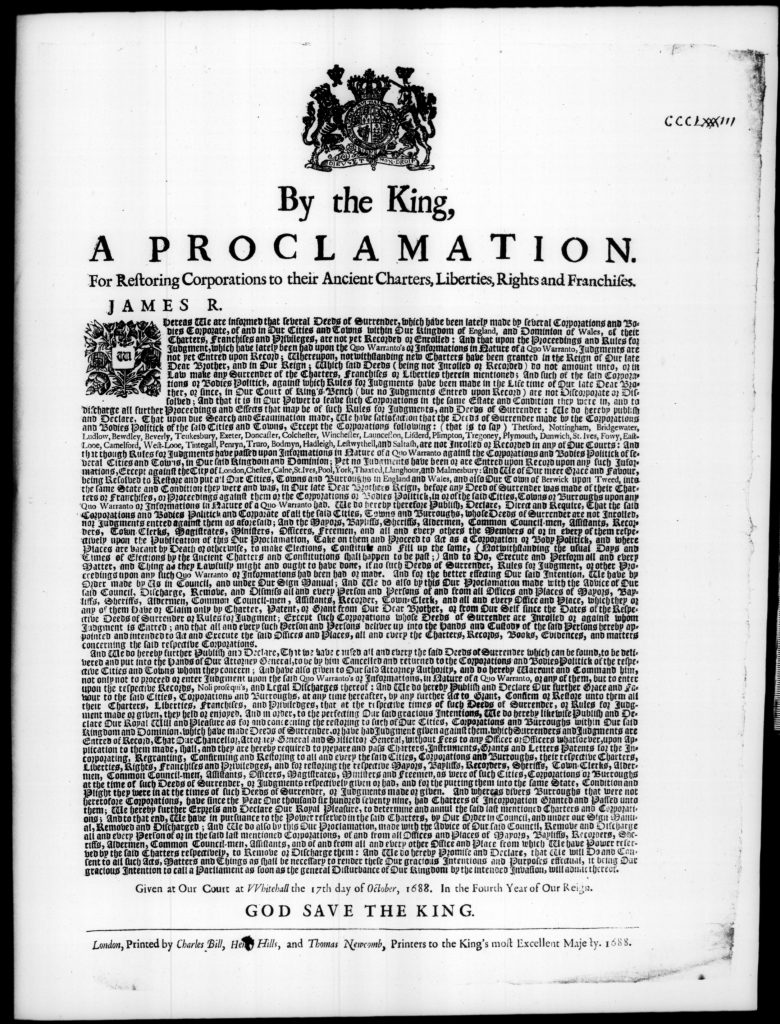
On 17 October, James issued a proclamation restoring corporations to their ancient charters, liberties, rights, and franchises. The policy pursued since the reign of Charles II was being hurriedly dismantled by the monarch who had exploited it most aggressively.
Lynn reacted within days. On 20 October, the royal proclamation was read in the Hall, and members who had belonged to the Corporation before the surrender began to reassemble. On 2 November, the town authorised representatives to recover from the Attorney General the original deed by which Lynn had surrendered its franchises and liberties four years earlier.
The dates give the story an almost theatrical ending. On 2 November, Lynn was trying to retrieve the document recording the surrender of its liberties. On 5 November, William of Orange landed at Torbay. James’s regime rapidly collapsed, and by the end of the year the King had fled England.
The political Revolution of 1688–89 established William III and Mary II on the throne. It also ended the particular experiment in royal control which had placed Lynn’s Corporation at the mercy of decisions made in Whitehall.
What actually happened to Lynn?
The episode is easily exaggerated in one direction and underestimated in another. Charles II did not abolish King’s Lynn Corporation in 1684, nor did James II send royal officials to administer the town directly. Much of the ordinary work of borough government continued in familiar hands. The markets still operated, Corporation business continued, local courts functioned, and Lynn remained recognisably governed through its ancient municipal institutions.
What had changed was the source of ultimate political security. Before 1684, Lynn’s governing elite possessed a much stronger claim to choose its own members under its inherited chartered privileges. After the surrender and regrant, the Crown possessed a weapon which could be used to alter the personnel of government. In 1688 James used it ruthlessly. The dismissal of fifteen officers, the nomination of their successors, and the royal insistence that John Davy remain mayor show how far that weapon could reach.
Nor should the story be reduced to James II alone. The decisive constitutional change occurred under Charles II. James merely demonstrated what Charles’s remodelling of the corporations had made possible.
There is an appealing irony in the speed with which the arrangement unravelled. For years the Stuart monarchy had worked to make borough corporations more dependable servants of royal government. Lynn surrendered in 1684. Four years later, James exercised his powers to decide who could sit in its government and who should occupy the mayor’s chair.
Then William of Orange prepared to cross the North Sea. Suddenly the ancient liberties of English towns looked much more attractive to James II. On 17 October 1688 he restored them. Three days later his proclamation was being read in King’s Lynn’s Hall.
The King had given Lynn its freedom back. He was about to lose his kingdom.
© James Rye 2026
Book a Guided Tour with a Trained and Qualified King’s Lynn Guide Through Historic Lynn
References
- Halliday, Paul D. Dismembering the Body Politic: Partisan Politics in England’s Towns, 1650–1730. Cambridge: Cambridge University Press, 1998.
- James II. A Proclamation for Restoring Corporations to Their Ancient Charters, Liberties, Rights and Franchises. 17 October 1688.
- King’s Lynn Borough Archives. Hall Books, KL/C 7 series.
- Miller, John. Cities Divided: Politics and Religion in English Provincial Towns 1660–1722. Oxford: Oxford University Press, 2007.
- Richards, William. The History of Lynn, vol. 2. Lynn, 1812.
- Short, M. J. “The Corporation of Hull and the Government of James II, 1687–8.” Historical Research 71 (1998): 172–195.