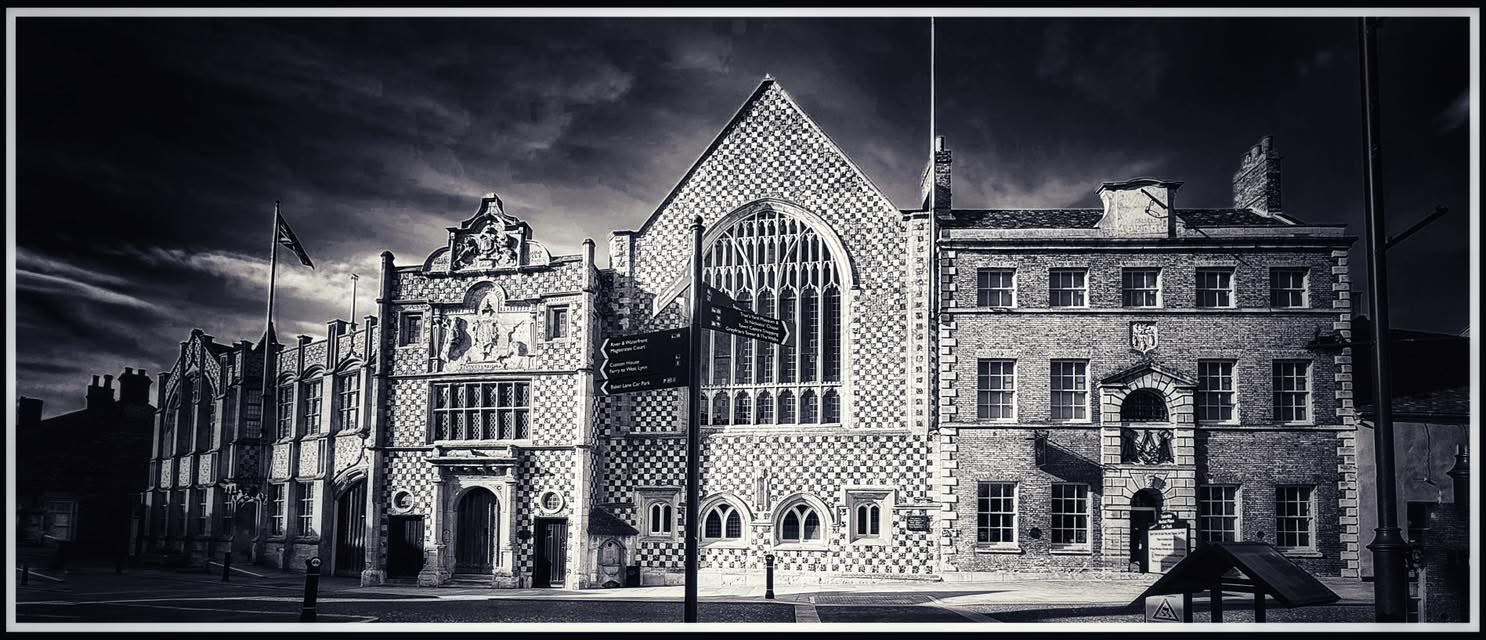
A woman in an old civic chair
In November 1925, Florence Ada Coxon became the first woman mayor of King’s Lynn. The borough had been keeping lists of its mayors since the Middle Ages. Those lists were overwhelmingly male, as were the portraits, ceremonies, and habits of civic office. Coxon’s arrival in the mayoral chair was therefore a marked public change, not simply another name added to an annual roll.
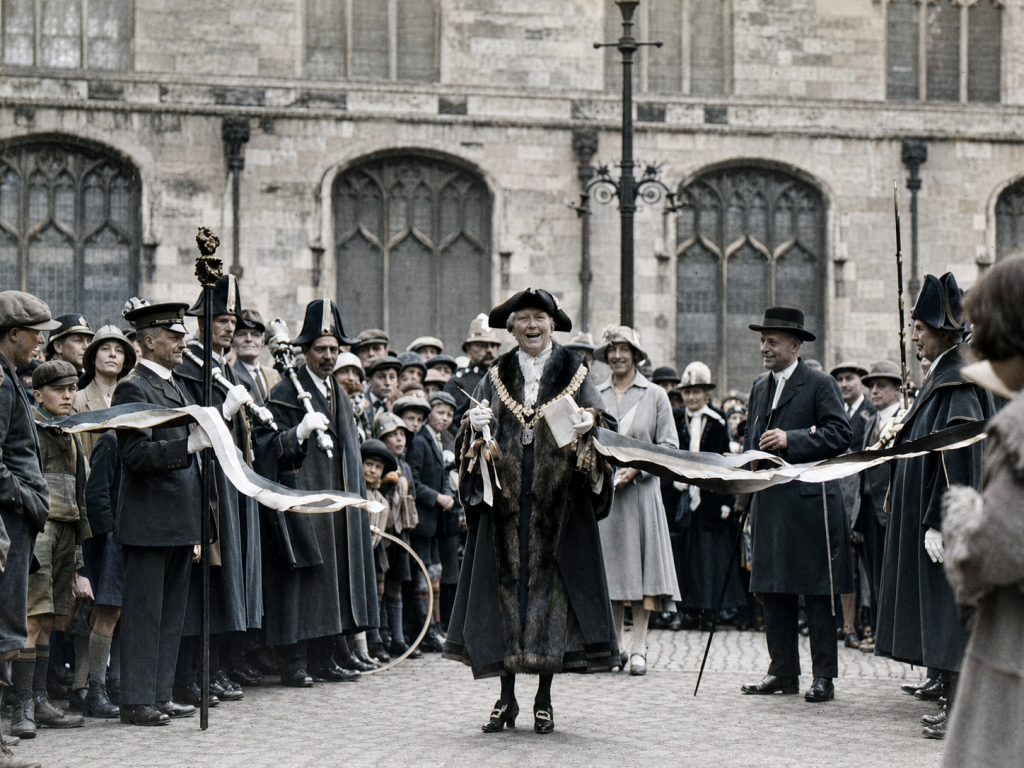
Original Source KL Magazine
She was not an accidental figure, nor merely the wife of a former mayor. By the time King’s Lynn elected her to the mayoralty, she had already become the borough’s first woman councillor, had worked in Conservative and Unionist politics, had taken part in local educational governance, and had made herself a visible presence in the public life of the town. Her later career made the story still more unusual. In her sixties, she entered Gray’s Inn; in old age, she was called to the Bar.
Ada Coxon’s life joins King’s Lynn’s municipal history to a wider English story: women entering public office after the First World War, taking up party organisation, and moving into professions from which they had recently been excluded.
Florence Ada Neale of Emneth
The published local account gives her birth as Florence Ada Neale in 1862. She grew up at Emneth, near Wisbech, and was known by her second name, Ada. At the age of twenty-one she married Stephen Arthur Thomas Coxon, a dentist. The couple had three children, Howard, Cedric, and Beryl.
They first lived in Wisbech, then moved to King Street in King’s Lynn. This mattered. King Street placed them close to the old commercial and civic heart of the town, within easy reach of the quayside, the Saturday Market Place, the Town Hall, and the older institutions of borough life. In the 1920s, the Coxons were not distant suburban figures looking in. They were part of the town’s public world.
Stephen Coxon, often recorded by his initials, S. A. T. Coxon, entered civic life himself and became Mayor of King’s Lynn in 1923. Ada followed a different but connected path. Her own public standing was built through women’s political organisation, Conservative and Unionist association work, and education.
Unionist, Conservative, and civic-minded
Ada Coxon’s politics were firmly Unionist and Conservative. She served as chair of the local Women’s Unionist Association, chair of the local division of the Norfolk Women’s Coalition Association, chair of the King’s Lynn Unionist and Conservative Association, and vice-chair of the King’s Lynn Division of Norfolk Men’s Conservative and Unionist Association. She also served as a governor of King Edward VII Grammar School.
That record shows she could not be folded loosely into the militant suffrage story without evidence. The material presently available points instead to a woman of inter-war civic Conservatism: organised, public-spirited, politically active, and regarded by her supporters as practical and capable.
The timing of her career is equally important. The Representation of the People Act 1918 gave the parliamentary vote to women over thirty who met a property qualification. Women and men did not receive the vote on equal terms until the Equal Franchise Act of 1928. Coxon’s rise in King’s Lynn therefore came during a transitional decade, when women’s political rights had widened but equality in the parliamentary franchise had not yet arrived.
First woman councillor
In 1924, Coxon was elected the first woman councillor of the Borough of King’s Lynn. The date deserves attention. It was only six years after some women had gained the parliamentary vote and four years before the equal franchise.
Her election was not simply a private success. It altered the appearance of municipal authority in the old borough. Council chambers, mayoral processions, civic dinners, and public ceremonies had long been shaped by male office-holders. Coxon entered that setting with a record of organisation behind her and with enough local confidence to be placed in office.
The following year, King’s Lynn went further.
The mayoralty of 1925
The official list of King’s Lynn mayors records Florence Ada Coxon in 1925 and marks her as the “First Woman Mayor”. Since mayors in King’s Lynn took office in November until 1949, her mayoral year should be understood as beginning in November 1925 rather than as a neat calendar-year appointment.
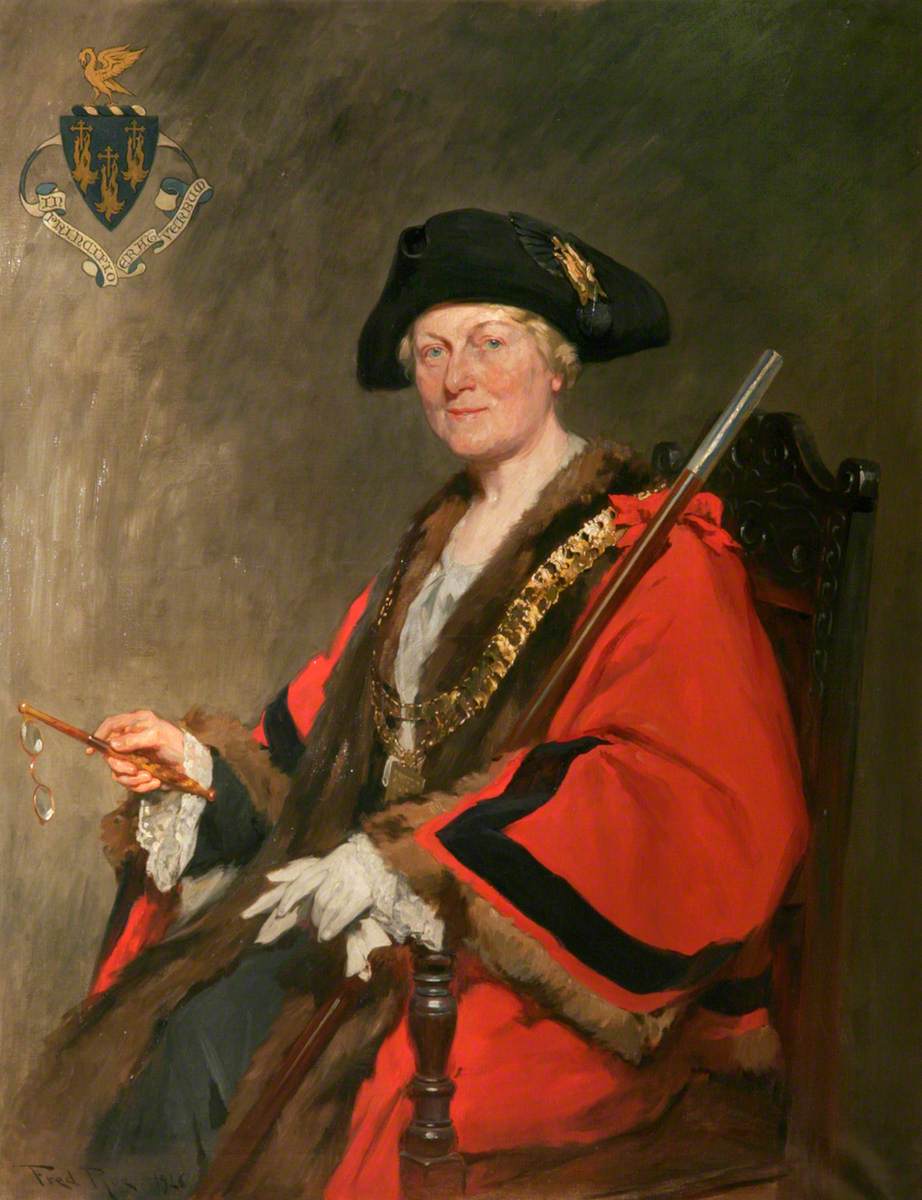
Local accounts also describe her as the town’s first female Chief Magistrate. That phrase should be read with care. It belongs to the older civic language of the mayoralty and its association with local authority. It should not be confused with a later judicial career. Coxon did become a barrister, but the evidence does not show that she became a judge.
A contemporary newspaper praised her as a woman of “sound business ability and breadth of view”. The phrase is revealing. Her supporters did not present her merely as a novelty. They presented her as someone fitted for the duties of office.
There was also a practical ceremonial question. If the mayor was a woman, who would serve as mayoress? Coxon chose her daughter, Beryl. Beryl recorded events from the mayoral year and commemorated her mother’s service in verse. The family clearly understood the significance of the appointment.
The town as a public stage
The mayoralty in 1920s King’s Lynn was not only a matter of committee work. It had a visible public life. The mayor appeared in processions, attended functions, stood for the borough on ceremonial occasions, and helped embody the dignity of the town.
Coxon took part in civic marches and public events, including occasions connected with the Lynn Mart and sporting life. These details matter because they show the office being lived in public. A woman was not only sitting in the mayoral chair. She was being seen in the streets and spaces of King’s Lynn as the borough’s civic head.
It is also worth keeping the local government geography straight. Coxon was mayor of the old Borough of King’s Lynn, not of the present Borough of King’s Lynn and West Norfolk. The old borough was reconstituted in 1974 as the Town of King’s Lynn under the local government changes of the period. The District of West Norfolk received borough status in 1981, becoming the Borough of King’s Lynn and West Norfolk.
Public service and the OBE
In 1929, Coxon was appointed an Officer of the Civil Division of the Order of the British Empire. The official notice in The Edinburgh Gazette gave the reason as “public and political services in East Anglia”.
That short official phrase places her beyond a purely local “first woman mayor” story. By 1929, Coxon’s public work was recognised at regional and national level. Her career had moved through party organisation, civic government, education, and public service. The OBE acknowledged that accumulated record.
Ada Coxon at Gray’s Inn
Coxon’s legal career came late, and that is part of what makes it so striking. The Sex Disqualification (Removal) Act 1919 had opened the way for women to enter professions and public functions from which sex or marriage had previously excluded them. Women could now become barristers, solicitors, jurors, magistrates, and members of professional bodies that had once been closed to them.
Coxon entered that changed legal world as an older woman. The local account says she was admitted as a student of the Bar at Gray’s Inn in June 1928. A recent scholarly study of the first women admitted to the Inns of Court gives the more exact date as 7 June 1928 and places her call to the Bar on 26 January 1933. Gray’s Inn’s own subject index also places the notable call in Hilary 1933.
This corrects a small point in some retellings, where 1932 is given for her call. The safer date, on the presently available evidence, is 1933.
Gray’s Inn remembered the occasion. Its subject index records that the old custom of shouting down newly called barristers on Call Night was suspended for Florence Coxon’s call. That small institutional note is telling. She was not just another new barrister. Her age, sex, public standing, or some combination of all three, made the occasion unusual enough to be remembered.
The right phrase is that Coxon was called to the Bar. She was not “called to the bench”, unless new evidence emerges that she became a Bencher or held judicial office. The evidence supports barrister-at-law.
Ada died in 1951. Gray’s Inn’s obituary index records the date as 3 July. Her husband Stephen had died earlier, in 1934.
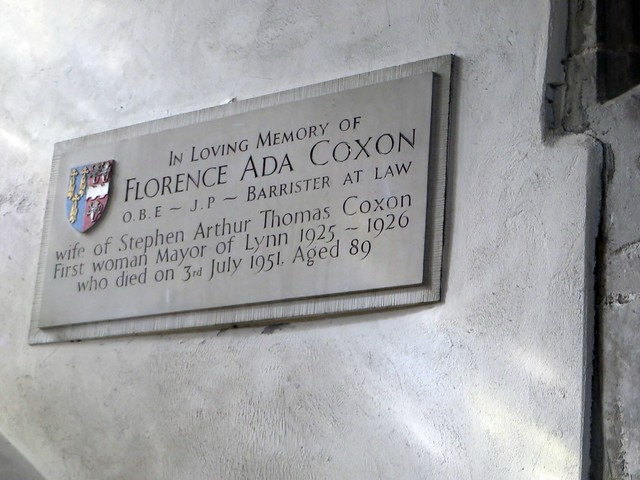
Source jmc4, “Church Explorer”, on Flickr.
The centenary return
In 2025, the Borough Council of King’s Lynn and West Norfolk marked the centenary of Coxon’s mayoralty with a display at Stories of Lynn. The project was developed with the Norfolk Record Office and Norfolk Museums Service and was timed to coincide with International Women’s Day. The council described Coxon as King’s Lynn’s first female mayor, noted her local political and educational work, and drew attention to her call to the Bar at the age of seventy.
By 2025, the council counted fourteen women as having served as mayor in King’s Lynn since Coxon. That later record should not soften the significance of the first appointment. Coxon entered public office when the habits of municipal life were still heavily male, when women’s political rights were still incomplete, and when entry into the legal profession had only recently become possible.
Her story is therefore larger than a single civic honour. Florence Ada Coxon, née Neale, moved from Emneth to King Street, from local political organisation to the mayoral chair, from King’s Lynn civic ceremony to Gray’s Inn, and from the old borough’s public life into the wider history of women’s entry into English law. She was a King’s Lynn figure, but not only a King’s Lynn curiosity. Her life marks one of those moments when local history shows national change at human scale.
Source note
Some catalogue material gives Florence Ada Coxon’s birth year as 1886, but that is difficult to reconcile with the local account giving 1862, with her marriage at twenty-one, and with the legal chronology that places her in her sixties when admitted to Gray’s Inn. This draft follows the 1862 chronology, while noting that a final archival check of birth registration, baptism, marriage, census, and probate records would be advisable before publication in print.
The date of her call to the Bar is also treated cautiously. Some local material gives 1932, but Gray’s Inn’s own subject index places the notable Call Night in Hilary 1933, and Charlotte Coleman’s prosopographical study gives 26 January 1933.
© James Rye 2026
Book a Guided Tour with a Trained and Qualified King’s Lynn Guide Through Historic Lynn
References
- Art UK, Fred Roe portrait of Florence Ada Coxon:
https://artuk.org/discover/artworks/florence-ada-coxon-first-woman-mayor-1925-42 - Borough Council of King’s Lynn and West Norfolk, List of Mayors of King’s Lynn:
https://www.west-norfolk.gov.uk/download/downloads/id/5646/list_of_mayors_of_kings_lynn_1248-2023.pdf - Borough Council, Women in Leadership: Celebrating Florence ‘Ada’ Coxon’s Legacy:
https://www.west-norfolk.gov.uk/news/article/1818/women_in_leadership_celebrating_florence_ada_coxon_s_legacy_for_international_women_s_day - KL Magazine, Celebrating the Legacy of an Astounding Female Leader:
https://www.klmagazine.co.uk/articles/florence-ada-coxon - National Portrait Gallery, Florence Ada Coxon and Stephen Arthur Thomas Coxon:
https://www.npg.org.uk/collections/search/portrait/mw254592/Florence-Ada-Coxon-ne-Neale-and-Stephen-Arthur-Thomas-Coxon - Gray’s Inn, Graya Subject Index (includes the reference to Coxon’s Call Night):
https://www.graysinn.org.uk/app/uploads/2025/07/20250704_GraysInn_Library_GrayaSubjectIndex.pdf - Gray’s Inn, Graya Obituary Index:
https://www.graysinn.org.uk/app/uploads/2025/07/20250704_GraysInn_Library_GrayaObituaryIndex.pdf - The Edinburgh Gazette, 4 June 1929, p. 573, Coxon’s OBE:
https://www.thegazette.co.uk/Edinburgh/issue/14553/page/573/data.pdf - UK Parliament, Representation of the People Act 1918:
https://www.parliament.uk/about/living-heritage/transformingsociety/electionsvoting/womenvote/case-study-the-right-to-vote/the-right-to-vote/birmingham-and-the-equal-franchise/1918-representation-of-the-people-act/ - UK Parliament, Equal Franchise Act 1928:
https://www.parliament.uk/about/living-heritage/transformingsociety/electionsvoting/womenvote/case-study-the-right-to-vote/the-right-to-vote/birmingham-and-the-equal-franchise/1928-equal-franchise-act/ - UK Parliament, Sex Disqualification (Removal) Act 1919:
https://www.parliament.uk/about/living-heritage/transformingsociety/tradeindustry/industrycommunity/collections/sex-disqualification-removal-act/sex-disqualification-removal-act/