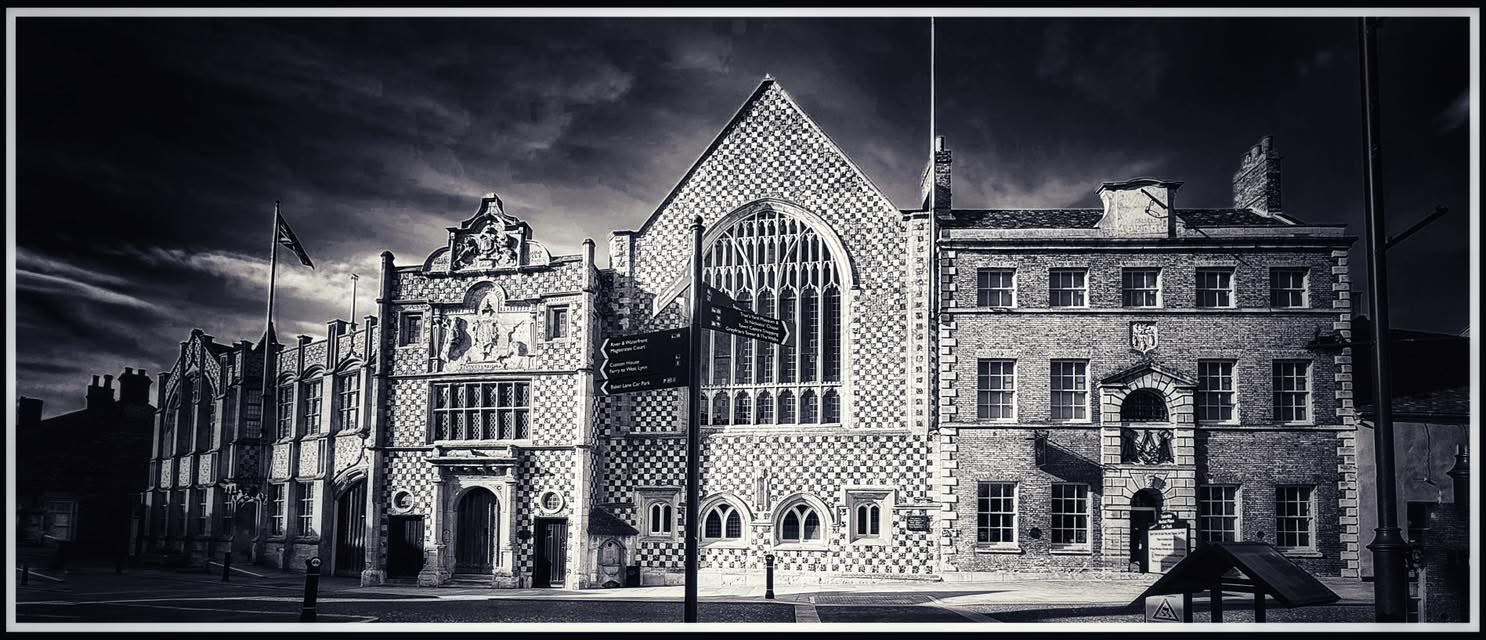
On 11 July 1701, royal customs officers brought an embarrassing accusation before King’s Lynn Corporation. Men employed in the port had been taking bribes, falsifying certificates, and cheating King William III of tax revenue. When questioned, the men confessed. The Corporation dismissed them.
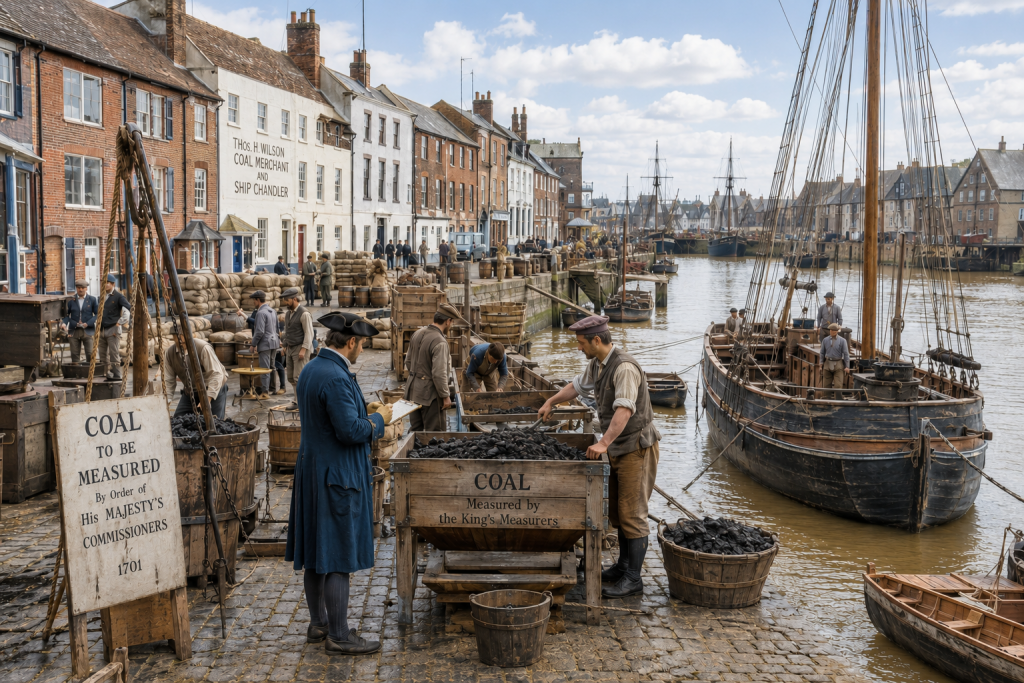
Barely a month later, several were back at work.
It is a wonderfully revealing little scandal. Behind the dishonest coal measurements lies a larger change in the way England was governed. Lynn still operated through ancient borough privileges, local officers, tolls, and trading customs. William III’s government, meanwhile, was raising unprecedented amounts of taxation to pay for war and taking a much closer interest in the goods passing through English ports. On Lynn’s waterfront in 1701, those two systems met.
Measuring coal on Lynn’s waterfront
King’s Lynn had regulated its commercial life for centuries. The Corporation appointed officers, supervised markets, collected tolls and dues, and defended the trading privileges of freemen. Among its lesser officials were the Head Porters and Metters, men whose everyday work included supervising, handling, and measuring commodities passing through the port.
Coal made accurate measurement particularly significant. Large quantities arrived by sea from north-eastern England before being distributed from Lynn into its extensive inland market. A cargo could not simply be unloaded and sold without someone establishing how much coal was actually there. Official metters provided that measurement.
By 1701, however, their figures concerned more than merchants and the Corporation. Parliament had imposed duties on coal, and Lynn’s metters had become involved in administering them. The Hall Book describes them as having authority under the government’s commissioners to act as “metters, weighers, and measurers”. A man carrying out what looked like a traditional borough office was therefore helping to determine how much tax reached the royal Exchequer.
That brought the Lynn metter into a very different world. William III’s wars against Louis XIV’s France had greatly increased the government’s need for money. Customs and excise expanded, Parliament authorised new taxes, public borrowing grew rapidly, and the Bank of England was founded in 1694. Ports were increasingly important points at which the government collected revenue. An inaccurate coal measurement at Lynn could now cost the King money.
Bribes, false returns, and a confession
On 11 July 1701, senior officers of the royal customs appeared before the Corporation. Their complaint was not against one troublesome employee. It concerned the borough’s body of Head Porters and Metters.
The Hall Book recorded that the men had “taken and received bribes” and had produced “short and false certificates and retornes”. The purpose or consequence was equally clearly stated. The false returns were “defrauding his Majestie of the said Duties”.
Precisely how the fraud operated is not explained in the surviving published account. One obvious possibility is that a metter certified less coal than had actually been landed, reducing the duty payable and receiving a payment in return. That would fit the accusation remarkably well, but without fuller evidence it remains a reconstruction. What the record does establish is bribery, false certification, and loss of royal revenue.
There was apparently little prospect of mounting a defence. When the Corporation questioned its officers, they “severally confest”. The Corporation dismissed them.
That might have provided a satisfyingly straightforward ending to the affair: Crown officials expose corruption, the guilty men confess, and the borough authorities remove them. Lynn’s Hall Book, however, supplies a rather better ending.
Five weeks later, they were back
On 13 August, several of the dismissed corn and coal metters and Head Porters petitioned the Corporation. They wanted their jobs back. The Corporation agreed.
The reinstated men were required to take the customary oath and provide a bond of £20, with a surety, guaranteeing the proper performance of their duties. Twenty pounds represented a substantial sum in 1701, so this was not merely a verbal warning. The Corporation was placing a considerable financial penalty behind its demand for future good behaviour.
Even so, the speed of the rehabilitation is striking. Only weeks earlier these men had confessed to accepting bribes and falsifying official returns that affected royal taxation. Now some were again trusted to perform the work.
The Hall Book gives no explanation. Perhaps skilled and experienced metters were not easily replaced. Perhaps merchants or other influential townsmen intervened. Personal relationships may have counted for something within Lynn’s relatively small commercial community. It is equally possible that the Corporation believed dismissal, public disgrace, and the requirement for substantial financial security had provided sufficient punishment.
There may also have been an element of municipal independence in the decision. Royal customs officials had exposed the fraud, but the Head Porters and Metters were part of Lynn’s own administrative machinery. The Corporation had dismissed them and now decided which men could return, and under what conditions. We cannot prove that Lynn’s governors consciously intended the reinstatements as an assertion of their authority, but the sequence shows that they retained practical control over their officers.
The King takes a closer interest in Lynn’s coal
Thirteen years before the coal scandal, Lynn had experienced a much more blatant form of royal interference. James II possessed powers enabling him to reshape municipal corporations, and in June 1688 fifteen members of Lynn Corporation were removed in one operation. They included the mayor, the town clerk, and five aldermen. Their replacements were men acceptable to the Crown.
The Revolution of 1688 changed that political world. William III’s government did not simply continue James II’s attempt to control Lynn Corporation. The events of 1701 were different. No evidence has been found that William threatened Lynn’s charter, tried to remove its mayor, or attempted to reconstruct the Corporation. Instead, the pressure came through money.

England was developing what historians have called a “fiscal-military state”, capable of raising and borrowing much larger sums to sustain warfare. Customs officers, excise officials, tax collectors, commissioners, and the Exchequer increasingly connected local economic activity with central government. Lynn’s medieval and Tudor privileges had developed long before such a system existed.
The metters provide an unusually vivid example of what that change meant on the ground. Their office belonged to Lynn’s traditional commercial organisation. Yet the quantities they certified could now determine the amount of tax received by the Crown.
The measuring vessel had acquired a political significance.
Why coal kept causing trouble
Coal was especially likely to produce disputes at Lynn because the town occupied an advantageous position between coastal shipping and a large inland market. Coal arriving from the north-east could pass through Lynn towards consumers across parts of Norfolk, Cambridgeshire, Huntingdonshire, and Bedfordshire. The Corporation’s tolls, trading privileges, and regulations allowed the borough and its freemen to benefit from that traffic.
What Lynn regarded as ancient and legitimate rights could look very different from outside the borough.
Only a few years after the metters were caught, Bedfordshire and Huntingdonshire interests complained to Parliament about Lynn’s regulation of the coal trade. The great coal dispute of 1704–05 involved allegations that the borough’s charges and restrictions increased prices and favoured Lynn traders. Once again, royal revenue entered the argument, with Lynn’s opponents claiming that the Corporation’s practices also damaged the Queen’s income.
It is tempting to draw a straight line from the dishonest metters of 1701 to the coal controversy of 1704–05. The evidence does not justify it. We have found no proof that the earlier fraud caused the later parliamentary dispute, or that the same people were involved. They do, however, expose the same awkward meeting point between local privilege, commerce, and national taxation.
Lynn’s other argument of 1701
The Corporation was already attracting attention at Westminster that summer for an entirely different reason. On 12 June 1701, William III gave royal assent to an Act establishing a new system of hospitals and workhouses in King’s Lynn “for the better employing and maintaining the Poor there”.
The scheme had encountered organised opposition. Printed objections accused the proposed system of giving too much authority to Lynn’s governing establishment, particularly over poor rates and the treatment of people considered disorderly. The Corporation nevertheless secured its Act. The young Robert Walpole, then MP for nearby Castle Rising, participated in the parliamentary proceedings. In 1702 he became MP for King’s Lynn, beginning his extraordinarily long association with the borough.
This was not another dispute between Lynn and the Crown. William III had approved the legislation. It does show that the Corporation was vigorously defending and extending its powers at precisely the moment when royal customs officers were examining the behaviour of its waterfront officials.
Was the Crown attacking Lynn?
Earlier accounts of this period can tempt us into seeing 1701 as one episode in a continuing struggle between the Crown and Lynn Corporation. The evidence does not support so simple an interpretation.
There certainly was a dispute involving royal authority. Crown customs officers discovered corruption among Lynn officials, and royal revenue had been lost. Yet there is no evidence that William III responded by attacking the Corporation’s constitution or threatening its charter. Lynn dealt with its offending officers itself and, remarkably, soon restored some of them.
That distinction becomes particularly useful when we reach 1705. Four years after the metters’ confessions, Lynn received something considerably more frightening. A writ concerning debts, fines, and forfeitures allegedly owed to Queen Anne raised the possibility of taking “the liberties of this Burgh” into the Queen’s hands.
Whether the Crown’s financial claims of 1705 had any connection with the revenue fraud discovered in 1701 remains unknown. Unless evidence emerges from the Customs, Treasury, Exchequer, or borough records, the two episodes should not be joined together as cause and effect.
The 1701 affair deserves its own place in Lynn’s history. It catches the town at a moment of transition. Ancient borough offices still governed everyday commerce on the quayside, but the national government was reaching further into that commercial world. A Lynn metter could still be appointed by his Corporation, work among people he knew, and operate within customs inherited from earlier centuries.
But once his measurement determined the King’s tax, somebody in Whitehall had an interest in what was inside his measuring vessel.
And in July 1701, the royal customs officers discovered that the figures did not add up.
© James Rye 2026
Book a Guided Tour with a Trained and Qualified King’s Lynn Guide Through Historic Lynn
References
- Great Britain. An Act for erecting Hospitals and Workhouses within the Borough of King’s Lynn in the County of Norfolk, for the better employing and maintaining the Poor there. 12 & 13 William III, c. 6. 1701.
- Howse, Daniel. Governance, Social Relations and Popular Politics in Eighteenth Century Norwich. PhD diss., University of East Anglia, 2013.
- Reasons Humbly Offer’d against Lynn Poor-Bill. London, 1701.
- Richards, William. The History of Lynn, Civil, Ecclesiastical, Political, Commercial, Biographical, Municipal, and Military, from the Earliest Accounts to the Present Time. Vol. 2. Lynn: W. G. Whittingham, 1812. https://archive.org/
- Several Objections against the Lynn Poor-Bill. 1701.