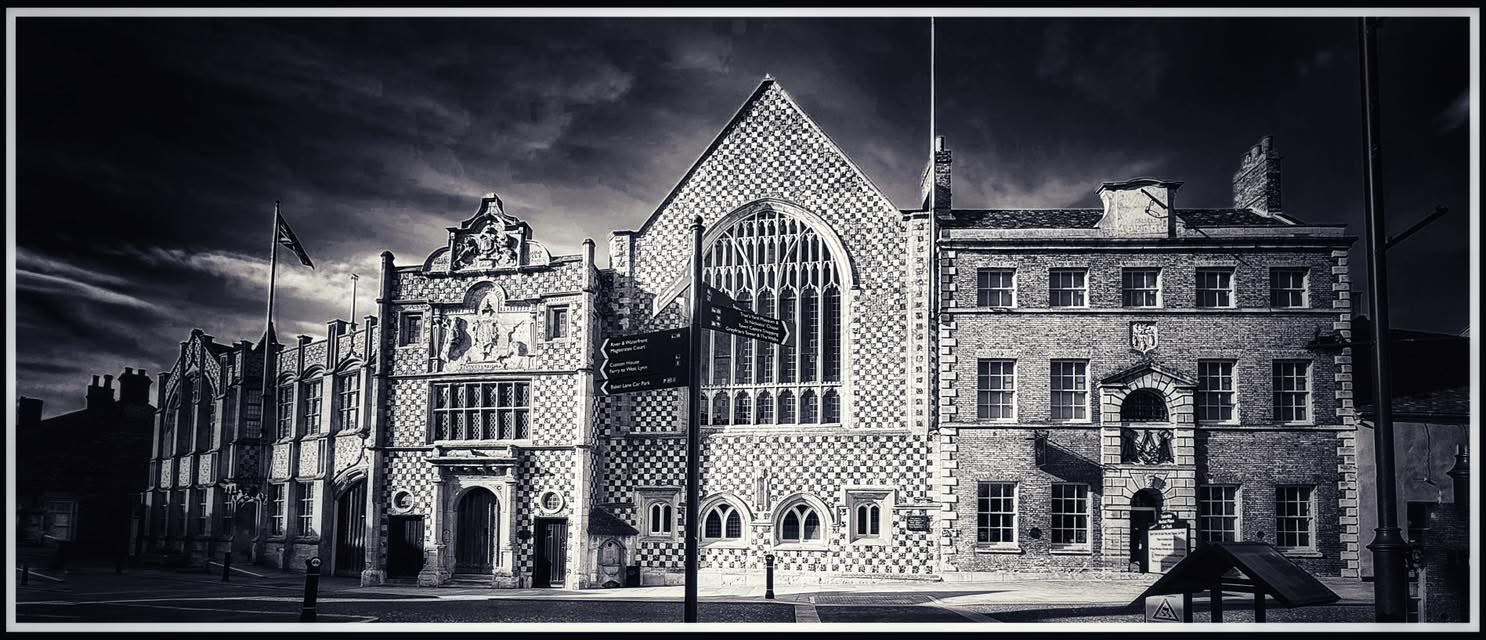
On 2 April 1797, six transport vessels entered King’s Lynn harbour carrying about 900 French prisoners of war. Lynn was used to ships bringing coal, wine, grain, timber, hemp, deals, and Baltic cargoes. Nine hundred captured Frenchmen were a less familiar consignment.
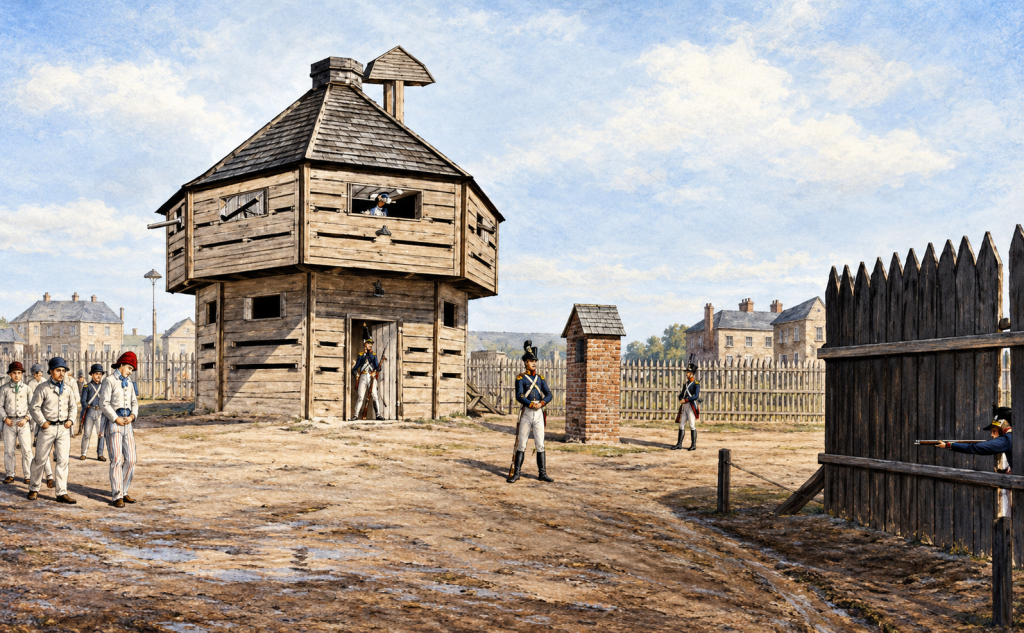
AI enhance image of an 1809 original at theprisoner.org.uk
The prisoners had come round the coast from Falmouth. They were not staying in Lynn for long, although long enough, apparently, for one French captain to escape from the Purfleet. The rest were transferred into lighters and carried inland across the waterways of the Fens towards Yaxley and Peterborough. Their destination was Norman Cross, a vast new prison depot beside the Great North Road, a few miles south of Peterborough.
The first prisoners entered Norman Cross on 7 April 1797. Some had spent several days “cooped up” aboard the transports at Lynn while officials organised their onward journey. The camp was not quite finished. Two of its four prison compounds were ready, which was apparently enough for government purposes. The remaining prisoners, carpenters, soldiers, clerks, contractors, cooks, guards, and invalids would simply have to make the best of a building project that had become a national emergency.
Norman Cross is often described as the world’s first purpose-built prisoner-of-war camp. The phrase needs care, since an earlier purpose-built war prison existed at Stapleton near Bristol in 1782. Norman Cross was nevertheless the first large British depot planned as a complete institution for holding thousands of captured enemy servicemen during the French Revolutionary and Napoleonic wars. It was prison, barracks, workshop, hospital, market, cemetery, and bureaucratic experiment all at once.
And King’s Lynn was one of its gateways.
Why Lynn mattered
Norman Cross was chosen with calculation. It was inland, which meant that an escaped French sailor could not simply stroll to the nearest friendly vessel. It stood beside the Great North Road, giving the authorities a direct route to London. Yet it was also linked to the east coast ports of King’s Lynn, Great Yarmouth, Wisbech, and Boston. Prisoners could be landed at those ports, carried by river and fenland navigation to Yaxley, Stanground or Peterborough, and then marched the remaining miles to the camp.
That put Lynn into the machinery of wartime imprisonment. The same waters that had long helped the town trade with the Wash, the Ouse, the Fens, and the inland counties could be used to move captured enemies. The port was not simply watching the Napoleonic war from a distance. It was part of the transport system.
In March 1797 Captain Daniel Woodriff of the Transport Board was told to inspect the depot and then go on to Lynn to report on the best anchorage and the movement of prisoners. A local contractor, Mr Hadley, offered to transport prisoners at one shilling a head. The authorities thought this “exorbitant and quite out of the question”. Shortly afterwards they accepted a different arrangement with Mr Kempt at one shilling and sixpence a head for the longer journey to Yaxley, which suggests either administrative confusion or a very eighteenth-century approach to economy.
Kempt’s partner was also to feed the prisoners on the journey. In theory, each man received one pound of bread or biscuit and three-quarters of a pound of beef per day. The passage was expected to take three days. Anyone tempted to romanticise river travel across the Fens should imagine hundreds of hungry prisoners crowded into shallow boats, officials counting rations, and boatmen calculating whether the government would pay promptly.
The Lynn connection did not stop with the first arrivals. Further parties passed through the town during 1797 and 1798. Some came from Great Yarmouth. Dutch prisoners were added after the Battle of Camperdown in October 1797. A later local account states that four more transports carrying prisoners entered Lynn in 1799.
A new town made of timber
Norman Cross was built at speed. Work began in December 1796 and the first prisoners arrived the following April. Its cost was recorded as £34,581 11s 3d, a sum precise enough to reassure anyone who feared that wartime government might lose track of the odd threepence.
The camp occupied about 43 acres. At the centre stood an octagonal blockhouse. Around it were four separate prison compounds, each containing four large wooden barrack blocks, or caserns. Each casern could hold about 500 men, sleeping in hammocks. There were kitchens, wells, storehouses, exercise yards, turnkeys’ lodges, a hospital, a mortuary, and a windowless punishment block known as the “black hole”. Outside the prison enclosure stood barracks for the guards.
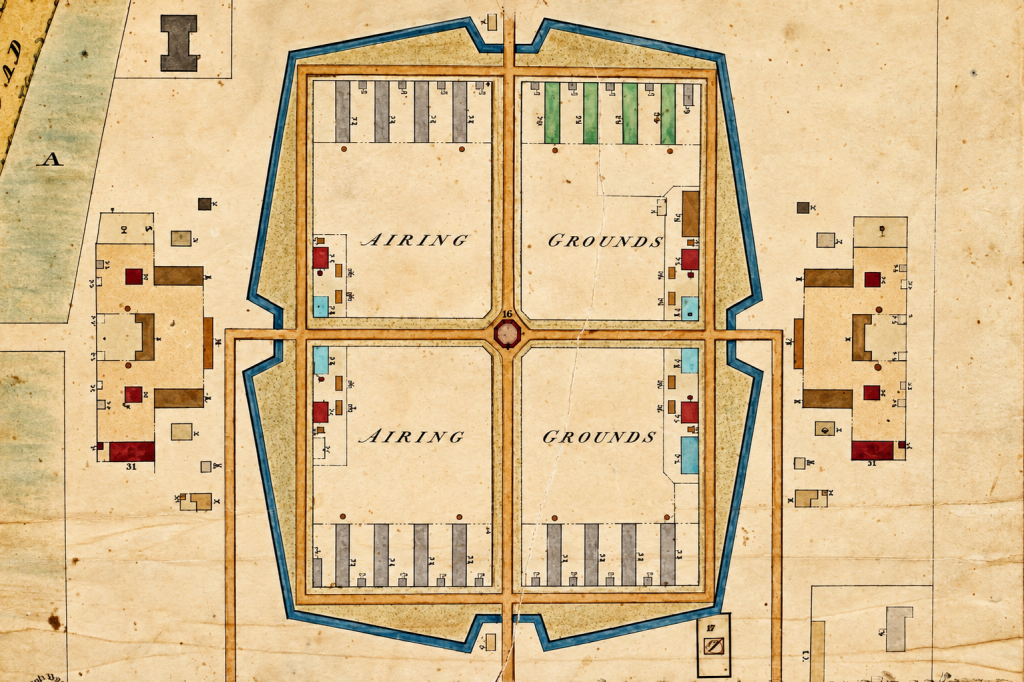
The plan looks almost elegant on paper. Four compounds, straight lines, repeated buildings, careful separation, and a central point of observation. It was Georgian order applied to the problem of several thousand unwilling Frenchmen, Dutchmen, Italians and others who had been captured in a war that kept changing its shape.
At its busiest, Norman Cross held about 6,000 prisoners. With guards and staff, it could resemble a sizeable town dropped into the Huntingdonshire countryside. The difference was that its inhabitants had not chosen to move there and were not encouraged to admire the view.
The first soldiers arrived before the first prisoners. A Whittlesey farmer, John Lamb, noted in his diary on 24 March 1797 that “the soldiers came to guard the Barracks”. He added that the volunteers “did not much like it; they liked drinking better”. It is hard to improve on that as a summary of military enthusiasm under trying circumstances.
The men behind the palisades
The prisoners at Norman Cross were not criminals. They were prisoners of war: sailors, soldiers, privateersmen, and others caught up in Britain’s long conflict with Revolutionary and Napoleonic France. Some were Dutch. Some came from Italy and other parts of Europe or the wider French imperial world. A few were boys.
Rank made a great difference. Officers and some civilian captives might be released on parole and lodged in Peterborough or nearby towns, where they promised not to escape and reported regularly to an agent. They received an allowance and could live with a degree of comfort, depending on their means and connections. Ordinary prisoners lived inside the depot, slept in crowded wooden buildings, and spent much of the day in the open airing grounds.
This outdoor routine was meant to preserve health and reduce tunnelling. In summer it may have been bearable. In winter, fresh air could easily become one of those virtues more admired by administrators than by the people receiving it.
Clothing was a continuing problem. Britain and France disputed responsibility for supplying prisoners, and delay did not keep men warm. When the British authorities issued prison clothing, it could be deliberately conspicuous. Yellow garments and red waistcoats had an obvious advantage for the captor. A man dressed like a warning flag was less likely to disappear quietly into the English countryside.
Conditions at Norman Cross were often better than those on prison hulks, the old ships used to confine captives around the coast. That comparison should not make us too comfortable. To be better than a crowded, insanitary hulk was not the same as being humane by modern standards. Norman Cross offered order, rations and some opportunities for work, but also boredom, cold, disease, confinement, discipline, and years of uncertainty.
Bone ships and forbidden straw
The most memorable things made at Norman Cross were not official documents. They were miniature ships, boxes, toys, guillotines, dominoes, buttons, combs, dice, mechanical figures, and straw-work pictures produced by prisoners with time, skill, hunger, and imagination.
Much of the raw material came from ordinary waste. Bones left after meals could be cleaned, carved and polished into delicate objects. Wood offcuts, straw, hair, paper, shell, and scraps of metal could be turned into saleable goods. The model ships are especially striking. Some are so elaborate that they seem to defy the circumstances in which they were made. Rigging, guns, stern windows, deck fittings, and figureheads were constructed from materials that might otherwise have ended in a midden.
The authorities allowed prisoners to sell their work at a market near the east gate. Visitors bought souvenirs. Local people traded with captives. Successful craftsmen earned money for extra food, tobacco, tools, clothing or materials. Other prisoners remained poor, but craft production created a small economy inside the walls.
There was, inevitably, a difficulty. The prisoners became too good at it.
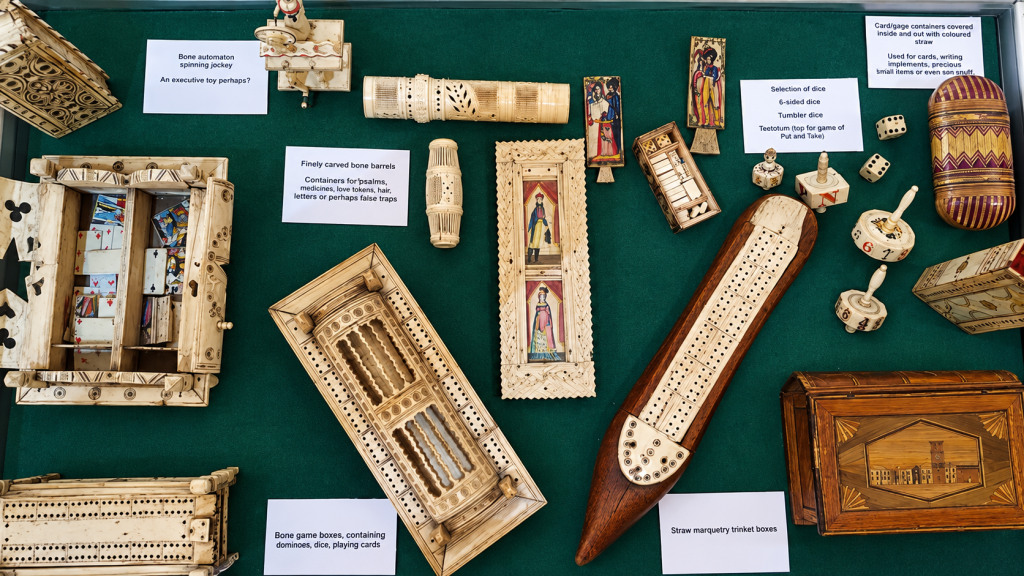
Source: Peterborough Archeology
Straw plaiting caused particular concern because it competed with local workers and with taxed imports. The authorities prohibited the trade. The prisoners responded with the commercial energy of men who had little else to do. Straw was smuggled in, finished plait was smuggled out, and guards, visitors, dealers and local people became involved. Searches for contraband straw became notorious. George Borrow later remembered them as harsh “straw plait hunts”, although his account was written long afterwards and was angrily disputed by later defenders of the camp authorities.
Archaeology supports the broader picture of industrious manufacture. Excavation in 2009 recovered nearly 800 pieces of worked bone and bone-working waste, including evidence for unfinished combs, buttons, handles and dominoes. Peterborough Museum now holds a major collection of Norman Cross craftwork. Lynn Museum has also been associated with prisoner-of-war craft, a fitting survival in the port through which so many captives passed.
Escape, pursuit and the black hole
Prisoners tried to escape almost from the beginning. Some cut through palisades. Some tunnelled. Some used disguises. One reportedly tried to pass in a fake British uniform with a fake gun. Another hid in the cart used to remove sewage, a plan which combined courage, desperation, and a relaxed attitude to smell.
When prisoners were recaptured, punishment could include confinement in the black hole and reduced rations. The regulations even allowed the reduction to continue until the money saved had repaid the public cost of pursuit and recapture. An escape attempt could therefore end not only in punishment but in what amounted to an official bill.
Lynn had its own small escape drama. The French captain who fled from the Purfleet in 1797 vanishes from the local notice almost as soon as he appears. We do not know whether he hid among warehouses, found help, passed himself off as someone else or simply took advantage of confusion at the waterside. The brevity of the report is part of its charm. A government system designed to move hundreds of prisoners across land and water had mislaid a captain in the middle of King’s Lynn.
Security at Norman Cross grew tighter as the years passed. After serious disturbances and escapes, the original timber perimeter was replaced by a brick wall. In 1809 an eight-metre-wide ditch was dug inside the wall to create a “silent sentry walk”, allowing guards to patrol where prisoners could not easily observe them. Unfortunately, the ditch appears to have weakened the wall foundations. It is a useful reminder that prison design, like plumbing and committee work, often solves one problem by creating another.
The cost in lives
The craftwork, escapes and comic incidents should not disguise the suffering. At least 1,770 prisoners died at Norman Cross. The worst mortality came during the epidemic of 1800–01, when more than 1,000 deaths were recorded.
The disease has been described as typhus or a related fever, although the exact diagnosis remains uncertain. What matters for the human story is clear enough. Thousands of men were confined in a restricted space. Sanitation was limited. Clothing could be inadequate. Infection moved quickly. Medical understanding had not yet caught up with the causes of such outbreaks.
Official accounts sometimes blamed prisoners for their own misery, especially those who gambled away food or clothing. Gambling did occur, and so did exploitation by other prisoners. Yet institutional records always need reading with care. Administrators had an obvious interest in portraying suffering as the result of bad conduct rather than of bad conditions.
The burial evidence is still more complicated than older accounts suggested. Archaeological investigation found prisoner graves north and east of the camp, including multiple burials. It did not confirm the traditional belief that the large field west of the Great North Road had been used for the main epidemic cemetery. Norman Cross therefore remains a place where the visible landscape, documentary record, memory and archaeology do not all tell the story in exactly the same way.
George Borrow, Norfolk memory and Norman Cross
King’s Lynn’s second connection with Norman Cross came through the West Norfolk Militia. In July 1811 Lieutenant Thomas Borrow was quartered at the depot. His young son George, later the author of Lavengro and The Bible in Spain, spent part of his childhood there.
Borrow’s recollections helped fix Norman Cross in literary memory. He wrote of the strange prison buildings, the crowded caserns, the French prisoners and the violent suppression of the straw-plait trade. His account was vivid, sympathetic and not always reliable. He was remembering childhood scenes many years later, and his taste for drama was considerable. Walker, writing in 1913, thought Borrow had maligned the authorities. Borrow thought the prisoners had been treated shamefully.
The truth probably lies neither in Walker’s institutional defence nor in Borrow’s literary indignation. Norman Cross was not a place of simple cruelty, and it was not a model village with locks. It was a prison built by a state trying to manage mass captivity in wartime. Some officials acted conscientiously. Some prisoners received kindness. Some guards traded illegally. Some captives cheated, gambled, fought, worked brilliantly, endured patiently, tried to escape or died.
Borrow’s Norfolk childhood makes the connection with Lynn more than logistical. The town had helped feed Norman Cross with prisoners. The West Norfolk Militia then supplied men who guarded them. A Norfolk boy watched, remembered, and later turned the place into prose.
The prisoners come back through Lynn
The story came full circle in 1814. After Napoleon’s first abdication, Norman Cross was emptied and its prisoners were sent home. Lynn again became part of the route.
A local report in June 1814 stated that more than 1,400 French prisoners had arrived in the town from Stilton Barracks to embark for France, probably Dunkirk. Unfavourable winds delayed their departure. The report was surprisingly cheerful, noting that the prisoners had behaved in an orderly fashion, although many were walking about the streets and some were taking “tolerable libations of ale”.
That phrase deserves to survive. It suggests a scene very different from the anxious arrival of prisoners in 1797. The war was ending. The men who had spent years behind the walls of Norman Cross were nearly home. Lynn’s streets briefly contained a large number of former enemies with time to kill, ships to await, and ale to sample.
The mayor was less amused. He complained about the number of prisoners at large in the town while waiting for cartel ships to carry them back to France. This was understandable. Fourteen hundred liberated Frenchmen wandering around Lynn was not the easiest civic problem. Still, compared with invasion scares, wartime shortages, prison deaths and years of captivity, a few farewell drinks in King’s Lynn were a mild disorder.
Norman Cross closed in August 1814. In 1816 its buildings were sold and dismantled. Some timber was reused locally. Much was cut for firewood. The great wooden prison town disappeared, leaving earthworks, buried remains, two surviving houses associated with the depot and the memorial to the prisoners who died there.
Lynn’s role is easy to miss because the prison stood near Peterborough. Yet the connection was real. Prisoners arrived through the harbour, were barged through the Fenland waterways, escaped from the Purfleet, passed again through the town on their way home, and left behind craftwork whose survival still links captivity, trade, and memory.
The government built Norman Cross to keep men in one place. The men themselves made bone ships which travelled farther than they could.
© James Rye 2026
Book a Guided Tour with a Trained and Qualified King’s Lynn Guide Through Historic Lynn
References
Abell, Francis. Prisoners of War in Britain, 1756 to 1815: A Record of Their Lives, Their Romance and Their Sufferings. Oxford: Oxford University Press, 1914.
Borrow, George. Lavengro: The Scholar, the Gypsy, the Priest. London: John Murray, 1851.
Chamberlain, Paul. The Napoleonic Prison of Norman Cross: The Lost Town of Huntingdonshire. Stroud: The History Press, 2018.
Duché, Elodie. “Prisoners of War.” In The Cambridge History of the Napoleonic Wars. Volume 3: Experience, Culture and Memory, edited by Alan Forrest and Peter Hicks, 93–114. Cambridge: Cambridge University Press, 2022.
Hillen, Henry J. History of the Borough of King’s Lynn. Vol. 2. Norwich: East of England Newspaper Company, 1907.
Historic England. “Site of the Norman Cross Depot for Prisoners of War.” National Heritage List for England, list entry 1006782.
Mytum, Harold, and Naomi Hall. “Norman Cross: Designing and Operating an Eighteenth-Century British Prisoner of War Camp.” In Prisoners of War: Archaeology, Memory, and Heritage of Nineteenth- and Twentieth-Century Mass Internment, edited by Harold Mytum and Gilly Carr, 75–91. New York: Springer, 2013.
Peterborough Museum and Art Gallery. “Norman Cross Gallery Large Print Guide.”
Walker, Thomas James. The Depot for Prisoners of War at Norman Cross, Huntingdonshire, 1796 to 1816. London: Constable and Company, 1913.
Wessex Archaeology. Norman Cross, Cambridgeshire: Archaeological Evaluation and Assessment of Results. Report 71507. Salisbury: Wessex Archaeology, 2010.