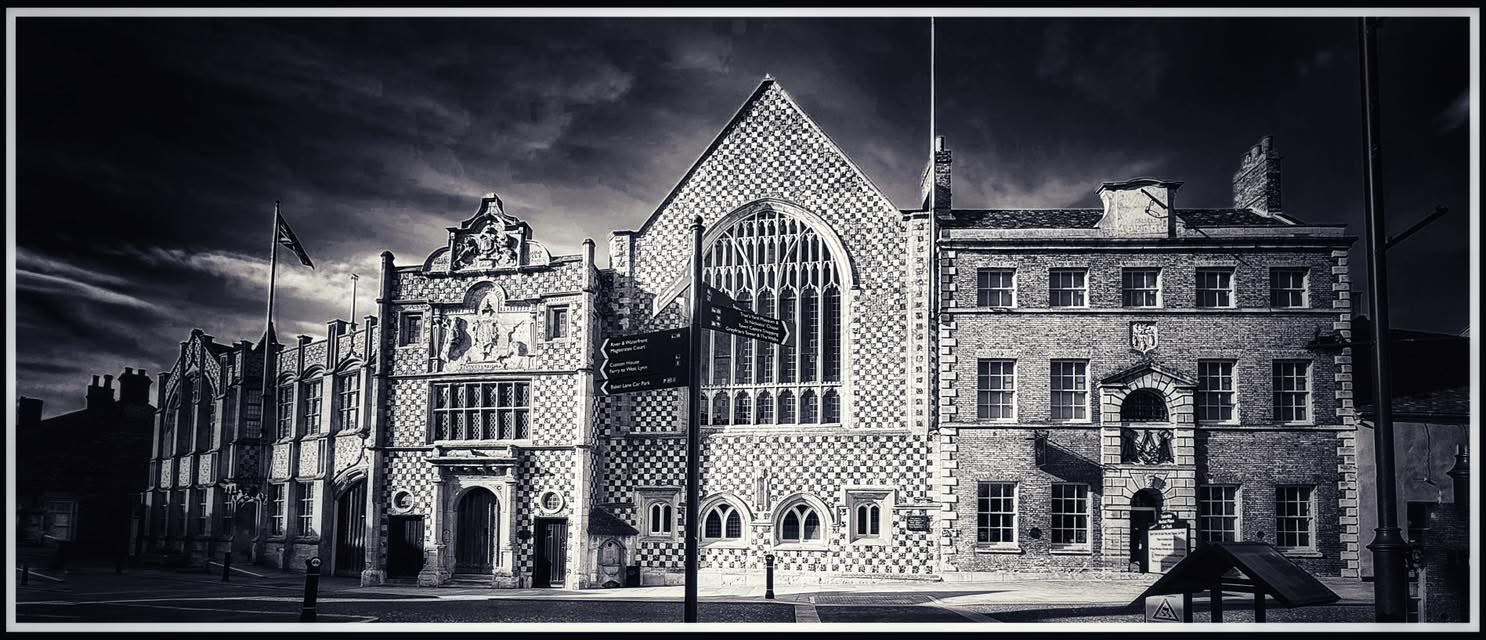

There is a curious mark on the brickwork of the Tuesday Market Place which generations of Lynn people have known as the Witch’s Heart. According to the story, it was made in 1590 when a woman called Margaret Read was burned for witchcraft. As the flames consumed her, her heart burst from her body, struck the wall and left its permanent impression in the brickwork. In some versions it then bounced down towards Page Stair Street and plunged into the river, making the water boil. It is one of those wonderfully gruesome local stories that seems to connect a surviving feature of the town directly with its Tudor past. There is only one substantial problem. The brick façade on which the heart appears was built about 1720, roughly 130 years after Margaret was supposedly executed.
Margaret Read is not, however, simply a modern invention. A woman of that name really does appear in the historical record as an alleged Lynn witch. Twenty-six years after her supposed death, another Lynn woman, Mary Smith, was certainly prosecuted for witchcraft and executed. Yet the evidence for the two women could hardly be more different. Margaret emerges from a single sentence written nearly 150 years after the event and then disappears into folklore. Mary is the subject of an extraordinary book published in the year of her execution, which describes her quarrels, her alleged victims, the accusations against her and her final confession. Together, their stories take us from legend into the darker reality of what could happen when illness, neighbourhood hostility and a belief in supernatural evil combined in early modern Lynn.
Margaret Read: eleven words and a legend
The earliest firm reference yet found to Margaret comes from Benjamin Mackerell’s History and Antiquities of the Flourishing Corporation of King’s-Lynn, published in 1738. In his chronological list of events, under the year 1590, he wrote simply: “One Margaret Read was this Year Burnt at Lynn for Witchcraft.” Those eleven words are the historical foundation on which the enormous later structure of the Margaret Read legend has been built. Mackerell supplied no age, occupation or address, named no accuser and described no crime. He did not identify the court which convicted her or say where she died. Most frustratingly, he did not tell his readers where he obtained the information.
Mackerell was not merely compiling old stories overheard around Lynn. He had access to the borough’s records and used documentary material that may subsequently have disappeared, so his statement deserves to be taken seriously. Unfortunately, the surviving borough quarter sessions records begin only in 1620. If Margaret’s trial had been recorded in an earlier series, it has been lost. Nor has a surviving assize record yet been identified. Parish registers offer tantalising possibilities without solving the problem. A Margrett Read was baptised at St Margaret’s on 25 March 1568 and would have been about twenty-two in 1590. Another Margaret, originally Margaret Hammond, had married Thomas Read in 1562. Either might conceivably have been Mackerell’s woman, or neither might. Read, Reed and Reade were interchangeable spellings in an age before surnames were standardised, which makes the search still harder.
There is another difficulty hidden inside Mackerell’s tiny entry. English witches were normally hanged, not burned. Under the Witchcraft Act of 1563, causing another person’s death through witchcraft could be punished as a felony, but the usual execution for felony was hanging. Burning was associated particularly with heresy and certain forms of treason. A woman who murdered her husband, or a servant who murdered an employer, could be convicted of petty treason and burned. Intriguingly, Lynn also possessed a tradition about a maidservant burned after killing her mistress. Perhaps that story and Margaret’s became entangled. Margaret might have been hanged and later memory supplied the flames. Mackerell could have misunderstood an older record, or two different executions might eventually have become one story. None of these explanations can yet be proved.
From Margaret Read to “Shady Meg”
What happened next is much easier to see. Where the historical record was almost silent, folklore supplied the missing biography. Margaret became “Shady Meg”. Later versions gave her an aunt called Agnes Shipwell, enemies named Marion Harvey and Nick Kirk, a magical poppet, a ducking and, eventually, a precise execution date of 20 July 1590. None of these details appears in Mackerell’s account, and no contemporary evidence for them has yet been identified. Their very precision makes them seductive. A named enemy and an exact July date sound as though someone has consulted a trial record, when no such record is known to survive.
The Witch’s Heart became the physical proof around which the story could gather. The building now numbered 15–16 Tuesday Market Place contains an early sixteenth-century core, so there was certainly a structure on or around the site in Tudor times. Historic England, however, dates its unified brick façade to about 1720. The visible heart therefore cannot have been created by something striking the present wall in 1590. Its real purpose is uncertain. It may have been decorative, perhaps some form of protective or apotropaic device, or it may have been added after the Margaret Read story had begun circulating. What can be ruled out is the literal explanation offered by the legend.
This does not make the Witch’s Heart historically uninteresting. Quite the opposite. It shows how a town remembers its past. Mackerell left Lynn with a woman, a year, an accusation and a horrific punishment. Later generations supplied personality, motive, scenery and supernatural spectacle. The Tuesday Market Place, a genuine setting for public ceremony and punishment, provided the perfect stage. A strange mark on an old building supplied something that could be pointed out to children and visitors. Margaret Read gradually became more vivid as the evidence for the real woman became more remote.
Mary Smith takes us into a very different world.
Mary Smith and the ordinary beginnings of a witch hunt
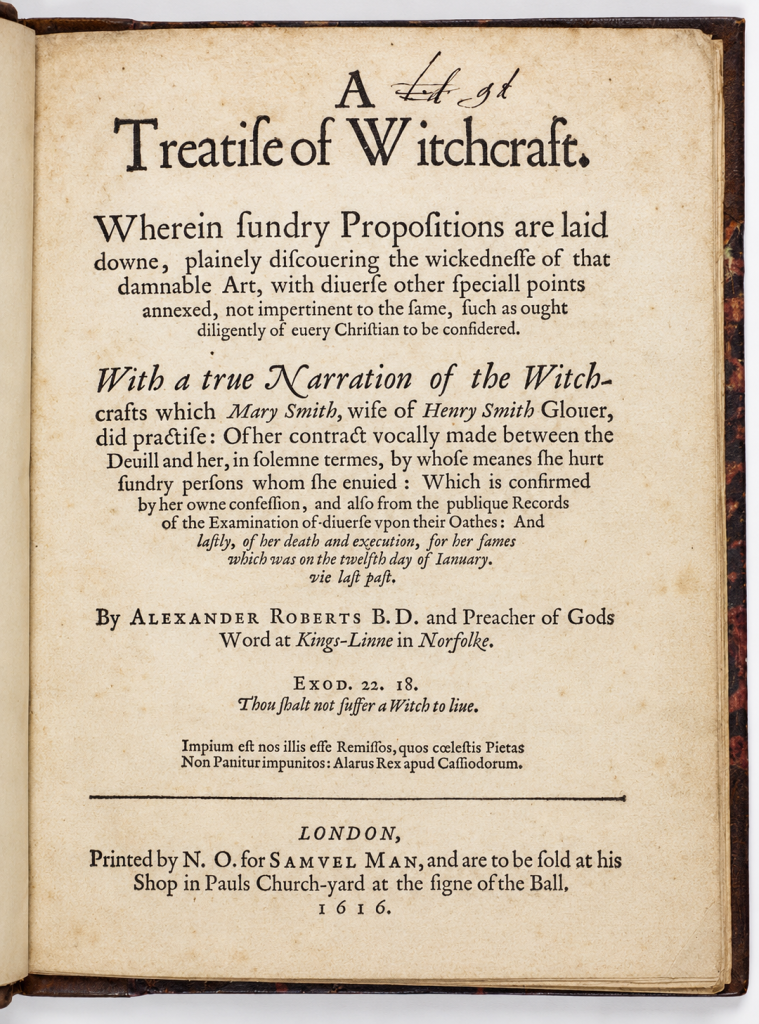
Mary Smith was executed in January 1616. Unlike Margaret, she can be seen in considerable detail because the Lynn clergyman Alexander Roberts published A Treatise of Witchcraft in the same year. Roberts identified her as the wife of Henry Smith, a glover, and described Mary herself as buying and selling cheese. She therefore belonged firmly within the working commercial community of the port. She was not an isolated old woman living beyond the edge of the town. Her disputes arose among sailors, servants, craftspeople and small traders whose lives crossed continually in Lynn’s streets, shops and houses.
Roberts gives us an unusually rich account, but he is also a dangerous witness. He believed absolutely in witches and demons. His book was produced at the request of Lynn’s civic authorities and was intended to demonstrate that Mary’s prosecution had been justified. He regarded women as especially vulnerable to Satan because he believed them more emotional, credulous and uncontrolled in their speech than men. He also took part in the religious questioning that preceded Mary’s final confession. We therefore possess something much better than folklore, but not an impartial trial report. Almost everything we know about Mary has passed through the hands of a man convinced of her guilt.
Strip away Roberts’s demonology and the beginnings of the case are strikingly commonplace. Mary quarrelled with people. She became angry, spoke harshly and sometimes cursed them. Later, something unpleasant happened to the person with whom she had quarrelled. In a society in which supernatural causation was widely accepted, the sequence could appear compelling. The curse was remembered because the illness followed it.
One alleged victim was John Orkton, a sailor recently returned from Holland, who had struck Mary’s son for some unspecified misconduct. Mary was understandably angry and was said to have wished that Orkton’s fingers might rot. He subsequently became seriously ill. The flesh of his fingers deteriorated, some were amputated and his toes were also affected. Roberts saw the fulfilment of a curse. Four centuries later, infection, gangrene or some other physical disease may seem more plausible, although the evidence is far too poor for a diagnosis. What stands out is Roberts’s treatment of the original quarrel. He regarded Orkton’s striking of Mary’s son as trivial, while Mary’s angry response became evidence of malignant character.
Other accusations developed in much the same way. Elizabeth Hancock, a widow who later married James Scot, became involved in a quarrel after Mary accused her of stealing one of the Smiths’ hens. Mary allegedly wished that the hen’s bones would stick in Elizabeth’s throat, after which Elizabeth experienced pain, weakness and prolonged fits. Her father, Edward Drake, did something that reveals how deeply magical thinking penetrated everyday life. He consulted a practitioner who prescribed a remedy involving flour mixed with Elizabeth’s urine and baked into a cake. Parts of the preparation were then applied to her body with ointment, powder and written words. This was counter-magic, intended to expose the witch or turn the spell back upon her. Roberts thoroughly disapproved. From his clerical perspective, a cunning man who claimed to cure witchcraft was drawing upon the same forbidden powers as the witch herself. Elizabeth’s family was less interested in theological distinctions. They wanted her to recover.
Soon a large cat was repeatedly appearing at Elizabeth’s house. Her husband attacked it, but it escaped despite the building supposedly being secured. In an atmosphere already saturated with suspicion, the animal ceased to be simply a cat. It became Mary’s familiar spirit, or perhaps Mary herself in animal form. A neighbour’s quarrel, an illness and an inconvenient animal were being assembled into a coherent supernatural story.
A fat-tailed sow, a toad and some Holland cheese
The accusations continued. Cicely Balye, a servant in Robert Coulton’s household, quarrelled with Mary while sweeping the street outside her employer’s house. Mary criticised her work and called her a “great fat-tailed sow”, adding that her fatness would soon be pulled down. That night Cicely experienced a terrifying sensation of pressure on her chest and believed that a cat, or Mary in the form of a cat, was sitting upon her. She struggled to breathe and later suffered a wasting illness. Her nocturnal experience resembles what we now call sleep paralysis, during which someone may awaken unable to move, experience pressure on the chest and sense a threatening presence in the room. We cannot diagnose Cicely retrospectively, but her account provides a striking example of how a genuine and frightening physical experience could be interpreted through the expectations of her time. She later watched Mary through a partition and saw her kneeling and murmuring. Once Mary was regarded as a witch, even an ambiguous domestic scene could become evidence of spell-casting.
The story of Edmund Newton brings us particularly close to the commercial life of Lynn. Newton was a shoemaker who also dealt in Holland cheese, and Roberts claimed that Mary resented the profits he made from the trade in which she herself participated. Newton became ill and reported a bewildering collection of supernatural visitors. A small bearded figure offered to cure his leg but appeared to have cloven feet. Toads and crab-like creatures were interpreted as Mary’s familiars. When a servant burned one of the toads, Mary was supposedly afflicted at the same moment, neatly confirming the belief that injury to a familiar would rebound upon its witch.
It sounds like a world far removed from ordinary life, yet Roberts’s narrative is full of recognisable Lynn details. John Orkton returned from Holland. Mary and Edmund Newton traded in Holland cheese. Craftspeople supplemented their occupations through petty commerce, servants worked in houses where neighbours could see and hear one another, and disputes spilled into the street. This was a port connected with the North Sea trading world, but at neighbourhood level reputations were made among people living close together. A disagreement about the price of cheese or the theft of a hen could be remembered long after the original quarrel if illness followed.
The accusations also became self-reinforcing. Once several people believed Mary had harmed them, the next unexplained illness no longer stood alone. It joined a growing body of apparent evidence. Earlier arguments could be reconsidered and given new significance. Animals behaved suspiciously. Words acquired supernatural force. Coincidence became causation. There must have been occasions when Mary cursed someone and nothing happened, but those failures had no reason to enter Roberts’s book. The apparent successes were remembered.
Mary, the Devil and the gallows
Roberts claimed that Mary eventually confessed to entering into a pact with the Devil. She described a dark human figure who promised revenge upon her enemies if she would renounce God and accept his assistance. Other supernatural appearances supposedly took the form of a fireball and a horned creature. Such descriptions fitted comfortably within the demonological ideas already circulating in early seventeenth-century England, which makes it difficult to know how much originated with Mary and how much was shaped by the expectations of the men questioning her.
The circumstances of the confession deserve particular attention. Mary had already been convicted and sentenced to death. Roberts and several other clergymen repeatedly visited her in prison, urging her to confess and prepare herself for execution. Roberts maintained that she spoke voluntarily. That may be true in the narrow sense that there is no evidence she was physically tortured. Yet a condemned woman, surrounded by ministers who believed she had served Satan and who presented confession as the road to Christian forgiveness, was hardly speaking in neutral circumstances. Mary may eventually have accepted their interpretation of events. She may have adopted their language because she hoped to die reconciled to God, or she may simply have understood that denial could no longer save her life.
On 12 January 1616 Mary was taken to the place of execution. Roberts described a large crowd and recorded that she repeated her confession before asking for “The Lamentation of a Sinner” to be sung. He did not clearly state how she died or identify the location. Mackerell, writing in 1738, supplied the first point when he recorded that Mary Smith had been “hang’d at Lynn for Witchcraft”. Hanging accords with English legal practice and is much more credible than later accounts claiming that Mary was burned, probably through confusion with Margaret Read. The Tuesday Market Place is sometimes given as the place of Mary’s execution, but Roberts did not say so. Unless further evidence appears, the location should remain uncertain.
Two witches, or two stories about women?
Margaret Read and Mary Smith have often been drawn together under the convenient heading of the “Witches of Lynn”, but historically they present almost opposite problems. With Margaret, we have very little evidence and an abundance of story. With Mary, we have an abundance of evidence, but almost all of it was assembled by men who had already decided what that evidence meant.
Margaret may indeed have been executed in 1590. Mackerell’s access to Lynn’s records means his terse statement cannot be brushed aside, but the famous details surrounding Shady Meg are later additions and the Witch’s Heart cannot have been created in the manner described. Mary Smith certainly faced a witchcraft prosecution and almost certainly died on the gallows in 1616. Yet Roberts’s detailed narrative does not prove that she possessed supernatural powers. It shows how readily ordinary misfortunes could become evidence once a community had identified the person it believed responsible.
There is something particularly poignant in how little either woman speaks for herself. Margaret has almost disappeared behind an exploding heart and a nickname that may have been invented centuries after her death. Mary appears much more clearly, but largely through the words of the clergyman who believed she was a witch and helped persuade her to confess. Behind Roberts’s devils, cats and toads we can occasionally glimpse another Mary: a glover’s wife trying to make money from cheese, angry when a sailor struck her son, quarrelling with neighbours and apparently capable of a formidable insult.
The supernatural stories belong to their age. The fear, hostility and consequences were painfully real.
© James Rye 2026
Book a Guided Tour with a Trained and Qualified King’s Lynn Guide Through Historic Lynn
References
- Gaskill, Malcolm. Crime and Mentalities in Early Modern England. Cambridge: Cambridge University Press, 2000.
- Hillen, Henry J. History of the Borough of King’s Lynn. Vol. 2. Norwich: East of England Newspaper Company, 1907. https://archive.org/details/historyofborough02hill
- Historic England. “15 and 16 Tuesday Market Place, King’s Lynn.” National Heritage List for England, List Entry 1212298. https://historicengland.org.uk/listing/the-list/list-entry/1212298
- Mackerell, Benjamin. The History and Antiquities of the Flourishing Corporation of King’s-Lynn in the County of Norfolk. London: E. Cave, 1738. https://archive.org/details/historyandantiq00mackgoog
- Norfolk Record Office. “The Witches of Lynn.” Norfolk Record Office Blog, 31 October 2018. https://norfolkrecordofficeblog.org/2018/10/31/the-witches-of-lynn/
- Roberts, Alexander. A Treatise of Witchcraft: Wherein Sundry Propositions Are Laid Downe. London: N. O. for Samuel Man, 1616. https://www.gutenberg.org/files/17209/17209-h/17209-h.htm
- Sharpe, James. Instruments of Darkness: Witchcraft in Early Modern England. London: Hamish Hamilton, 1996.